Trang An Landscape Complex: Vietnam's First UNESCO Dual World Heritage Site
Trang An Landscape Complex in Ninh Binh is Vietnam's first site recognized by UNESCO for both its natural and cultural values. Visitors explore a labyrinth of limestone karsts, river caves, and centuries-old temples by flat-bottomed rowboat, in one of northern Vietnam's most atmospheric landscapes.
Quick Facts
- Location
- Trang An, Ninh Binh Province, approximately 90 km south of Hanoi
- Getting There
- From Hanoi: bus or train to Ninh Binh city, then taxi or xe om (motorbike taxi) to the complex. Journey takes roughly 2 hours each way.
- Time Needed
- Half day minimum; full day recommended if combining multiple boat routes
- Cost
- Ticket prices are subject to change; verify current rates at the official ticket offices on-site before boarding
- Best for
- Nature lovers, history seekers, photographers, families, and those seeking calm away from city noise
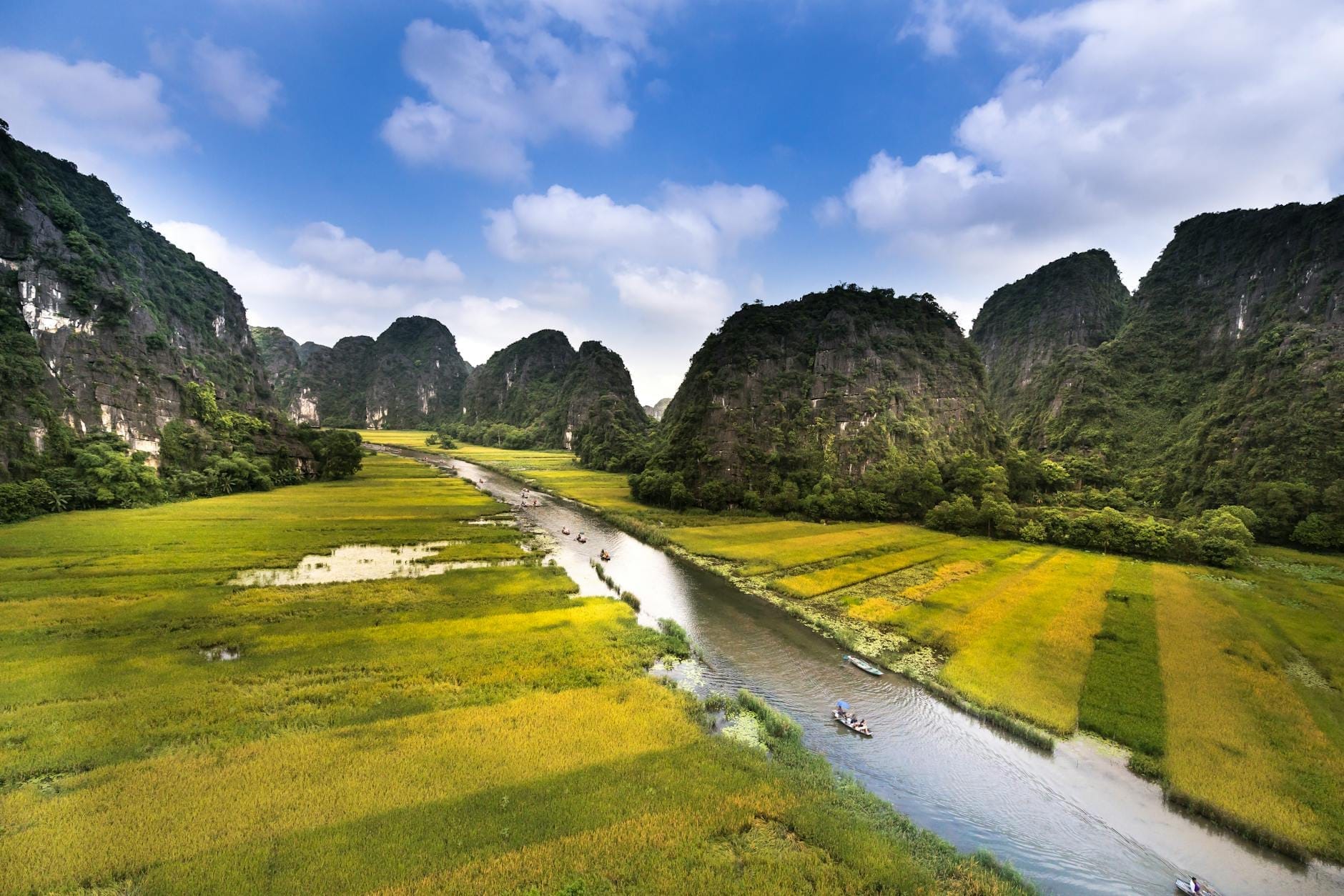
What the Trang An Landscape Complex Actually Is
The Trang An Landscape Complex is a sprawling geopark of flooded limestone karst valleys in Ninh Binh Province. In 2014, UNESCO inscribed it as a World Heritage Site under both natural and cultural criteria, making it the first site in Vietnam to hold that dual distinction. The natural portion protects some of the oldest and most intact limestone karst formations in Southeast Asia, shaped over tens of millions of years. The cultural layer runs just as deep: archaeological evidence places human habitation here as far back as 30,000 years, and the surrounding hills once formed the defensive perimeter of Hoa Lu, the capital of Dai Co Viet, Vietnam's first independent state in the 10th and 11th centuries CE.
The complex is divided into three main scenic areas: Trang An, Tam Coc-Bich Dong, and Hoa Lu. Each offers a different experience, but all share the same basic format: low wooden rowboats, narrow river passages cutting through sheer karst walls, and cave tunnels that plunge you briefly into darkness before opening onto another flooded valley. Visiting Trang An is not a hike or a museum visit. It is a slow, almost meditative experience governed entirely by the pace of a rower's oar.
💡 Local tip
Arrive at the ticket office before 8:30 AM on weekdays to avoid queues at the boat dock. Weekends and Vietnamese public holidays draw large domestic crowds, and wait times for a boat can stretch to over an hour by mid-morning.
The Boat Journey: What You Will See and Feel
Once you board a flat-bottomed wooden rowboat, the scale of the landscape becomes immediately apparent. Limestone cliffs rise 100 meters or more directly from the water's surface, their faces streaked with moisture and draped in ferns and creeping vines. Egrets stand motionless on exposed rocks. The sound of traffic and commerce vanishes almost instantly, replaced by the rhythmic dip of oars and the occasional call of a bird echoing off stone walls.
Most boat routes pass through between three and nine cave tunnels, depending on which circuit you choose. Inside the caves, your eyes adjust to near-total darkness, broken only by the pale light at each exit. Some tunnels run 100 meters or more, and the ceilings in places drop low enough that passengers instinctively lean back. The caves smell of cool mineral water and damp limestone, which is a particular, ancient scent that stays with you long after you leave. Between caves, the route opens into wide valley basins ringed by cliff walls, where lotus flowers grow in season and kingfishers cut across the water at low altitude.
The rowers, often local women, navigate using both oars and their feet when the tunnel walls narrow. It is worth watching this technique. It is efficient, practiced, and quietly impressive, developed over decades of guiding boats through passages that leave almost no room for error.
Tickets & tours
Live prices and dates from our booking partner. If you book, we may earn a commission at no extra cost to you.
Ninh Binh day tour with Hoa Lu, Trang An and Hang Mua from Hanoi
From 39 €Instant confirmationFree cancellationBai Dinh Pagoda and Trang an Eco-Tourism Full Day Tour
From 31 €Instant confirmationFree cancellationBat Trang village of ceramics half-day guided tour from Ha Noi
From 37 €Instant confirmationFree cancellationFull-Day Guided Tour of Hoa Lu, Trang An, and Mua Cave with Lunch
From 48 €Instant confirmationFree cancellation
Temples, Shrines, and the Cultural Layer
The boat routes link a series of ancient temples and shrines set against or directly into the karst walls. Phuc Khong Temple, Trinh Temple, and Tran Temple are among the significant stops on the Trang An circuit. These are active places of worship, not museum reconstructions, and visitors should dress modestly (covered shoulders and knees) and remove footwear where required. The temples honor figures from the Dinh and Le dynasties, which ruled from nearby Hoa Lu Ancient Capital in the 10th and 11th centuries. Standing inside one of these small pagodas while the smell of incense drifts out across the water gives the route a dimension that a pure nature tour would not.
If you have a full day in Ninh Binh, the temple stop at Bich Dong Pagoda within the broader complex is worth the short hike. The pagoda climbs a limestone hill in three tiers, and the upper level offers a clear view over the rice paddies and karst formations that define this part of the province. The climb is about 15 minutes and involves some steep stone steps, but the perspective from the top is unlike anything you get from the boat.
How the Experience Changes by Time of Day
Early morning is the most atmospheric time to be on the water. Between 7 and 9 AM, mist often sits in the valley basins, softening the cliff edges and giving the landscape a quality closer to traditional ink painting than anything you associate with a tourist attraction. Light enters the karst corridors at a low angle, and the relative quiet means you can hear the water, the birds, and almost nothing else.
By 10 AM on weekends, the boat docks fill with tour groups, and the cave passages can briefly resemble a traffic jam of wooden boats. The experience does not collapse under this pressure, the landscape is too large and too absorbing for that, but the serenity of early morning is replaced by something more social and considerably louder. Midday in summer brings strong heat that bounces off the limestone, and sun protection becomes genuinely important. A hat, sunscreen, and a light long-sleeved layer will make the difference between an enjoyable tour and an uncomfortable one.
Late afternoon light, roughly from 3 PM onward, is excellent for photography. The shadows lengthen on the cliff walls and the golden tones pick up the moss and limestone textures in a way that flat midday light does not. If you can time your boat departure to be on the water by 3:30 PM, the return leg often produces the best images of the day.
⚠️ What to skip
Trang An's cave tunnels mean your boat will be in complete or near-complete darkness for stretches. Cameras and phones should be secured, and loose items kept inside a bag or held firmly. Water can enter the boat in low-clearance passages.
Getting There from Hanoi
Trang An sits roughly 90 km south of Hanoi, making it one of the most practical day trips from Hanoi. The most common approach is the train from Hanoi's Ga Ha Noi station to Ninh Binh station, a journey of roughly two hours. Trains run multiple times daily and are more comfortable and reliable than buses on this route, though buses from My Dinh bus terminal are also available and slightly cheaper. From Ninh Binh station, a taxi or xe om to the Trang An boat dock takes 15 to 20 minutes.
Organized day tours from Hanoi are widely available and include transport, a guide, and sometimes lunch. These are a reasonable option if you want the logistics handled, but they typically follow a fixed schedule and may combine Trang An with other Ninh Binh stops in ways that feel rushed. If your priority is time on the water and genuine quiet, arriving independently and choosing your own departure time gives you more control.
Those planning more time in the region should consider staying overnight in Ninh Binh town or nearby Tam Coc village. The area rewards slower exploration, and spreading the complex's main sites across two days, particularly if you plan to visit both Trang An and Tam Coc, is more satisfying than rushing through both in a single day. For context on planning your time in the north, the Hanoi itinerary guide covers how Ninh Binh fits into a broader northern Vietnam trip.
Honest Assessment: What Works and What Does Not
Trang An deserves its UNESCO status and its reputation. The landscape is genuinely extraordinary, the caves are memorable, and the cultural sites add real depth to what could otherwise be a purely scenic boat ride. On a quiet weekday morning in October or November, with mist on the water and the birds active, it is among the most absorbing natural experiences in northern Vietnam.
That said, the site has grown considerably in commercial infrastructure since its UNESCO inscription. The main dock area involves a walk through souvenir stalls and food vendors before you reach the boats. The souvenir pressure is not aggressive, but the transition from commercial zone to pristine landscape is abrupt rather than gradual. Some visitors also find the tipping expectation from rowers at the end of the tour unclear; having small VND notes ready avoids an awkward ending to an otherwise beautiful journey.
Travelers who strongly dislike slow-paced, low-stimulation activities may find the boat tour longer than expected. The experience rewards patience and observation. If you are looking for something active, an ascent to Mua Cave viewpoint nearby offers a sharply different physical challenge and an aerial perspective over the same landscape. Those with mobility limitations should be aware that boarding and exiting the low wooden boats can be physically demanding, particularly at busier docks where boats move with the current.
ℹ️ Good to know
Lotus flowers bloom in the valley basins roughly from May through July, adding vivid pink and white color to the water between cave passages. This is one of the most photogenic periods to visit, though it coincides with warmer, occasionally rainy weather. Carry a light waterproof layer.
Seasons and Weather: When to Go
The optimal months to visit Trang An are September through November, when temperatures cool after the summer rains, skies clear, and the rice paddies in the surrounding valleys turn golden before harvest. This aligns with general advice on the best time to visit Hanoi and the northern region overall. March and April are also good: warm but not yet punishing, and the vegetation along the cliff walls is at its most intensely green after the winter moisture.
Summer months (June through August) bring heat and occasional heavy rain. The caves remain cool regardless of outside temperature, which makes the tunnels a relief during hot weather, but the approach to the docks and the open valley sections can be uncomfortable at midday. Winter (December through February) brings cool, sometimes grey and misty conditions that suit the landscape aesthetically but may feel cold on the water without a windproof layer.
Insider Tips
- Choose the longest available boat circuit if time allows. Shorter routes cover fewer caves and miss some of the more remote valley basins that the full circuit reaches. Ask at the ticket office which route passes through the most cave tunnels.
- Bring small denomination Vietnamese Dong notes separately from your main wallet. Tipping rowers at the end of the tour is customary and genuinely appreciated; having the cash ready avoids fumbling at the dock.
- The life jackets provided are mandatory and non-negotiable, but they can feel bulky in low-clearance cave passages. Wear fitted clothing rather than a bulky jacket underneath so the vest sits properly.
- If you visit in the rice harvest season (roughly September to October), look for the paddies on the approach road to the complex. Stopping briefly on the way back to Ninh Binh town for photographs of harvesters against the karst backdrop is one of the most rewarding moments in the entire area.
- Photography inside the dark cave tunnels requires either a fast lens (f/1.8 or wider) or a camera with strong high-ISO performance. Phone cameras with night mode work better than expected if held steady, but bring a small grip or lean the phone against the boat's edge.
Who Is Trang An Landscape Complex For?
- Nature photographers looking for dramatic limestone karst landscapes and reflective water
- History and archaeology enthusiasts interested in Vietnam's early dynastic period and prehistoric habitation
- Families with older children who can sit calmly in a small boat for 2 to 3 hours
- Travelers seeking a full-day escape from Hanoi's pace without an overnight trip
- Couples looking for an immersive, quiet experience in an extraordinary natural setting
Nearby Attractions
Other things to see while in Ninh Bình:
- Bích Động Pagoda
Bích Động Pagoda is a three-tiered Buddhist temple complex built directly into a karst cliff in Ninh Bình province, roughly 100 km south of Hanoi. Originating in 1428 with major reconstruction in the early 18th century, it layers religious history, natural drama, and river scenery into one of northern Vietnam's most rewarding half-day excursions.
- Hoa Lư Ancient Capital
Hoa Lư was Vietnam's first independent imperial capital, established in 968 AD among dramatic limestone karst formations in what is now Ninh Bình province. Two surviving temple complexes dedicated to the Đinh and Lê dynasties stand where palaces once rose, making this one of the most historically significant sites in northern Vietnam.
- Mua Cave & Hang Mua Peak
Hang Mua Peak, the high point of the Mua Cave complex in Ninh Binh, rewards a steep 500-step ascent with an uninterrupted 360-degree panorama over rice paddies, karst limestone mountains, and the winding Ngo Dong River. It is one of the most photogenic viewpoints in northern Vietnam, and one of the most honest: the views genuinely deliver.
- Tam Coc
Tam Coc draws visitors with its slow boat rides through three natural limestone caves, surrounded by flooded rice paddies and vertical karst peaks. It sits at the heart of Ninh Binh province, about 100 km south of Hanoi, and pairs well with nearby temples and cycling routes.
Planning a trip? Discover personalized activities with the Nomado app.