Bích Động Pagoda: The Cave Temple Hidden Inside a Limestone Mountain
Bích Động Pagoda is a three-tiered Buddhist temple complex built directly into a karst cliff in Ninh Bình province, roughly 100 km south of Hanoi. Originating in 1428 with major reconstruction in the early 18th century, it layers religious history, natural drama, and river scenery into one of northern Vietnam's most rewarding half-day excursions.
Quick Facts
- Location
- Tam Cốc, Hoa Lư District, Ninh Bình Province, Vietnam
- Getting There
- Approx. 100 km from Hanoi; accessible by bus to Ninh Bình city, then motorbike taxi or bicycle from Tam Cốc village
- Time Needed
- 1.5 to 2.5 hours (pagoda only); pair with a Tam Cốc boat trip for a full half-day
- Cost
- Entry is typically included in Tam Cốc area tickets; verify current rates at the site entrance as prices are subject to change
- Best for
- Temple history, karst landscape photography, peaceful morning visits, day trips from Hanoi
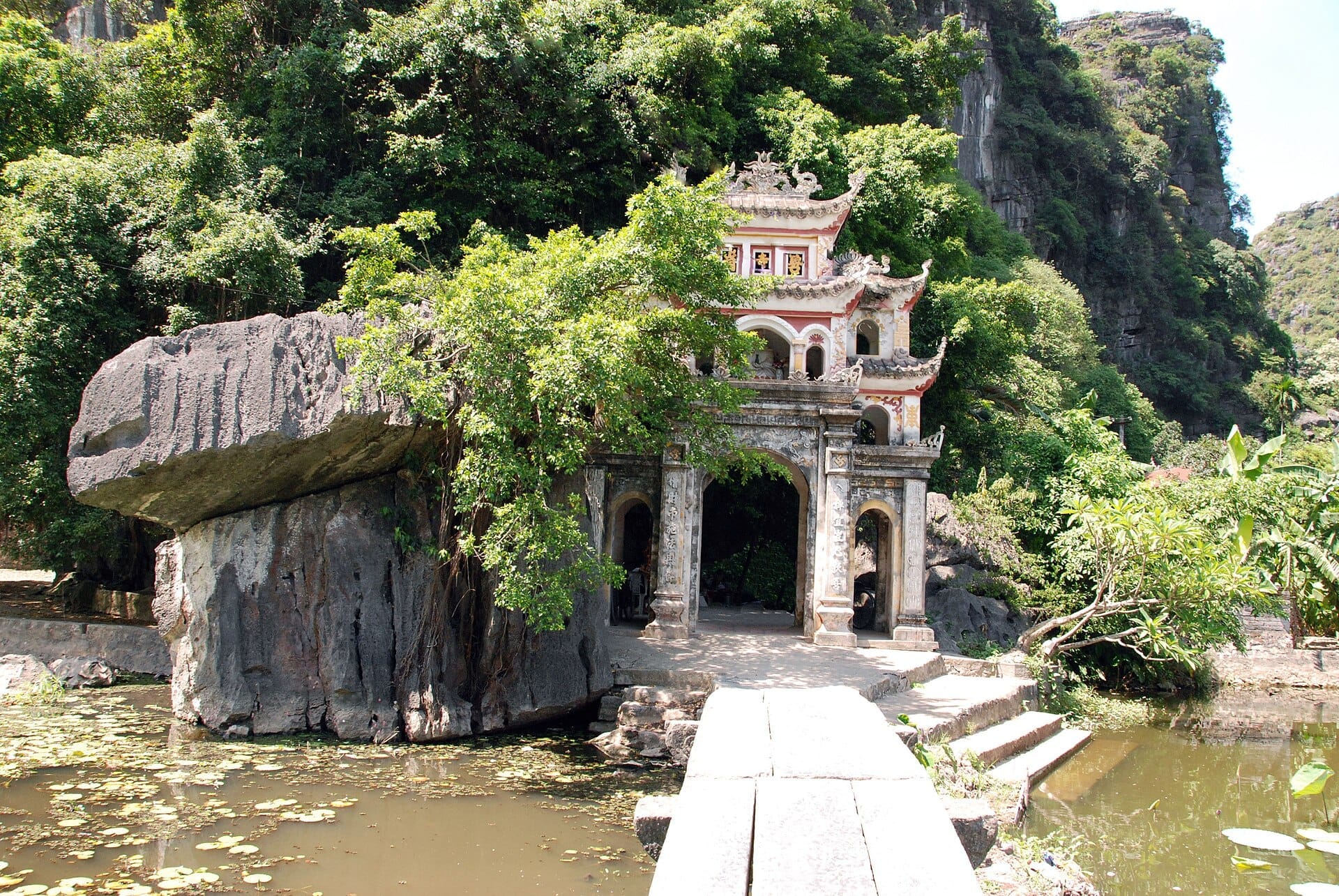
What Bích Động Pagoda Actually Is
Bích Động Pagoda is not a single building. It is a vertical sequence of three separate shrines, each positioned at a different elevation inside and against a limestone karst cliff. The lowest level sits at the base of the rock face, the middle shrine is set inside a cave chamber, and the uppermost altar occupies a second, smaller cave near the cliff summit. Climbing between them takes around 20 to 30 minutes and involves stone steps cut directly into the rock.
The complex originated in 1428 as a small pagoda, but was rediscovered and reconstructed into three levels in 1705 by two monks during the Trịnh lords period, with structures visible today largely from that early 18th century restoration. The name Bích Động translates roughly as 'azure cave,' a reference to the blue-green algae and mosses that coat the limestone walls during the wet season, giving the interior a cool, dim, and distinctly geological character unlike any urban pagoda.
💡 Local tip
Arrive before 8:30 am to have the cave shrines largely to yourself. Tour groups from Tam Cốc boat trips typically arrive mid-morning, and the narrow cave passages become congested quickly.
The Approach: River, Rice Fields, and Stone Gateway
Most visitors reach Bích Động by bicycle or motorbike from Tam Cốc village, following a flat road through rice paddies with the Trường Yên karst range rising sharply ahead. The 2 km ride from the main Tam Cốc boat landing takes about 10 minutes and passes through farmland that floods to ankle depth during the summer wet season, June through August, turning the surrounding fields into mirrors that reflect the peaks.
The entrance area includes a stone gate and a small courtyard with a pond. A footbridge crosses the pond, and from here the cliff face is directly in front of you, far larger than it appeared from the road. If you are combining this visit with a boat trip on the Ngũ Nhạc River through Tam Cốc's tunnel caves, note that the pagoda and the boat landing are separate ticketing points. See the full planning context in the Tam Cốc guide for how to sequence both in one morning.
Tickets & tours
Live prices and dates from our booking partner. If you book, we may earn a commission at no extra cost to you.
Bai Dinh Pagoda and Trang an Eco-Tourism Full Day Tour
From 31 €Instant confirmationFree cancellationFull-Day Tour to Hanoi Perfume Pagoda with Lunch and Boat Ride
From 59 €Instant confirmationBai Dinh Pagoda, Mua Cave and Trang An Guided Tour with Buffet Lunch
From 36 €Instant confirmationFree cancellationBoat trip to Perfume Pagoda and cable car to Huong Tich Cave from Ha Noi
From 88 €Instant confirmationFree cancellation
Climbing the Three Levels: What You Find at Each
Lower Pagoda (Chùa Hạ)
The lower pagoda is a small, free-standing structure at the cliff base, the most conventionally temple-like of the three. It holds several Buddha statues and burns incense continuously. The smell of sandalwood is noticeable as soon as you cross the threshold, mixing with the damp mineral scent of the nearby rock. Morning light catches the gilded statues from an angle that midday sun misses entirely, which is one practical reason the early-morning timing matters.
Middle Pagoda (Chùa Trung)
Stone steps, uneven and worn smooth by decades of foot traffic, lead up from the lower courtyard into the cave mouth. The middle pagoda occupies a genuine cave chamber, high-ceilinged and cool even in July, when temperatures outside hover around 34°C. Natural light enters through the cave opening, and the mix of dim interior and bright exterior makes photography technically challenging without a wide aperture or a phone camera that handles mixed exposure well. The altar inside is modest but maintained actively by resident monks.
The cave walls show water erosion patterns and stalactite formations above the altar. Touching the formations is discouraged and, in some passages, prohibited by signage. The floor can be slippery after rain, and the passage narrows significantly toward the rear of the chamber.
Upper Pagoda (Chùa Thượng)
The climb to the upper pagoda is the steepest section, involving a series of stone steps and one short, low passage where taller visitors need to duck. The reward is an elevated cave shrine with an opening that frames the valley below, showing a green patchwork of rice paddies, the river channel, and the karst peaks of the surrounding landscape. This viewpoint is the reason serious landscape photographers specifically come to Bích Động rather than stopping only at Tam Cốc. On clear mornings in October and November, low mist sits in the valley below this opening, and the light is usable from around 7 am.
⚠️ What to skip
The steps between all three levels are steep and uneven. Sandals or flat-soled shoes with no grip are genuinely unsafe on wet stone. Wear closed shoes or sandals with rubber soles. The climb is not suitable for visitors with significant mobility limitations.
Historical and Cultural Context
Ninh Bình province holds some of the densest concentrations of historical Buddhist sites in northern Vietnam, partly because the Đinh and Early Lê dynasties established their capital at Hoa Lư in the 10th century, only a few kilometers from here. The region remained politically significant through successive Vietnamese dynasties, and the karst topography made it both defensible and spiritually resonant. The Lê dynasty's long administrative reach shaped many of the religious sites that survive in this landscape today.
Bích Động sits within easy reach of Hoa Lư's ancient royal citadel, and the two are often combined as a single day trip from Hanoi. The Hoa Lư Ancient Capital offers 10th-century temple architecture and a very different kind of historical atmosphere, making the pairing genuinely complementary rather than repetitive.
The Trịnh lords-era restoration of the 18th century reflects a broader pattern of elite patronage of Buddhist institutions across northern Vietnam during that period. The carved stone inscriptions on the cave walls at Bích Động include calligraphy attributed to Trịnh Sâm, though the authenticity of specific attributions is debated among historians. The inscriptions are visible but not labeled in English, so their significance is largely lost on visitors without a guide.
Practical Planning: Getting There and Timing
Hanoi to Ninh Bình takes approximately 2 hours by express bus from Giáp Bát or Mỹ Đình bus stations. Trains also run on the Hanoi to Ho Chi Minh City main line and stop at Ninh Bình station, with the journey taking roughly 2 to 2.5 hours. From Ninh Bình city center, Tam Cốc is about 7 km west, reachable by taxi, Grab, or arranged transport through most guesthouses.
Most travelers visit Bích Động as part of a day trip from Hanoi. The day trips from Hanoi guide covers transport logistics, realistic departure times, and how to structure the day to include both Bích Động and other sites in the Ninh Bình area without rushing.
Bicycle rentals are widely available at Tam Cốc guesthouses for around 30,000 to 50,000 VND per day (verify current rates locally), and the flat terrain between the village and the pagoda makes cycling a reasonable option for most fitness levels. Motorbike taxis operate from the Tam Cốc boat landing area and are faster but less common early in the morning.
ℹ️ Good to know
The best photographic conditions at Bích Động are in October and November (clear skies, lower humidity, possible morning mist in the valley) and in May, when the surrounding rice paddies are a saturated green. Avoid midday in June through August due to both heat and crowd peaks.
Who Gets the Most from This Visit, and Who Might Not
Bích Động works best for travelers who are genuinely interested in the intersection of religious architecture and natural landscape, or for photographers drawn to karst scenery with a human-made focal point. The physical requirement of climbing steep, irregular steps means the upper pagoda is not accessible for every visitor, and the experience is reduced if you can only reach the lower level.
Travelers who have already visited the Perfume Pagoda near Hanoi may find Bích Động smaller in scale and more straightforward, though Bích Động has a more intimate atmosphere and less commercial pressure. The Perfume Pagoda complex involves a longer boat journey and cable car; Bích Động is more compact and manageable within a half-day.
Visitors primarily interested in Buddhist art collections, museum-quality displays, or air-conditioned interiors will find little here beyond active religious use and natural scenery. Families with very young children should assess the stair situation honestly before committing to the full climb. The lower pagoda courtyard is accessible and worth seeing even if the upper sections are skipped.
If your primary goal is dramatic karst landscape from the water rather than on foot, the boat journey through Tràng An Landscape Complex offers caves and scenery from river level with no significant climbing, and is a UNESCO-listed site with different but comparable natural drama.
Insider Tips
- Go directly to the pagoda first before joining a Tam Cốc boat queue. Boat trips fill up by 9 am on weekends and in peak season (April to June, September to October). Visiting Bích Động at 7:30 am and then returning to the boat landing by 9:30 am puts you ahead of the main crowd wave.
- The cave entrance at the middle pagoda faces east-northeast. In the first two hours after sunrise, light enters the cave mouth at a low angle and briefly illuminates the altar directly. This window lasts only about 20 minutes and produces photographs that midday visitors simply cannot replicate.
- Bring a small torch or use your phone's flashlight in the upper cave passage. The area between the middle and upper pagodas has one section with very limited natural light, and the steps are uneven enough to make footing uncertain without additional light.
- Local guides at the Tam Cốc area typically charge 100,000 to 200,000 VND for a combined site tour (verify current rates). If the stone inscriptions and Buddhist iconography interest you, a guide who can read classical Vietnamese adds real interpretive value that no English signage currently provides.
- The stone courtyard at the entrance becomes genuinely hot between 11 am and 2 pm in summer. If you arrive during this window, move through quickly rather than lingering, and keep water with you. There are vendors near the entrance, but prices are higher than in Tam Cốc village.
Who Is Bích Động Pagoda For?
- Photographers focused on karst landscapes combined with religious architecture, especially in early morning or autumn light
- Travelers doing a full Ninh Bình day trip who want historical depth beyond the boat-and-caves circuit
- Buddhist temple enthusiasts interested in active, working cave shrines rather than museum-style religious sites
- Hikers comfortable with steep stone steps who want a physical element to their cultural sightseeing
- Day-trippers from Hanoi looking for a half-day anchor point that combines natural scenery and historical context
Nearby Attractions
Other things to see while in Ninh Bình:
- Hoa Lư Ancient Capital
Hoa Lư was Vietnam's first independent imperial capital, established in 968 AD among dramatic limestone karst formations in what is now Ninh Bình province. Two surviving temple complexes dedicated to the Đinh and Lê dynasties stand where palaces once rose, making this one of the most historically significant sites in northern Vietnam.
- Mua Cave & Hang Mua Peak
Hang Mua Peak, the high point of the Mua Cave complex in Ninh Binh, rewards a steep 500-step ascent with an uninterrupted 360-degree panorama over rice paddies, karst limestone mountains, and the winding Ngo Dong River. It is one of the most photogenic viewpoints in northern Vietnam, and one of the most honest: the views genuinely deliver.
- Tam Coc
Tam Coc draws visitors with its slow boat rides through three natural limestone caves, surrounded by flooded rice paddies and vertical karst peaks. It sits at the heart of Ninh Binh province, about 100 km south of Hanoi, and pairs well with nearby temples and cycling routes.
- Trang An Landscape Complex
Trang An Landscape Complex in Ninh Binh is Vietnam's first site recognized by UNESCO for both its natural and cultural values. Visitors explore a labyrinth of limestone karsts, river caves, and centuries-old temples by flat-bottomed rowboat, in one of northern Vietnam's most atmospheric landscapes.
Planning a trip? Discover personalized activities with the Nomado app.