Perfume Pagoda: Hanoi's Sacred Mountain Pilgrimage
The Perfume Pagoda is a sprawling complex of Buddhist shrines, limestone caves, and riverside temples carved into the Huong Tich mountain range, about 60 km (37 miles) southwest of Hanoi. Getting there is half the experience: a rowing boat along the Yen River, followed by a hike or cable car through forested cliffs to the main cave shrine. It is one of Vietnam's most important pilgrimage sites, drawing millions of devotees, particularly during the annual spring festival.
Quick Facts
- Location
- My Duc District, Hanoi, ~60 km southwest of the city centre
- Getting There
- Private car or organized tour from Hanoi (2-2.5 hrs); public buses available to Yen Wharf from Hanoi
- Time Needed
- Full day (6-8 hours including travel from Hanoi)
- Cost
- Entrance fee applies; additional costs for boat, cable car, and guided tours — verify current rates before visiting
- Best for
- Buddhist pilgrims, nature hikers, photographers, cultural travelers
What the Perfume Pagoda Actually Is
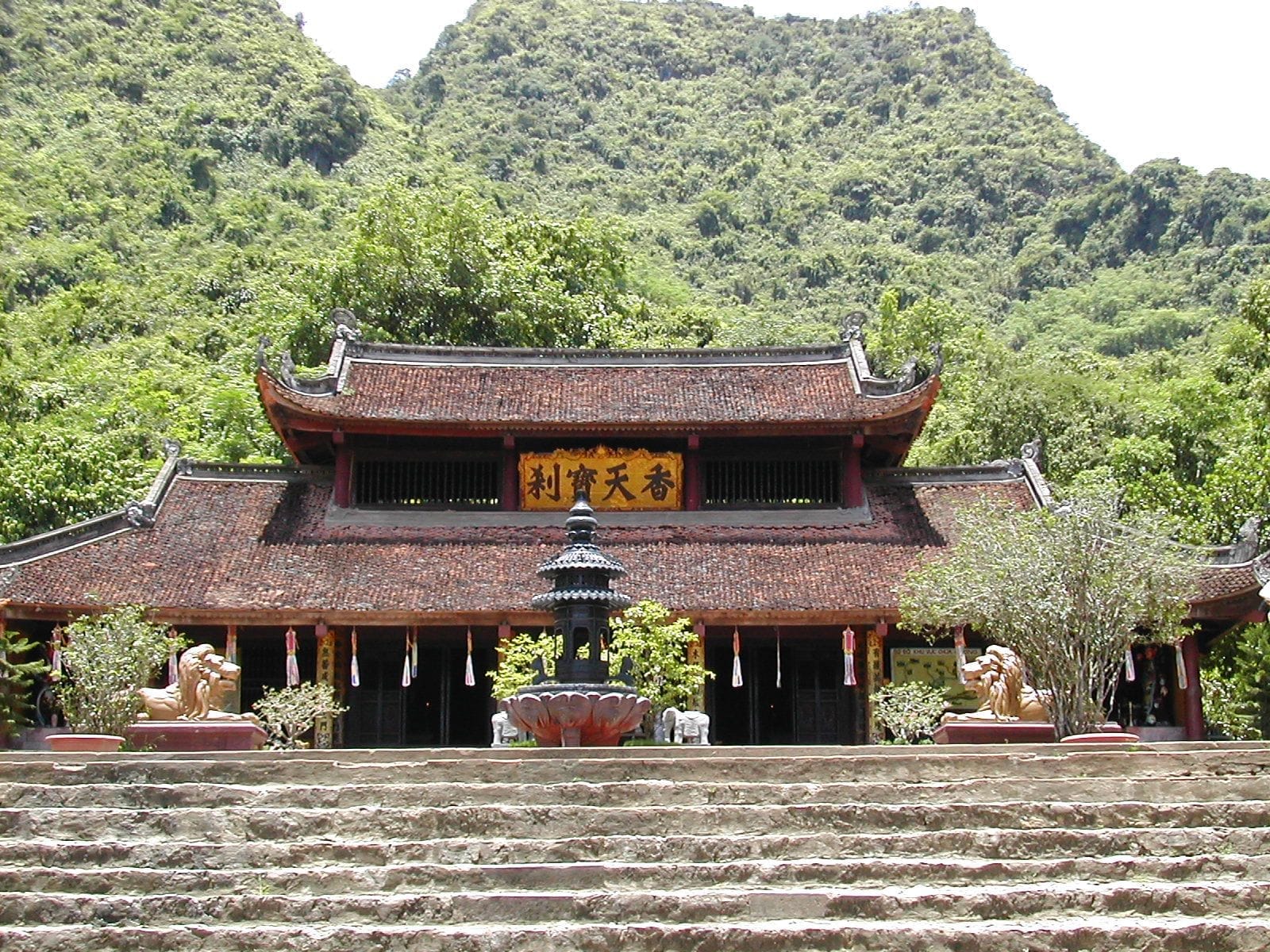
The name is slightly misleading. The Perfume Pagoda is not a single pagoda — it is a landscape complex of more than 20 temples, shrines, and cave sanctuaries spread across the Huong Son (Fragrant Traces) mountain range in My Duc District. The centerpiece is Huong Tich Cave, a vast limestone cavern deep inside the mountain that has been a site of Buddhist worship since at least the 17th century. The cave's Vietnamese name, Chua Huong, literally translates to Perfume Pagoda, and the scent of incense drifting through its cool, damp interior goes some way toward explaining why.
This is one of the most actively sacred destinations in northern Vietnam, drawing Buddhist pilgrims by the millions each year, particularly between January and March during the Perfume Pagoda Festival. On peak festival weekends, the atmosphere shifts from serene to overwhelming. Outside the festival season, the same trails and boat routes feel entirely different: quieter, greener, and considerably more contemplative.
ℹ️ Good to know
The Perfume Pagoda Festival typically runs from the first day of the first lunar month through the end of the third lunar month. This usually falls between late January and early April in the Gregorian calendar. Visiting during this period means peak crowds but also the full cultural spectacle of Vietnamese Buddhist pilgrimage.
The Boat Journey: Arrival on the Yen River
The journey begins at Yen Wharf, where flat-bottomed rowing boats wait to carry visitors along the Yen River to the main temple area. The river is shallow and slow, lined with karst limestone peaks that rise from flat paddy fields. Local women row the boats using their feet, a technique particular to this stretch of river that consistently surprises first-time visitors. The round trip by boat is roughly 4 km each way and takes about an hour in each direction.
In the early morning, before the sun burns off the mist, the river has a quality that is difficult to describe without resorting to cliché. The water is flat, the mountains are grey-green above the rice fields, and the only sounds are oars cutting the surface and distant temple bells. By mid-morning, dozens of boats move in convoy and the atmosphere becomes livelier. If a quiet crossing matters to you, aim to be at the wharf before 7:30 am.
Along the river, you pass several smaller temples before reaching Thien Tru Pagoda, the gateway complex where most visitors disembark. Thien Tru itself is worth time: its bell tower, three-gated entrance, and tiered gardens set into the cliff face give a clear sense of the architectural vocabulary repeated throughout the complex.
Tickets & tours
Live prices and dates from our booking partner. If you book, we may earn a commission at no extra cost to you.
Climbing to Huong Tich Cave: Hike or Cable Car
From Thien Tru, there are two ways to reach the Huong Tich Cave shrine: a steep mountain trail of roughly 4 km through forest, or a cable car that covers the ascent in about 15 minutes. The hike takes 1.5 to 2 hours each way and passes several smaller shrines and lookout points. The trail is well-worn stone steps for much of the route but becomes uneven in places, and the descent can be slippery after rain.
💡 Local tip
Wear proper footwear with grip. Sandals and flip-flops are genuinely dangerous on the descent, especially in wet conditions. Lightweight hiking shoes are appropriate; the trail is not technical but the stone steps are polished smooth from centuries of pilgrims.
The cable car is a practical option and reduces fatigue significantly, which matters if you plan to also walk the temple grounds and cave. Many visitors take the cable car up and hike down, which is the most efficient combination. The hiking trail down passes through denser forest canopy and is noticeably cooler in the afternoon than the exposed upper sections.
At the cave entrance, vendors sell incense bundles, and the smell of smoke mingles with the mineral dampness of the rock. Huong Tich Cave opens into a series of enormous chambers hung with stalactites that pilgrims have named over centuries — a rounded formation called the Rice Cooking Pot, a long stalactite called the Brocade, and a reclining Buddha figure said to have been carved from natural rock. The scale of the cave is genuinely impressive, even stripped of its religious significance.
Historical and Religious Context
The Perfume Pagoda complex has been a Buddhist pilgrimage destination with the first temple built in the 15th century the caves and mountains of Huong Son as sacred ground. The site grew in prominence under the Nguyen lords and became firmly established in the Vietnamese Buddhist calendar during the 18th and 19th centuries. The complex was damaged during the Vietnam War and subsequently restored, with ongoing conservation work continuing at various shrines.
The annual pilgrimage festival is one of the longest-running traditional festivals in Vietnam. Its cultural weight is comparable to major pilgrimage events in other Buddhist countries: families travel from across northern Vietnam, many making the journey annually as an act of devotion. The festival has economic significance for the local My Duc community, which depends heavily on pilgrim and tourist traffic.
For travelers who have already explored Hanoi's urban Buddhist sites — such as Tran Quoc Pagoda on West Lake or the One Pillar Pagoda near the Ho Chi Minh complex — the Perfume Pagoda offers a dramatically different register: active rural pilgrimage rather than urban monument.
Practical Walkthrough: How the Day Unfolds
Most organized tours from Hanoi depart between 6:00 and 7:30 am, arriving at the wharf by 8:30 to 9:00 am. This timing matters because the boat queues build quickly on weekends and during festival season. Independent travelers who arrange private transport can time their arrival more precisely. The drive from central Hanoi takes roughly 2 to 2.5 hours depending on traffic.
Allow at least 30 minutes at Thien Tru Pagoda, then 15 to 20 minutes on the cable car (including queuing), and 30 to 45 minutes inside and around Huong Tich Cave. Add time for the hike if you choose that route. Lunch is available at stalls and small restaurants near the boat dock and along the route — grilled fish and river snails are the local specialties. Bring cash in Vietnamese dong, as card payments are not reliably accepted.
⚠️ What to skip
During the peak festival months, cable car queues can stretch to 1-2 hours. If you visit in this period, budget extra time and consider whether the crowds align with what you are looking for from the day.
Modest dress is expected throughout the complex. Shoulders and knees should be covered when entering shrines and the cave. Sarongs and cover-ups are sold near the entrance for those who arrive underprepared, but carrying your own is simpler. Photography inside the cave is generally permitted, but flash photography near active shrines is inappropriate.
Is This Worth a Full Day from Hanoi?
The honest answer depends on what you are looking for. The Perfume Pagoda requires a full day and a willingness to deal with logistics that are more complex than most Hanoi attractions. If you are drawn to active pilgrimage culture, limestone landscapes, and cave temples, the combination of river journey, forested mountain, and sacred cave is hard to match anywhere close to Hanoi.
If you are primarily interested in scenery and landscape rather than religious sites, the area around Ninh Binh offers comparable karst terrain with more diverse options and easier logistics. Travelers who are short on time in Hanoi and focused on the city's core attractions may find the full-day commitment difficult to justify against other priorities.
The Perfume Pagoda is most meaningfully compared to Trang An Landscape Complex near Ninh Binh, which also combines boat journeys with cave temples. Trang An is more accessible as a day trip and easier to integrate into a broader Ninh Binh day trip from Hanoi. The Perfume Pagoda offers something Trang An does not: the density and authenticity of active Vietnamese Buddhist pilgrimage on a large scale.
For context on planning your overall Hanoi itinerary and deciding where the Perfume Pagoda fits, the Hanoi itinerary guide covers how to sequence major sites efficiently.
Insider Tips
- Book a private boat rather than joining a shared one if you want control over timing. Shared boats may wait until they are full, delaying your departure from the wharf by up to 30 minutes.
- The smaller shrines along the river approach, particularly Trinh Temple, are frequently skipped by groups focused on reaching Huong Tich Cave quickly. They are worth a short stop — the painted guardian figures and incense-blackened ceilings are striking.
- Carry small denomination Vietnamese dong for incense offerings, temple donations, and trail-side vendors. Bringing a 500,000 VND note and expecting change at a mountain snack stall will cause problems.
- The cave interior is cool (around 18-20°C year-round) regardless of outdoor temperature. A light layer in your bag is worthwhile even in summer, particularly if you are staying inside for 30 or more minutes.
- Off-season weekdays (April through November, outside festival months) offer the same landscape with a fraction of the visitors. The river journey and cave feel fundamentally different when you are not queuing at every stage.
Who Is Perfume Pagoda For?
- Travelers interested in Vietnamese Buddhist pilgrimage culture and active religious sites
- Hikers and nature walkers who want limestone karst scenery with cultural context
- Photographers looking for mist, river reflections, and cave formations in a single day
- Visitors spending a week or more in Hanoi who have already covered the city's core attractions
- Families with older children who can manage the boat journey and moderate trail or cable car
Nearby Attractions
Combine your visit with:
- Bát Tràng Ceramic Village
Just 13 kilometers southeast of central Hanoi, Bát Tràng Ceramic Village has been producing distinctive blue-and-white stoneware for over six centuries. It remains a working craft community where visitors can watch artisans at the wheel, decorate their own pieces, and buy direct from the families who fire them.
- Ha Long Bay
Ha Long Bay is one of Southeast Asia's most recognizable seascapes, a UNESCO World Heritage Site where nearly 2,000 limestone islands rise from the Gulf of Tonkin. But the experience depends almost entirely on which cruise you book, when you go, and what you're hoping to feel.
- Vietnam Museum of Ethnology
The Vietnam Museum of Ethnology in Hanoi offers an unusually thorough look at the country's 54 officially recognized ethnic groups, combining indoor galleries with full-scale outdoor village reconstructions. It rewards curiosity and patience in equal measure.
Planning a trip? Discover personalized activities with the Nomado app.