Ha Long Bay: What to Expect Before You Book the Cruise
Ha Long Bay is one of Southeast Asia's most recognizable seascapes, a UNESCO World Heritage Site where nearly 2,000 limestone islands rise from the Gulf of Tonkin. But the experience depends almost entirely on which cruise you book, when you go, and what you're hoping to feel.
Quick Facts
- Location
- Quang Ninh Province, Gulf of Tonkin, approx. 170 km east of Hanoi
- Getting There
- Limousine bus from Hanoi's Old Quarter (3.5–4 hrs); organized overnight cruises include transfer
- Time Needed
- Minimum 2 days/1 night on a cruise; 3 days/2 nights for a fuller experience
- Cost
- Bay entrance fee included in most cruise packages; budget cruises from ~$80–100/night, mid-range from ~$150–250/night
- Best for
- Scenery lovers, kayakers, photographers, couples, first-time Vietnam visitors
What Ha Long Bay Actually Looks Like
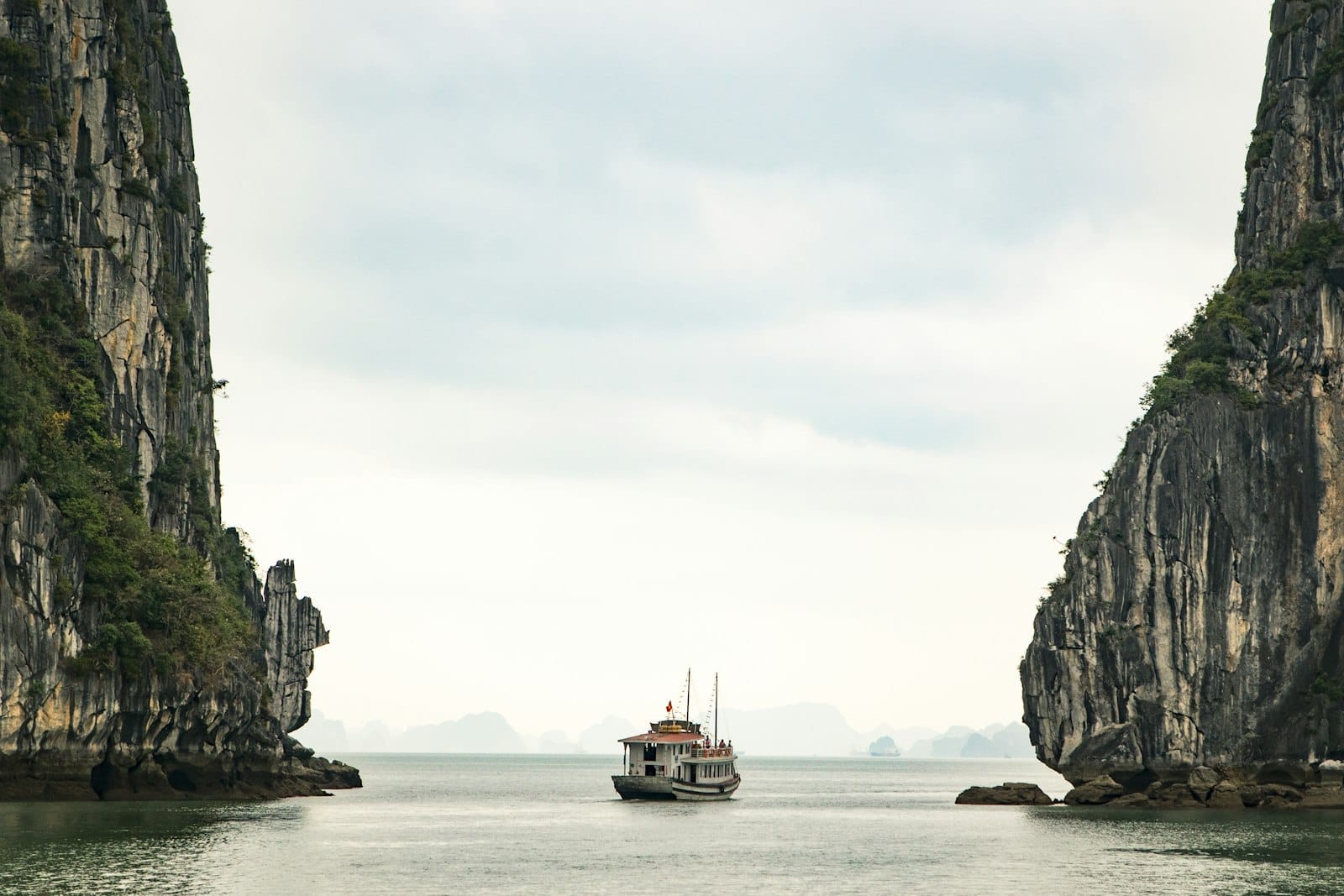
Ha Long Bay is not subtle. When your boat leaves Ha Long City's harbor and the city skyline gives way to open water, the first karst towers appear almost immediately, rising sheer from the green-grey sea like formations from another planet. They are not gently rolling hills. They are vertical: black-streaked limestone pillars, some topped with scraggly jungle vegetation, that seem to multiply the further you travel into the bay. By the time you're an hour out, land has disappeared in every direction and you're surrounded entirely by rock and water.
The bay covers roughly 1,553 square kilometers and contains an estimated 1,969 islands and islets, the vast majority uninhabited. The geology dates back around 500 million years, with the distinctive karst formations shaped by millennia of erosion, water infiltration, and tectonic movement. What you see above the waterline is only part of the story: many islands are hollow, containing cave systems that were used by prehistoric communities and later by fishing families for centuries.
ℹ️ Good to know
Ha Long Bay ("Bay of the Descending Dragon") and the adjacent Bai Tu Long Bay share the same geological formation. Bai Tu Long is less visited and often recommended for travelers seeking quieter waters, though access is more limited.
The Cruise Experience: Morning, Afternoon, and After Dark
The character of Ha Long Bay changes completely depending on the light and the hour. Early morning, particularly before 7 a.m., is when the bay earns its reputation. A low mist often sits between the karsts in October through March, and the water reflects the pale sky almost perfectly. The only sounds are the low engine hum of nearby boats and the occasional call of a bird from the rock faces. This is the version of Ha Long Bay that photographs propagate worldwide, and it genuinely exists.
By mid-morning, the atmosphere shifts. Tour boats from Ha Long City spread across the bay and the more popular cave sites fill with visitor groups. The caves themselves, particularly Sung Sot (Surprise Cave), are illuminated with colored lighting and can feel more like a theme park attraction than a natural wonder during peak hours. Arriving at cave sites before 9 a.m. makes a significant difference.
Afternoons on the water are best spent kayaking through the floating villages or into the narrow passages between karsts. The light becomes warmer, the crowds thin after lunch, and the scale of the formations becomes easier to appreciate from a kayak than from the deck of a cruise boat. At dusk, the western-facing decks turn gold for around 20 minutes before the sun drops, and then darkness settles quickly. Overnight in the bay, the water reflects stars and the silhouettes of the karsts become abstract shapes against a black sky.
Tickets & tours
Live prices and dates from our booking partner. If you book, we may earn a commission at no extra cost to you.
Private full-day trip from Hanoi to Halong Bay with boat cruise
From 59 €Instant confirmationFree cancellationHalong Bay 3 days and 2 nights on boat cruise from Hanoi
From 438 €Instant confirmationFree cancellationHa Long Bay 1-day luxury cruise
From 62 €Instant confirmationFree cancellationHa Long Bay Luxury Day Cruise with Buffet Lunch From Hanoi
From 59 €Instant confirmationFree cancellation
Caves, Kayaking, and What's Worth Your Time
Most cruises include a cave visit, and Sung Sot Cave is the most common. It is genuinely large, with cathedral-like chambers and impressive stalactite formations. The colored lighting is garish, but the physical scale of the cave is hard to dismiss. Thien Cung Cave offers similarly dramatic formations and tends to be less trafficked. Both require a moderate uphill walk from the dock.
Kayaking is consistently the activity that travelers rate highest, regardless of budget tier. Paddling into Luon Cave's enclosed lagoon or through the arched passage at Cap La Island gives a sense of the landscape's intimacy that no cruise deck replicates. If your itinerary doesn't include kayaking, it's worth switching to one that does.
Swimming is possible at several beach stops, and the water temperature is comfortable from April through November. Note that jellyfish are present in parts of the bay from late summer onward. For an extended experience of this landscape without the crowds, consider also looking at Trang An Landscape Complex near Ninh Binh, which offers a comparable karst-and-water experience entirely by rowboat, much closer to Hanoi.
Choosing Your Cruise: The Decision That Defines the Trip
There is a wider quality gap between cruise tiers in Ha Long Bay than almost anywhere else in Vietnam. Budget boats often use older vessels, serve mediocre food, and run fixed itineraries through the most crowded zones. Mid-range boats (typically $150–250 per person per night) offer significantly better cabin conditions, food quality, and access to less-trafficked areas of the bay, including Bai Tu Long Bay.
Key things to verify before booking: whether the boat actually sleeps in the bay overnight (some return to Ha Long harbor each evening, which defeats much of the point), which specific zone the itinerary covers, whether kayaking and cave visits are included in the price or cost extra, and cabin size. Cabins on budget boats can be extremely small with inadequate ventilation.
💡 Local tip
Book directly through established operators or a Hanoi-based travel agent you have verified. Third-party booking sites sometimes misrepresent boat class or itinerary details. Read recent reviews (within 3 months) specifically about the boat and food, not just the scenery.
If you're planning logistics from Hanoi, the guide on getting to Ha Long Bay from Hanoi covers transfer options, departure points, and journey times in detail.
When to Go: Weather, Crowds, and the Fog Factor
Ha Long Bay is a year-round destination, but the experience varies substantially by season. October through April is generally considered the optimal window. Temperatures are cooler (15–20°C in winter months), skies are clearer, and the light is sharper. The famous morning mist is most prevalent from November through February, when cold air meets warmer water, which makes for atmospheric photography but also means visibility can be low early in the day.
May through September brings higher temperatures (up to 33°C), higher humidity, and the possibility of typhoons, particularly August and September. Cruises can be cancelled with little notice during storm season. That said, the bay in summer has lush green vegetation on the karsts and warm water for swimming. If you visit in summer, travel insurance with weather cancellation coverage is advisable.
Lunar New Year (Tet, usually late January or February) brings a surge in domestic tourism that significantly increases boat numbers on the water. For a broader view of when Hanoi and surrounding regions are most and least crowded, see the best time to visit Hanoi guide, which covers northern Vietnam's seasonal patterns in full.
Getting There from Hanoi
Ha Long Bay is approximately 165 kilometers east of Hanoi. The most practical option for most travelers is a package cruise that includes round-trip transportation from Hanoi's Old Quarter. Limousine buses, which carry 9–16 passengers in reclining seats, are the most comfortable independent option and depart from several points in central Hanoi. The journey takes 3.5 to 4 hours depending on traffic, which can be heavy leaving Hanoi in the early morning.
There is no direct train to Ha Long City. Seaplane transfers are available and significantly reduce travel time, though at considerably higher cost. If you're managing your own logistics rather than booking a package, confirm which pier your cruise departs from: Ha Long City has multiple embarkation points and they are not centrally located relative to each other.
⚠️ What to skip
Traffic between Hanoi and Ha Long can cause significant delays, especially on weekends and public holidays. Build in extra time before departure, and confirm your cruise's cut-off arrival time at the pier.
Practical Notes and Honest Limitations
Motion sickness is a real consideration. The Gulf of Tonkin is generally calm, but light choppiness is common in winter months and during weather transitions. If you're prone to seasickness, take medication before boarding and request a cabin near the middle of the boat where motion is least pronounced.
Photography note: overcast days are often better for bay photography than full sun. Hard midday light bleaches the water color and creates harsh shadows on the karsts. Early morning and late afternoon in softer light produce better results regardless of weather. A wide-angle lens or phone in panoramic mode captures the scale more accurately than a standard focal length.
Ha Long Bay is not a quiet or undiscovered place. In peak season, hundreds of boats operate simultaneously in the most popular zones. Travelers who find heavy tourism dispiriting may prefer alternatives like Tam Coc or the broader Ninh Binh region, which offer comparable karst scenery with considerably less infrastructure and boat traffic.
Accessibility: cruise boats involve boarding via small tender boats and navigating narrow stairs aboard the vessel. Caves require uphill walking on uneven surfaces. This is not an easy destination for travelers with mobility limitations, though some higher-end operators can accommodate specific needs with advance notice.
Insider Tips
- Request a cabin at the bow or on the upper deck rather than at the stern: exhaust from the engine room can make rear-facing cabins unpleasant when the boat is underway.
- Pack a thin windproof layer even in warmer months. The wind on the water at night is significantly colder than temperatures on land suggest, particularly October through February.
- Bring cash in Vietnamese Dong for onboard extras like additional drinks, laundry, and tip for crew. Few budget or mid-range boats have card payment facilities for extras.
- If your cruise anchors in a lagoon or bay overnight, set an alarm for 5:30 a.m. and go to the top deck before anyone else. The first light on the karsts in silence is what most travelers mean when they describe Ha Long Bay as extraordinary.
- The floating fishing villages in the bay are gradually being relocated as part of Vietnamese government environmental policy. Check before your trip whether villages like Cua Van still have residents, as the situation is actively changing and some boats still market the villages as inhabited when they are not.
Who Is Ha Long Bay For?
- First-time visitors to Vietnam who want an iconic natural landscape
- Couples or honeymooners on a mid-range or luxury cruise
- Kayakers and swimmers comfortable on open water
- Photographers who can commit to early mornings and soft-light hours
- Families with older children who can manage stairs and uneven cave paths
Nearby Attractions
Combine your visit with:
- Bát Tràng Ceramic Village
Just 13 kilometers southeast of central Hanoi, Bát Tràng Ceramic Village has been producing distinctive blue-and-white stoneware for over six centuries. It remains a working craft community where visitors can watch artisans at the wheel, decorate their own pieces, and buy direct from the families who fire them.
- Perfume Pagoda
The Perfume Pagoda is a sprawling complex of Buddhist shrines, limestone caves, and riverside temples carved into the Huong Tich mountain range, about 60 km (37 miles) southwest of Hanoi. Getting there is half the experience: a rowing boat along the Yen River, followed by a hike or cable car through forested cliffs to the main cave shrine. It is one of Vietnam's most important pilgrimage sites, drawing millions of devotees, particularly during the annual spring festival.
- Vietnam Museum of Ethnology
The Vietnam Museum of Ethnology in Hanoi offers an unusually thorough look at the country's 54 officially recognized ethnic groups, combining indoor galleries with full-scale outdoor village reconstructions. It rewards curiosity and patience in equal measure.
Planning a trip? Discover personalized activities with the Nomado app.