Tam Coc: Karst Caves, Rice Fields, and River Boats in Ninh Binh
Tam Coc draws visitors with its slow boat rides through three natural limestone caves, surrounded by flooded rice paddies and vertical karst peaks. It sits at the heart of Ninh Binh province, about 100 km south of Hanoi, and pairs well with nearby temples and cycling routes.
Quick Facts
- Location
- Ninh Binh Province, ~100 km south of Hanoi
- Getting There
- Train or bus to Ninh Binh city, then taxi or xe om (~10 min) to Tam Coc boat dock
- Time Needed
- Half day minimum; full day with cycling and temples
- Cost
- Boat ticket approx. 250,000 VND per person (verify current rate at ticket office); cycling rentals extra
- Best for
- Scenic boat rides, photography, cycling, escaping Hanoi's urban density
What Tam Coc Actually Is
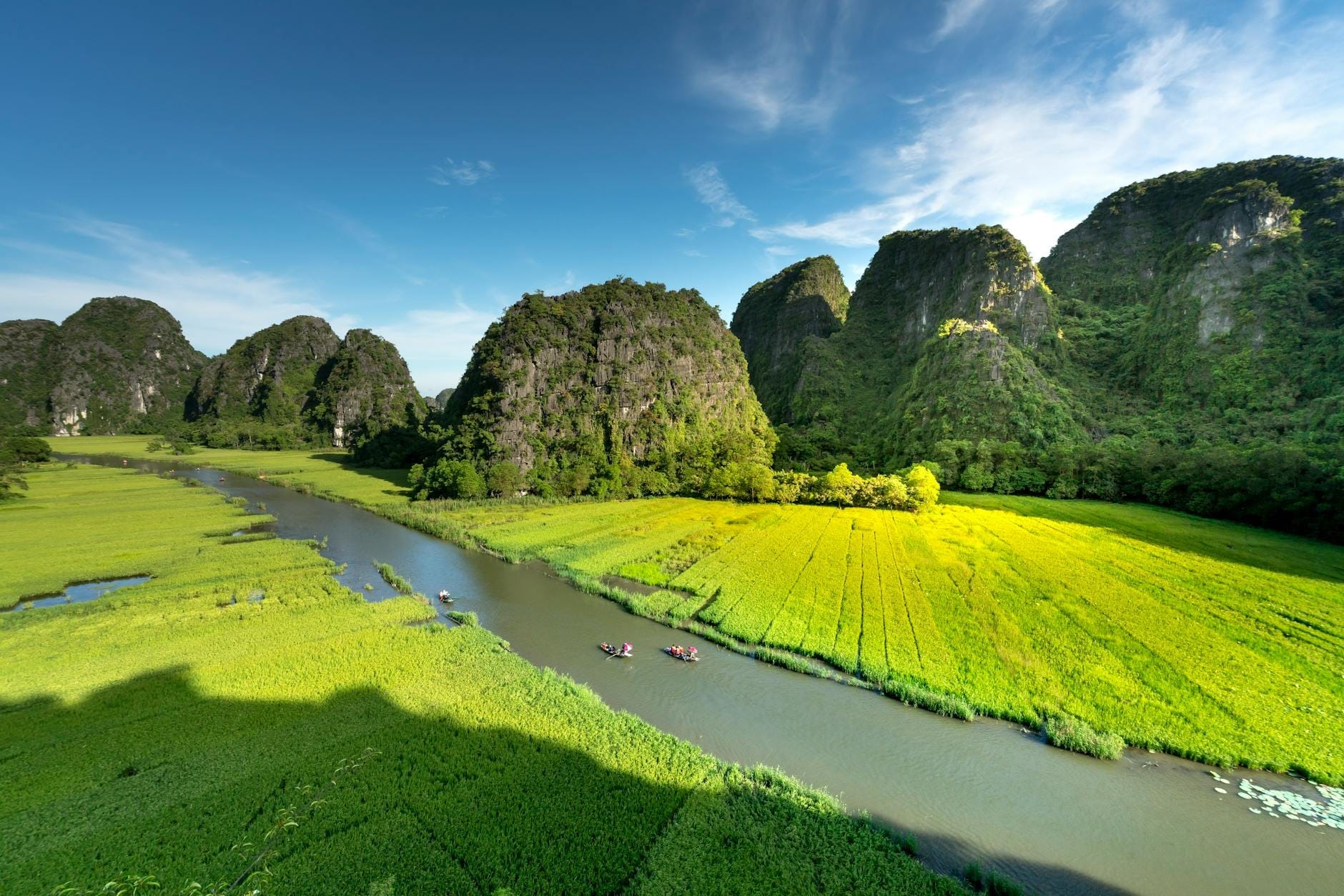
Tam Coc translates literally as 'Three Caves' in Vietnamese, referring to three consecutive tunnels carved by the Ngo Dong River through the base of limestone karsts: Hang Ca, Hang Giua, and Hang Ba. The river is narrow and slow-moving, and boats pass through each cave at water level, which means the ceiling can hang just a meter or two above your head in places. The rock is dark and wet, the air drops noticeably cooler, and the sound of oars replaces all other noise. Outside the caves, the river opens into wide, flat valleys where rice paddies stretch between the karst formations, creating a landscape that shifts dramatically with the season and the light.
Tam Coc is not a secret. It appears on almost every Ninh Binh itinerary, and the boat dock sees significant daily traffic. That said, the landscape itself remains genuinely impressive regardless of how many tourists are present. The karst formations rise 50 to 100 meters straight from the valley floor, forming a scale that makes the paddies below feel very small. If your threshold for crowds is low, however, it is worth understanding what you are signing up for before you arrive.
ℹ️ Good to know
Tam Coc and Trang An are neighboring but distinct sites in Ninh Binh. Trang An is a UNESCO World Heritage Area with longer cave routes. Tam Coc is more accessible and faster to complete. Many visitors do both in a single day.
The Boat Ride: What to Expect
The standard boat trip covers roughly 5 km round-trip and takes between 90 minutes and 2 hours. Boats are flat-bottomed, narrow wooden vessels that hold two passengers. Your rower, typically a local woman, often rows with her feet while using hands to manage the oar in tighter sections. This is not a performance for tourists. It is an efficient technique developed for low-clearance passages, and watching it in practice is one of the more unusual things about the experience.
Mornings before 9 a.m. offer the most atmospheric conditions, when mist sits low over the paddies and the light is flat and cool. By 10 a.m. the dock fills considerably, and boats move in loose processions rather than independently. Peak midday hours in summer (June through August) bring direct sun with no shade on the water, which is uncomfortable in high humidity. If you can time arrival for the first departure slot, you will have noticeably more space on the river.
⚠️ What to skip
Rowers frequently offer embroidery and handicrafts for sale mid-river, and some can be persistent. Prices are not fixed. Declining politely is perfectly acceptable, and you are not obligated to buy anything as part of the ticket.
Photography from the boat is rewarding but technically demanding. The light is contrasty by mid-morning, and the caves themselves are very dark, requiring either a high ISO setting or acceptance that cave interiors will not be well-exposed in the same frame as the bright exterior. A wide-angle lens or a smartphone's ultra-wide mode works well for capturing the full height of the karsts from the river. A small dry bag for your camera is worth bringing, particularly during rainy season (roughly May through September), when light rain is possible at almost any point.
Tickets & tours
Live prices and dates from our booking partner. If you book, we may earn a commission at no extra cost to you.
Hoa Lu, Tam Coc and Mua Cave from Hanoi with Buffet Lunch
From 48 €Instant confirmationFree cancellationHoa Lu, Tam Coc, and Hang Mua day trip from Hanoi
From 59 €Instant confirmationFree cancellationThe countryside of Tam Coc and Hoa Lu plus a boat ride guided tour from Ha Noi
From 99 €Instant confirmationFree cancellationHoa Lu and Tam Coc Full Day Guided Tour from Hanoi with Lunch
From 64 €Instant confirmation
Cycling the Valley: Beyond the River
Renting a bicycle at Tam Coc and exploring the surrounding countryside is, for many visitors, a better use of time than a second boat trip. The valley roads are flat, lightly trafficked, and lined with paddies and karst formations that look different at ground level than they do from the water. A loop taking in Bich Dong Pagoda to the north is a popular route.
Bich Dong is a cave pagoda built into the face of a karst hill, with three temple levels ascending through the rock. It is one of the more compelling temple sites in the Ninh Binh area, combining natural cave formations with active religious architecture. See the full guide to Bich Dong Pagoda for details on access and what to expect inside.
Cycling in the late afternoon, between 4 and 6 p.m., has a particular quality. The karsts cast long shadows across the paddies, and farmers are often returning from the fields. The rice is harvested twice a year, roughly May to June and October to November, and during harvest the paddies are bright gold. Outside harvest periods they range from vivid green in the growing stages to flooded brown after cutting. Each version of the landscape is worth seeing.
Historical and Cultural Context
Ninh Binh province holds a deeper historical significance than the landscape alone suggests. The Hoa Lu area, just a few kilometers north of Tam Coc, served as Vietnam's first independent capital under the Dinh and Early Le dynasties in the 10th century, before the capital moved to Thang Long (modern Hanoi) in 1010. This region was chosen precisely because the karst formations created a natural fortress, with the rivers and cliffs forming defensive barriers that made Hoa Lu easier to protect than open plains.
The Hoa Lu Ancient Capital site preserves two restored royal temple complexes dedicated to Emperor Dinh Tien Hoang and Emperor Le Dai Hanh, and it is close enough to Tam Coc to visit in the same day. Understanding Hoa Lu makes the Tam Coc landscape feel less like a scenic backdrop and more like a place with real historical weight.
The Trang An Landscape Complex, which encompasses Tam Coc along with other cave and temple areas, was designated a UNESCO World Heritage Site in 2014, recognized for both its natural karst geology and its archaeological and historical significance. The caves in this region contain evidence of human habitation dating back over 30,000 years.
Getting There from Hanoi
Ninh Binh is approximately about 100 km south of Hanoi, and travel time by road is typically 1.5 to 2.5 hours depending on traffic. The Reunification Express train from Hanoi's main station (Ga Ha Noi) runs services to Ninh Binh station several times daily, and the journey takes around 2 hours. From Ninh Binh station, the Tam Coc boat dock is about 7 to 9 km away, reachable by taxi or xe om (motorbike taxi).
Many travelers opt for organized day trips from Hanoi, which include transport, the boat ticket, and sometimes lunch. These are convenient but allow little flexibility. If you prefer to move at your own pace, the train-plus-local-transport combination is straightforward. Check the full Ninh Binh from Hanoi day trip guide for route options, recommended departure times, and what to combine in a single outing.
💡 Local tip
An early morning train from Hanoi (departing around 6–7 a.m.) gets you to Ninh Binh before the boat dock fills. Check the Vietnam Railways website (dsvn.vn) for current schedules and book in advance on weekends and public holidays.
Honest Assessment: Who Will Love It, Who Might Not
Tam Coc genuinely delivers on its core promise: a slow boat through limestone cave tunnels, surrounded by rice paddy landscape at a scale that photographs cannot fully capture. The experience of floating through the dark interior of Hang Ca and emerging into open valley is worth the trip for most visitors.
That said, the site operates at a commercial scale. The boat dock area is surrounded by souvenir stalls and restaurants, and the riverfront approach has the infrastructure of a well-established tourist destination rather than a quiet natural site. Visitors seeking true solitude in nature will likely feel that Tam Coc's neighbor, the Trang An boat route, offers a quieter and more ecologically intact experience, though it requires more time.
Travelers who prioritize cultural depth over scenery may find the overall Ninh Binh area more interesting when approached through its historical sites. The Trang An Landscape Complex boat routes pass more temple sites and cave shrines, and the pace is generally slower. Combining Tam Coc in the morning with Trang An in the afternoon is an ambitious but viable full-day itinerary.
Visitors with limited mobility should note that the boats are low and require stepping down from a dock. The cycling routes are flat and accessible. The cave passages are navigated while seated in the boat, with no walking required inside.
Insider Tips
- Arrive at the boat dock before 8 a.m. if possible. The first boats on the water have the river largely to themselves, and the early light over the karsts is the best of the day.
- Wear a hat and sunscreen even on overcast days. Time on the river means extended sun exposure with no shade, and the reflection off the water intensifies it.
- The cycling route between Tam Coc and Bich Dong Pagoda (about 2 km) passes through working farm roads. Go slowly and give way to farmers with loaded bikes or carts. The interaction is part of the experience.
- Bring Vietnamese dong in cash. The ticket booth and most food stalls operate cash-only, and ATMs in the immediate Tam Coc area are limited.
- If you are visiting during the rice harvest (approximately May to June and October to November), the landscape looks entirely different from the green growing season. Both are worth seeing, but the gold-field harvest period photographs dramatically.
Who Is Tam Coc For?
- First-time visitors to northern Vietnam who want to experience karst landscape without a multi-day Ha Long Bay trip
- Photographers willing to work with early morning light and the technical challenge of cave-to-exterior exposure
- Families with children old enough to sit still in a narrow boat for 90 minutes
- Day-trippers from Hanoi combining nature and history in a single outing
- Cyclists who want a flat, scenic route through working agricultural landscape
Nearby Attractions
Other things to see while in Ninh Bình:
- Bích Động Pagoda
Bích Động Pagoda is a three-tiered Buddhist temple complex built directly into a karst cliff in Ninh Bình province, roughly 100 km south of Hanoi. Originating in 1428 with major reconstruction in the early 18th century, it layers religious history, natural drama, and river scenery into one of northern Vietnam's most rewarding half-day excursions.
- Hoa Lư Ancient Capital
Hoa Lư was Vietnam's first independent imperial capital, established in 968 AD among dramatic limestone karst formations in what is now Ninh Bình province. Two surviving temple complexes dedicated to the Đinh and Lê dynasties stand where palaces once rose, making this one of the most historically significant sites in northern Vietnam.
- Mua Cave & Hang Mua Peak
Hang Mua Peak, the high point of the Mua Cave complex in Ninh Binh, rewards a steep 500-step ascent with an uninterrupted 360-degree panorama over rice paddies, karst limestone mountains, and the winding Ngo Dong River. It is one of the most photogenic viewpoints in northern Vietnam, and one of the most honest: the views genuinely deliver.
- Trang An Landscape Complex
Trang An Landscape Complex in Ninh Binh is Vietnam's first site recognized by UNESCO for both its natural and cultural values. Visitors explore a labyrinth of limestone karsts, river caves, and centuries-old temples by flat-bottomed rowboat, in one of northern Vietnam's most atmospheric landscapes.
Planning a trip? Discover personalized activities with the Nomado app.