Tran Quoc Pagoda: Hanoi's Oldest Temple on West Lake
Tran Quoc Pagoda stands on a small island in West Lake, making it one of Hanoi's most photographed religious sites. Dating back over 1,500 years, it combines active Buddhist worship with striking lakeside scenery. This guide covers everything you need to plan a worthwhile visit.
Quick Facts
- Location
- Thanh Nien Road, Tay Ho District, Hanoi
- Getting There
- Grab or taxi from the Old Quarter (15-20 min); public bus routes 45 and 33 stop nearby on Thanh Nien Road
- Time Needed
- 45 minutes to 1.5 hours
- Cost
- Free entry
- Best for
- Buddhist heritage, lakeside photography, quiet reflection
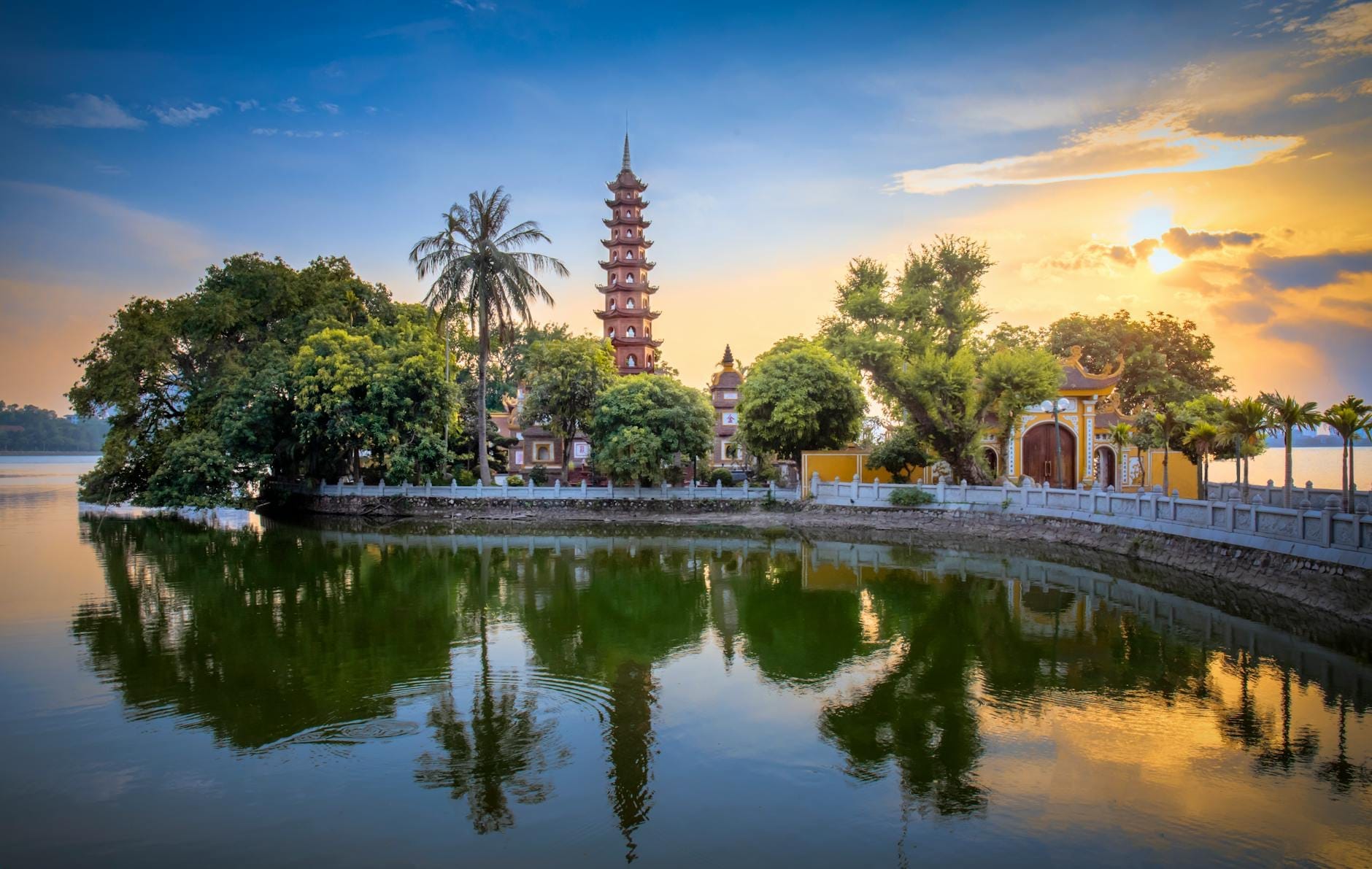
What Is Tran Quoc Pagoda?
Tran Quoc Pagoda is widely regarded as the oldest Buddhist pagoda in Hanoi, with origins traditionally traced to the 6th century CE during the reign of Emperor Ly Nam De. The structure was originally built on the banks of the Red River before being relocated to its current position on Kim Ngư Islet, a small island in West Lake, in 1615. Over the following centuries it was expanded, reinforced, and repaired, resulting in the layered architectural composition visible today.
The pagoda sits at the end of a small causeway off Thanh Nien Road, the tree-lined boulevard that separates West Lake from Truc Bach Lake. From the street, the 11-story stupa that crowns the complex is visible above the treeline, its pale sandstone tiers catching light differently depending on the hour. The combination of lake reflections, lotus plants, and ancient brickwork gives this site a visual quality that few religious sites in northern Vietnam can match.
ℹ️ Good to know
Tran Quoc is an active place of worship, not a museum. Dress modestly: cover shoulders and knees. Lightweight trousers or a sarong kept in your bag will save you from being turned away at the gate.
The Architecture Up Close
The most immediately striking element is the 15-metre stupa, completed in 1998 but built in the classical style of earlier Vietnamese Buddhist towers. Each of its 11 tiers contains a small seated Buddha in a carved niche, and the tip is crowned with a lotus blossom in gilded bronze. The stupa's vertical silhouette against the horizontal plane of West Lake is what most photographers come to capture.
Behind the stupa, the main sanctuary halls follow a traditional northern Vietnamese pagoda layout: a series of connected buildings progressing from a front worship hall to deeper chambers housing major statues. The interiors are dense with lacquered altars, incense coils, bronze bells, and offerings of fruit and flowers. The smell of sandalwood incense is constant and at times strong, strongest near the inner sanctuaries where worshippers light offering sticks throughout the day.
A large Bodhi tree, grown from a cutting reportedly gifted by the Indian president in 1959, stands in the courtyard near the entrance. Plaques at its base mark this history. It has grown substantially and now provides meaningful shade over the courtyard stones, which can become uncomfortably hot underfoot in the midday sun between April and September.
The architectural style places Tran Quoc within the broader tradition of Vietnamese Buddhist pagoda design, which you can explore further by visiting the One Pillar Pagoda in the Ba Dinh district, a structurally very different but equally historic site.
Tickets & tours
Live prices and dates from our booking partner. If you book, we may earn a commission at no extra cost to you.
Bai Dinh Pagoda and Trang an Eco-Tourism Full Day Tour
From 31 €Instant confirmationFree cancellationBai Dinh Pagoda, Mua Cave and Trang An Guided Tour with Buffet Lunch
From 36 €Instant confirmationFree cancellationBai Dinh Pagoda and Trang An Guided Tour with Buffet Lunch
From 48 €Instant confirmationFree cancellationPrivate Return Transfer from Ha Noi to the Perfume Pagoda
From 85 €Instant confirmationFree cancellation
How the Experience Changes Through the Day
Early morning, roughly 6:30 to 8:30, is when the pagoda functions most purely as a place of worship. Local residents arrive on foot or by bicycle, carry offerings of incense and fruit, and move quietly through the halls. The light at this hour is soft and diffuse, often filtered through mist rising off the lake surface. This is the least crowded window and the most atmospheric for photography, particularly for shots framing the stupa against the pale morning sky.
By mid-morning, tour groups arrive, primarily organized groups of domestic tourists and smaller numbers of international visitors. The narrow causeway can feel congested if two groups pass simultaneously. If you arrive between 10 and 11:30, expect company but not chaos. The courtyard has limited shaded seating, so prolonged waiting in summer heat is uncomfortable.
Late afternoon, especially in the hour before sunset, brings a different quality. The pagoda faces west over the lake, which means the stupa catches warm orange light and the water reflects it back. Photographers specifically time visits for this window, and it can get busy again between 4:30 and 6:00. The evening brings a quieter, cooler energy as families from the surrounding Tay Ho neighbourhood walk the Thanh Nien lakeside path.
💡 Local tip
For the best combination of light and low crowds, arrive at 7:00 AM on a weekday. Weekends draw larger numbers of domestic visitors, particularly Sunday mornings when many Hanoi residents visit temples.
Getting There and Navigating the Area
Tran Quoc Pagoda is located on Thanh Nien Road in the Tay Ho District, roughly 4-5 kilometres northwest of the Old Quarter. The most straightforward approach from central Hanoi is by Grab (the dominant ride-hailing app in Vietnam), which typically takes 15 to 20 minutes from Hoan Kiem and costs around 40,000 to 60,000 VND depending on traffic. Public bus routes 45 and 33 run along Thanh Nien Road and stop within walking distance of the causeway entrance, though schedules and exact stops should be verified locally.
If you are already at West Lake for other reasons, such as walking the Tay Ho lakeside path or visiting Quan Thanh Temple, Tran Quoc is easy to combine on foot. The pagoda entrance is on the eastern side of Thanh Nien Road, marked by a gate and a small parking area. There is no dedicated bicycle storage, but many visitors lean bikes against the perimeter wall outside.
The pagoda pairs naturally with nearby Quan Thanh Temple, a Taoist shrine located just a few hundred metres south along the same road. Both can be visited in a single morning without much ground to cover between them.
Cultural and Historical Context
Buddhism arrived in northern Vietnam during the early centuries CE, carried along trade and administrative routes from India through China. Tran Quoc is considered one of the most significant surviving examples of this early Buddhist presence in the region, though the current buildings are largely the result of reconstructions and additions across many dynasties, from the Ly and Tran periods through to the Nguyen era.
The pagoda holds active status within the Vietnamese Buddhist Sangha, meaning it functions as a congregation site, not merely a heritage landmark. On major Buddhist observances such as Vesak (Phat Dan) in May, and during the Tet lunar new year period, the site draws large crowds of worshippers from across Hanoi. Visiting during these periods can be a remarkable cultural experience, but the space will be significantly more crowded and the atmosphere more ceremonial. Casual sightseeing takes a back seat on these dates.
If the religious and historical significance of Hanoi's Buddhist heritage appeals to you, the Temple of Literature offers a complementary perspective on the role of education and Confucian scholarship in the same historical era, though its architecture and function differ considerably.
Photography Notes and Practical Considerations
The classic composition places the stupa in the foreground with the expanse of West Lake behind it. The best angle is from the courtyard, slightly to the left of the stupa base, with the lake visible between the trees. A wide-angle lens at dawn or dusk gives the most depth. On overcast days, the flat light can actually work in your favour for interior shots of the lacquered altars, which are difficult to expose correctly in harsh direct sun.
Photography inside the main halls is generally tolerated but should be done with discretion. Do not photograph worshippers at close range without acknowledgment, and lower your camera if ceremonies are in progress. The monks and caretakers are generally patient with respectful visitors.
⚠️ What to skip
The causeway narrows to a single-lane path and can become slippery after rain. Wear shoes with grip. Flip-flops are common among visitors but are not well-suited to the uneven stone surfaces, particularly near the water's edge.
Accessibility is limited. The causeway and courtyard are at ground level, but the interior halls involve raised thresholds and some steps. There is no dedicated accessibility infrastructure. Visitors who use wheelchairs or have significant mobility limitations may find the main halls difficult to enter.
For a broader West Lake visit, consider combining Tran Quoc with a walk around the southern shore or a coffee stop in the Tay Ho neighbourhood. More ideas for structuring your time around the area can be found in our complete guide to things to do in Hanoi.
Is It Worth Your Time?
For travellers with even a passing interest in Buddhist architecture or Vietnamese history, yes. The combination of genuine antiquity, active religious life, and a setting on the lake gives it a quality that distinguishes it from many heritage sites that feel more like open-air museums. It is not a large site, and the visit need not take long. Thirty to forty focused minutes is enough to see everything; an hour gives you time to sit, absorb the atmosphere, and watch the light change on the water.
Those who might want to skip it: travellers already carrying significant temple fatigue after touring multiple religious sites, or those visiting Hanoi only for its food, nightlife, or colonial architecture. The pagoda itself adds little to an itinerary built around those interests. It is also not well-suited to visitors with young children who need space to move around; the site is compact and requires quiet behaviour.
Insider Tips
- The reflection of the stupa in the lake is sharpest in the early morning before wind picks up. By 9 AM, the surface is usually broken by boat traffic and ripple from wind, which eliminates the mirror-like effect most photographs rely on.
- A small donation box is located near the entrance of the main hall. Leaving a modest contribution (5,000 to 20,000 VND) is appropriate and appreciated at active religious sites like this.
- The Bodhi tree in the courtyard has a small placard in Vietnamese and English explaining its origin as a cutting from the tree in Bodh Gaya, India. It is easy to walk past without noticing; take a moment to read it.
- Thanh Nien Road has no pavement on parts of its western side. If you are walking between Tran Quoc and Quan Thanh Temple, stay aware of motorbike traffic, particularly around the parked vehicles near the causeway entrance.
- Visit on a weekday rather than a weekend if your primary interest is quiet contemplation or photography. Sunday mornings in particular attract large numbers of Hanoi families and worshippers.
Who Is Tran Quoc Pagoda For?
- Travellers interested in Buddhist heritage and Vietnamese religious architecture
- Photographers looking for a distinctive lakeside composition with historical depth
- Visitors combining a morning around West Lake with a walk along Thanh Nien Road
- Those wanting to experience a genuinely active religious site, not just a tourist attraction
- Travellers with limited time who want a compact but historically significant stop
Nearby Attractions
Other things to see while in Tây Hồ (West Lake):
- Quan Thánh Temple
One of Hanoi's four sacred guardian temples, Quan Thanh Temple stands at the southern tip of West Lake with roots stretching back to the 11th century. Inside, a massive bronze statue of the deity Tran Vu dominates the prayer hall, surrounded by incense smoke and the low sound of ritual bells. It is a working place of worship that happens to be one of the city's most photogenic historic sites.
- West Lake
West Lake, known locally as Hồ Tây, is Hanoi's largest lake and the spiritual and social heart of the Tây Hồ district. Stretching across roughly 500 hectares, it draws early-morning joggers, weekend cyclists, temple-goers, and travelers seeking a calmer counterpoint to the Old Quarter's noise.
Planning a trip? Discover personalized activities with the Nomado app.