Quan Thanh Temple: Hanoi's Ancient Taoist Guardian on West Lake
One of Hanoi's four sacred guardian temples, Quan Thanh Temple stands at the southern tip of West Lake with roots stretching back to the 11th century. Inside, a massive bronze statue of the deity Tran Vu dominates the prayer hall, surrounded by incense smoke and the low sound of ritual bells. It is a working place of worship that happens to be one of the city's most photogenic historic sites.
Quick Facts
- Location
- Thanh Nien Road, Quán Thánh Ward, Tay Ho District, Hanoi
- Getting There
- Grab or taxi from the Old Quarter (10-15 min). City buses serve Thanh Nien Road. No metro stop nearby.
- Time Needed
- 30 to 60 minutes for the temple; pair with a West Lake walk for a half-day
- Cost
- Small entrance fee applies (verify current rate on arrival; typically under 30,000 VND)
- Best for
- History lovers, architecture enthusiasts, and travelers combining with a West Lake circuit
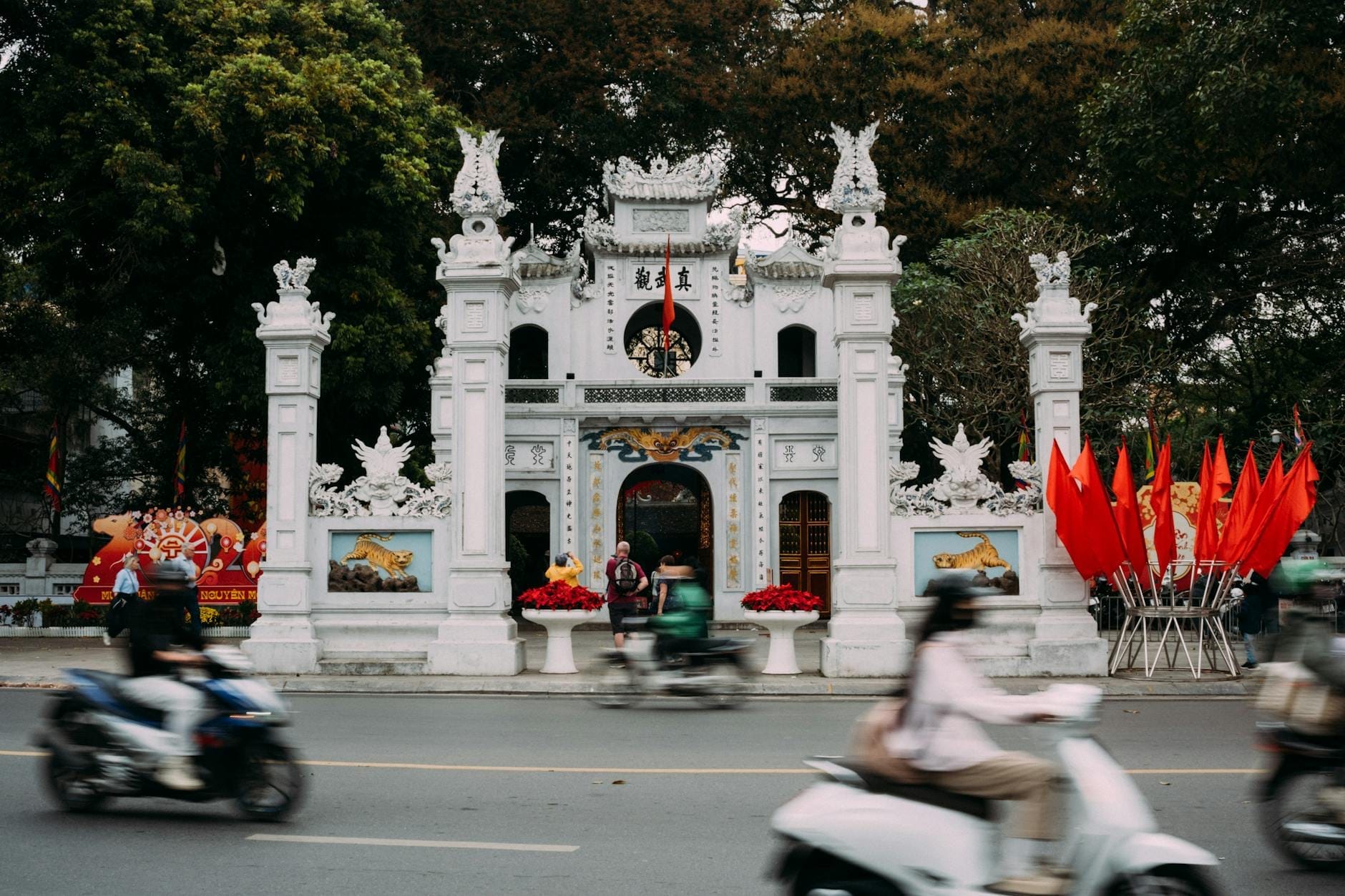
What Quan Thanh Temple Actually Is
Quan Thanh Temple, known in Vietnamese as Đền Quán Thánh, is a Taoist temple originally built during the reign of King Ly Thai To in the early 11th century, when Hanoi was founded as the imperial capital under the name Thang Long. It was constructed to honor Tran Vu, a deity associated with the north and with water control, a particularly significant concern for a city built on the banks of the Red River. The temple is considered one of the Four Sacred Temples of Thang Long, each positioned to guard a cardinal direction of the ancient city.
The temple sits on Thanh Nien Road, the narrow causeway that divides West Lake from Truc Bach Lake to the west. This positioning is not incidental. The site was chosen according to geomantic principles, and the alignment of the temple's main gate with the water creates a visual relationship between the sacred building and the landscape that still registers clearly when you stand at the entrance.
ℹ️ Good to know
Dress modestly before entering: shoulders and knees should be covered. Lightweight scarves or a spare layer in your bag solves this easily. Shoes are removed before entering the main sanctuary.
The Bronze Statue: The Reason Most People Come
The centerpiece of Quan Thanh Temple is the statue of Tran Vu, cast in bronze in 1677 and standing approximately 3.96 meters tall with a weight recorded at around 4 tonnes. It is one of the largest ancient bronze castings in Vietnam and a landmark achievement of traditional Vietnamese metallurgy. The figure is seated in a commanding posture, robed and bearded, with a tortoise and serpent at its feet, symbols drawn from Taoist cosmology representing the northern sky and water.
Up close, the statue's surface has the deep patina that comes from centuries of incense smoke and occasional ritual cleaning. The craftsmanship in the facial detail and the layering of robes is visible even from a respectful distance. A smaller bronze bell and drum are housed nearby, and the inscriptions on stone stelae within the compound document the temple's restoration history across several dynasties.
Tickets & tours
Live prices and dates from our booking partner. If you book, we may earn a commission at no extra cost to you.
Quang Phu Cau Incense Village and Handicraft Village Day Tour
From 38 €Instant confirmationQuang Phu Cau Incense Village and Ninh Binh Tour with Lunch
From 77 €Instant confirmationFree cancellationIncense Quang Phu Cau and Handicraft Villages Guided Tour
From 26 €Instant confirmationFree cancellationQuang Phu Cau incense stick village guided tour from Hanoi
From 56 €Instant confirmationFree cancellation
How the Temple Feels at Different Times of Day
Early morning is when the temple operates as a genuinely active place of worship rather than a tourist site. Locals arrive before 8am to light incense and pray, and the smell of sandalwood and burning paper offerings is strongest then. The light filtering through the courtyard trees at that hour falls in low, angled shafts across the tiled roof ridges, making it the most atmospheric time for photography if that is a priority.
By mid-morning on weekends, organized tour groups from the Old Quarter begin arriving. The courtyard is not large, and it can feel crowded when two or three groups overlap. If you prefer a quieter visit, aim for a weekday morning or return in the late afternoon, when tour traffic drops and the evening light softens the temple's ochre walls.
The surrounding Thanh Nien Road takes on its own character depending on the hour. In the early morning, joggers and cyclists use it as a lakeside circuit. By midday it carries motorbike traffic and food vendors. In the evening, it becomes a popular spot for locals to walk along both lakes simultaneously, with street food carts appearing near the temple gate.
Architecture and Compound Layout
The temple complex follows a traditional Vietnamese religious layout: a main gate facing the lake road, a courtyard with mature trees providing shade, and a series of connected halls leading to the main sanctuary where the Tran Vu statue is housed. The roofline is decorated with ceramic ridge ornaments depicting dragons and mythological figures, a style consistent with the Nguyen dynasty restoration period.
Stone stelae within the courtyard record restoration works carried out in 1677, 1893, and subsequent periods. The current structure is largely a product of later restorations rather than original 11th-century construction, which is worth understanding: what you are seeing is a continuously maintained sacred site, not a preserved ruin. The craftsmanship across different restoration eras is layered into the fabric of the building in ways that reward close attention.
The temple's position on Thanh Nien Road also makes it a natural stopping point on any walk that takes in the West Lake area. The Tran Quoc Pagoda, Hanoi's oldest Buddhist pagoda, sits on a small island in West Lake roughly two kilometers to the northwest and pairs well with a visit here for a half-day of historic religious sites.
Practical Walkthrough: What to Expect on Arrival
The entrance gate opens onto Thanh Nien Road. A ticket window is located near the main gate; the fee is modest and payable in Vietnamese Dong. Once inside, the courtyard gives you a moment to orient before entering the inner halls. Signage is present in Vietnamese and partially in English, though the English translations are sometimes incomplete.
Move through the outer courtyard at your own pace. The main sanctuary housing the bronze statue is straight ahead. Photography is generally permitted in the courtyard and from the doorway of the sanctuary, but be attentive to worshippers who may be praying and give them space and quiet.
💡 Local tip
Bring small denomination VND notes. Donation boxes are placed throughout the inner halls, and it is customary to make a small offering. Larger notes attract attention and small change is often unavailable at the gate.
Quan Thanh Temple is well-positioned for combining with nearby attractions. A short walk south along Thanh Nien Road brings you to the edge of the Tay Ho district, where the lakeside cafes and restaurants are concentrated. A longer walk or quick Grab ride takes you toward the Ba Dinh district and the cluster of monuments around Ho Chi Minh's former residence.
Weather, Seasons, and When to Visit
Hanoi has a tropical monsoon climate. The months from October to April are generally drier and cooler, making outdoor exploration more comfortable. The temple courtyard has tree cover but limited shade in the open areas, so midday visits in summer (May through August) can be uncomfortably hot and humid. Rainy season brings the possibility of sudden downpours that turn the tiled courtyard slippery.
September and October offer some of the clearest light of the year and are widely considered among the best months to visit Hanoi overall. Spring festivals, particularly around Tet (Vietnamese Lunar New Year), bring significantly higher volumes of worshippers to the temple, which can be either a rich cultural experience or a crowd management challenge depending on your preference.
⚠️ What to skip
During major Vietnamese holidays including Tet, the temple can become extremely crowded with worshippers. This is culturally significant to witness but not ideal for a quiet visit. Plan accordingly.
Who This Attraction Suits and Who Might Skip It
Quan Thanh Temple rewards travelers with an interest in Vietnamese religious history, Taoist iconography, or traditional architecture. It also works well as a complementary stop for anyone doing a broader West Lake circuit. For context on how this temple fits into Hanoi's full landscape of historic sites, the things to do in Hanoi guide covers the full spread of options across the city.
Travelers who are primarily interested in Hanoi's colonial architecture or food scene may find Quan Thanh Temple less compelling as a standalone destination. The experience is relatively short, and the site does not have the same scale as the Temple of Literature or the breadth of the Vietnam Museum of Ethnology. It is best understood as one node in a larger itinerary rather than an anchor attraction.
Visitors with significant mobility limitations should note that the temple compound involves uneven stone paving and steps up to the sanctuary threshold. The ground is particularly slick after rain.
Insider Tips
- Arrive before 8am on a weekday to see the temple functioning as a place of active worship rather than a tourist stop. The incense smoke, ritual sounds, and absence of crowds make it a fundamentally different experience.
- The best camera angle for the main gate and roofline is from slightly south on Thanh Nien Road, where the West Lake water appears in the background behind the entrance. Early morning light falls favorably from the east at this angle.
- Stone stelae inside the courtyard are inscribed with records of temple restorations dating to the 17th century. A slow read of the English translations (where available) adds significant historical depth to what you are looking at.
- Combining this visit with a lakeside breakfast at one of the cafes on the western side of Truc Bach Lake, a five-minute walk away, makes for an efficient and pleasant morning.
- If visiting during festival periods, expect the burning of votive offerings to be far more intense. The smoke can be eye-watering near the inner halls. Move to the courtyard edges if it becomes uncomfortable.
Who Is Quan Thánh Temple For?
- Travelers interested in Vietnamese Taoist traditions and religious history
- Architecture and cultural heritage enthusiasts exploring beyond the Old Quarter
- Photographers seeking early morning light and traditional roofline compositions
- Visitors combining a half-day West Lake circuit with historic site visits
- Anyone wanting to understand Hanoi's ancient spiritual geography as a walled imperial city
Nearby Attractions
Other things to see while in Tây Hồ (West Lake):
- Tran Quoc Pagoda
Tran Quoc Pagoda stands on a small island in West Lake, making it one of Hanoi's most photographed religious sites. Dating back over 1,500 years, it combines active Buddhist worship with striking lakeside scenery. This guide covers everything you need to plan a worthwhile visit.
- West Lake
West Lake, known locally as Hồ Tây, is Hanoi's largest lake and the spiritual and social heart of the Tây Hồ district. Stretching across roughly 500 hectares, it draws early-morning joggers, weekend cyclists, temple-goers, and travelers seeking a calmer counterpoint to the Old Quarter's noise.
Planning a trip? Discover personalized activities with the Nomado app.