Grand Canal Walk: Dublin's Waterside Path Through Portobello and Ranelagh
The Grand Canal Walk traces one of Dublin's most rewarding urban towpaths through the southside neighbourhoods of Portobello and Ranelagh. Free to walk at any hour, the route offers a rare slice of calm water, Georgian bridges, and resident wildlife a short distance from the city centre.
Quick Facts
- Location
- Grand Canal, Portobello & Ranelagh, Dublin (south inner city)
- Getting There
- Dublin Bus routes 14 and 15 stop near Portobello Bridge; Luas Green Line at Charlemont stop (approx. 5-min walk)
- Time Needed
- 1–2 hours for the Portobello–Ranelagh stretch; the full Grand Canal Way trail is 117 km and typically takes about 5 days
- Cost
- Free — no ticket, permit, or booking required
- Best for
- Walkers, cyclists, photographers, local colour, canal-side cafés
- Official website
- www.waterwaysireland.org/things-to-do/walking/grand-canal-way
What the Grand Canal Walk Actually Is
The Grand Canal Walk refers, depending on context, to two overlapping things: the full Grand Canal Way, a waymarked long-distance trail of 117 km stretching from Lucan Bridge near Adamstown in County Dublin to Shannon Harbour in County Offaly, and the much shorter urban stretch through Portobello and Ranelagh that most Dublin visitors actually walk. This page focuses on the latter: the canal-side towpath running through these two southside neighbourhoods, where the canal is alive with narrow boats, swans, and the daily rhythm of locals.
The Grand Canal itself is a feat of 18th-century engineering. Projected in 1755 and built from around 1757, the main line connecting Dublin to the River Shannon was completed in 1804. The full main line of the Grand Canal, including its link to the River Liffey, runs approximately 132 km through 43 locks. Commercial barge traffic ceased around the mid-20th century, and the canal has since been restored for recreational use — walking, cycling, kayaking, and leisure boating. What remains is a linear greenway running through the heart of the city.
ℹ️ Good to know
The Portobello–Ranelagh stretch of the canal is not a single marked trail with a trailhead — it is a public towpath accessible at multiple points. The most convenient entry points from the city centre are Portobello Bridge (Harold's Cross Road) and Baggot Street Bridge.
The Walk: What You'll See and Feel
Walking the towpath through Portobello, the immediate texture is Georgian brick. Flat-fronted terraced houses line the canal bank, many dating to the early 19th century, their facades reflected in the still water on calm mornings. The towpath itself is a combination of flat tarmac, compacted gravel, and occasional grass margins — easy underfoot and genuinely flat, which is rare in a city built on slight undulations.
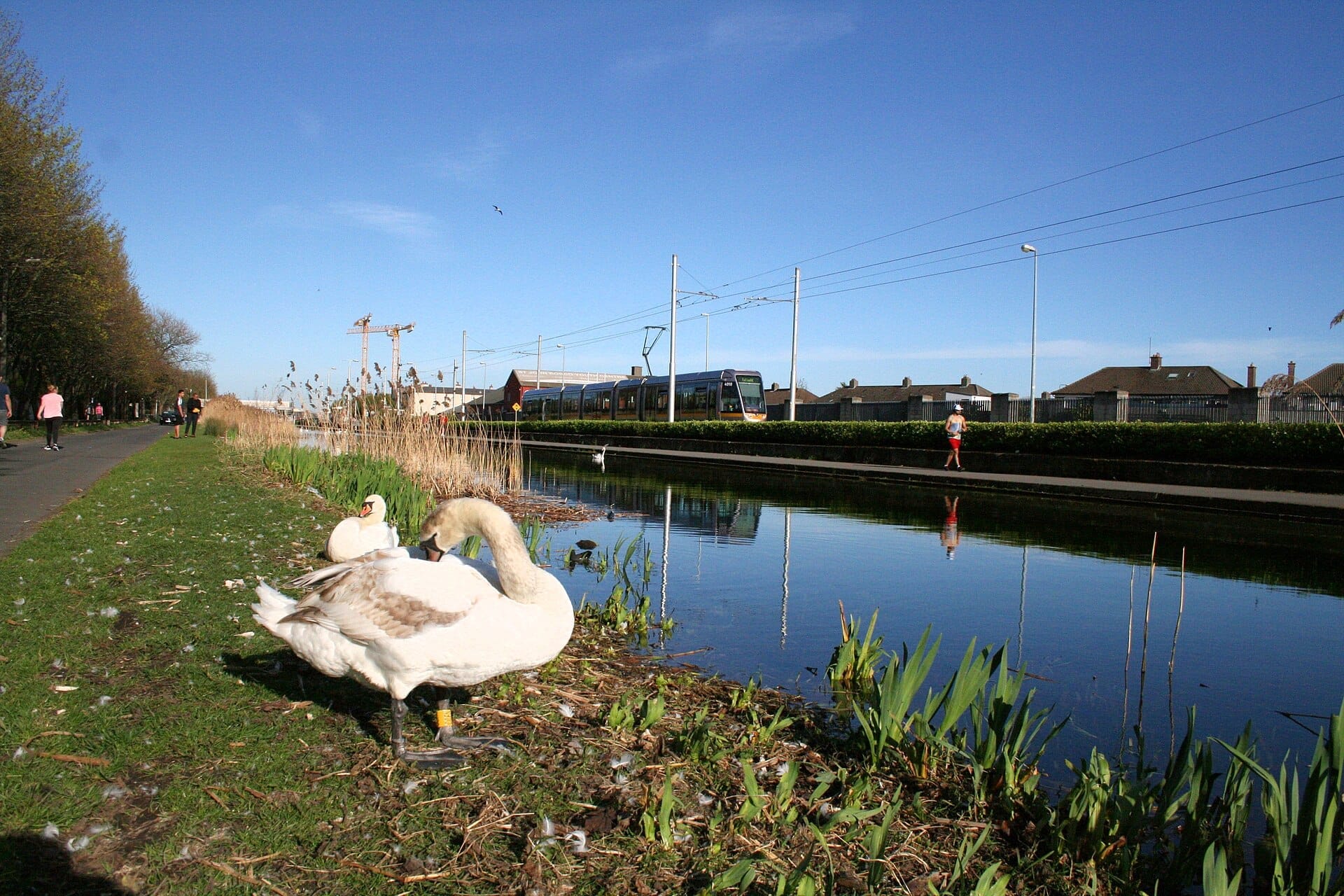
The water is greener than you might expect, and slow-moving. Swans are a fixture rather than a novelty here; they drift with self-assurance between moored narrow boats, which come in every shade of hand-painted colour. In spring, the grass banks grow long and the path takes on a slightly wild quality, with wildflowers pushing up between the towpath edge and the water. In autumn, the plane trees and willows shed into the canal, and the surface becomes a slow-moving mosaic of leaves.
The sounds shift depending on the hour. Early morning, you hear water lapping against the lock walls and the occasional creak of a moored boat. By mid-morning, runners and cyclists begin to appear, and café noise from Portobello's cafés drifts over the bridge. Weekend afternoons bring families, dogs, and people sitting on the stone lock steps eating food from nearby takeaways. The canal never feels crowded in the way that Grafton Street does, but it is never truly empty either.
The Portobello neighbourhood has strong cultural associations. It was historically home to a significant Jewish community from the late 19th century, traces of which survive in street names and a small number of remaining buildings. The area now has a dense concentration of independent cafés, wine bars, and food spots, making it an easy walk to break for coffee or lunch. For a broader picture of the southside's character, the Portobello and Ranelagh neighbourhood guide gives useful context.
Tickets & tours
Hand-picked options from our booking partner. Prices are indicative; availability and final rates are confirmed when you complete your booking.
Dublin Self-Guided Audio Walking Tour
From 5 €Instant confirmationFree cancellationDublin city guided walking tour
From 17 €Instant confirmationFree cancellationOld Dublin guided walking tour
From 28 €Instant confirmationFree cancellationEssential Dublin guided walking tour
From 19 €Instant confirmationFree cancellation
How the Experience Changes by Time of Day
Early morning, roughly 7am to 9am, is when the canal towpath earns its reputation for calm. The light in Dublin comes in low and soft at this hour, especially in spring and autumn, and it catches the water surface at an angle that photographers know to look for. Mist sometimes sits on the canal in autumn mornings, hovering just above the surface before the day warms. At this hour, the canal belongs primarily to runners and dog walkers, and the mood is quiet and purposeful.
Late afternoon, from around 4pm to 6pm on weekdays, is the most social hour on the towpath. After-work crowds use the canal as a decompression route home, stopping on the lock steps or benches to sit with a coffee or a can. The light at this hour in summer can be exceptional — Dublin's westward evening light hits the Georgian brick and canal surface together, giving the whole stretch a warmth the photographs rarely do justice to.
💡 Local tip
If photography is your reason for walking here, aim for the hour after sunrise or the hour before sunset. The Portobello Bridge itself makes a strong compositional anchor, and the reflection of lock gates in still water works best before wind picks up mid-morning.
The Historical Weight of the Canal
The Grand Canal was built at a moment when inland waterways were the primary means of moving goods in bulk across Ireland. Barges carried turf, grain, Guinness stout, and passengers between Dublin and the midlands. The lock-keeper's cottages that still stand at intervals along the canal are among the most photogenic buildings on the route — small, low, built for function rather than display, and now mostly in private hands.
The Portobello stretch holds a particular literary association. Patrick Kavanagh, one of Ireland's most significant 20th-century poets, lived near the canal and wrote about it with a directness that cut against the romantic Irish pastoral tradition. His poem 'Canal Bank Walk', written in 1958, is directly about this stretch of water. A memorial to Kavanagh sits near Baggot Street Bridge, in the form of a bronze figure seated on a bench — a statue that invites visitors to sit beside it, which most people do. It is one of the more human memorials in the city.
The canal also features in the broader story of Dublin's literary landscape, a city whose relationship with its writers is unusually physical — plaques, statues, and named streets appear throughout the southside.
Practical Walkthrough: How to Approach the Route
The most natural starting point for visitors coming from the city centre is Portobello Bridge, reached easily on foot from St Stephen's Green in about 20 minutes, or from the Charlemont Luas stop in about 5 minutes. From here, you can walk east along the towpath toward Grand Canal Dock, or west toward Rathmines and beyond. The eastern direction, toward Baggot Street Bridge and onward to Grand Canal Dock, is the more architecturally interesting stretch for first-time visitors.
The section from Portobello Bridge to Baggot Street Bridge is roughly 1.2 km and takes about 15 to 20 minutes at a slow pace — longer if you stop at locks or benches. From Baggot Street Bridge, continuing east brings you through a quieter residential stretch before the canal opens out into Grand Canal Dock, a redeveloped docklands area with a large water basin, modern architecture, and the Bord Gáis Energy Theatre on its edge.
If you continue east to the dock itself, the Grand Canal Dock is worth the extra 20-minute walk — the scale shift from narrow towpath to open water basin is striking, and the Samuel Beckett Bridge is visible from the dock's northern edge.
⚠️ What to skip
The towpath surface is generally even but can be slippery after rain, particularly on the stone lock surrounds. Flat-soled shoes or light trainers are adequate; the route is not suitable for formal footwear after wet weather. Dublin's climate means wet conditions are possible at any time of year.
Accessibility: The urban towpath sections through Portobello and Ranelagh are broadly flat and paved, making them manageable for pushchairs and most wheelchair users in dry conditions. The full 117 km Grand Canal Way trail is not described as continuously wheelchair-accessible by official sources — surfaces vary between tarmac, gravel, and grass over longer distances.
When the Canal Disappoints (and Who Should Look Elsewhere)
The Grand Canal Walk is frequently overestimated as a destination in itself. If you have limited time in Dublin and are drawn by the idea of a scenic water walk, be realistic: this is a canal through a city, not a riverside trail through countryside. The water is often murky. Some sections, particularly under road bridges, smell faintly of algae. The industrial character of the locks is attractive to some eyes and dull to others.
Visitors who find urban walks unrewarding, who need dramatic scenery, or who are expecting something comparable to a countryside trail will likely be underwhelmed. The canal's appeal is specific: it rewards those who are interested in neighbourhood texture, architectural detail, and the particular quality of stillness that a canal creates within a city. If your priority is natural scenery, Dublin's coastline or the Wicklow Mountains will serve you better.
For a genuine coastal walk on Dublin's doorstep, the Howth Cliff Walk offers sea views and headland trails that the canal cannot match.
Pairing the Walk with the Neighbourhood
The canal towpath makes most sense as part of a longer southside afternoon rather than a standalone visit. Portobello and Ranelagh have enough independent cafés and food spots that a walk can be bookended by good coffee at the start and a late lunch at the end. The Saturday market at Rathmines Town Hall is within easy walking distance if you time it right.
The Iveagh Gardens, a quiet walled garden south of St Stephen's Green, is about 15 minutes' walk from Portobello Bridge and makes a natural companion stop. The Iveagh Gardens are less visited than St Stephen's Green and have a more formal, enclosed quality that contrasts well with the open canal towpath.
If you are building a full day in this part of Dublin, the Dublin on a budget guide includes several southside options that pair well with a free canal walk.
Insider Tips
- The stone steps leading down to the water at Portobello Lock (Lock 2 on the canal) are a popular informal seating spot for locals in the late afternoon. Sitting there for 15 minutes gives a better sense of the neighbourhood than almost anything else.
- The Patrick Kavanagh memorial at Baggot Street Bridge has two benches — the bronze statue occupies one; the other is for visitors. Sitting beside it and looking back along the canal is the natural reading of the memorial, and it is quieter here than at most Dublin photo stops.
- Morning light travels east-to-west on the southside canal, meaning photographers face the light directly when walking eastward in the morning. Walk west first, then turn east for better front-lit shots of the lock gates and moored boats.
- Narrow boats moored on the canal are sometimes available for short hire through Waterways Ireland-registered operators, but availability is seasonal and booking is required in advance. Do not assume you can hire on arrival.
- The stretch between Leeson Street Bridge and Baggot Street Bridge has the densest concentration of mature trees overhanging the water and is the most photogenic single section of the urban canal — worth the extra five minutes to reach if you start at Portobello.
Who Is Grand Canal Walk For?
- Photographers looking for reflective water, Georgian brick, and morning light
- Walkers who want a flat, crowd-free route connecting southside neighbourhoods
- Literary travellers interested in Patrick Kavanagh and the canal's place in Irish poetry
- Families with pushchairs wanting a paved, level outdoor route away from traffic
- Visitors building a half-day southside itinerary combining cafés, parks, and walking
Nearby Attractions
Other things to see while in Portobello & Ranelagh:
- Camden Street & Harcourt Street
Stretching south from St Stephen's Green into the Portobello neighbourhood, Camden Street and Harcourt Street make up the spine of Dublin's most approachable nightlife zone. By day, the area is a working residential and commercial strip. By night, it becomes one of the city's most reliably animated places to eat, drink, and catch live music.