Camden Street & Harcourt Street: Dublin's After-Dark Corridor
Stretching south from St Stephen's Green into the Portobello neighbourhood, Camden Street and Harcourt Street make up the spine of Dublin's most approachable nightlife zone. By day, the area is a working residential and commercial strip. By night, it becomes one of the city's most reliably animated places to eat, drink, and catch live music.
Quick Facts
- Location
- Dublin 2, running south from St Stephen's Green into Portobello
- Getting There
- Luas Green Line – Harcourt stop, directly on Harcourt Street
- Time Needed
- 1–2 hours for a daytime stroll; a full evening if you're out for the night
- Cost
- Free to walk; venue entry fees vary (check individual venues)
- Best for
- Nightlife, casual dining, Georgian streetscapes, local bar culture
What Camden Street and Harcourt Street Actually Are
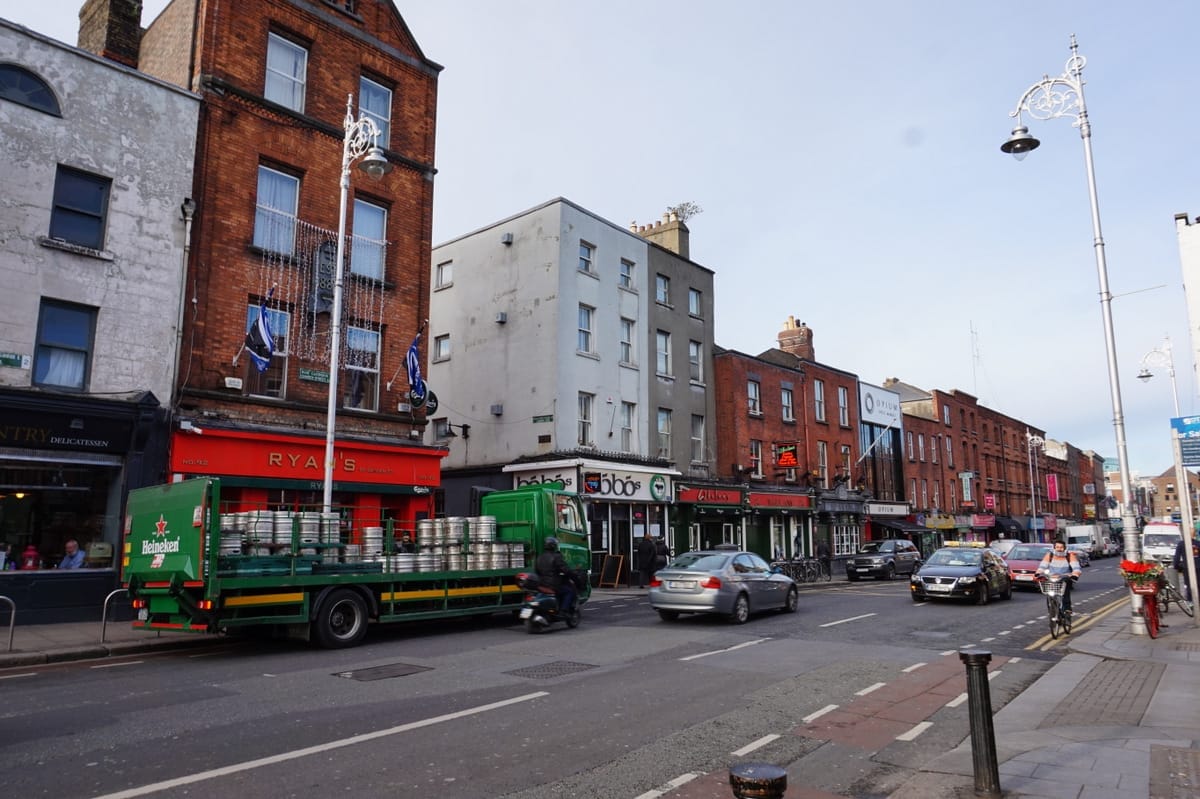
Camden Street (Irish: Sráid Camden) and Harcourt Street (Irish: Sráid Fhearchair) are two roughly parallel south-Dublin streets that together form the backbone of what local guides sometimes call the Village Quarter. Camden Street runs through the Portobello neighbourhood in Dublin 2, from Cuffe Street at the north end down towards the South Circular Road and Portobello. Harcourt Street runs roughly parallel, just to the east, meeting St Stephen's Green at its northern tip and passing the old Harcourt Street Station, a Victorian railway terminus that today anchors the Luas Green Line's Harcourt stop, before continuing south towards the South Circular Road.
Neither street is a purpose-built entertainment district in the way that Temple Bar is. They evolved organically: terraces of Georgian and Victorian red-brick buildings that were once merchant houses and professional offices gradually filled with pubs, music venues, restaurants, and late-night clubs over the course of the late 20th century. That history gives the area a more textured, less theme-park feel than some of Dublin's more tourist-facing zones.
ℹ️ Good to know
The streets themselves are public thoroughfares with no admission charge. Individual venues set their own door fees and entry policies, particularly after 11 pm at weekends.
The Streetscape: Georgian Bones Under Neon Signs
The name Camden Street first appears on Dublin maps in 1778, most likely named for John Jeffreys Pratt, 1st Earl Camden (1714–1794). By the early 19th century, the surrounding blocks were filling with terraced housing, and several historic buildings survive along the upper end of Camden Street and the nearby junction with Harcourt Road. A three-storey former house at 35 Camden Street Upper, rated of regional architectural, artistic, and social interest by the National Inventory of Architectural Heritage, is a good example of the area’s historic residential fabric before commercial uses took over at ground level.
Harcourt Street carries a grander architectural register. Its terraces are broader, the door surrounds more elaborate, and several buildings retain original Georgian fanlights and ironwork railings. The old Harcourt Street Station at the top of the street was completed in 1859 to designs by George Wilkinson and operated passenger services until 1958. Its red-brick Italianate facade, now incorporated into a hotel, gives the northern end of the street an unexpectedly monumental anchor.
Walking the area in daylight lets you notice details that disappear once the evening crowds arrive: the worn limestone steps of former townhouses, hand-painted shopfront lettering on older premises, and the way the street grid here connects directly into the Portobello and Ranelagh neighbourhoods further south, where the scale shifts entirely to quiet residential streets.
Tickets & tours
Hand-picked options from our booking partner. Prices are indicative; availability and final rates are confirmed when you complete your booking.
Giant's Causeway, Dark Hedges, and Belfast Tour from Dublin
From 85 €Instant confirmationFree cancellationDublin self-guided audio tour
From 10 €Instant confirmationBird of Prey, Cliffs of Moher and Aillwee Cave from Dublin
From 201 €Instant confirmationFree cancellationGame of Thrones Studio tour with return transfer from Dublin
From 63 €Instant confirmationFree cancellation
Daytime: A Working Street Worth Exploring Slowly
On a weekday morning, Camden Street is straightforwardly utilitarian. Butchers, off-licences, a pharmacy, a barber, a hardware shop. The footpath is narrow in places and shared between delivery vehicles and commuters, so it rewards patience rather than speed. The smell of fresh bread drifts from a bakery mid-block most mornings; a few independent coffee shops pull a regular clientele of remote workers and locals before 10 am.
Weekend afternoons have a different pace entirely. Brunch spots fill up from around midday onwards, and the stretch between Camden Street and Wexford Street sees foot traffic building steadily from 1 pm. This is a good window for exploring without feeling hemmed in, before the evening crowds arrive. Several of the pubs open from lunchtime and are genuinely quiet in the early afternoon, offering a chance to sit without the noise levels that define the night.
💡 Local tip
For photography, the light on Camden Street's west-facing terrace is best in the late afternoon, roughly 3–5 pm, when the Georgian brickwork takes on a warm tone and before the overhead signage becomes the dominant visual element.
Evenings and Nightlife: What to Expect
From around 8 pm on a Friday or Saturday, the atmosphere shifts noticeably. The streets fill, queues form outside certain venues, and the sound of live music carries from open pub doors. Wexford Street, which links Camden Street to Harcourt Street mid-block, functions as a kind of connector between the two, and several of the area's best-regarded music pubs are clustered along this short stretch.
Harcourt Street's nightlife tends toward the larger, more club-oriented end of the spectrum. Several of Dublin's longer-established late-night venues are located here, drawing crowds that skew younger and stay later. The Luas stop outside the old station is a significant practical asset: Green Line trams run until around 00:30 on Friday and Saturday nights, and the stop becomes the default meeting and departure point for large groups moving between the area and the city centre or further south to Ranelagh and Dundrum.
If a big, loud club night is not what you are after, the Camden Street end of the corridor is more varied. Smaller pubs, some with live traditional music, sit alongside cocktail bars and independent restaurants. The area is a meaningful alternative to the Liberties and Smithfield pub scene for people who want to avoid the most heavily tourist-facing parts of the city without leaving the inner southside.
⚠️ What to skip
At weekends after midnight, the streets around Camden and Harcourt can become crowded and noisy. Taxis queue but move slowly. If you plan to use the Luas, check the last tram times for the Green Line on the Transport for Ireland website before going out, as these change on different nights.
Getting There and Getting Around
The Harcourt Luas stop on the Green Line places you directly at the junction of Harcourt Street and the old station. From there, Camden Street is a five-minute walk west along Harcourt Road or via Charlotte Way. The tram connects Harcourt to St Stephen's Green in one stop and then continues through the city centre towards Broombridge, making this one of the better-served entertainment areas in Dublin for public transport.
Multiple Dublin Bus routes pass through the broader area, with stops along Camden Street and on Cuffe Street to the north, near St Stephen's Green. Current route numbers and timetables should be confirmed via the Transport for Ireland journey planner before travel, as these are subject to change.
Both streets are walkable from St Stephen's Green in under ten minutes on foot, making the area easy to incorporate into an evening that starts on the northside or in the city centre. The footpaths on Camden Street vary in width and surface quality; some sections are uneven, particularly on the older stretches near the Harcourt Road junction. The Harcourt Luas stop is wheelchair accessible, with level-access trams and ramp infrastructure at the platform.
Who Should Reconsider
Camden Street and Harcourt Street will not suit every visitor. If you are looking for daytime cultural attractions with dedicated exhibition spaces or heritage interpretation, neither street has much to offer in that sense. The architectural interest is real but it is street-level and incidental rather than curated. Families with young children will find the area livelier than convenient in the evenings, and the narrower pavements on Camden Street are not particularly pushchair-friendly during busy periods.
Travellers primarily interested in traditional Irish pub culture in a quieter setting might be better served by O'Donoghue's or the pubs around Merrion Square, where crowds tend to be smaller and the atmosphere more relaxed on a typical evening. Camden and Harcourt are best understood as a lively, mixed urban corridor rather than a heritage experience.
Practical Intelligence Summary
- Nearest Luas: Harcourt stop, Green Line. Level-access trams, wheelchair-accessible platform.
- Nearest bus stops: Camden Street and Cuffe Street. Check Transport for Ireland for current routes.
- Walking time from St Stephen's Green: approximately 8–10 minutes on foot.
- No entry fee to access the streets. Venue fees vary; confirm with individual bars or clubs before going.
- Photography is best in afternoon daylight on the Camden Street terrace and around the old Harcourt Street Station facade.
- Dress code: most pubs are casual. Some late-night venues on Harcourt Street operate a smart-casual door policy at weekends.
- Weather: Dublin's climate is temperate maritime, meaning rain is possible year-round. A compact waterproof layer is practical for any evening out.
Insider Tips
- The old Harcourt Street Station facade (now a hotel) is one of the better examples of Victorian railway architecture in Dublin and worth a look even if you are only passing through. The Italianate brickwork and arched entrance are best seen from the pavement on Harcourt Street itself, not from inside.
- Wexford Street, the short link between Camden and Harcourt, contains some of the area's most characterful music pubs. It is easy to miss if you walk the main streets without turning off, but the few minutes it takes to walk its length are well spent.
- If you want a quieter drink in the area on a weekend, arrive before 7 pm. Most of the pubs are genuinely spacious and relaxed before the dinner-to-drinks crowd arrives. After 9 pm, expect noise levels and standing-room conditions at the more popular spots.
- The Georgian terrace on the upper section of Camden Street near the Harcourt Road junction has some of the area's most intact 19th-century shopfront proportions. Look above street-level signage for original window arrangement and roofline detail.
- For those using the Luas Green Line, the stop at Harcourt is also a practical access point for St Stephen's Green, the Iveagh Gardens, and the Portobello canal walks, making it possible to build a full afternoon and evening itinerary around a single transit stop.
Who Is Camden Street & Harcourt Street For?
- Nightlife seekers who want a less tourist-saturated alternative to Temple Bar
- Casual diners looking for a broad range of restaurants and late kitchens
- Visitors interested in Georgian and Victorian streetscapes in an everyday urban context
- Groups who want flexibility between pub culture, live music, and late-night venues in a compact area
- Travellers staying in the southside who want walkable evening options without crossing the Liffey
Nearby Attractions
Other things to see while in Portobello & Ranelagh:
- Grand Canal Walk
The Grand Canal Walk traces one of Dublin's most rewarding urban towpaths through the southside neighbourhoods of Portobello and Ranelagh. Free to walk at any hour, the route offers a rare slice of calm water, Georgian bridges, and resident wildlife a short distance from the city centre.