Graceland Cemetery and Arboretum: Chicago's Open-Air Architecture Museum
Graceland Cemetery and Arboretum is a approximately 120-acre historic cemetery on Chicago's North Side where landscape design, architectural sculpture, and the city's own history converge. Established in 1860, it holds the graves of figures who literally built Chicago, from Louis Sullivan to Daniel Burnham, all set within a pastoral, park-like arboretum. Entry is free.
Quick Facts
- Location
- 4001 N. Clark Street, Chicago, IL 60613 (Clark & Irving Park Road, on the border of Lakeview and Uptown)
- Getting There
- CTA Red Line to Sheridan (approx. 0.5 mi walk west); multiple CTA bus routes serve Clark & Irving Park
- Time Needed
- 1.5 to 3 hours for a thorough walk
- Cost
- Free (open grounds); active cemetery, no general admission charge
- Best for
- Architecture lovers, history buffs, photographers, quiet walkers
- Official website
- www.gracelandcemetery.org
What Graceland Cemetery Actually Is
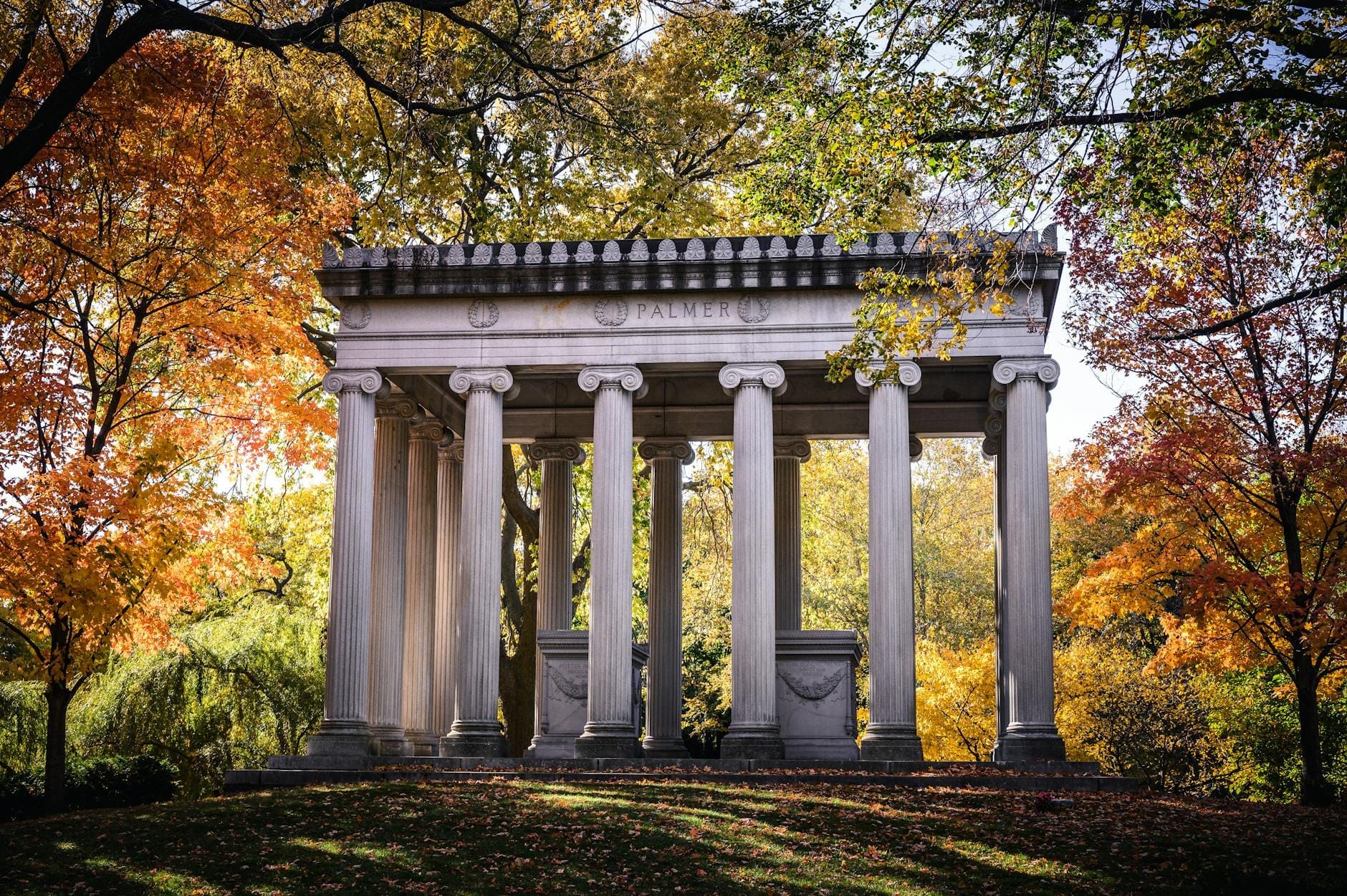
Graceland Cemetery and Arboretum is a approximately 120-acre private cemetery and designed landscape on Chicago's North Side, operating since 1860. That description undersells it considerably. This is the resting place of Louis Sullivan, Daniel Burnham, Ludwig Mies van der Rohe, and dozens of other figures who shaped Chicago's skyline, politics, and economy. The monuments and mausoleums scattered across its grounds include some of the most significant funerary architecture in the United States, with work by Sullivan himself, McKim, Mead & White, and Lorado Taft.
It sits on the border of the Lakeview and Uptown neighborhoods, about a mile north of Wrigley Field, and most visitors arrive not knowing what to expect. What they find is a quiet, gently rolling landscape with mature trees, a small lake, and an almost total absence of city noise. The grounds are formally classified as an arboretum, and the tree canopy includes labeled specimens that have stood for well over a century.
💡 Local tip
Pick up a self-guided tour map at the cemetery office near the main Clark Street entrance. Without it, you can easily walk past the most significant monuments without recognizing them. The map is free.
History and Landscape Design
Lawyer Thomas Bryan founded Graceland in 1860 and secured a perpetual charter from the State of Illinois in 1861. The original 80-acre plot was later expanded to its current roughly 119 to 121 acres. Bryan engaged H.W.S. Cleveland, a leading American landscape architect, to shape the grounds, and later work was carried out by Ossian Simonds, whose naturalistic philosophy emphasized gentle gradients, informal plantings, and the visual experience of moving through the space on foot or by carriage. The result was a landscape designed to feel more like a country park than a burial ground.
That design philosophy is still legible today. The internal roads curve rather than grid. The topography has been shaped to screen adjacent sections from one another, creating a series of distinct enclosures. The small Lake Willowmere at the center of the grounds reflects sky and tree canopy, and in late morning light the reflections of the surrounding willows and bald cypresses are genuinely striking. This kind of cemetery design, sometimes called the rural or garden cemetery movement, was a direct predecessor of the American public park, and Graceland is one of its best-preserved examples in any major city.
For visitors already interested in Chicago's architectural history, a visit pairs well with reading from the Chicago architecture guide before arriving, since many of the figures buried here are referenced in any serious account of how the city was built.
Tickets & tours
Hand-picked options from our booking partner. Prices are indicative; availability and final rates are confirmed when you complete your booking.
Chicago Graceland Cemetery self-guided audio tour
From 15 €Instant confirmationGo City | Chicago All-Inclusive Pass
From 127 €Instant confirmationFree cancellationiFLY Chicago Lincoln Park indoor skydiving experience
From 126 €Instant confirmationFree cancellationiFLY Chicago Rosemont indoor skydiving tickets
From 117 €Instant confirmationFree cancellation
The Monuments: What to Look For
The architectural and sculptural quality of Graceland's monuments is the main reason it draws visitors beyond the merely curious. Louis Sullivan's Getty Tomb (1890) is frequently cited as one of the finest examples of his ornamental style, a low limestone structure whose carved facade demonstrates exactly the kind of organic surface decoration that made Sullivan famous. Sullivan himself is buried nearby under a far more modest stone, which some find quietly ironic.
Daniel Burnham, the architect and planner behind the 1893 World's Columbian Exposition and the 1909 Plan of Chicago, is buried on a small island in Lake Willowmere, reachable only by a footbridge. The setting is deliberately dramatic. Ludwig Mies van der Rohe, who remade the Illinois Institute of Technology campus and whose steel-and-glass language defined mid-century modern architecture worldwide, has a simple flat black granite slab that is almost aggressively understated.
Lorado Taft's monumental bronze figure known as "Eternal Silence" or the "Statue of Death," erected for the Graves family, is the piece most visitors photograph. The hooded figure in dark green-brown patina stands roughly eight feet tall and does not move your eye anywhere: it simply fixes you. It was installed in 1909 and has been weathering in place ever since. The face is partially shadowed by the hood regardless of the sun's angle, which was deliberate.
Other notable monuments include the Schoenhofen mausoleum, an Art Nouveau sphinx-and-pyramid structure from 1893, and the Getty family's Getty Chapel. Visiting without a map, you can walk directly past these without recognizing what they are. The cemetery is large enough that a rushed one-hour visit will leave out roughly half the significant sites.
How the Experience Changes by Time of Day and Season
Early morning visits, before 9 a.m., offer the cemetery at its quietest. The grounds staff begins work around opening, but the interior paths are largely empty. Mist off Lake Willowmere is common on cool mornings from September through November, and the combination of that mist with the weeping willows along the bank is one of those visual moments that is difficult to manufacture artificially. Photographers working with available light should note that the main architectural monuments face in various directions, so morning light is ideal for some (the Getty Tomb faces roughly east) and flat or backlit for others.
Midday in summer is comfortable under the tree canopy but can feel warm on the open central meadow areas. The grounds are used by a modest number of local residents for quiet walks, and you may encounter small groups on organized tours. By mid-afternoon, particularly on weekends, visitor numbers increase but never approach anything like crowding. The atmosphere remains contemplative throughout.
Autumn is the most visually rewarding season. The arboretum status of the grounds means there is genuine variety in the tree species, including oaks, maples, bald cypresses, and ginkgos, and the color change from mid-October through early November produces a canopy of yellows, oranges, and reds above the stonework. Winter visits are possible and have their own character: the bare tree structure reveals sight lines through the landscape that disappear in summer, and snow on the horizontal surfaces of monuments creates strong graphic contrasts. Dress warmly; there is no shelter inside the grounds.
⚠️ What to skip
Graceland is an active cemetery. Funerals and interments take place regularly, particularly on weekday mornings. Be respectful of those proceedings. Keep voices low, give grieving families wide space, and do not photograph active services.
Getting There and Moving Around
The main entrance is at 4001 N. Clark Street, at the intersection of Clark Street and Irving Park Road. The CTA Red Line's Sheridan station is approximately half a mile to the east, a walkable distance through a residential stretch of the Lakeview neighborhood. Multiple CTA bus routes serve the Clark and Irving Park intersection directly. If you are arriving from the Loop, the Red Line is the most straightforward option. The journey from downtown takes roughly 20 minutes.
Parking is available inside the cemetery grounds for those arriving by car or rideshare. The internal road network is paved and open to vehicles, though most visitors on a focused walk will do better on foot to access the narrower paths that lead to specific monuments. The landscape design means gradients are gentle throughout, by deliberate plan: Ossian Simonds specified no more than a 6-foot rise per 100 feet of road length. This makes the grounds accessible for most walkers, though visitors with mobility needs should contact the office at +1 773-525-1105 in advance to confirm current path conditions.
Graceland sits in the Lakeview neighborhood, and a visit pairs naturally with a walk or meal in the surrounding area. If you are also visiting Wrigley Field or exploring the broader Lakeview and Wrigleyville neighborhood, Graceland is a logical addition to the same half-day.
Photography and Practical Notes
Photography of the grounds, monuments, and architecture is widely practiced and generally welcomed for personal or editorial use. The most-photographed subjects, Eternal Silence, the Getty Tomb, and the Burnham island, are all on the self-guided tour route. For the Getty Tomb, morning light from the east is preferable. For Eternal Silence, overcast light removes harsh shadows from the hood's interior and reveals more of the figure's detail. A 24-70mm equivalent lens covers most situations; a longer focal length is useful for isolating monument details across open lawn areas.
Wear shoes with some grip. The paths are paved but grass sections around individual monuments can be damp, particularly in morning hours or after rain. There are no food or drink vendors inside the grounds. The nearest cafes are along Clark Street north and south of the entrance.
ℹ️ Good to know
Visiting hours are 8:00 a.m. to 4:30 p.m. daily. Confirm current hours at gracelandcemetery.org before visiting, as hours are subject to change.
Is Graceland Worth Your Time?
For travelers interested in architecture, landscape design, or Chicago history, Graceland is among the most rewarding free sites in the city. The concentration of historically significant monuments in a single designed landscape, combined with the genuine tranquility of the grounds, makes it qualitatively different from a standard sightseeing stop. Nothing here is trying to sell you anything. The quietness is not engineered for tourists; it is simply what the place is.
Travelers who are not particularly interested in architecture, landscape history, or the specific individuals buried here are likely to find it pleasant but not especially compelling. It is not a spectacle. The reward is proportional to what you bring to it in terms of context. Families with young children should be aware that there is little in the way of interactive elements, and the requirement for quiet and respectful behavior may be challenging for small children.
Graceland is one of several Chicago sites that rewards visitors who have done some preparatory reading on the city's architectural legacy. The Chicago Architecture Foundation River Cruise and the Chicago Architecture Center both provide context that makes a Graceland visit considerably richer.
Insider Tips
- The free self-guided tour map from the main office is essential. Without it, Eternal Silence and the Getty Tomb are easy to miss in the 119 acres of grounds.
- For the best light on Lake Willowmere, arrive within an hour of opening on a clear autumn morning. The combination of mist, willows, and low-angle light is best before 9:30 a.m.
- The Burnham island is best appreciated by stopping on the footbridge rather than rushing to the grave. The reflection of the surrounding trees in still water is the point of the setting.
- Weekday mornings see the most funerary activity. If you want the grounds entirely to yourself, come on a weekend afternoon in late October or early November.
- The arboretum's tree labels are small and easy to overlook. Slow down along the perimeter path near the lake and you will find labeled specimens including a notably large bald cypress that is worth the detour.
Who Is Graceland Cemetery For?
- Architecture and design enthusiasts who want to see Sullivan and Burnham in their final context
- Photographers seeking quiet, layered light conditions and monumental subjects
- History-focused travelers tracing Chicago's Gilded Age and Progressive Era figures
- Solo walkers or couples looking for genuine quiet away from downtown
- Visitors who have already covered the main Loop attractions and want something less trafficked
Nearby Attractions
Other things to see while in Lakeview & Wrigleyville:
- Boystown (Northalsted)
Northalsted, long known as Boystown, is Chicago's most recognized LGBTQ+ neighborhood, stretching along North Halsted Street in Lakeview. It's a place to eat, drink, and attend festivals, but also a neighborhood with genuine history as the first officially recognized gay neighborhood in the United States.
- Wrigley Field
Wrigley Field is more than a stadium — it's a National Historic Landmark–eligible ballpark that has anchored Chicago's Lakeview neighborhood since 1914. Whether you're catching a Cubs game or taking a ballpark tour, this guide covers everything from getting there to the best seats in the house.