Wrigley Field: Inside Chicago's Most Beloved Ballpark
Wrigley Field is more than a stadium — it's a National Historic Landmark–eligible ballpark that has anchored Chicago's Lakeview neighborhood since 1914. Whether you're catching a Cubs game or taking a ballpark tour, this guide covers everything from getting there to the best seats in the house.
Quick Facts
- Location
- 1060 W. Addison St., Lakeview (Wrigleyville), Chicago, IL 60613
- Getting There
- CTA Red Line — Addison station (directly adjacent to the ballpark)
- Time Needed
- 3–4 hours for a game; 90 minutes for a guided tour
- Cost
- Game tickets vary by date and seat location (USD); tour tickets also dynamically priced — check mlb.com/cubs
- Best for
- Baseball fans, architecture lovers, first-time Chicago visitors, families
- Official website
- www.mlb.com/cubs/ballpark
What Wrigley Field Actually Is
Wrigley Field is the second-oldest ballpark in Major League Baseball and the oldest surviving National League ballpark in the country. Opened in 1914 as Weeghman Park for the short-lived Federal League, it became home to the Chicago Cubs in 1916 and was renamed Wrigley Field in 1926 after chewing-gum magnate William Wrigley Jr. It was added to the National Register of Historic Places in 1987 and designated a Chicago Landmark in 2004 — recognition that feels earned the moment you walk through the gates.
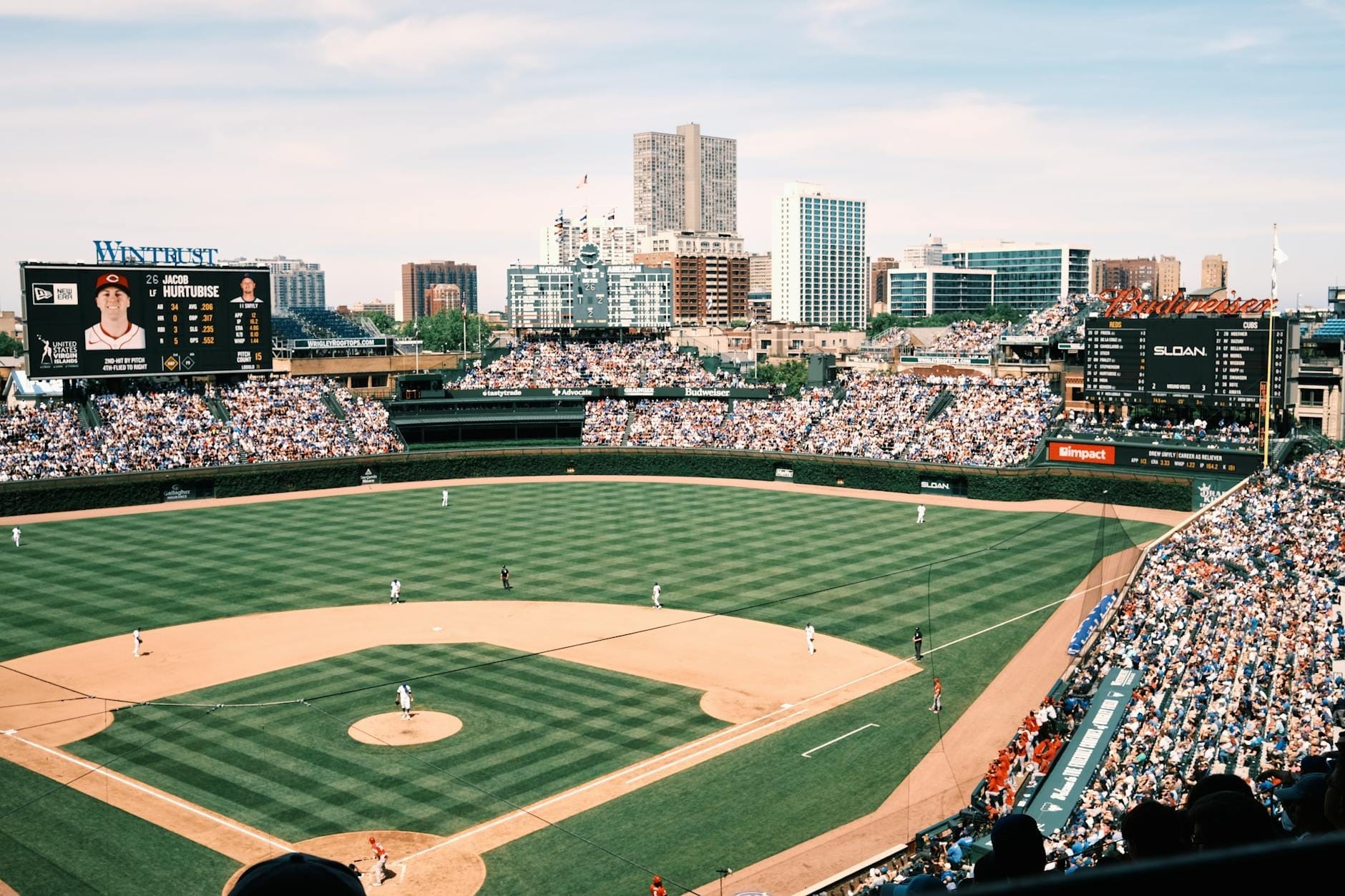
With a seating capacity of 41,649 for baseball, the park sits on a compact city block bounded by Clark Street, Addison Street, Waveland Avenue, and Sheffield Avenue. There is no vast parking campus or ring of highway ramps. The stadium simply rises out of the neighborhood, its red marquee sign hovering above Clark Street at street level. Rooftop bleachers on the buildings across Waveland and Sheffield Avenue allow fans — and locals who pay for the privilege — to watch from outside the park entirely.
💡 Local tip
The Red Line Addison station drops you at the ballpark's front door. On game days, expect platform crowding 30–60 minutes before first pitch. Arrive earlier or plan to linger after the final out when trains are packed.
The Experience: Game Day vs. Non-Game Day
A Cubs home game transforms Wrigleyville into one of the most charged street scenes in American sports. Addison Street and Clark Street fill with people in blue-and-red gear from midday onward. The bars closest to the park — packed tightly along Clark — spill out onto the sidewalks. The smell of stadium food, specifically hot dogs and the faint sweetness of Old Style beer, hits you half a block before the gates. It is loud, cheerful, and at peak afternoon games in July, genuinely sweltering.
Inside, the scale surprises first-time visitors. Wrigley is intimate by modern MLB standards. Upper-deck seats feel close to the field. The famous hand-operated scoreboard sits centered above the bleachers in center field — it has operated manually since the 1930s and still does today. The ivy covering the outfield walls, planted in 1937, turns deep green in summer and goes bare by October, giving late-season playoff games a stark, atmospheric look that photographs well from any angle.
On non-game days, the neighborhood is quieter but far from empty. The marquee at Clark and Addison draws a steady stream of visitors posing for photos regardless of the season. Ballpark tours run on select dates — these are the only way to get field-level access, walk the dugout, and see areas like the press box or the Cubs clubhouse depending on tour type. Check the tours page on mlb.com/cubs for current availability and pricing, as both change frequently.
ℹ️ Good to know
Wrigley Field does not have standard daily public walk-in hours. Access is limited to ticketed games and scheduled tours. If a tour date matters to you, book in advance — popular tour slots sell out, especially in the preseason and during summer.
Tickets & tours
Hand-picked options from our booking partner. Prices are indicative; availability and final rates are confirmed when you complete your booking.
Chicago Bears football game ticket at Soldier Field
From 278 €Instant confirmationField Museum of Natural History tickets and audio tour
From 44 €Instant confirmationGo City | Chicago All-Inclusive Pass
From 127 €Instant confirmationFree cancellationiFLY Chicago Lincoln Park indoor skydiving experience
From 126 €Instant confirmationFree cancellation
Time of Day and Seasonal Conditions
Day games at Wrigley are a distinct experience from night games. The Cubs have historically played more afternoon games than most MLB teams, and the sun position at a 1:20 PM first pitch means right-field seats get direct afternoon sun in summer. Bring sunscreen if you're sitting in the first-base or right-field sections. Upper-deck seats on the third-base side stay shaded earlier and often catch a breeze off the lake, which is about one mile east.
Night games in June and July are some of the best seats in American sports in terms of atmosphere. The lights came to Wrigley only in 1988, after decades of day-only baseball — a fact older fans still discuss with some feeling. Under the lights, the ivy and the manual scoreboard take on a different quality. The temperature usually drops 10–15 degrees from the afternoon peak, making evening games significantly more comfortable than a July afternoon contest.
Late-season games in September and October can be cold. Chicago's shoulder-season temperatures regularly drop below 50°F (10°C) at night, and the lake wind makes it feel colder. Layers are not optional — they are necessary. Conversely, April opening series games can also be frigid. The Cubs open at home in early April most years, and snow flurries during opening weekend are not historically unusual.
For a broader look at how Chicago's seasons affect outdoor plans, the best time to visit Chicago guide covers month-by-month conditions across the city.
Architecture and Historical Context
The physical structure of Wrigley Field is an artifact of early-20th-century ballpark design, when stadiums were built into city grids rather than isolated on suburban campuses. The double-deck steel-and-concrete grandstand wraps around the infield in the classic horseshoe configuration. The press box above home plate, the exposed structural columns in the lower deck, and the tight concourse beneath the seating bowl are all features that modern stadium architects have deliberately eliminated — which is precisely what makes Wrigley feel different.
A major renovation project that ran roughly from 2014 to 2019 added modern amenities, new video boards, expanded concourse areas, and improved accessibility infrastructure including elevators and ramps, while preserving the historic fabric of the building. The balance is imperfect — some long-time fans argue the new video boards are too large for the park's scale — but the National Historic Landmark designation in 2020 suggests the core character survived intact.
Wrigley Field fits naturally into a day that also includes the city's broader architectural heritage. The Chicago architecture guide provides context for how the stadium relates to the city's wider tradition of structural innovation and historic preservation.
Getting There and Navigating the Area
The CTA Red Line is the clear choice for reaching Wrigley Field. The Addison station sits literally at the ballpark's front door — you exit the turnstiles and the Clark Street gate is 50 feet away. From downtown (the Loop), the Red Line to Addison takes about 20–25 minutes. Trains run frequently on game days with added service, though post-game crowds on the platform can mean three or four trains pass before you board.
Driving is an option but comes with real tradeoffs. The surrounding streets are mostly residential with permit-only parking enforced aggressively on game days. Private lots and garages within walking distance fill quickly and charge accordingly. For most visitors, the Red Line is simply faster and less stressful. Rideshare drop-offs are designated in specific zones around the park; check the Cubs' ballpark page for the current pick-up and drop-off locations, as these have shifted with renovations.
The Lakeview neighborhood around the park is walkable and well-served by food options at every price point. Clark Street north and south of the stadium has bars, pizza spots, and fast-casual restaurants that are significantly less crowded before 11 AM or after games end. If you want to eat near the ballpark without paying a premium, arrive 90 minutes before first pitch rather than 30 minutes before.
Wrigleyville sits at the heart of the broader Lakeview and Wrigleyville neighborhood, which has its own character well beyond game days, including restaurants, nightlife, and the LGBTQ+ corridor along Halsted Street.
Photography and Practical Details
The red marquee at Clark and Addison is the most photographed element of the ballpark exterior. It faces east, so morning light works against you for a front-facing shot. Late afternoon, roughly 3–5 PM on a sunny day, provides the most flattering light on the marquee from the south side of Addison Street. The rooftop buildings on Waveland Avenue can also be photographed from street level, giving a sense of scale that most interior stadium shots miss.
Inside the park, camera policies follow standard MLB rules: personal cameras are permitted, but professional equipment with a detachable lens longer than a certain threshold (typically around 4 inches) requires a media credential. Check current bag policy on the Cubs' ballpark page before you arrive, as clear-bag requirements and prohibited items have changed in recent years and vary by event type.
Accessibility at Wrigley has improved substantially since the renovation. Elevators connect the main concourse levels, accessible restrooms are distributed throughout the ballpark, and designated wheelchair seating with companion seats is available at multiple price points. Specific accessible entrance locations and seating maps are listed under guest services on the Cubs' website. If you have specific mobility needs, contacting the guest services line in advance is worth the effort.
⚠️ What to skip
The older structural columns in the lower deck can obstruct sightlines in certain seat locations. When buying tickets, use the Cubs' seat view tool to check the perspective from your exact section before purchasing. Obstructed-view seats are typically priced lower but should be chosen deliberately, not by accident.
Is Wrigley Field Worth It If You're Not a Baseball Fan?
Honestly, yes — with a qualifier. The ballpark tour is the better route for non-fans who are drawn by the architecture and history rather than the sport. Tours provide access to parts of the stadium that a regular game ticket does not: the field level, the dugout, and historic spaces that contextualize the 110-year-old structure. It is a more considered experience than sitting through nine innings without caring who wins.
That said, attending even one game is a reasonable thing to do in Chicago regardless of your baseball knowledge, purely for the neighborhood atmosphere and the sensory experience of being in a century-old stadium. The crowds are generally good-natured, the concession food is stadium-standard, and the ivy is genuinely striking up close. Those who will find it least rewarding are travelers with very limited time who could be spending three hours at the Art Institute or the Field Museum instead. Wrigley Field is a strong choice for a half-day or evening, not a consolation prize.
If you're building a fuller Chicago itinerary, the Chicago one-day itinerary and 3-day Chicago guide both address how to balance a Wrigley visit against the city's other major draws.
The Wrigleyville Street Scene Before and After Games
The block radius around Wrigley Field before a Cubs game operates as an informal street party that starts forming two to three hours before first pitch. Clark Street is lined with bars and restaurants that have built their entire business models around game-day traffic. The foot traffic is dense, the music is audible from multiple directions, and scalpers work the sidewalk openly. It is a specific kind of Chicago atmosphere that does not exist around many other attractions.
After games, the scene either stays energetic (Cubs win) or gets quieter faster (Cubs lose). The neighborhood has a long, shared memory of losing — the Cubs went 108 years between World Series titles before winning in 2016 — and that history gives even casual encounters around the ballpark a texture you notice if you're paying attention. The 2016 championship banner on the scoreboard is visible from inside the park, and its presence still draws lingering looks from fans old enough to remember the drought.
Insider Tips
- The rooftop buildings on Waveland and Sheffield Avenues sell tickets independently of the Cubs. Watching from a rooftop gives you a birds-eye view of the ivy and the manual scoreboard that no seat inside the park can match. Search for 'Wrigley rooftops' to find current operators and pricing.
- Balls hit over the outfield walls onto Waveland Avenue (left field) are catchable by fans on the sidewalk — a tradition called 'Waveland Avenue shagging.' Bring a glove if you want to join the regulars who line up before batting practice.
- The manual scoreboard in center field is operated by hand from inside the wall during games. If you look closely through the openings, you can occasionally see the scoreboard operators. It uses a combination of metal plates and painted numbers, the same basic system it has used since the 1930s.
- For the best non-obstructed, lower-cost seats, look at the upper-deck sections along the first- and third-base lines. The sightlines are clean, you get a full view of the ivy and the skyline behind the left-field bleachers, and prices are usually significantly lower than lower-deck equivalents.
- If you plan to tour Wrigley Field without a game, mid-week tour slots outside the main season (late March to early April, or in October after the Cubs season ends) tend to have more availability and a more relaxed pace than peak summer tour dates.
Who Is Wrigley Field For?
- Baseball fans visiting Chicago who want to experience one of the sport's most storied venues
- Architecture and urban history enthusiasts interested in early-20th-century stadium design
- Families looking for a half-day activity with built-in atmosphere and neighborhood character
- First-time Chicago visitors who want to experience something distinctly local rather than generically tourist-oriented
- Sports travelers building an itinerary around Chicago's professional teams and venues
Nearby Attractions
Other things to see while in Lakeview & Wrigleyville:
- Boystown (Northalsted)
Northalsted, long known as Boystown, is Chicago's most recognized LGBTQ+ neighborhood, stretching along North Halsted Street in Lakeview. It's a place to eat, drink, and attend festivals, but also a neighborhood with genuine history as the first officially recognized gay neighborhood in the United States.
- Graceland Cemetery
Graceland Cemetery and Arboretum is a approximately 120-acre historic cemetery on Chicago's North Side where landscape design, architectural sculpture, and the city's own history converge. Established in 1860, it holds the graves of figures who literally built Chicago, from Louis Sullivan to Daniel Burnham, all set within a pastoral, park-like arboretum. Entry is free.