Fort St. Angelo: Malta's Most Storied Fortress
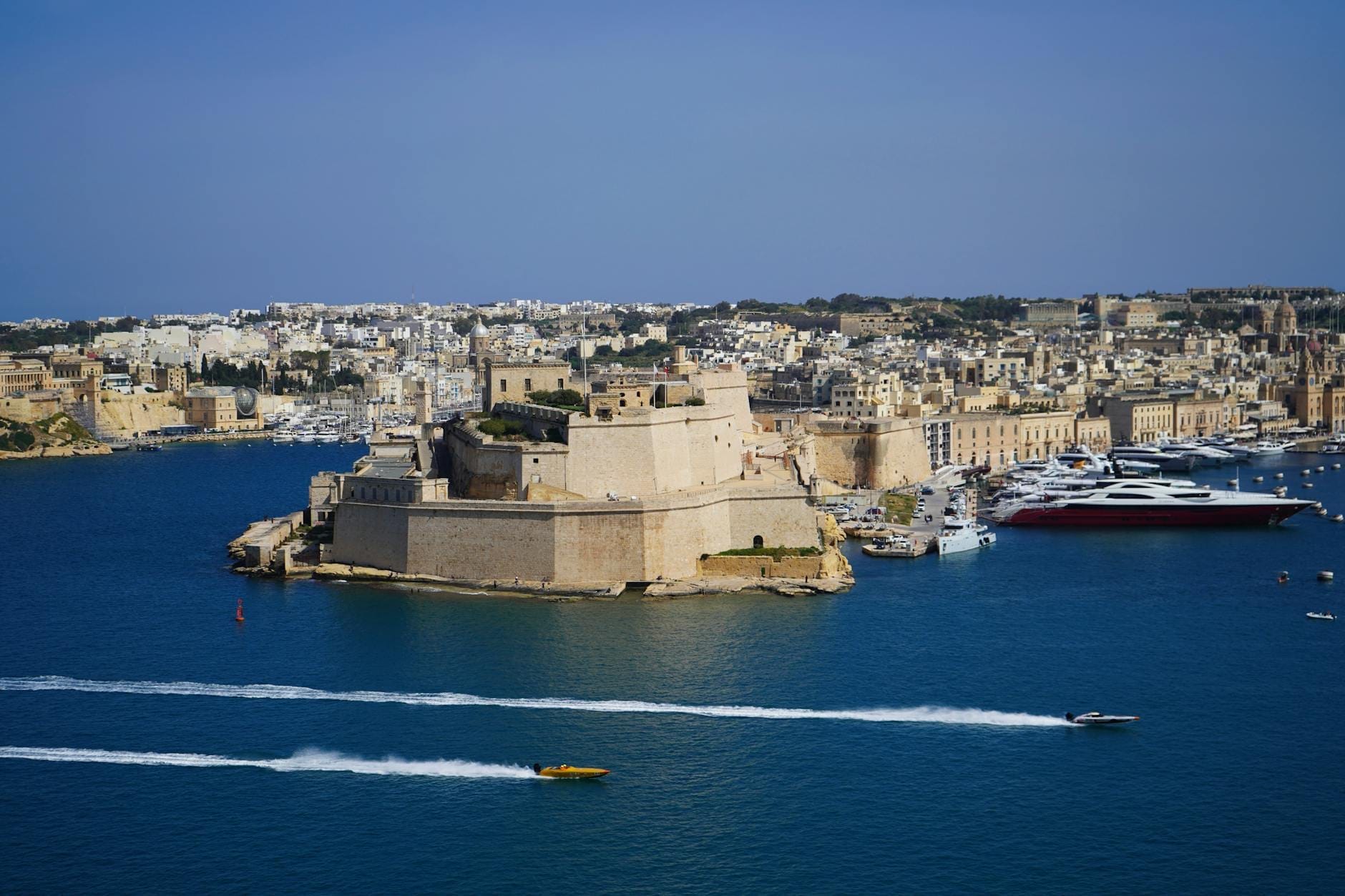
Perched at the tip of the Birgu peninsula above the Grand Harbour, Fort St. Angelo has been at the center of Mediterranean history for over 700 years. From the Knights of St. John's Great Siege of 1565 to its role as a Royal Navy shore base in WWII, this is the fortress where Malta's story was repeatedly decided.
Quick Facts
- Location
- Xatt l-Assedju l-Kbir 1565, Birgu (Vittoriosa), Three Cities, Malta
- Getting There
- Bus to Birgu area, then 10 min walk to fort entrance. Water taxi from Valletta Customs House is a scenic alternative.
- Time Needed
- 2 to 3 hours for a thorough visit
- Cost
- Admission charged (€6 for seniors 60+); verify current adult rates with Heritage Malta before visiting
- Best for
- History enthusiasts, photography, Grand Harbour panoramas, Knights of Malta deep-dives
- Official website
- heritagemalta.mt/explore/fort-st-angelo
Why Fort St. Angelo Deserves More Than a Passing Glance
Fort St. Angelo is not simply old. It is old in a way that accumulates meaning: every layer of stone here corresponds to a different era of Mediterranean power. The fort's position at the tip of the Birgu peninsula means that whoever controlled it controlled access to the Grand Harbour, one of the finest natural anchorages in the entire Mediterranean. That geography turned this rocky hillock into one of the most contested pieces of land in European history.
Most visitors to Malta spend their fortress time in Valletta, at Fort St. Elmo. Fort St. Angelo, positioned directly across the water, is less crowded and arguably more historically layered. It also sits at the heart of Birgu, the original home of the Knights of St. John before Valletta was ever built, which gives the Three Cities area a depth that Valletta's more polished streets sometimes obscure.
💡 Local tip
The water taxi (dgħajsa) from Valletta Customs House to the Three Cities drops you within a short walk of the fort and gives you your first view of Fort St. Angelo from the water, the same approach that warships and supply vessels used for centuries. It costs just a couple of euros and is far more atmospheric than arriving by bus.
Seven Centuries of History, Compressed
The site was documented as Castrum Maris, meaning castle-by-the-sea, by at least 1274, though the fortifications almost certainly predate that record. By that point it was already functioning as a coastal defensive position, guarding the harbour approach during the medieval period of Arab and Norman rule over the islands.
The story that most defines the fort began in 1530, when the Knights of St. John, recently expelled from Rhodes by the Ottomans, accepted Malta from Holy Roman Emperor Charles V as their new base. They immediately recognized Fort St. Angelo's value, made Birgu their headquarters, and spent the next three decades rebuilding and reinforcing it. The fort became the nerve center of the Knights' military operations and their first line of defence.
That defence was tested to its absolute limit in the Great Siege of 1565, when an Ottoman force estimated at 30,000 to 40,000 men besieged the island for nearly four months. Fort St. Angelo, firing across the harbour at Ottoman positions, held throughout the siege. The fortress became a symbol of Christian Europe's resistance. If you want to understand the full political and religious stakes of that confrontation, the Knights of Malta history guide provides essential context before your visit.
The fort continued to evolve. A major reconstruction by military engineer Carlos Grunenbergh in the 1689 to 1690s gave it four gun platforms capable of mounting around 50 artillery pieces, the configuration that defines much of what you see today. Then came the British, who used it as a Royal Navy shore base. Commissioned as HMS Egmont in 1912 and later renamed HMS St Angelo in 1933, it absorbed 69 direct bomb hits during WWII without being put out of action. It continued as a Royal Navy shore establishment until Malta's independence era, finally being handed back to Malta in 1979.
In 1998, the upper section of the fort was conceded to the Sovereign Military Order of Malta on a 99-year lease, reuniting the fortress symbolically with the Order that built it up four and a half centuries earlier. The fort has also been on UNESCO's tentative World Heritage list since 1998.
Tickets & tours
Hand-picked options from our booking partner. Prices are indicative; availability and final rates are confirmed when you complete your booking.
City Sightseeing hop-on hop-off bus tour of Gozo
From 20 €Instant confirmationFree cancellationThe Malta Experience Audio-Visual Show and La Sacra Infermeria Tour
From 20 €Instant confirmationFree cancellationLuggage Storage in Malta
From 6 €Instant confirmationFree cancellation6-day heritage and attractions pass in Malta
From 80 €Instant confirmationFree cancellation
What You Actually See Inside
Heritage Malta manages the site and has organized the interior into a clear visitor circuit. The historical displays are genuinely informative rather than superficial, covering the medieval origins, the Knights' occupation, the Great Siege, the British naval years, and the WWII period. There are artifacts, reconstructed spaces, and interpretive panels that reward careful reading rather than a quick scan.
Architecturally, the fort is a layered organism. You move through different centuries as you walk its corridors and ramps. The Chapel of St. Anne, which sits within the fort's walls, dates back to Norman times in its origins and remains one of the oldest chapels in Malta. Its scale is intimate rather than grand, which makes it feel more genuinely old than many of the island's more photographed churches.
The gun emplacements deserve time. Standing on the wide stone bastions and imagining those 50 artillery pieces trained across the water at Ottoman galleys requires some effort, but the geography makes it viscerally possible. You can look directly across to where the Ottoman encampments would have been on the surrounding heights. The spatial relationships that defined the siege become legible in a way they cannot from a book or a map.
⚠️ What to skip
Access to the upper fort is possible only by steps. There are no lifts or ramps to the upper level. Visitors with mobility difficulties should factor this in before purchasing tickets, as significant portions of the most dramatic viewpoints require stair climbing.
The Views From the Bastions
The panorama from Fort St. Angelo's upper bastions is among the best in Malta and one of the least discussed. You see the Grand Harbour in its full width, with Valletta's fortifications directly opposite, the Upper and Lower Barrakka Gardens visible on the Valletta promontory, and the open Mediterranean beyond. Cruise ships, tankers, and traditional fishing boats share the water below in a composition that is genuinely difficult to photograph badly.
In the early morning, particularly between 7am and 9am, the light hits the limestone facades of Valletta from the east and turns them a warm amber. This is the hour when the harbour is at its quietest and the views feel private rather than shared with tour groups. By mid-morning the atmosphere shifts, the heat builds, and the fortress fills with guided groups arriving from cruise ships docked in the harbour below.
Late afternoon brings a different quality of light, golden and angled from the west, which illuminates the fortifications of the Three Cities behind you rather than Valletta in front. For photographers who want the fort itself rather than the harbour view, afternoon is actually more productive. The crowds also thin noticeably after 3pm.
Getting There and Practical Details
The fort is addressed at Xatt l-Assedju l-Kbir 1565 in Birgu, which is a formal address for what is effectively the waterfront beside the fort entrance. Bus services run to the Birgu area, with the closest stop around 10 minutes on foot from the entrance. Check Malta Public Transport route information before you travel, as routes and frequencies vary by season.
The water taxi from Valletta is the recommended approach for most visitors. The traditional Maltese dgħajsa boats operate from the Customs House in Valletta and land at the Three Cities waterfront, leaving you a short walk from the fort. It is an experience in its own right. For broader context on navigating the island, the guide to getting around Malta covers all transport options in detail.
Admission fees: Heritage Malta charges €6 for senior citizens (60+) as of January 2024. Adult and concession prices should be verified directly with Heritage Malta before visiting, as fees are subject to change. No opening hours were confirmed at the time of writing; check the official Heritage Malta website for current operating times before making the trip.
Wear comfortable, closed footwear. The stone surfaces inside the fort are uneven and can be slippery after rain. In summer, the limestone bastions radiate heat intensely by midday; bring water and sun protection if you plan an extended visit. There is no significant shade on the upper gun platforms.
Fort St. Angelo Within Birgu
The fort is the anchor attraction of Birgu, but the town around it is worth at least half a day on its own. Birgu's narrow streets, auberges, and fortified walls predate Valletta by decades, and the atmosphere is considerably less tourist-polished. The Inquisitor's Palace is a short walk from the fort and represents one of the few surviving inquisitors' palaces in the world, a genuinely unsettling and fascinating building. The combination of Fort St. Angelo in the morning and the Inquisitor's Palace in the afternoon makes for a full and coherent day in the Three Cities.
Travelers who expect the polished presentation of a large national museum may find Fort St. Angelo's experience rougher around the edges. The charm is inseparable from the authenticity: this is a working historical fortress, not a reconstructed theme park. Some areas are unrestored and feel like genuine ruins rather than curated exhibits. That is either a drawback or the main point, depending on what kind of traveler you are.
ℹ️ Good to know
Fort St. Angelo is best combined with a broader Three Cities walking route. Birgu, Senglea, and Cospicua together form a compact peninsula across the harbour from Valletta that most day-trippers skip entirely, which means you experience a side of Malta that remains genuinely local in character.
Insider Tips
- Book tickets through Heritage Malta in advance during summer months, particularly July and August, when cruise ship arrivals can send visitor numbers spiking mid-morning with little warning.
- The water taxi return to Valletta in the late afternoon, with the sun behind you and the baroque skyline ahead, is one of the best ten minutes in Malta. Do not take the bus back and miss it.
- Bring binoculars. The bastions offer clear sightlines to Fort St. Elmo across the water, and during the summer In Guardia pageant re-enactments, the ceremonial activity is visible from the upper ramparts.
- The Chapel of St. Anne inside the fort is tiny and easy to rush past. It is one of the oldest functioning chapels in Malta and worth a quiet five minutes if you find it empty.
- Fort St. Angelo has appeared on Maltese commemorative coins and stamps. Spotting its silhouette from a café window in Birgu, coffee in hand, is a small pleasure worth noticing.
Who Is Fort St. Angelo For?
- History enthusiasts, particularly those with an interest in medieval military architecture or the Knights of St. John
- Photographers seeking Grand Harbour panoramas without Valletta's crowds
- Travelers combining a day in the Three Cities with the Inquisitor's Palace for a full historical immersion
- WWII history buffs interested in Malta's remarkable role in the Mediterranean campaign
- Anyone who finds fortress interiors more compelling when they look like fortresses rather than museums
Nearby Attractions
Other things to see while in The Three Cities:
- Fort Rinella
Fort Rinella in Kalkara houses one of only two surviving Armstrong 100-ton rifled muzzle-loading guns in the world. Built between 1878 and 1886 to defend the Grand Harbour, this Victorian battery is now a living museum run by the Malta Heritage Trust, open exclusively on Saturdays with guided tours included in admission.
- Gardjola Gardens
Perched at the southern tip of Senglea in Malta's Three Cities, Gardjola Gardens offers one of the most striking views of the Grand Harbour anywhere in the archipelago. Entry is free, the historic vedette watchtower is right at the garden's edge, and the whole place rewards those willing to cross the water from Valletta.
- Inquisitor's Palace
Hidden in the narrow streets of Birgu (Vittoriosa), the Inquisitor's Palace is one of the rarest buildings of its kind still open to the public anywhere in the world. From its forbidding prison cells to the grandeur of the inquisitor's private quarters, the palace traces over 400 years of Maltese legal, religious, and social history under a single roof.