Fort Rinella: Malta's Victorian Fortress and the World's Biggest Surviving Cannon
Fort Rinella in Kalkara houses one of only two surviving Armstrong 100-ton rifled muzzle-loading guns in the world. Built between 1878 and 1886 to defend the Grand Harbour, this Victorian battery is now a living museum run by the Malta Heritage Trust, open exclusively on Saturdays with guided tours included in admission.
Quick Facts
- Location
- Triq il-Kanun tal-Mija (St Rocco Road), Kalkara, Malta
- Getting There
- Bus no. 3 from Valletta main station (every 30 min, Mon–Sat); alight at the main gate
- Time Needed
- 1.5 to 2.5 hours, including the guided tour
- Cost
- Adults (16+) €12, Children (5–15) €7, Family (2 adults + 3 children) €28. Members free. Includes guided tour and audio-guide.
- Best for
- Military history enthusiasts, families with older children, photography
- Official website
- www.wirtartna.org/fortrinella
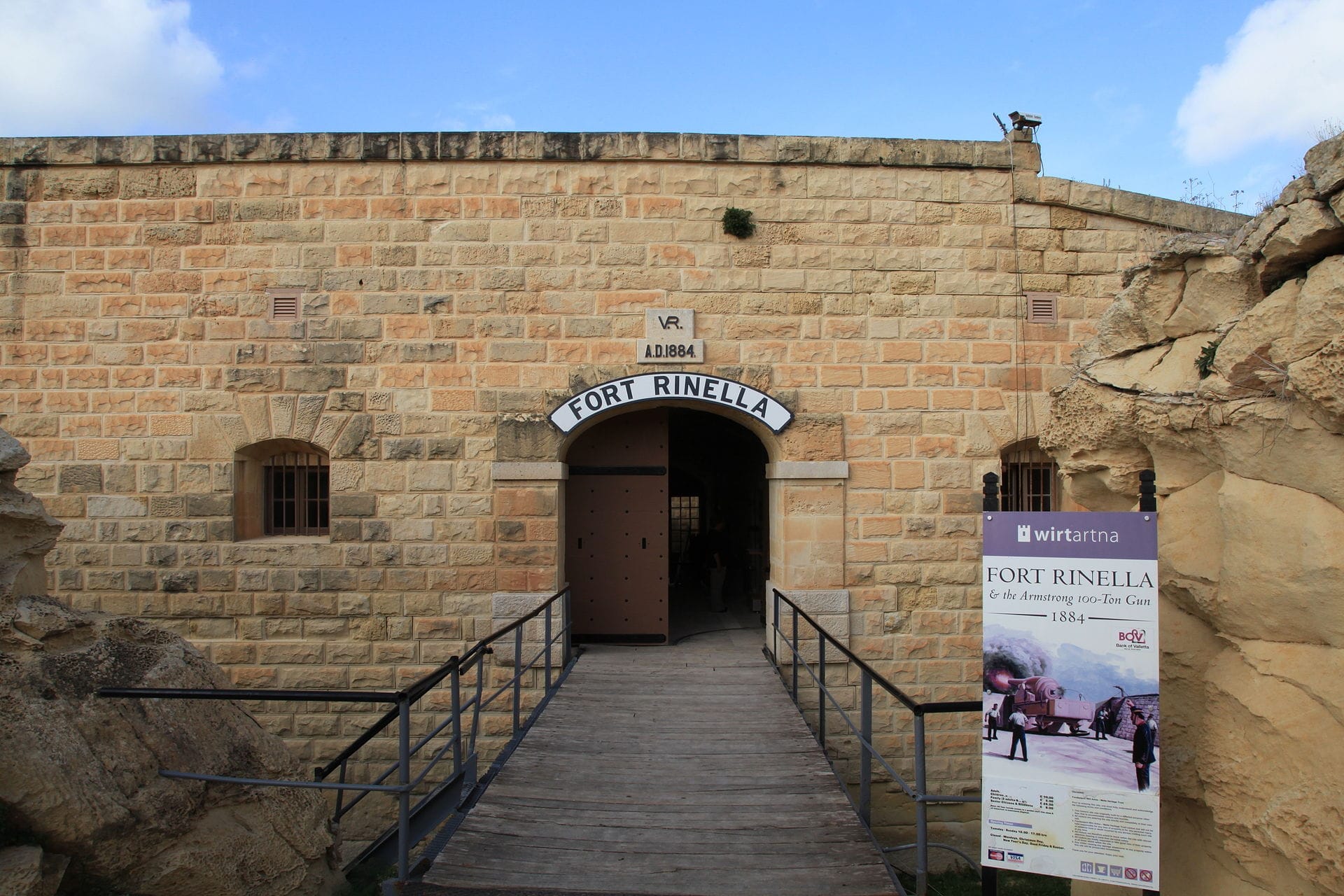
What Fort Rinella Actually Is
Fort Rinella, officially known as Rinella Battery (Batterija ta' Rinella), is a Victorian-era coastal fortification in Kalkara, sitting on the eastern shore of the Grand Harbour entrance between Fort Ricasoli and Fort St. Rocco. Construction ran from 1878 to 1886, commissioned by the British colonial government to counter the threat of heavily armoured ironclad warships that were rendering older limestone gun batteries obsolete.
The fort's single defining feature is its Armstrong 100-ton rifled muzzle-loading gun, a 17.72-inch barrel that arrived in 1882 and entered service in 1884. It is one of only two such guns still in existence anywhere in the world; the other stands at Gibraltar. The sheer scale of the weapon shaped the entire design of the battery around it. Everything from the hydraulic loading machinery to the underground magazines was engineered for one purpose: to fire a projectile capable of penetrating the thickest armour plating of the era.
ℹ️ Good to know
Fort Rinella is open on Saturdays only, from 10:00 to 16:30, with last admission at 16:00. It is closed on 24, 25, and 31 December, 1 January, Good Friday, and Easter. Plan your visit accordingly.
The gun was declared obsolete by 1906, as naval technology had advanced beyond even the most powerful fixed coastal artillery. The site was eventually taken over by Fondazzjoni Wirt Artna (the Malta Heritage Trust) in 1991 and opened to the public as a museum in 1996. The foundation has since restored the fort's operational mechanisms and now fires the cannon once a year using a blank charge, making it the only functional 100-ton Armstrong gun in the world.
The Scale of the Gun: Understanding What You Are Looking At
Nothing in a photograph prepares you for the physical presence of the Armstrong 100-ton gun. The barrel alone stretches over nine metres, and the mounting platform, traversing carriage, and hydraulic elevating gear occupy a pit roughly the size of a tennis court. The gun weighs approximately 101 tonnes, took teams of men to operate, and required its own dedicated steam-powered hydraulic system just to load. A full firing cycle took roughly seven to eight minutes.
The guided tour walks you through the loading sequence in real time, using the original Victorian machinery. Watching the loading tray and ramming mechanism operate at human scale makes it genuinely easier to understand why these guns became engineering curiosities rather than practical weapons. They were simultaneously the most powerful coastal artillery ever built and almost immediately overtaken by faster-firing, breech-loading alternatives.
Photography of the gun is best done from the traversing platform itself, where you can capture the full length of the barrel against the backdrop of the Mediterranean. Morning visits produce slightly softer light on the pale limestone and metalwork, though the fort faces roughly southeast, so midday light is generally flat. The underground magazine areas are dimly lit and benefit from a wide-aperture lens if you carry one.
Tickets & tours
Hand-picked options from our booking partner. Prices are indicative; availability and final rates are confirmed when you complete your booking.
City Sightseeing hop-on hop-off bus tour of Gozo
From 20 €Instant confirmationFree cancellationThe Malta Experience Audio-Visual Show and La Sacra Infermeria Tour
From 20 €Instant confirmationFree cancellationLuggage Storage in Malta
From 6 €Instant confirmationFree cancellation6-day heritage and attractions pass in Malta
From 80 €Instant confirmationFree cancellation
The Experience by Time of Day
The fort opens at 10:00 and the first guided tours tend to depart shortly after. Arriving early gives you the best chance to explore the exterior spaces and underground tunnels before larger tour groups from coaches arrive mid-morning. The site is compact but layered, with multiple levels of galleries, engine rooms, and magazines that benefit from unhurried exploration.
By around 11:30, the courtyard can feel noticeably busier, particularly on Saturdays when family groups and organised tours overlap. The fortifications offer limited shade in summer, so late afternoon visits (while still within opening hours) are cooler and more comfortable between June and September. Bring water regardless of the season; the battery has no café or refreshment point on site.
💡 Local tip
Arrive at 10:00 to join the first tour of the day. You will move through the underground galleries with fewer people around you, which significantly changes the atmosphere in the narrow passages and magazine rooms.
The smell inside the fort is notably different from the warm limestone air above ground: the underground rooms carry a cool, slightly damp mineral scent, and the engine room retains the faint residue of oil and grease from restored machinery. These sensory contrasts, stepping from the bright Mediterranean glare into a Victorian hydraulic engine room, are part of what makes the visit memorable beyond the historical content.
Historical Context: Why This Fort Was Built Here
By the 1870s, the Grand Harbour had been Malta's strategic reason for existing as a British naval base for over sixty years. The rise of ironclad warships capable of withstanding traditional smooth-bore artillery forced the British Admiralty to commission new generation artillery positions at key harbour approaches across the Empire. Fort Rinella was one such response, positioned to cover the southern approaches to the Grand Harbour in combination with Fort Ricasoli on the opposite headland.
The choice of the 100-ton Armstrong gun reflects just how seriously the British took the threat. These weapons were the most technologically advanced heavy artillery of their era, designed specifically to defeat heavily armoured vessels at range. For context, the gun at Fort Rinella fired projectiles weighing approximately 907 kilograms. The fortress and its gun were a direct product of the late Victorian arms race between naval armour and coastal artillery. To understand the broader military history that shaped this coastline, the Knights of Malta history guide provides essential background on how the island's strategic position made it a target of constant fortification across the centuries.
The fort saw no combat during its operational life. By the time World War I brought renewed strategic pressure to Malta, the 100-ton gun had already been retired for nearly a decade. During World War II, the site was reused for other military purposes, though its primary artillery function was long past. The postwar decades left it unmaintained until Fondazzjoni Wirt Artna began its methodical restoration in the 1990s.
Getting There and Practical Logistics
Fort Rinella sits in Kalkara, a quiet residential area on the eastern edge of the Grand Harbour. The most straightforward route from Valletta is Bus no. 3, which runs every 30 minutes Monday through Saturday and stops directly at the main gate. The journey from Valletta takes roughly 20 to 25 minutes depending on traffic. Note that bus frequency may vary on public holidays, which is relevant since the fort itself closes on several key dates.
By car, the approach is through the Cottonera area and Kalkara village, following signs toward the fort. Roadside parking is available near the entrance, though the lanes are narrow in places. Visitors combining Fort Rinella with nearby sites should note that Fort St. Angelo is a logical companion stop, accessible from the Three Cities waterfront. The two forts together give a comprehensive picture of how Grand Harbour was defended across different centuries.
The terrain inside Fort Rinella includes stairs, uneven stone surfaces, and low ceilings in some underground sections. Visitors with mobility limitations should be aware that the site's Victorian-era construction was not designed with modern accessibility in mind. Contact Fondazzjoni Wirt Artna directly before visiting to discuss specific requirements.
⚠️ What to skip
The fort is only open on Saturdays. If you are visiting Malta mid-week or planning a tight itinerary, this single-day opening is the most common reason visitors miss it. Double-check closure dates for public holidays before travelling to the site.
Who This Attraction Suits (and Who Might Want to Skip It)
Fort Rinella works best for travellers with a genuine interest in military history, industrial archaeology, or Victorian engineering. The guided tour is detailed and assumes at least moderate curiosity about how the machinery and fortifications functioned. Younger children who are not engaged by historical explanation may find the visit slow between the more visually dramatic moments. Families with children aged ten and above tend to get significantly more from the experience. For a broader itinerary that balances historical and outdoor experiences, the Malta attractions overview offers useful context for planning.
Travellers with very limited time in Malta who are choosing between major sites will need to weigh Fort Rinella against more broadly appealing alternatives. The Saturday-only opening also makes scheduling inflexible. That said, for anyone who has already seen Valletta's main historic sites and wants something genuinely unusual, the fort delivers an experience with almost no equivalent elsewhere in the Mediterranean. There is nowhere else you can stand next to a functional 100-ton Armstrong gun.
The surrounding Three Cities area rewards a full day rather than a rushed afternoon. After visiting Fort Rinella, the waterfront of Vittoriosa (Birgu) and the Inquisitor's Palace offer a complete shift in historical register, from Victorian military engineering to the ecclesiastical power structures of the Knights of St John.
The Annual Cannon Firing
Once a year, Fondazzjoni Wirt Artna fires the Armstrong 100-ton gun with a blank charge, making it the only occasion in the world when one of these weapons is actually discharged. The event draws a significant audience and is typically announced well in advance through the foundation's website and social media channels. If your travel dates coincide with this event, it is worth planning around it deliberately. The sound and spectacle of the gun firing, even without a live projectile, is by all accounts extraordinary.
Check the official website at wirtartna.org/fortrinella for the annual firing date, which varies from year to year. Tickets for this event may sell out or require advance booking, separate from standard admission.
Insider Tips
- The guided tour is included in admission and is not optional for the gun mechanism areas. Do not expect to explore those sections independently. Work with the tour schedule rather than against it.
- If you are driving, the lane approaching the fort is narrow. Larger vehicles should park before the final turn and walk the last few hundred metres to avoid difficulty reversing.
- The underground magazine rooms can be significantly cooler than outside, which is welcome in summer but worth noting in winter when temperatures on exposed limestone can feel raw. A light layer helps.
- Combine the visit with a walk along the Kalkara waterfront afterward. The views back across the Grand Harbour toward Valletta are excellent from this angle and almost entirely tourist-free.
- The annual gun firing is announced on the Fondazzjoni Wirt Artna website and social channels. If you are specifically interested in the mechanical demonstration at full scale, timing your visit for this event is worth the effort of checking dates in advance.
Who Is Fort Rinella For?
- Military history and industrial heritage enthusiasts
- Photographers interested in Victorian-era engineering and fortifications
- Families with children aged 10 and above who have an interest in history
- Travellers who have already covered Valletta's main sites and want something genuinely off the standard circuit
- Anyone who wants to see one of only two surviving Armstrong 100-ton cannons in the world
Nearby Attractions
Other things to see while in The Three Cities:
- Fort St. Angelo
Perched at the tip of the Birgu peninsula above the Grand Harbour, Fort St. Angelo has been at the center of Mediterranean history for over 700 years. From the Knights of St. John's Great Siege of 1565 to its role as a Royal Navy shore base in WWII, this is the fortress where Malta's story was repeatedly decided.
- Gardjola Gardens
Perched at the southern tip of Senglea in Malta's Three Cities, Gardjola Gardens offers one of the most striking views of the Grand Harbour anywhere in the archipelago. Entry is free, the historic vedette watchtower is right at the garden's edge, and the whole place rewards those willing to cross the water from Valletta.
- Inquisitor's Palace
Hidden in the narrow streets of Birgu (Vittoriosa), the Inquisitor's Palace is one of the rarest buildings of its kind still open to the public anywhere in the world. From its forbidding prison cells to the grandeur of the inquisitor's private quarters, the palace traces over 400 years of Maltese legal, religious, and social history under a single roof.