Gardjola Gardens: Senglea's Watchtower Viewpoint Over the Grand Harbour
Perched at the southern tip of Senglea in Malta's Three Cities, Gardjola Gardens offers one of the most striking views of the Grand Harbour anywhere in the archipelago. Entry is free, the historic vedette watchtower is right at the garden's edge, and the whole place rewards those willing to cross the water from Valletta.
Quick Facts
- Location
- Southernmost tip of Senglea (Isla), Three Cities, Malta
- Getting There
- Bus to Isla Bus Terminus then a short walk; or Valletta–Cospicua ferry then approx. 25 min walk
- Time Needed
- 30–60 minutes for the gardens; allow half a day if exploring Senglea
- Cost
- Free entry
- Best for
- Harbour views, military history, photography, quiet escapes from Valletta crowds
What Gardjola Gardens Actually Is
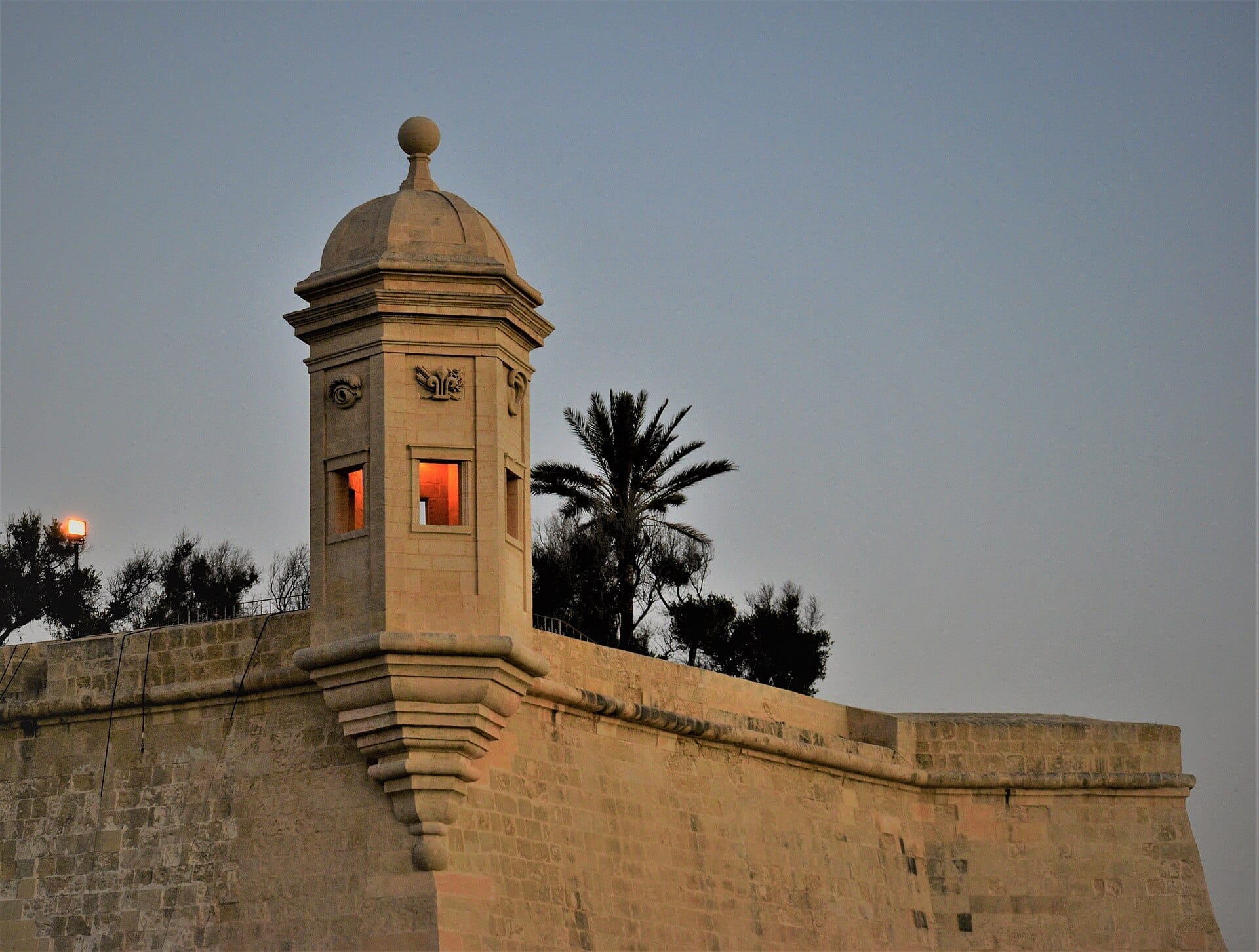
Gardjola Gardens is a compact public garden sitting at the absolute tip of the Senglea peninsula, the smallest of Malta's Three Cities. At its edge stands il-Gladiola (Gardjola), a carved limestone watchtower that has looked out over the Grand Harbour since the time of the Knights of St. John. The tower is not a museum and there is no queue to join. You simply walk to it, lean against the parapet, and take in one of the most layered harbour views in the Mediterranean.
This is not a botanical garden in the traditional sense. The plantings are modest: shade trees, benches, and a low boundary wall that separates you from a long drop to the water. What draws people here is the perspective. From this point, you can see Valletta's fortified walls directly across the water, the dockyard cranes of the Three Cities to the right, and the open harbour stretching toward the sea on the left. On clear days, the view extends to Fort St. Angelo and the tip of Birgu.
💡 Local tip
The garden sits at the same level as Senglea's elevated street grid. To reach it, walk south along Triq Bir id-Deheb through the upper part of town. If you arrive by the eastern shoreline stairs from a car park below the walls, follow the steps up and turn left.
The Vedette: A Watchtower Worth Understanding
The structure, called il-Gladiola in Maltese (gardjola means 'guard post' or lookout point), was built by the Knights of St. John as a military surveillance point. Its carved stone decorations are specific and deliberate: a human eye and an ear are sculpted into the stone, symbols that the watchtower sees and hears everything that moves through the harbour. This kind of iconographic fortification detail is rare and far more interesting than most tourists expect when they arrive.
The tower predates Senglea's greatest moment. In 1565, during the Great Siege of Malta, Senglea withstood a sustained Ottoman assault and earned the title Città Invicta, the Invincible City. The town had been established by Grand Master Claude de la Sengle in 1551, and the fortifications including this watchtower were part of that original defensive vision. Walking the edge of the garden, you are standing on walls that saw one of history's most dramatic siege defenses.
For deeper context on the Knights' legacy across the harbour, the Fort St. Angelo in nearby Birgu is directly visible from here and offers a more detailed military history experience. The Knights of Malta history guide is also worth reading before or after your visit.
Tickets & tours
Hand-picked options from our booking partner. Prices are indicative; availability and final rates are confirmed when you complete your booking.
City Sightseeing hop-on hop-off bus tour of Gozo
From 20 €Instant confirmationFree cancellationThe Malta Experience Audio-Visual Show and La Sacra Infermeria Tour
From 20 €Instant confirmationFree cancellationLuggage Storage in Malta
From 6 €Instant confirmationFree cancellation6-day heritage and attractions pass in Malta
From 80 €Instant confirmationFree cancellation
How the Experience Changes by Time of Day
Morning visits, particularly in spring and autumn, are the most rewarding. The light falls across the harbour from the east, illuminating Valletta's golden limestone facades directly ahead of you. The garden is quiet, with only the occasional dog walker or local resident on a bench. The water is calm and the reflections of the fortifications are sharp enough to photograph without a tripod.
By midday in summer, the terracotta-colored walls radiate heat and the garden offers little shade beyond a few trees near the benches. It is still worth visiting, but keep it short and bring water. The afternoon light between 16:00 and 18:00 shifts the harbour to amber tones that make the vedette tower glow against the sky.
At dusk, the gardens attract a small crowd of locals. The Valletta waterfront lights up across the water, and if a superyacht or cruise ship has anchored in the Grand Harbour, its silhouette frames the scene in a way that photographs rarely do justice to. This is the best time for photography if you want atmosphere rather than pure architectural clarity.
⚠️ What to skip
In peak summer (July–August), Senglea itself can be extremely quiet on weekdays, with many local businesses closed. Check before combining the gardens with a meal or cafe stop in town.
Getting There: Practical Options
Most visitors approach from Valletta. The Valletta–Cospicua ferry crosses the Grand Harbour in minutes and operates regularly, making it a practical and scenic option. From the Cospicua (Bormla) terminal, Senglea is roughly a 25-minute walk through the Three Cities streetscape. The walk itself passes through Cospicua and into Senglea's lower waterfront, which is worth doing at least one way.
By bus, routes serve the Isla Bus Terminus in Senglea. From the terminus, the gardens are a short walk northwest following the peninsula toward its tip. By car, limited parking exists on top of the city walls adjacent to the gardens, or in a lower car park at the shoreline accessed from the east side, with stairs connecting up to the garden level. The terrain involves steps in several approaches, but the garden itself has a ramp at the entrance, and the path to the vedette is accessible.
If you are planning a full Three Cities day, the Inquisitor's Palace in Birgu is a logical companion attraction, and the Three Cities area rewards slower exploration.
What to Know Before You Go
Entry is free and no booking is required. The gardens are public space managed by the local council and open during daylight hours, though exact closing times are not formally posted. There are no facilities inside the gardens: no toilets, no cafe, and no gift shop. The nearest amenities are back along the main street through Senglea.
The garden is compact enough that you will cover it in 15 to 20 minutes if you are moving purposefully. Most visitors spend 30 to 45 minutes, lingering at the vedette and adjusting for the best photography angle. The low stone parapet at the very tip has no railing beyond a low wall, so watch children carefully near the edges.
There is no bad weather for this garden in the mild sense, but the limestone surfaces become slippery after rain and the low seating areas are fully exposed during winter storms. The best months for visiting are April through June and September through October, when temperatures range from 20 to 28 degrees Celsius and the harbour light is at its most flattering.
ℹ️ Good to know
Photography tip: a wide-angle lens captures the full sweep from Fort St. Angelo on the right to Valletta's Baroque skyline on the left. The vedette tower works best as a foreground element in late afternoon light when the harbour is glittering behind it.
Honest Assessment: Who Will Love It and Who Will Not
Gardjola Gardens delivers far more than its compact footprint suggests for anyone interested in Malta's military and maritime history. The view is genuinely exceptional and the vedette is an architectural detail that rewards close attention. The fact that it is free, uncrowded, and overlooked by most day-trippers to Malta makes it stand out.
It is not a half-day destination on its own. If you are traveling specifically to see the garden and nothing else in Senglea, you may find the journey longer than the time spent there. Combine it with a broader Three Cities walk, the ferry crossing from Valletta, or a late afternoon stroll along the Senglea waterfront to make the logistics worthwhile.
Visitors looking for a fuller viewpoint experience in Valletta itself might also consider the Upper Barrakka Gardens, which offer a complementary view looking toward Senglea from the opposite shore. The two viewpoints are best understood as a pair: one looks from the capital outward, the other looks back from the fortified peninsula. For those building a broader itinerary, the things to do in Valletta guide covers the full neighbourhood context.
Travelers who are primarily interested in beaches, nightlife, or modern Malta will not find much to hold their attention here. The garden's appeal is quiet and historical. If standing on fortification walls while looking at a limestone harbour city does not sound compelling, this stop is skippable.
Insider Tips
- Walk to the very tip of the garden and look straight down at the water. The harbour depth at this point makes the colour an unusual deep teal, noticeably different from the shallower areas near the Three Cities marina.
- The carved eye and ear on the vedette tower are on the outer face of the turret facing the harbour. Most visitors miss them because they approach from the garden side. Walk around to the front of the tower and look at the carved decorative panels directly.
- The gardens are one of the better spots to watch the Valletta ferry traffic and occasional superyacht movements without the crowds that gather at the Upper Barrakka Gardens across the water.
- Combine your visit with the Senglea waterfront promenade below the walls. You can descend via the eastern stairs after the garden and walk back along the water level, which gives a completely different sense of the fortification scale.
- If you visit during a regatta or harbour festival, Gardjola Gardens becomes one of the best free grandstands in Malta. The Maltese traditional boat races (dgħajsa races) sometimes pass directly below the vedette point.
Who Is Gardjola Gardens For?
- History and military architecture enthusiasts who want to understand the Knights' fortification system from the inside
- Photographers looking for a Grand Harbour composition that does not appear in every Malta travel photo
- Travellers on a budget who want a genuine viewpoint experience without the ticket cost
- Couples or independent travellers spending a quiet afternoon exploring the Three Cities on foot
- Return visitors to Malta who have already covered the main Valletta attractions and want something less frequented
Nearby Attractions
Other things to see while in The Three Cities:
- Fort Rinella
Fort Rinella in Kalkara houses one of only two surviving Armstrong 100-ton rifled muzzle-loading guns in the world. Built between 1878 and 1886 to defend the Grand Harbour, this Victorian battery is now a living museum run by the Malta Heritage Trust, open exclusively on Saturdays with guided tours included in admission.
- Fort St. Angelo
Perched at the tip of the Birgu peninsula above the Grand Harbour, Fort St. Angelo has been at the center of Mediterranean history for over 700 years. From the Knights of St. John's Great Siege of 1565 to its role as a Royal Navy shore base in WWII, this is the fortress where Malta's story was repeatedly decided.
- Inquisitor's Palace
Hidden in the narrow streets of Birgu (Vittoriosa), the Inquisitor's Palace is one of the rarest buildings of its kind still open to the public anywhere in the world. From its forbidding prison cells to the grandeur of the inquisitor's private quarters, the palace traces over 400 years of Maltese legal, religious, and social history under a single roof.