Eagle Pharmacy Museum (Apteka pod Orłem): A Witness to the Kraków Ghetto
The Eagle Pharmacy Museum on Plac Bohaterów Getta in Podgórze preserves the only pharmacy permitted to operate inside the Kraków Ghetto during World War II. It tells the story of Tadeusz Pankiewicz, a Polish pharmacist who used his position to shelter, supply, and assist the Jewish community under Nazi occupation. Small in scale, enormous in weight.
Quick Facts
- Location
- Plac Bohaterów Getta 18, Podgórze, Kraków
- Getting There
- Tram to Plac Bohaterów Getta stop; approx. 10–15-minute walk from Kazimierz
- Time Needed
- 45–90 minutes
- Cost
- PLN 22 regular / PLN 16 concession; free on Wednesdays
- Best for
- History of the Holocaust, WWII commemoration, Righteous Among the Nations
- Official website
- muzeumkrakowa.pl/en/branches/eagle-pharmacy
What the Eagle Pharmacy Museum Actually Is
The Eagle Pharmacy Museum, known in Polish as Apteka pod Orłem, occupies the original ground-floor pharmacy at Plac Bohaterów Getta 18 in Kraków's Podgórze district. Between 1941 and 1943, when the Nazis established the Kraków Ghetto in this neighborhood, it was the only pharmacy permitted to operate within its walls. The pharmacist was Tadeusz Pankiewicz, a non-Jewish Pole who chose to remain inside the Ghetto rather than relocate when forced relocations began. That decision made his shop one of the very few places inside the Ghetto where Jewish residents could speak freely with someone from outside.
Today the building operates as a branch of the Museum of Krakow and houses a permanent exhibition on the fate of the Ghetto's Jewish community. The museum is modest in footprint. You can cover it in under an hour. But the specificity of the setting, original furnishings, archival photographs, and documents related to Pankiewicz's role give it a weight that larger institutions sometimes struggle to achieve. Pankiewicz was later recognized as Righteous Among the Nations by Yad Vashem.
💡 Local tip
Entrance is free every Wednesday. If you're planning around budget, this is the day to visit. The museum is open Wednesday through Sunday, 09:00–17:00, and is closed Monday and Tuesday.
The History Behind the Address
Podgórze was a separate town before being incorporated into Kraków in 1915, and it had a distinct working-class character separate from the Old Town across the river. In March 1941, the German occupation authorities ordered Kraków's Jewish population to relocate into a sealed Ghetto established in this neighborhood. Roughly 15,000 people were eventually confined into an area with housing originally built for about 3,000. The square now called Plac Bohaterów Getta was at the heart of this zone.
Pankiewicz had operated the pharmacy at this address since 1939. When the Ghetto was drawn up around it, he applied for and received permission to keep it open, becoming the only Aryan permitted to live and work inside the sealed district. He and his female assistants used the pharmacy to provide medications, shelter escapees, pass messages, and supply hair dye to help Jewish women attempting to pass as non-Jewish. His memoir, "The Kraków Ghetto Pharmacy," published after the war, remains one of the primary eyewitness accounts of daily life inside the Ghetto.
The Ghetto was liquidated in two violent deportation actions in 1942 and 1943, sending the majority of its population to the Bełżec extermination camp and the Kraków-Płaszów concentration camp. The history of those events is also told at the Schindler's Factory Museum nearby, and at the Ghetto Heroes Square directly in front of the pharmacy, where 70 empty metal chairs, including 33 large chairs, mark the deportation site.
Tickets & tours
Live prices and dates from our booking partner. If you book, we may earn a commission at no extra cost to you.
Entrance ticket for the Legends of Krakow robotic show
From 9 €Instant confirmationFree cancellationWieliczka Salt Mine guided tour with hotel pickup from Krakow
From 58 €Instant confirmationFree cancellationWieliczka salt mine guided tour from Krakow
From 60 €Instant confirmationFree cancellationAuschwitz-Birkenau Spanish Guided Tour with Hotel Pick-Up
From 44 €Instant confirmation
Inside the Exhibition
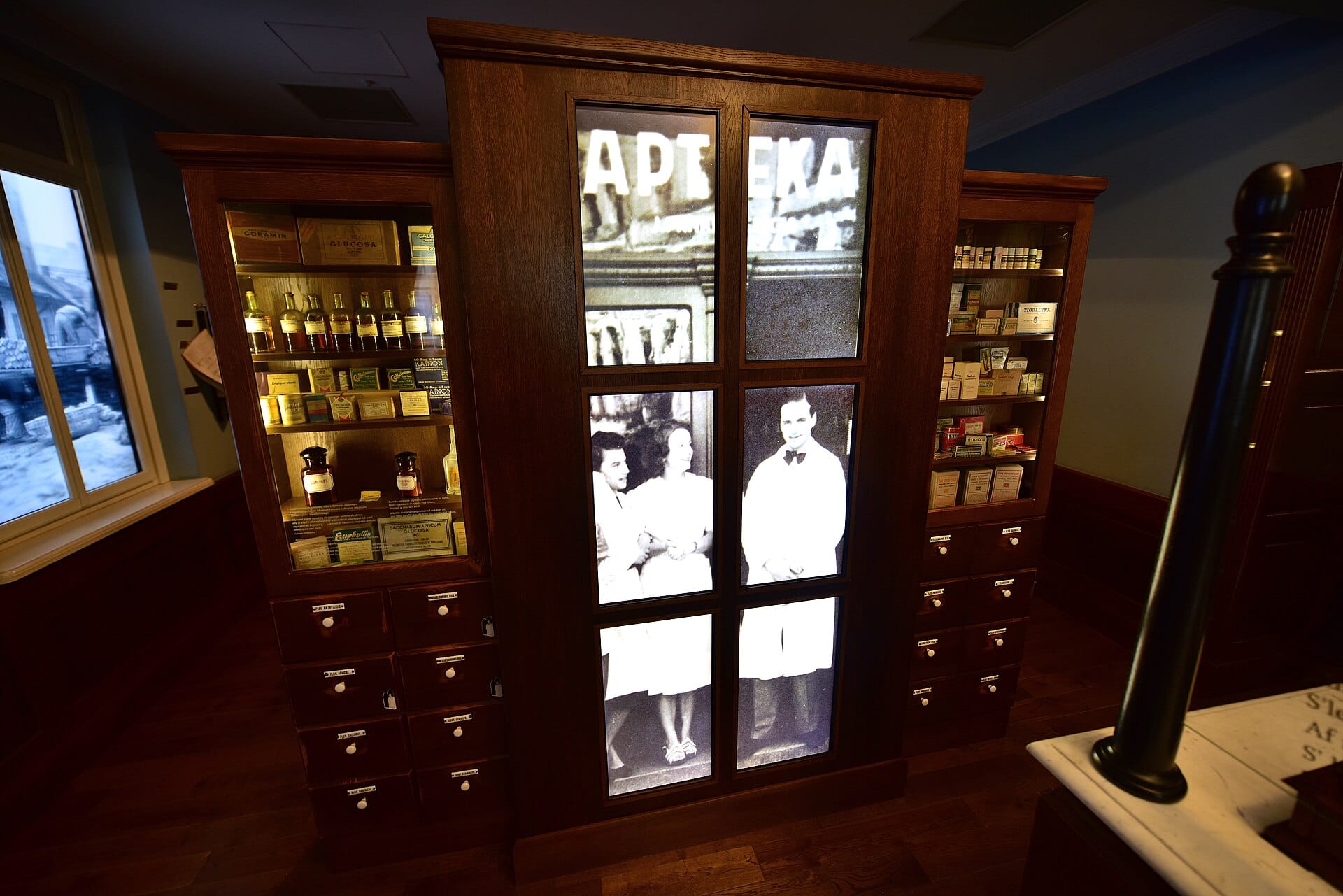
The interior retains elements of its original pharmacy layout: wooden counters, glass-fronted cabinets, and period medicine jars still occupy parts of the display space. The exhibition layers documentary photographs, personal objects, maps of the Ghetto boundaries, and translated excerpts from Pankiewicz's memoir over this preserved environment. The effect is somewhere between a museum and a time capsule.
The exhibition moves chronologically, beginning with the establishment of the Ghetto and the early conditions of confinement, then tracing the tightening restrictions, deportations, and eventual liquidation. Individual stories are highlighted throughout. Unlike some memorial sites that present numbers and timelines, this one returns repeatedly to named individuals, people who came to the pharmacy, people Pankiewicz described in his writing, people whose fates are documented in the records.
The rooms are small and the lighting is deliberately subdued in sections. Text panels are available in Polish and English. Photography inside is generally permitted for personal use, but keep the atmosphere in mind: other visitors are often in quiet, concentrated engagement with the material. This is not a space where casual photography feels appropriate in most moments.
ℹ️ Good to know
The exhibition is titled "Tadeusz Pankiewicz's Eagle Pharmacy" in Museum of Krakow documentation. If you're booking group visits or requesting accessibility information, use this full name when contacting the museum directly via their official site.
How the Experience Changes by Time of Day
The museum opens at 09:00, and early-morning visits, particularly on weekdays, tend to be significantly quieter. School groups are a regular presence from mid-morning onward, especially in spring and autumn. If you want to move through the exhibition at your own pace without managing around a class, arriving at opening or within the first 30 minutes is worth the effort.
By midday on weekends, the square outside fills with visitors who have walked over from Kazimierz or finished a tour of Schindler's Factory Museum just a short distance away. The pharmacy itself doesn't become crowded in the way a major museum does, but the small rooms can feel close when multiple groups overlap. The 09:00–10:30 window on a Wednesday is probably the calmest the museum gets, with the added benefit of free admission.
The exterior of the building and the square itself are most affecting in quieter hours. Early morning, with the metal chairs of the Ghetto Heroes Square monument catching low light and the street relatively empty, the neighborhood feels heavy with its own history. On a warm weekend afternoon, the same square can look almost festive with tourists and cyclists, creating a jarring contrast.
Getting There and the Surrounding Area
Plac Bohaterów Getta is served by tram, with a stop of the same name. From the Kazimierz district to the north, the walk across the bridge takes around 20 minutes and is a reasonable route if you're combining both areas in a single itinerary. Several tram lines also connect the square to Kraków's main arteries, making it accessible from the Old Town without a transfer.
The immediate neighborhood around Plac Bohaterów Getta has its own concentration of WWII-related sites. The square itself features the Ghetto Heroes Square monument. Schindler's Factory Museum is a short walk east. The Podgórze district also holds remnants of the original Ghetto wall at a few locations nearby. Visitors who plan a half-day dedicated to this history should expect to cover two to four sites in the area, with the Eagle Pharmacy as a logical starting or ending point.
If you're structuring a full day, the Schindler's List filming locations in Kraków guide provides context for how Podgórze fits into both the historical record and the sites that Spielberg used for his 1993 film.
What to Know Before You Go
The museum is compact. A focused visit takes around 45 minutes; if you read every panel carefully, allow 75 to 90 minutes. There is no café inside the building. Restroom access is limited, so plan accordingly if you're visiting with children or on a long walking day.
Tickets are PLN 22 for adults and PLN 16 concession, with free entry every Wednesday. The museum is open Wednesday through Sunday, 09:00–17:00, and is closed on Mondays and Tuesdays. Official accessibility information was not available in published sources at the time of writing; visitors with mobility requirements should contact the Museum of Krakow directly before their visit to confirm current conditions.
The Eagle Pharmacy pairs naturally with the Galicia Jewish Museum in Kazimierz, which takes a different documentary approach to the same general period of history. Together, they offer two distinct lenses on Polish-Jewish heritage in Kraków. If you're planning the broader context, the Kraków Jewish Quarter guide covers the main sites across both neighborhoods.
⚠️ What to skip
The museum is closed Monday and Tuesday. This catches many visitors off guard, particularly those combining it with a Schindler's Factory visit on those days. Check both sites' schedules before making the trip to Podgórze.
Who Should Consider Skipping This
The Eagle Pharmacy Museum is an entirely text-and-photograph-based exhibition in a small space. Visitors who are not deeply engaged with Holocaust history or WWII context may find it less immediately accessible than a larger, more visually varied museum. Children under 10 are likely to find the exhibition too text-heavy and emotionally difficult to process. If your primary interests in Kraków are architecture, food, or outdoor exploration, this is a specialized site that requires genuine engagement with its subject matter to be worthwhile.
The emotional load matters. Visitors who are already feeling the weight of a day that included Auschwitz-Birkenau or other Ghetto sites may find this museum more than they can take in with full attention. In that case, revisiting it on a separate day, or earlier in the sequence, tends to yield a more engaged visit.
Insider Tips
- Visit on a Wednesday for free admission and, if you go at opening time, you're likely to have the exhibition almost entirely to yourself.
- Read Tadeusz Pankiewicz's memoir 'The Kraków Ghetto Pharmacy' before visiting, or pick it up at a Kraków bookshop first. The exhibition's named references land very differently when you already know the individuals being described.
- After the museum, spend 10 minutes at the Ghetto Heroes Square monument directly outside before moving on. The 70 empty metal chairs, including 33 large chairs, represent Ghetto residents; the chairs face the direction of the deportation transports.
- The pharmacy building is on the corner of the square. If you approach from the Kazimierz side via the Kładka Ojca Bernatka footbridge, you'll arrive directly into the square and can orient yourself around the monument first.
- Schindler's Factory Museum is a 10-minute walk east. The two make a logical paired itinerary, but both require real concentration. Budget three to four hours total and don't try to fit in other major sites on the same half-day.
Who Is Eagle Pharmacy Museum (Apteka pod Orłem) For?
- Travelers with a serious interest in Holocaust history and WWII memorial sites
- Visitors who want a small, intimate museum experience rather than a large institution
- Those tracing the geography of the Kraków Ghetto on foot
- Readers of Pankiewicz's memoir or those who have seen Schindler's List
- Anyone combining a half-day in Podgórze with Schindler's Factory and the Ghetto Heroes Square
Nearby Attractions
Other things to see while in Podgórze:
- Ghetto Heroes Square (Plac Bohaterów Getta)
In the Podgórze district, Plac Bohaterów Getta marks the exact spot where the Kraków Ghetto's Jewish residents were assembled for deportation to concentration and extermination camps. Seventy empty metal chairs of varying sizes stand across the square as a permanent memorial, free to visit at any hour.
- Cricoteka (Tadeusz Kantor Museum)
Housed in a striking former power plant on the Vistula riverbank in Podgórze, Cricoteka is both an archive and a museum dedicated to Tadeusz Kantor, one of the twentieth century's most radical theatre directors. The building itself is worth the visit.
- Schindler's Factory Museum
Oskar Schindler's Enamel Factory in Kraków's Zabłocie district is one of Poland's most significant WWII history museums. Housed in the original administrative building of the Deutsche Emailwarenfabrik, it tells the story of Nazi occupation through immersive, room-by-room exhibits that go far beyond the story of one man.
Planning a trip? Discover personalized activities with the Nomado app.