Ghetto Heroes Square (Plac Bohaterów Getta): Kraków's Most Sobering Memorial
In the Podgórze district, Plac Bohaterów Getta marks the exact spot where the Kraków Ghetto's Jewish residents were assembled for deportation to concentration and extermination camps. Seventy empty metal chairs of varying sizes stand across the square as a permanent memorial, free to visit at any hour.
Quick Facts
- Location
- Plac Bohaterów Getta, Podgórze district, Kraków
- Getting There
- Trams 3, 8, 19, 24 — stop: Plac Bohaterów Getta
- Time Needed
- 30–60 minutes; longer if combining with Schindler's Factory Museum nearby
- Cost
- Free — no tickets required, open 24 hours
- Best for
- History-focused travelers, those on a WWII itinerary, reflective solo visits
- Official website
- www.krakow.pl/instcbi/11195,inst,4812,307,instcbi.html
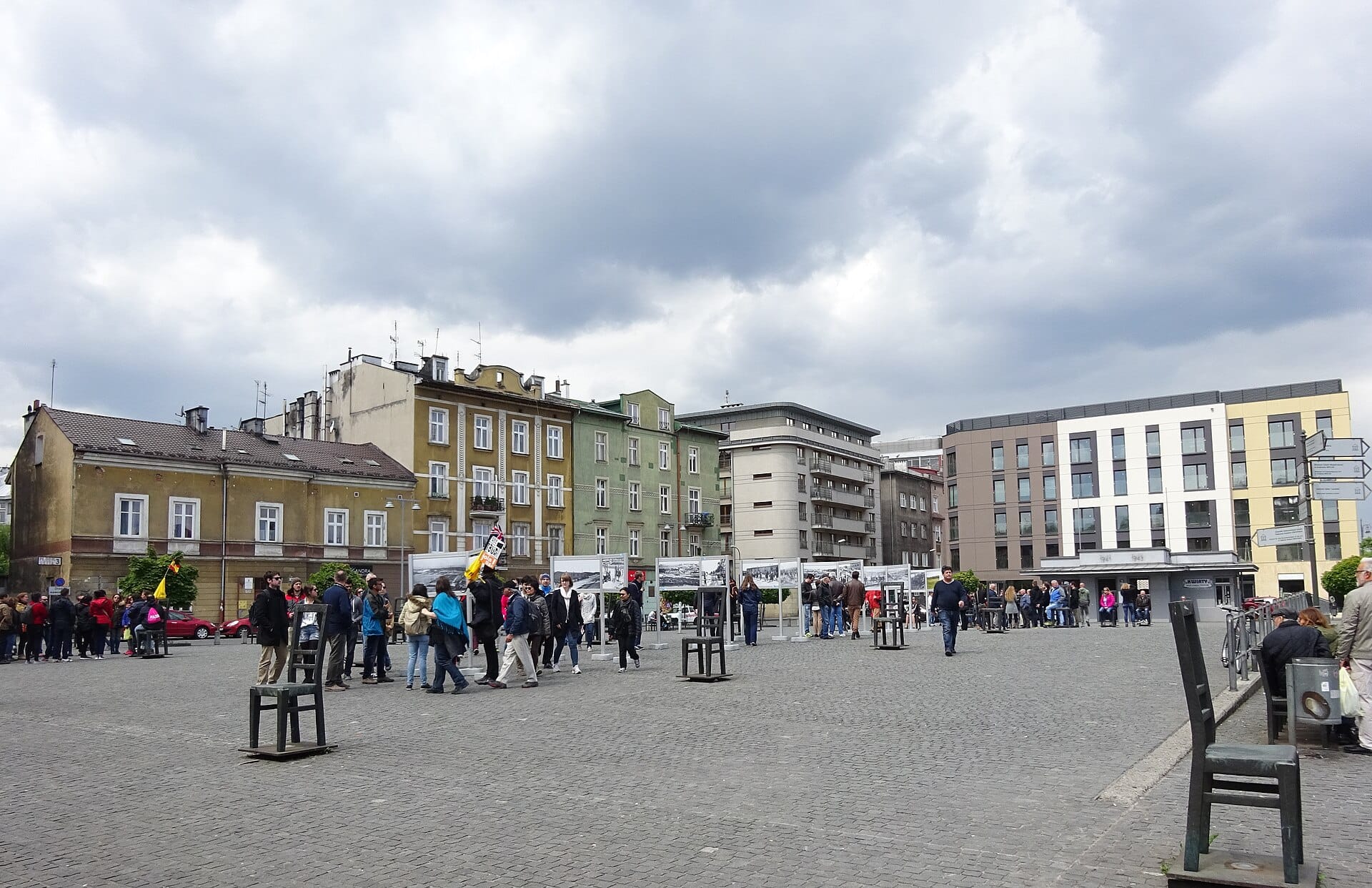
What Is Ghetto Heroes Square?
Plac Bohaterów Getta — Heroes of the Ghetto Square — is an open public plaza in Kraków's Podgórze district, on the south bank of the Vistula River. It is best known for its permanent memorial installation: 70 cast-metal chairs of varying sizes placed at irregular intervals across the paved square, each one empty. The chairs are not symbolic in an abstract sense. They reference the furniture and personal belongings that ghetto residents left in the street when they were ordered to assemble here for deportation between 1942 and 1943. What you are standing on is not an approximation of history — it is the actual ground.
The square was first laid out in 1836 and went through several names: Mały Rynek until around 1880, then Plac Zgody (Zgody Square, or Square of Concord) from 1917 to 1948. There is a grim irony in that name. Between 1941 and 1943, when the Nazis enclosed Podgórze within the boundaries of the Kraków Ghetto, Plac Zgody became the principal assembly point for mass deportations — mostly to the Bełżec and Auschwitz-Birkenau extermination camps. After the war it was renamed Plac Bohaterów Getta. The current chair memorial was installed in 2005.
ℹ️ Good to know
The square functions as a working tram interchange as well as a memorial. Trams and pedestrians move through it throughout the day. This is not a closed monument — it is a living public space layered on top of a site of mass atrocity, which some visitors find more affecting than a conventional museum.
The Memorial Chairs: What You Are Looking At
The installation includes 33 taller chairs and 37 smaller chairs, cast in bronze with a rough, weathered finish. They are not arranged in rows or formal patterns. Some are grouped loosely, others stand alone. The effect is deliberate: the installation by designers Piotr Lewicki and Kazimierz Łatak was intended to suggest the chaotic reality of forced assembly, not a commemorative ceremony.
Each chair has a specific visual quality depending on the light. On overcast days the iron reads as almost black against the pale stone paving. In direct afternoon sun the metal takes on a warmer, rust-brown tone that looks less industrial and more personal. Early morning, before the trams start running in force, the square can be almost completely quiet — just the chairs and the sound of pigeons. That quiet is worth seeking out.
The number 70 represents neither the total number of Ghetto residents nor deportees — those numbers are far larger. It is understood as a symbolic figure, part of the design language of the memorial rather than a precise historical count. Estimates suggest that approximately 15,000 to 18,000 Jews lived in the Kraków Ghetto at various points between 1941 and its liquidation in March 1943. The majority were killed or deported during two major Aktionen (deportation actions) in 1942.
Tickets & tours
Live prices and dates from our booking partner. If you book, we may earn a commission at no extra cost to you.
Krakow: Jewish ghetto and Schindler's Factory entrance ticket and guided tour
From 30 €Instant confirmationFree cancellationKrakow Old Town, Jewish Kazimierz and Ghetto tour by electric golf cart
From 64 €Instant confirmationFree cancellationPrivate Krakow Ghetto tour with audio-guide
From 71 €Instant confirmationFree cancellationJewish ghetto guided tour in Krakow
From 10 €Instant confirmationFree cancellation
The History Behind the Square
The Kraków Ghetto was established in March 1941 in Podgórze, deliberately separated from the city's established Jewish neighborhood of Kazimierz across the river. You can read more about that history in our Kraków Jewish Quarter guide. The choice of Podgórze rather than Kazimierz was calculated: it was an industrial, less desirable area, and relocating Jewish residents there also freed up Kazimierz housing for others.
At its peak the Ghetto held tens of thousands of people in a few city blocks. The Ghetto wall remnants are still visible in parts of the surrounding streets — a low, scalloped wall with an arch profile that deliberately echoed Jewish gravestones, a detail that was not accidental. The liquidation of the Ghetto began on March 13, 1943. Those deemed fit for forced labor were marched to the Płaszów concentration camp south of the city. Those who were not were killed on the spot or assembled at this square for transport onward to extermination camps such as Auschwitz-Birkenau.
The site is closely connected to the broader story told at Schindler's Factory Museum, which stands about 400 meters from the square and covers the Ghetto period in comprehensive detail. The two sites are best visited together; allow at least two hours for both.
How the Square Changes Through the Day
Visiting at different times of day changes the experience noticeably. Early morning, around 7–9am, the square sees mostly commuters and local residents. The chairs are unoccupied, the trams run infrequently, and the atmosphere is close to meditative. The light at this hour comes in low from the east, casting long shadows from each chair across the paving stones.
By midday, especially from May through September, tour groups arrive. The square forms a standard stop on WWII and Jewish Kraków walking tours, and it can become crowded between 11am and 2pm. Group dynamics affect the atmosphere in ways that are difficult to predict: some groups are quiet and reflective, others move quickly. If you want a more personal encounter with the memorial, arrive before 9am or after 6pm.
At night the chairs are lit from below by ground-level lights, which creates an effect that many visitors find more striking than the daytime visit. The iron forms take on additional weight in the dark, and the absence of tour groups makes it easier to slow down. The surrounding streets in Podgórze are safe at night and reasonably active with cafes and restaurants.
💡 Local tip
For photography, the blue hour after sunset — roughly 30 to 45 minutes after the sun drops — produces the best contrast between the lit chairs and the darkening sky. The chairs' ground lighting is consistent and does not flash or change color.
Getting There and Around Podgórze
Tram lines 3, 17, 19, and 24 all stop directly at the Plac Bohaterów Getta stop. The journey from Kraków's Old Town takes around 10–15 minutes depending on the line and traffic. Trams in Kraków run on a flat-fare ticketing system; tickets can be purchased at machines at tram stops or via the city's mobile app. For full details on getting around the city, see our guide to getting around Kraków.
On foot from Rynek Główny, the route is a straightforward 30-minute walk: south through Kazimierz, across the Powstańców Śląskich Bridge (or the Kładka Ojca Bernatka footbridge), and southeast through Podgórze. The walk passes through the heart of Kazimierz, which adds useful context to the journey.
The square itself is flat, paved, and fully accessible for wheelchair users. The tram stop immediately adjacent is at street level, though accessibility depends on the specific tram type in service. There are no steps, fences, or barriers around the memorial chairs.
⚠️ What to skip
Parking around Plac Bohaterów Getta is limited and the area is a busy tram corridor. Arriving by tram is significantly easier than driving.
What to Expect: Tone and Emotional Register
This is a heavy site, and it should be approached as one. The square does not have interpretive panels explaining the chairs in detail, which surprises some visitors who expect a more curated museum experience. The memorial relies almost entirely on its physical presence and the knowledge a visitor brings to it. If you arrive without any background on the Kraków Ghetto, the chairs may read as unusual public art without their full weight.
Children can visit — the open format and visual clarity of the chairs mean the site is approachable — but the conversations it prompts are significant. The nearby Schindler's Factory Museum has more structured interpretation for those who want narrative framing before or after their visit to the square.
Travelers doing a more complete survey of the region's WWII history will typically pair this visit with a day trip to Auschwitz-Birkenau. That site is approximately 70 km west of Kraków. Our guide on Auschwitz tours from Kraków covers logistics in detail.
Those who find WWII memorial sites emotionally difficult, or who are managing compassion fatigue from multiple sites in one trip, may want to space this visit out carefully. Visiting Auschwitz-Birkenau and Ghetto Heroes Square on the same day is common but demanding.
Insider Tips
- The small pharmacy on the corner of the square — the Eagle Pharmacy, now a museum — was operated by Tadeusz Pankiewicz during the Ghetto period and is one of only a handful of original buildings with a direct documented connection to that history. Its opening hours are separate from the square itself and require a small admission fee.
- Stand at the center of the square and look south: the low wall visible at the edge of Plac Bohaterów Getta is a surviving section of the original Ghetto wall, identifiable by its distinctive arched profile. Most visitors walk past it without recognizing what it is.
- The Schindler's Factory Museum, 400 meters east on ul. Lipowa, has timed entry tickets that sell out on weekends during peak season. Book online before your visit rather than assuming walk-up availability.
- If you visit in winter, particularly December through February, the iron chairs accumulate snow in a way that significantly changes the visual impact of the memorial. Cold-weather visits tend to be far less crowded and, for many visitors, more affecting.
- Several of the chairs are positioned at the edge of the square near tram tracks. Trams pass through the memorial space — not adjacent to it. That detail, which can feel jarring at first, is an accurate reflection of how public memory and daily life coexist in Podgórze.
Who Is Ghetto Heroes Square (Plac Bohaterów Getta) For?
- Travelers on a WWII or Holocaust history itinerary through Kraków and the surrounding region
- Those who want a contemplative, unmediated memorial experience rather than a structured museum visit
- Visitors combining the square with Schindler's Factory Museum for a half-day Podgórze history walk
- Photographers interested in memorial architecture, particularly at blue hour or in winter light
- Anyone seeking to understand the full geographic and historical context of Kazimierz and Podgórze together
Nearby Attractions
Other things to see while in Podgórze:
- Eagle Pharmacy Museum (Apteka pod Orłem)
The Eagle Pharmacy Museum on Plac Bohaterów Getta in Podgórze preserves the only pharmacy permitted to operate inside the Kraków Ghetto during World War II. It tells the story of Tadeusz Pankiewicz, a Polish pharmacist who used his position to shelter, supply, and assist the Jewish community under Nazi occupation. Small in scale, enormous in weight.
- Cricoteka (Tadeusz Kantor Museum)
Housed in a striking former power plant on the Vistula riverbank in Podgórze, Cricoteka is both an archive and a museum dedicated to Tadeusz Kantor, one of the twentieth century's most radical theatre directors. The building itself is worth the visit.
- Schindler's Factory Museum
Oskar Schindler's Enamel Factory in Kraków's Zabłocie district is one of Poland's most significant WWII history museums. Housed in the original administrative building of the Deutsche Emailwarenfabrik, it tells the story of Nazi occupation through immersive, room-by-room exhibits that go far beyond the story of one man.
Planning a trip? Discover personalized activities with the Nomado app.