Cricoteka: Kraków's Most Unconventional Museum
Housed in a striking former power plant on the Vistula riverbank in Podgórze, Cricoteka is both an archive and a museum dedicated to Tadeusz Kantor, one of the twentieth century's most radical theatre directors. The building itself is worth the visit.
Quick Facts
- Location
- Nadwiślańska 2–4, Podgórze, Kraków
- Getting There
- Tram or bus to Podgórze; stops on or near Nadwiślańska Street
- Time Needed
- 1.5–2.5 hours
- Cost
- Main exhibitions: 20 PLN regular / 10 PLN reduced. Free entrance on Wednesdays; some smaller gallery shows may use different prices.
- Best for
- Art and theatre enthusiasts, architecture lovers, those exploring Podgórze
- Official website
- cricoteka.pl/en_us
What Is Cricoteka?
The Centre for the Documentation of the Art of Tadeusz Kantor CRICOTEKA, now formally known as the Tadeusz Kantor Museum, is one of Kraków's most distinctive cultural institutions. It exists in a category of its own: part archive, part museum, part living tribute to an artist whose influence on European avant-garde theatre is difficult to overstate.
Tadeusz Kantor founded Cricoteka in 1980 as a 'living archive' of his Cricot 2 Theatre company. His work fused visual art, performance, and memory into productions that made audiences rethink what theatre could be. When he died in 1990, the institution became a custodian of that legacy. In 2018, the Polish Minister of Culture and National Heritage formally registered the Tadeusz Kantor Museum subdivision, entry no. 862 in the national Museums Register, giving the collection official museum status.
ℹ️ Good to know
Cricoteka's ticket page lists the main permanent and temporary exhibitions at 20 PLN regular / 10 PLN reduced, with free entrance on Wednesdays. Standard opening is Tuesday through Sunday, 11:00–19:00, with last admission at 18:45; the museum is closed on Mondays.
Cricoteka sits in Kraków's Podgórze district, across the Vistula from Kazimierz. It's a neighborhood with considerable historical weight: the Kraków Ghetto was established here during World War II, and several important memorial sites are nearby. The museum's presence adds another cultural layer to an area that rewards slow, attentive exploration.
The Building: A Power Plant Transformed
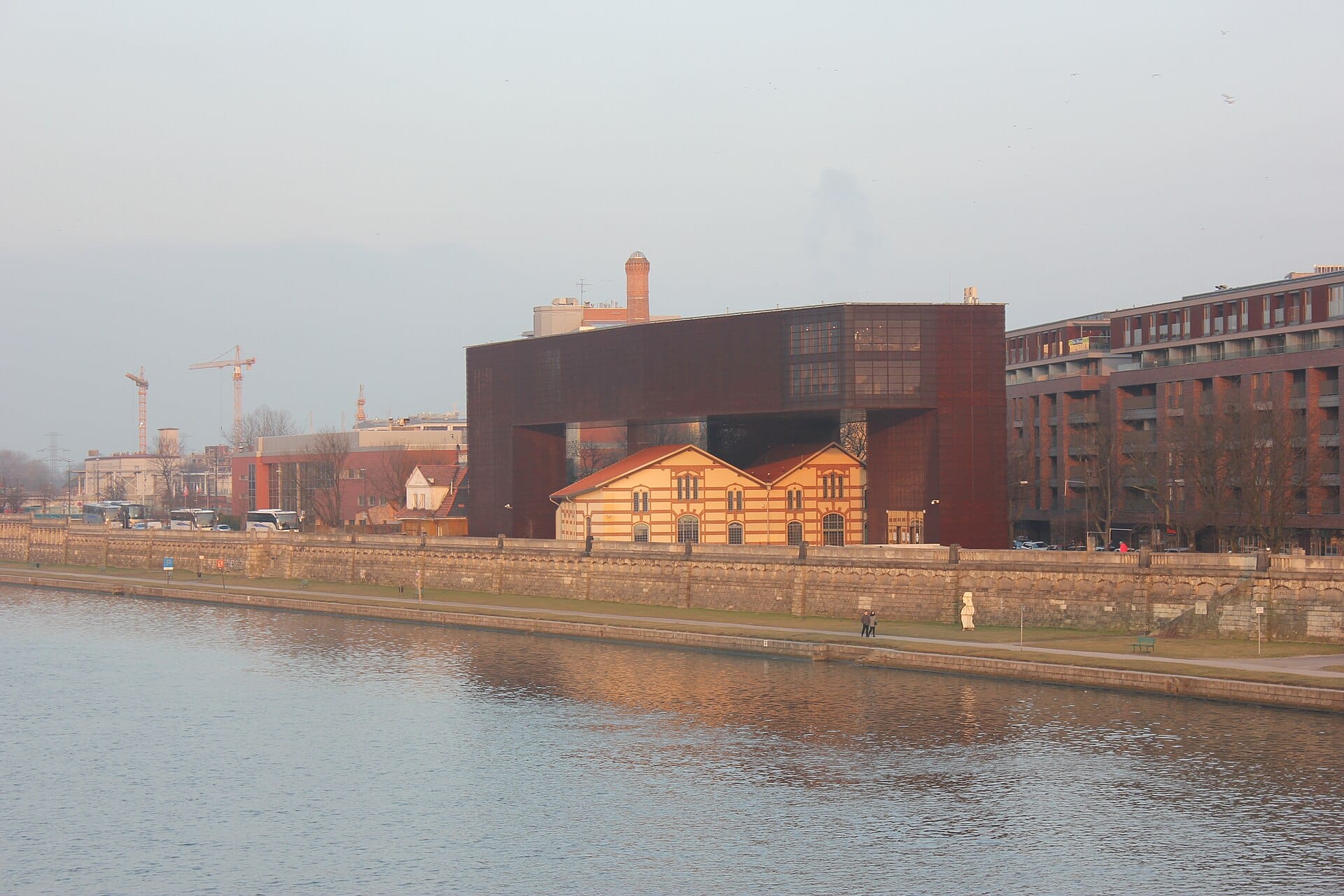
Before you engage with the collection inside, the building itself demands attention. Cricoteka occupies the former Podgórze power plant on Nadwiślańska Street, a late nineteenth-century industrial structure that has been dramatically extended with a contemporary steel and glass addition that cantilevers over the original brick shell. The juxtaposition is intentional and effective: industrial heritage held inside a modern envelope, which is not a bad metaphor for what Kantor himself did with theatre.
From the Vistula riverbank, the building reads as a layered composition, the old brick façade visible beneath the darker contemporary volume above it. On clear days, the river and the rebuilt Podgórze embankment path create a photogenic approach. Morning light falls directly on the riverside elevation, making it the better time of day for exterior photography. By afternoon, the interior spaces benefit from the diffused light that enters through the upper glazing.
Inside, the interiors are deliberately raw in places: exposed concrete, high ceilings in the former turbine hall, and a spatial generosity that suits both the scale of Kantor's theatrical props and the documentary material displayed alongside them. The building is certified barrier-free ('bez barier' by Kraków tourism standards), and a dedicated accessibility contact is available at +48 505 319 882 for visitors with specific needs.
Tickets & tours
Live prices and dates from our booking partner. If you book, we may earn a commission at no extra cost to you.
Entrance ticket for the Legends of Krakow robotic show
From 9 €Instant confirmationFree cancellationWieliczka Salt Mine guided tour with hotel pickup from Krakow
From 58 €Instant confirmationFree cancellationWieliczka salt mine guided tour from Krakow
From 60 €Instant confirmationFree cancellationKrakow: Jewish ghetto and Schindler's Factory entrance ticket and guided tour
From 30 €Instant confirmationFree cancellation
The Permanent Exhibition: What You Actually See
The permanent exhibition is the core reason to visit, and Wednesday free entrance makes it one of Kraków's more generous museum offers. The displays document the arc of Kantor's career from his early experimental paintings through the Cricot 2 Theatre productions that brought him international recognition, including works such as 'The Dead Class' (1975) and 'Wielopole, Wielopole' (1980).
Expect to encounter original set pieces, costumes, mannequins, archival photographs, correspondence, and video documentation of performances. These are not small objects: some of the theatrical machines and prop constructions are large enough to occupy entire rooms, and they carry a physical presence that documentation alone cannot convey. You understand, standing next to them, why audiences found Kantor's theatre unsettling and revelatory in equal measure.
The exhibition is thoughtfully sequenced, moving through Kantor's ideas about memory, death, and the relationship between actors and objects. Labels are available in English, so non-Polish speakers can follow the narrative without difficulty. Plan for at least ninety minutes if you want to engage properly with the material, not rush through it.
💡 Local tip
If you arrive with no prior knowledge of Kantor's work, spend five minutes with the introductory room before moving into the main galleries. It frames everything that follows and makes the larger installations significantly more legible.
Temporary Exhibitions and Programming
Beyond the permanent collection, Cricoteka runs a programme of temporary exhibitions that typically draw connections between Kantor's practice and contemporary art, performance, or theatre. These are worth checking before your visit: the quality is consistently high, and the 20 PLN admission is modest for what is usually a well-curated presentation.
The institution also hosts events, film screenings, lectures, and educational programmes throughout the year. For current listings, check the official website at cricoteka.pl before your visit. If you are planning a broader cultural itinerary, it pairs logically with the Schindler's Factory Museum nearby, which covers the wartime history of Podgórze in depth.
When to Visit and What to Expect
Cricoteka does not draw the same volume of visitors as the major Old Town institutions, which works in your favor. On most mornings, particularly on weekdays, the galleries are quiet enough that you can spend extended time with individual works without feeling rushed or crowded. Weekend afternoons see more visitors, but the space is large enough that it rarely feels congested.
The museum is open Tuesday through Sunday, 11:00 to 19:00, with last admission at 18:45. It is closed on Mondays. Public holiday hours may differ from the standard schedule, so if you are visiting around a Polish national holiday, check the museum's official website in advance.
The surrounding Podgórze riverbank is worth factoring into your visit timing. The embankment path along the Vistula connects Cricoteka to the Vistula riverbank walking route and, heading east, toward the Krakus Mound. In warmer months, the riverside is pleasant before or after the museum. In winter, the walk is shorter but the museum's warm interior makes it an appealing midday stop.
⚠️ What to skip
The museum building is not immediately obvious from the main street. Look for the contemporary steel-clad upper volume rising above the brick industrial structure along Nadwiślańska Street. There is signage, but it is modest.
Getting There
Cricoteka is located at Nadwiślańska 2–4 in Podgórze, south of the Vistula River. The most practical approach from central Kraków is by tram or bus to the Podgórze area, with stops accessible from Nadwiślańska Street and the surrounding streets. Kraków's public transport network, operated by MPK Kraków, connects the Old Town to Podgórze regularly throughout the day.
The walk from Kazimierz across the Podgórski footbridge takes roughly ten to fifteen minutes and is a pleasant route that also passes near Ghetto Heroes Square. This makes combining both sites into a single afternoon straightforward. There is no parking lot directly adjacent to the museum, so arriving by public transport or on foot is the practical choice.
Honest Assessment: Who This Museum Is For
Cricoteka is not a crowd-pleaser in the way that the Wawel Castle or the Wieliczka Salt Mine are. If you have no prior interest in avant-garde theatre, performance art, or twentieth-century European art history, the permanent exhibition may feel opaque rather than illuminating. The objects are extraordinary, but they require some contextual frame to fully register.
For visitors with even a passing interest in theatre, visual art, or the cultural history of postwar Europe, however, this is one of Kraków's most rewarding museums. It belongs on the itinerary alongside the Czartoryski Museum and the best museums in Kraków for anyone who wants more than the obvious historical circuits.
Visitors traveling with young children may find the museum less suitable: the content is conceptually dense, the atmosphere is quiet and contemplative, and there are few interactive elements aimed at younger audiences. It is an institution that rewards focused attention from adults, not one designed for family entertainment.
Insider Tips
- Wednesday is the free entrance day listed by Cricoteka for its main exhibitions. If your schedule allows, this is the lowest-cost day to visit the core collection and any temporary show that is included.
- The museum's upper floor offers views over the Vistula toward Wawel Hill. Position yourself at the glazed elevation in the late morning for the best sightline before the light shifts.
- The archive and library functions of Cricoteka are separate from the public museum spaces. If you have a research interest in Kantor's work, contact the institution in advance about access to documentation materials.
- Combine this visit with a walk to Ghetto Heroes Square (Plac Bohaterów Getta) ten minutes away. The contrast between the wartime memorial context of Podgórze and Cricoteka's artistic register gives both sites additional weight.
- Audio guides and additional interpretive materials in English are available at the front desk. Ask when you enter, as they are not always prominently displayed.
Who Is Cricoteka (Tadeusz Kantor Museum) For?
- Theatre and performance art enthusiasts seeking primary source material on European avant-garde
- Architecture lovers interested in adaptive reuse of industrial buildings
- Visitors building a full Podgórze cultural itinerary alongside Schindler's Factory
- Travelers looking for low-cost or Wednesday-free museum experiences in Kraków
- Contemporary art audiences curious about the intersection of visual art and performance
Nearby Attractions
Other things to see while in Podgórze:
- Eagle Pharmacy Museum (Apteka pod Orłem)
The Eagle Pharmacy Museum on Plac Bohaterów Getta in Podgórze preserves the only pharmacy permitted to operate inside the Kraków Ghetto during World War II. It tells the story of Tadeusz Pankiewicz, a Polish pharmacist who used his position to shelter, supply, and assist the Jewish community under Nazi occupation. Small in scale, enormous in weight.
- Ghetto Heroes Square (Plac Bohaterów Getta)
In the Podgórze district, Plac Bohaterów Getta marks the exact spot where the Kraków Ghetto's Jewish residents were assembled for deportation to concentration and extermination camps. Seventy empty metal chairs of varying sizes stand across the square as a permanent memorial, free to visit at any hour.
- Schindler's Factory Museum
Oskar Schindler's Enamel Factory in Kraków's Zabłocie district is one of Poland's most significant WWII history museums. Housed in the original administrative building of the Deutsche Emailwarenfabrik, it tells the story of Nazi occupation through immersive, room-by-room exhibits that go far beyond the story of one man.
Planning a trip? Discover personalized activities with the Nomado app.