Dongjiao Memory (Eastern Suburb Memory): Chengdu's Industrial Creative District
Once a state-owned electronics factory, Dongjiao Memory is now Chengdu's most atmospheric cultural park, combining preserved Soviet-style industrial architecture with live music venues, independent galleries, street art, and a dense cluster of cafés and restaurants. Entry is free and the park is open around the clock.
Quick Facts
- Location
- No. 4, Jianshe South Branch Road, Chenghua District, Chengdu
- Getting There
- Dongjiao Memory Station (东郊记忆站), Metro Line 8, Exit B1
- Time Needed
- 2–4 hours (longer if attending a live event)
- Cost
- Free general entry; paid admission for specific events and exhibitions
- Best for
- Architecture, music, street art, photography, independent culture
What Is Dongjiao Memory?
Dongjiao Memory, officially known as 东郊记忆 (Dongjiao Memory) and formerly called Chengdu Eastern Music Park, is a large-scale creative and cultural district built on the grounds of the former Hongguang Electronic Tube Factory in Chenghua District. The complex covers approximately 188,000 square meters and preserves the physical bones of a mid-20th-century state-owned industrial site while filling that skeleton with art spaces, music venues, boutique shops, and food outlets.
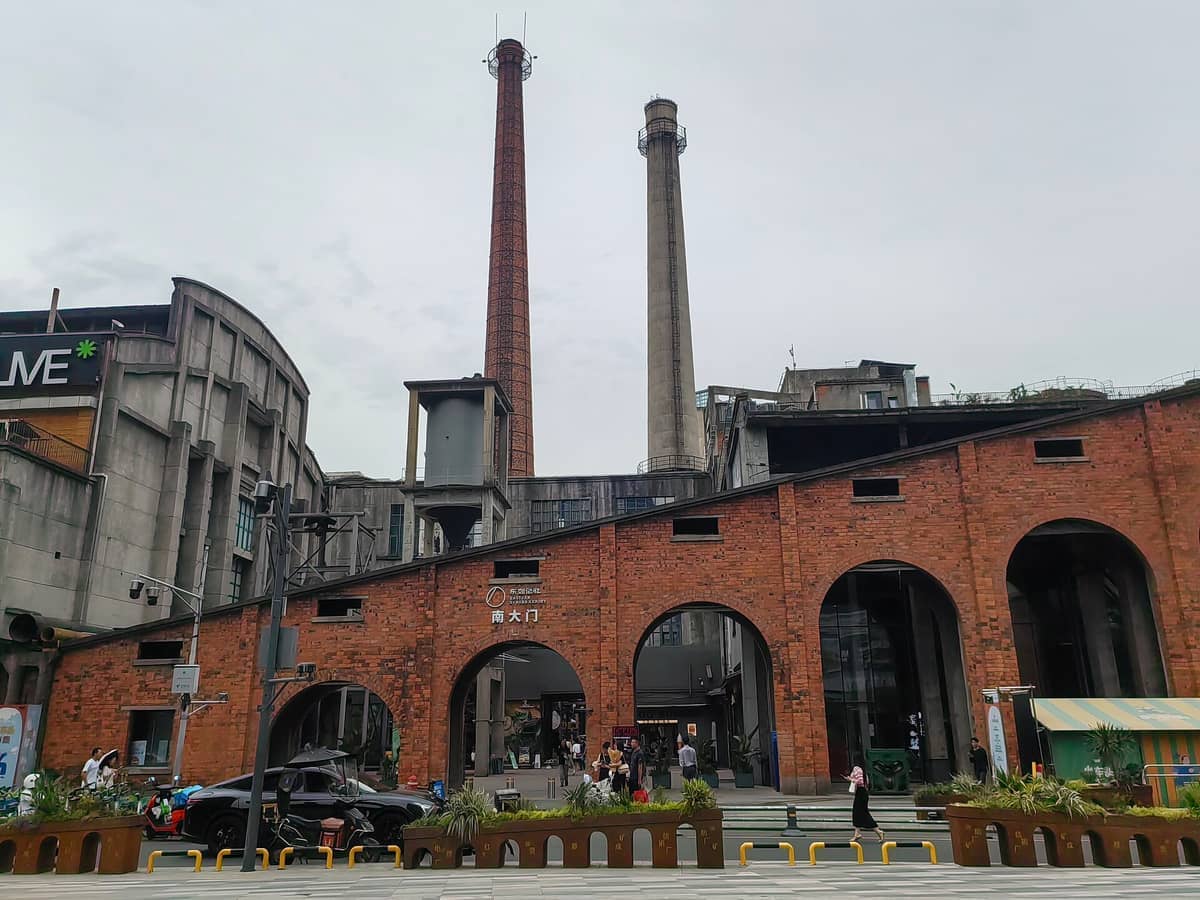
The factory's history ties it directly to China's post-1949 industrial ambitions. The Hongguang plant was a major producer of electronic tubes during the era of Soviet-influenced state enterprise, and much of the architecture reflects that period's aesthetic: heavy red brick, wide factory halls with sawtooth skylights, water towers, and chimney stacks that now serve as sculptural landmarks. Walking through the site, you are moving through a preserved industrial landscape that most Chinese cities chose to demolish rather than repurpose.
Construction of the cultural park began in 2009. It opened on 29 September 2011 under the name Chengdu Eastern Music Park, then was renamed Dongjiao Memory on 1 November 2012. The renaming signaled a broader ambition: less a single-purpose music venue, more a neighborhood-scale memory project for a city that grew very fast and lost a great deal of its industrial and working-class heritage in the process. For context on how this area fits into Chengdu's urban fabric, see our overview of Chenghua District.
The Architecture: What You Will Actually See
The visual experience of Dongjiao Memory is anchored in industrial heritage that has been selectively preserved and carefully staged. The red brick factory buildings, many retaining their original ventilation louvers, corrugated-metal rooflines, and cast-iron structural columns, have been adapted into galleries, performance halls, restaurants, and boutique retail. The chimneys remain fully intact and are often painted or used as projection surfaces for evening events.
Throughout the grounds, the contrast between raw industrial material and contemporary creative uses is the defining visual tension. A rusted factory gate frames a craft coffee bar. A row of vintage Soviet-era production slogans in red script sits a few meters from a contemporary mural by a Chengdu street artist. Corridors that once moved factory workers from station to station now guide visitors past record stores, independent clothing labels, and photography studios.
The layout is non-linear, which rewards explorers and frustrates anyone trying to tick boxes efficiently. Multiple open-air courtyards connect the larger buildings, and narrow passages between factory blocks reveal small installations, food kiosks, and performance stages that appear without warning. Bring comfortable walking shoes; the site is large and the ground transitions between paved paths, loose gravel, and tiled factory floors.
💡 Local tip
Photography tip: The sawtooth-roofed factory halls produce strong directional light in the morning. Visit before 10am for interior shots with natural window light and minimal crowds. The water tower and main chimney are best photographed from the open central plaza in late afternoon when the brick takes on a warmer tone.
Tickets & tours
Hand-picked options from our booking partner. Prices are indicative; availability and final rates are confirmed when you complete your booking.
Panda Base and city highlights private day tour in Chengdu
From 302 €Instant confirmationFree cancellationFull day private tour Giant Panda Base and city highlights
From 365 €Instant confirmationFree cancellationChengdu to Yibin private tour with Wuliangye Liquor Museum visit
From 300 €Instant confirmationChengdu private evening tour with hot pot dinner
From 247 €Instant confirmationFree cancellation
How the Atmosphere Changes Through the Day
Dongjiao Memory is technically open 24 hours, and the experience shifts considerably depending on when you arrive. Mornings are noticeably quiet. The food and retail operators open mid-morning at the earliest, so early visitors get the architecture without the commercial layer. Light enters the brick corridors at low angles, the air carries the faint smell of iron and old wood from the factory structures, and the only sounds are distant traffic from Jianshe South Road and the occasional stray cat that apparently considers the grounds home.
From early afternoon, the site starts filling with a particular mix: art school students sketching near the sculptures, young couples doing outfit photography against the brick backgrounds, and small groups of older Chengdu residents who seem to come specifically to sit in the courtyards and remember the industrial era the site commemorates. The café terraces get busy from around 2pm, and the smell of roasting coffee competes with occasional whiffs of hotpot from the restaurant zone near the eastern perimeter.
Evening is the most active period. Live music events, both ticketed indoor concerts and free outdoor performances, typically begin after 7pm and can run late into the night. The string lights and projections on the brick walls give the whole complex a different character from its daytime industrial austerity. Sound carries well between the buildings, so even without a ticket you can often hear whatever is playing from the outdoor pathways. On weekends, the queues for popular food stalls and the general crowd density increase noticeably.
ℹ️ Good to know
Weather note: Chengdu has a humid subtropical climate with a rainy season roughly from June through September. Many of the walkways between buildings at Dongjiao Memory are uncovered. In summer, afternoon rain is common, so a compact umbrella is worth carrying. In winter, temperatures typically stay above freezing but the open courtyards feel cold; the covered factory interiors remain comfortable.
Music, Events, and Cultural Programming
Music was the original organizing idea for this site when it opened as the Eastern Music Park, and live performance remains central to its identity. There are multiple indoor stages of varying capacity housed in the converted factory halls, and an outdoor amphitheater-style space used for larger events. Programming covers a range of genres, with a particular lean toward rock, indie, electronic, and folk acts, both local Sichuan musicians and touring artists from across China.
Beyond music, the site hosts art exhibitions, design markets, film screenings, and themed seasonal events. The specific programming changes frequently and is not always announced far in advance on international-facing platforms. If attending a specific event is a priority, check the venue's Chinese-language social media presence on WeChat or the local listings on Dianping before your visit.
For visitors who want to pair this with a broader evening out, Chengdu's nightlife options extend well beyond this district, but Dongjiao Memory is one of the more comfortable starting points for an evening in the eastern city because the park's scale means you can spend several hours without needing to travel between venues.
Food, Drink, and Retail Inside the Park
The commercial mix at Dongjiao Memory skews toward independent and semi-independent operators rather than chain brands, which gives the food zone a different texture from most of Chengdu's centrally managed commercial districts. You will find specialty coffee roasters, craft beer bars, Sichuan snack stalls, and full-service restaurants serving both local and international food, many occupying converted factory spaces with high ceilings and exposed brick interiors.
The snack and street food options near the main plaza are worth exploring if you want a casual, low-cost meal. Prices are generally moderate by Chengdu standards, though some café and bar operators charge a premium for the setting. For more context on what to eat across the city, the Chengdu street food guide covers the wider landscape including areas closer to the city center.
Retail within the park favors vinyl record stores, independent fashion labels, art-supply shops, and design goods. It is not a place to shop for souvenirs in the conventional sense; the commercial culture here is more oriented toward local creative industries than tourist merchandise.
Getting There and Practical Details
The most direct public transport option is Chengdu Metro Line 8, which has a station named specifically for this attraction: Dongjiao Memory Station (东郊记忆站). Exit B1 deposits you within easy walking distance of the main entrance. Chengdu's metro network is clean, reliable, and inexpensive, making this one of the most straightforward major attractions in the city to reach without a taxi or private car.
For visitors planning a full day in the eastern city, Dongjiao Memory can be combined with other parts of Chenghua District. The area around Jianshe South Road has continued to develop its creative and food scene and rewards unhurried exploration beyond the park's formal boundary. For general navigation advice across Chengdu, the getting around Chengdu guide covers metro lines, ride-hailing, and practical tips for foreign visitors.
The park's general entry is free, which makes it an attractive option for budget travelers. Paid admission applies only to specific concerts, exhibitions, or events held in the enclosed venues. Ticket prices for events vary and should be checked through current local listings, as they change with each program.
⚠️ What to skip
Accessibility note: Public listings confirm that the site is metro-accessible and pedestrian-friendly, but no authoritative source currently specifies the availability of step-free routes throughout the grounds, accessible toilet facilities, or other detailed accessibility provisions. Visitors with specific accessibility requirements should contact the venue directly before their visit.
Who Will Enjoy This Most, and Who Might Not
Dongjiao Memory is well suited to visitors who are interested in urban regeneration, industrial heritage, and contemporary Chinese creative culture. It is one of a small number of places in Chengdu where you can observe what local arts, music, and design culture looks like outside the polished commercial formats of the central shopping districts. The scale is large enough to spend a genuine half-day without feeling you have exhausted it.
Visitors looking purely for historical monuments or classic Sichuan cultural experiences may find the programming here less relevant than sites like Wenshu Monastery or Du Fu Thatched Cottage. Families with young children will find less purpose-built programming for kids here than at parks designed with families in mind. First-time visitors to Chengdu with limited days should weigh whether the industrial-creative format appeals before committing significant time.
The site is not particularly well signed in English. Basic navigation is manageable because the layout is largely open-air and visual, but reading event listings, menus, or exhibition text requires either Mandarin literacy, a translation app, or accepting a certain degree of navigational ambiguity. Most younger staff at the food and retail outlets will have some basic English or be comfortable with phone-based translation tools.
Insider Tips
- Visit on a weekday morning to photograph the industrial architecture without crowds. The sawtooth-roofed factory halls and the brick corridors between buildings are the visual heart of the site, and they are difficult to capture cleanly when they fill up on weekend afternoons.
- Check Dianping or local WeChat accounts for the week's event listings before visiting in the evening. Free outdoor performances are not always publicized in advance on international platforms, and arriving without checking means you may miss the main reason to be there after dark.
- The site is free to enter, but the surrounding neighborhood on Jianshe South Road has a growing number of independent food and drink outlets that are part of the same creative ecosystem. Budget time to walk one or two blocks outside the formal park boundary.
- If you want to buy vinyl records, this is one of the better locations in Chengdu. Several specialist record shops operate within the factory buildings and stock both Chinese and international releases, with knowledgeable staff.
- Bring a portable phone charger if you plan to stay from afternoon into the evening. The walk between indoor and outdoor spaces is extensive, and photographing the evening lighting and projections is battery-intensive.
Who Is Eastern Suburb Memory (Dongjiao Memory) For?
- Architecture and urban photography enthusiasts drawn to industrial heritage
- Music fans wanting to experience Chengdu's independent live music scene
- Travelers interested in contemporary Chinese creative and art culture
- Budget visitors seeking free daytime exploration with paid evening event options
- Repeat visitors to Chengdu looking beyond the central heritage attractions
Nearby Attractions
Other things to see while in Chenghua District:
- Chengdu Natural History Museum
Opened in November 2022, the Chengdu Natural History Museum is one of the largest and most architecturally ambitious natural history institutions in southwestern China. Located in Chenghua District and easily reached by Metro Line 8, it covers over 17,000 m² of exhibition space across geology, paleontology, biodiversity, and earth-science themes.
- Chengdu Research Base of Giant Panda Breeding
The Chengdu Research Base of Giant Panda Breeding is the world's largest captive giant panda breeding and visitor centre, home to dozens of giant and red pandas across 238 hectares of bamboo forest in Chenghua District. This guide covers exactly when to arrive, what to expect at each enclosure, and how to make the most of a half-day visit.
- Chengdu Zoo
Established in 1953 and covering about 17.73 hectares in Chenghua District, Chengdu Zoo is the city's main municipal zoo. With over 300 species on site, including giant pandas, it draws a broad local crowd and serves as a practical alternative to the more famous Panda Base for visitors on a tight budget.