Daci Temple: A Tang-Dynasty Monastery in the Middle of Chengdu's Shopping District
With major construction during the Tang dynasty in 757 CE, Daci Temple is one of Chengdu's oldest surviving Buddhist institutions. Located steps from Chunxi Road and Taikoo Li in Jinjiang District, it offers free admission, incense-scented courtyards, and a genuine sense of calm that the surrounding commercial district does not.
Quick Facts
- Location
- No. 23 Dacisi Road, Jinjiang District, Chengdu
- Getting There
- Chunxi Road Station, Metro Lines 2 or 3 (approx. 5-min walk)
- Time Needed
- 45 minutes to 1.5 hours
- Cost
- Free
- Best for
- History, Buddhist architecture, quiet contrast to nearby shopping
- Official website
- http://www.dacisi.org.cn
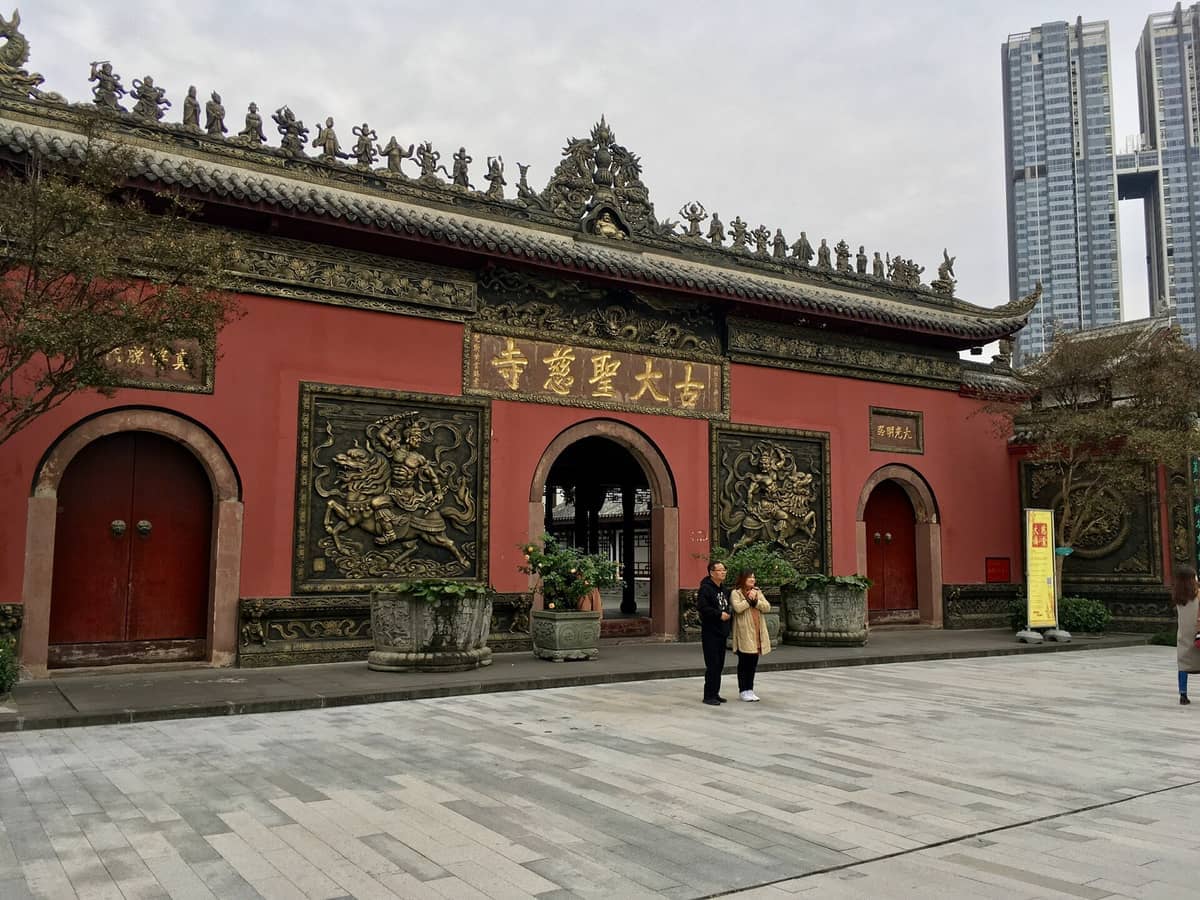
What Is Daci Temple, and Why Does It Matter?
Daci Temple, written in Chinese as 大慈寺 (Dàcí Sì) and historically known as 大圣慈寺, is a functioning Buddhist monastery whose origins trace back to the Wei and Jin dynasties. Its large-scale construction is traditionally dated to 757 CE, and at its Tang-Song-period peak, historical accounts describe the complex having 96 monastic complexes and 8,542 rooms. Very little of that original scale survives, but the temple that stands today carries genuine institutional continuity: it has been a center of Buddhist practice in Chengdu for over 1,200 years.
The reason Daci Temple appears in travel planning is partly its history, but mostly its location. The monastery sits at No. 23 Dacisi Road in Jinjiang District, directly adjacent to the Taikoo Li retail complex and near Chunxi Road Station. In almost any other city, a Tang-dynasty Buddhist complex surrounded by luxury boutiques would feel like a staged experience. Here, it feels like the city simply grew around something it could not bring itself to tear down.
Jinjiang District is Chengdu's commercial and cultural core. If your itinerary already includes Chunxi Road or Taikoo Li, Daci Temple requires almost no additional detour. But treating it as a quick photo stop would be a mistake. The temple rewards those who slow down.
💡 Local tip
Admission is generally free, but confirm at the entrance gate, as policies can change with the season or for special religious events. Confirm at the entrance gate, as policies can change with the season or for special religious events.
What You Will Actually See
Entering from Dacisi Road, you pass through a gate that immediately muffles the traffic noise outside. The courtyard smell is the first thing most visitors register: sandalwood incense, the kind that clings to clothing, coming from large bronze censers positioned in front of the main halls. The stone paving underfoot is uneven in places, worn smooth from decades of visitors and worshippers.
The layout follows a traditional central-axis arrangement, with successive halls progressing from the entrance toward the rear of the complex. The main halls are heavy timber structures with upturned eaves, gold and red paintwork darkened with age in ways that repainting does not quite restore. Inside, large gilded Buddha statues sit on elevated platforms, with incense smoke drifting across beams. The atmosphere is less museum and more active religious site: monks in grey robes move through the compound at different hours, and lay worshippers kneel and burn incense throughout the day.
The rear sections of the compound are quieter. Subsidiary halls, storage areas, and passages between structures contain smaller shrines, carved stone steles, and courtyard plantings that include old ginkgo and camphor trees. These back areas see fewer visitors and are where the quality of the silence changes noticeably.
Tickets & tours
Hand-picked options from our booking partner. Prices are indicative; availability and final rates are confirmed when you complete your booking.
Panda Base and city highlights private day tour in Chengdu
From 302 €Instant confirmationFree cancellationFull day private tour Giant Panda Base and city highlights
From 365 €Instant confirmationFree cancellationChengdu to Yibin private tour with Wuliangye Liquor Museum visit
From 300 €Instant confirmationChengdu private evening tour with hot pot dinner
From 247 €Instant confirmationFree cancellation
How the Experience Changes by Time of Day
Mornings, particularly before 10:00, are the most rewarding time to visit. The light comes in low at certain angles through the courtyard gates, the incense smoke is thickest from the morning prayer period, and the number of tourists is small relative to the number of worshippers. The acoustic quality is different in the morning: you can hear the wooden percussion instruments used during chanting from somewhere inside the main hall, a sound that carries across the courtyard in a way it does not once a crowd arrives.
By midday, visitor numbers peak. Groups from nearby Taikoo Li drift through, often spending only a few minutes. Photography at the main censers becomes competitive, and the atmosphere shifts toward something more performative. If your schedule requires a midday visit, the rear courtyards are considerably more pleasant than the main forecourt.
Late afternoon, in the hour before the 17:00 closing, brings another quieter window. The western light works well for photographing the main hall facade, and the worshippers who come in the evening hours give the compound a calmer atmosphere than the tourist peak around noon.
ℹ️ Good to know
Opening hours are reported as 08:00 to 17:00. The temple phone is +86 28 8665 8341 if you need to confirm.
The Tang Dynasty Origins and What They Mean in Practice
757 CE is the date associated with a major construction phase during the An Lushan Rebellion, when Emperor Xuanzong sought refuge in Chengdu. The imperial patronage of that period explains the ambitious scale of 96 monastic complexes and thousands of rooms, a size that made Daci Temple one of the largest Buddhist complexes in southwestern China during the Tang and Song dynasties., a size that made Daci Temple one of the largest Buddhist complexes in southwestern China during the Tang and Song dynasties. The murals from that period, painted by some of the most celebrated artists of the Tang court, are no longer extant, but their existence in historical records contributed to the site's cultural weight.
The complex has been destroyed and rebuilt multiple times across its history, as have most Buddhist institutions in China. The current structures are primarily later reconstructions, not Tang originals. Understanding this prevents the kind of disappointment that comes from expecting unmodified ancient architecture. What Daci Temple offers is institutional continuity, an active community, and the symbolic significance of a site that has repeatedly been considered worth rebuilding. That is a different kind of authenticity, and for many visitors it is enough.
If you are building a dedicated temple itinerary for Chengdu, the best temples in Chengdu guide provides useful comparisons, including Wenshu Monastery, which is larger and retains more of its traditional compound character.
Getting There and Practical Navigation
The most convenient access is via Chunxi Road Station on Metro Line 2. From there, the walk to Daci Temple is short, passing through the Taikoo Li complex., passing through the Taikoo Li complex. This means that if you are arriving specifically to visit the temple, you will walk through one of Chengdu's most commercially active areas first. The contrast between the two is part of what makes the visit memorable.
The address is No. 23 Dacisi Road, Jinjiang District. When entering into a map or giving the address to a ride-hailing driver, using the Chinese characters 成都市锦江区大慈寺路23号 will produce more reliable results than an English transliteration.
⚠️ What to skip
Modest dress is expected inside the temple halls. Covered shoulders and knees are appropriate. Remove hats before entering the main worship halls, and follow any posted instructions near active shrines.
Accessibility information for visitors with mobility requirements is not confirmed in public sources. The temple phone is +86 28 8665 8341. It is worth calling ahead to ask about step-free access, as the traditional courtyard layout typically involves raised thresholds and uneven paving that can be difficult for wheelchair users.
Photography at Daci Temple
The exterior of the main hall and the large bronze censers in the forecourt are the most photographed elements. The censers photograph particularly well in morning light when the incense smoke catches the low-angle sun. Wide-angle shots from the courtyard entrance tend to produce more compelling compositions than close framing of individual elements.
Photography inside the main halls is generally permitted for the statues and architecture, but you should not photograph worshippers during active prayer without permission. Monks are not subjects for tourist photography. Be discreet, lower the camera when prayer or chanting is underway, and follow any posted signs restricting photography in specific areas.
The contrast between the temple's dark timber eaves and the glass facades of Taikoo Li visible beyond the walls is one of the more distinctive compositions in central Chengdu, and can be captured from specific angles within the compound.
Who Should Reconsider
Travelers who prioritize spectacular or unmodified ancient architecture will find more at other Chengdu sites. The current structures are reconstructions, and the complex is modest in scale compared to its Tang-dynasty descriptions. Visitors with very limited time who have not yet seen Wenshu Monastery may find that the other temple offers a more complete and immersive traditional experience.
Families with young children can visit comfortably, but there is nothing specifically designed for children here. The main interest is architectural and historical, with quiet courtyards that some children will find slow.
If the temple itself is less of a priority than the surrounding area, the Chengdu street food guide covers the surrounding streets in Jinjiang District, which have significant food options in both directions from the temple.
Insider Tips
- Arrive before 09:00 on a weekday morning to experience the compound primarily as a working monastery rather than a tourist site. The number of worshippers relative to visitors is highest in this window.
- The ginkgo trees in the rear courtyards turn gold in late October and early November. This is one of the most visually rewarding times to visit and is not widely advertised.
- If you want to make an offering, purchase incense at the stalls just inside the main gate rather than bringing your own. The stall attendants can also indicate which halls correspond to which intentions, which is useful if you want to follow local practice rather than wander.
- The Taikoo Li complex immediately adjacent to the temple has been deliberately designed to frame views of the temple's roofline from several internal walkways. Walking through Taikoo Li before entering the temple gives you a useful exterior perspective on the compound's scale.
- The temple phone (+86 28 8665 8341) is the most reliable way to confirm current admission fees and any temporary closures for religious festivals before you travel to the site.
Who Is Daci Temple For?
- History travelers interested in Tang-dynasty Buddhism and how Chinese religious sites survive in modern urban contexts
- Photographers looking for the contrast between ancient architecture and contemporary commercial Chengdu
- Visitors on a short Jinjiang District itinerary who are already visiting Chunxi Road or Taikoo Li
- Anyone seeking 45 minutes of genuine quiet in one of Chengdu's densest districts
- Travelers building a broader Chengdu temple itinerary alongside Wenshu Monastery and Qingyang Palace
Nearby Attractions
Other things to see while in Jinjiang District:
- Anshun Bridge
Anshun Bridge (安顺廊桥) is a roofed corridor bridge crossing the Jinjiang River in Jinjiang District, rebuilt in 2003 in the style of a Qing dynasty original. Free to walk across at any hour, it draws the most visitors at night when the lantern lighting reflects across the water. This guide covers what you'll actually see, when to go, and how it fits into a broader Jinjiang itinerary.
- IFS Chengdu (International Finance Square)
Chengdu IFS, officially Chengdu International Finance Square, is the city's most prominent luxury retail and dining complex, sitting at the heart of Jinjiang District. The flagship shopping mall spans roughly 210,000 square metres within a development whose overall gross floor area exceeds 760,000 square metres, alongside Grade-A office buildings, a hotel, and residences., it draws shoppers, diners, and architecture enthusiasts in equal measure. Whether you are here for international flagship stores, Sichuan cuisine, or simply the spectacle of urban Chengdu at full volume, IFS delivers.
- Chunxi Road
Chunxi Road Pedestrian Street (春熙路步行街) is the commercial heart of central Chengdu, stretching roughly 1,840 metres through Jinjiang District. Free to enter and open around the clock, it combines flagship department stores, street food stalls, local fashion brands, and one of the city's most photographed squares. Whether you have two hours or a full afternoon, here is exactly what you will find.
- Taikoo Li Chengdu
Taikoo Li Chengdu is an open-air mixed-use development in Jinjiang District that wraps around the ancient Daci Temple. Spanning roughly 114,000 square metres of retail space, it brings together international flagship stores, local designer boutiques, and some of Chengdu's most sought-after restaurants across a low-rise, lane-style layout that genuinely rewards slow walking.