Anshun Bridge: Chengdu's Covered Corridor Bridge on the Nan River
Anshun Bridge (安顺廊桥) is a roofed corridor bridge crossing the Jinjiang River in Jinjiang District, rebuilt in 2003 in the style of a Qing dynasty original. Free to walk across at any hour, it draws the most visitors at night when the lantern lighting reflects across the water. This guide covers what you'll actually see, when to go, and how it fits into a broader Jinjiang itinerary.
Quick Facts
- Location
- No. 66 Binjiang East Road, Jinjiang District, Chengdu
- Getting There
- Near Hejiang Pavilion and Jiuyan Bridge area; accessible on foot from central Jinjiang
- Time Needed
- 20–45 minutes for the bridge itself; longer if combining with riverside walk
- Cost
- Free (CNY ¥0)
- Best for
- Evening strollers, architecture enthusiasts, photography, couples
What Anshun Bridge Actually Is
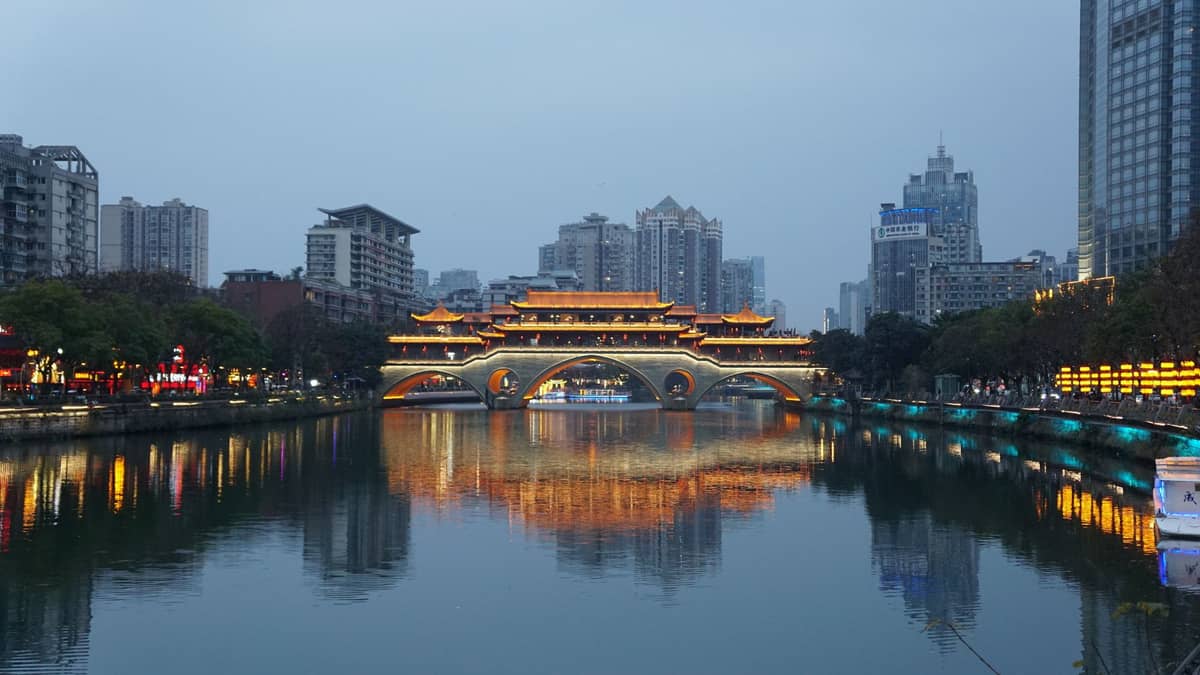
Anshun Bridge, known in Chinese as 安顺廊桥 (Anshun Langqiao), is a covered corridor bridge spanning the Jinjiang River in Jinjiang District. At roughly 81 metres long and 6 metres wide, it is wide enough to feel like a sheltered pavilion rather than a narrow crossing. The roof structure, red columns, and decorative eaves are modelled on traditional Chinese bridge architecture, and the current structure was completed in August 2003 to recreate a historic bridge that had occupied this site in various forms.
The name Anshun was attached to the bridge in 1746 after a flood, when An Hongde, governor of Huayang County, renamed it during the Qianlong era. Records of earlier structures on the same site predate that event. The 2003 rebuild is not trying to pass itself off as ancient, and it is better appreciated for what it is: a well-crafted contemporary interpretation of a historic form, positioned where the Nan River bends through the heart of central Chengdu.
ℹ️ Good to know
The bridge is open 24 hours, every day of the year, with no admission charge. You can walk it at any time, including early morning or late at night.
The Bridge at Different Hours
Daytime visits give you the clearest view of the structure itself. The red-painted timber columns and the curved roof ridge are detailed enough to reward a slow walk, and you can lean over the railing to watch the Nan River below, which runs brown and fairly wide at this point. The surrounding riverside promenade is lined with willows and paved stone paths, and the overall atmosphere on a weekday morning is quiet enough to hear birdsong and the low sound of water moving under the bridge.
By early evening the character shifts noticeably. The lanterns strung along the bridge's interior and the external uplighting switch on as the sky darkens, and the reflection of red and gold across the river surface is the main reason this bridge photographs as well as it does. Weekends between 7 pm and 10 pm are peak time: couples, families, and groups with phone cameras crowd the railings, and vendors along the riverbank do steady business. If you want a calmer evening crossing, aim for a weekday or arrive before 6:30 pm.
Late night, after 10 pm on most evenings, the bridge quiets down significantly. The lighting stays on, the riverside walkway remains accessible, and a walk across the bridge at this hour has a different quality entirely: the reflections are sharper, the noise from the surrounding city falls away, and you are more likely to share the space with a few local residents walking home than with tourist groups.
💡 Local tip
For photography, the 20–30 minutes after sunset offer the best balance of ambient sky colour and artificial lantern lighting. Pure night shots are dramatic but lose the bridge's architectural detail in the surrounding dark.
Tickets & tours
Hand-picked options from our booking partner. Prices are indicative; availability and final rates are confirmed when you complete your booking.
Panda Base and city highlights private day tour in Chengdu
From 302 €Instant confirmationFree cancellationFull day private tour Giant Panda Base and city highlights
From 365 €Instant confirmationFree cancellationChengdu to Yibin private tour with Wuliangye Liquor Museum visit
From 300 €Instant confirmationChengdu private evening tour with hot pot dinner
From 247 €Instant confirmationFree cancellation
Historical and Architectural Context
Covered corridor bridges, known as langqiao (廊桥) in Chinese, appear across southern and southwestern China. They serve a functional purpose beyond crossing water: the roof structure provides shelter from rain, and traditionally the covered interior was used for resting, trading, or socialising. In some regions, langqiao also housed shrines or deity figures. Anshun Bridge follows this typology closely, with its enclosed walking corridor and decorative end pavilions marking it as part of a recognisable regional tradition.
The Jinjiang River system has been central to Chengdu's history as a trade and transport artery. Bridges in this area were not merely infrastructure but social focal points, and the 1746 renaming of the Anshun Bridge after a flood places its documented history within the Qianlong era. The 2003 reconstruction sits within a broader effort to restore heritage-style architecture along Chengdu's inner-city riverbanks, part of the same urban renewal thinking that shaped the pedestrian promenades running along both banks in this district.
The bridge sits close to other significant points along the Jinjiang riverbank. The Hejiang Pavilion area is within easy walking distance, and the broader Jinjiang District corridor connects north toward Taikoo Li Chengdu and Chunxi Road, making the bridge a natural stop on any riverside walking itinerary through central Chengdu.
Walking the Bridge: A Practical Rundown
Approach from Binjiang East Road. The riverside promenade on both banks is well maintained, with paved paths wide enough for cyclists and pedestrians using the same route without much conflict, though the bridge deck itself is pedestrian only. The bridge entrance has no gate or ticketing point: you simply walk on.
The crossing takes under two minutes at a steady pace. Most visitors slow down to look at the river, take photographs through the latticed railings, or read the decorative panels inside the corridor. The roof keeps the interior shaded in the day and lantern-lit at night, and the wooden flooring underfoot produces a faint hollow sound when busy, which adds to the sensory texture of the crossing. On hot summer days the shade is a genuine relief, and on light rain days the roof makes the walk comfortable without waterproofs.
At both ends the bridge connects to paved riverside paths that run in either direction along the Jinjiang riverbank. The path toward the southeast leads toward the Jiuyan Bridge area and a stretch of riverside cafes and tea houses. Going northwest takes you toward Hejiang Pavilion. Both directions are worth exploring if you have time.
💡 Local tip
Wear comfortable flat shoes. The bridge deck and the adjoining riverside stones can be slippery after rain. There are no handrail-free sections, but the surface demands some attention in wet conditions.
Placing Anshun Bridge in a Larger Itinerary
Anshun Bridge works best as part of a longer riverside or district walk rather than as a standalone destination. A half-day itinerary might start with the bridge in the late afternoon, then continue toward the nearby riverbank tea houses, and finish in the Chunxi Road and Taikoo Li area after dark. Alternatively, those following a Chengdu walking tour through Jinjiang District will often encounter the bridge as part of a natural route between the historic core and the modern commercial centre.
If you are planning a broader day across the city, the bridge pairs well with a morning visit to Wenshu Monastery or an afternoon at People's Park before heading east toward the riverbank in the evening. The bridge is a good cooling-down point at the end of a full day on foot.
Chengdu's tea house culture is strong in this part of the city. Several riverside tea houses near the bridge offer seating with river views, and sitting for an hour with a pot of tea before or after crossing the bridge is a standard local move. For context on where to look, the Chengdu tea house guide covers the riverside options in useful detail.
Honest Assessment: Worth Your Time?
Anshun Bridge is not the most spectacular sight in Chengdu, and it would be misleading to suggest otherwise. It is a short bridge with a good-looking exterior and a pleasant riverside setting. Visitors who come expecting a grand monument or an immersive historical experience may find it underwhelming. The 2003 construction date means there is no genuine antiquity here, and the corridor interior, while attractive, contains no museum, no permanent exhibition, and no cultural programming.
What it does offer is atmosphere, and specifically evening atmosphere. If you are in Jinjiang District at dusk and looking for a 20-minute detour that produces satisfying photographs and a genuine sense of Chengdu's riverbank character, the bridge delivers reliably. It is also one of the few photogenic spots in central Chengdu where you can arrive at any hour, spend as long as you like, and leave without spending a yuan.
Those with very limited time in Chengdu and a long list of priorities can reasonably skip it. Those building a relaxed evening in Jinjiang District will find it a worthwhile addition to the walk.
Insider Tips
- The view from the riverbank looking back at the bridge is often better than the view from the bridge itself. Walk to the far bank after crossing and look back to see the full lit facade reflected in the water.
- On national holidays, particularly Golden Week in early October and the Spring Festival period, the riverbank around Anshun Bridge becomes very crowded in the evening. The bridge itself is narrow enough that movement slows to a shuffle at peak times. Arriving before 6 pm or after 10 pm avoids the worst of it.
- The riverside cafes and tea houses closest to the bridge fill up fast on weekend evenings. Walk two or three minutes further along the promenade in either direction and you will find seats more easily.
- For cleaner reflection shots in the water, look for an angle that keeps the bridge lights in frame without including the overhead street lighting from the road behind. Crouching slightly at the riverbank edge improves the framing significantly.
- The bridge is not signposted in English from the main roads nearby. On mapping apps, search for 安顺廊桥 or 'Anshun Langqiao' rather than just 'Anshun Bridge' for more reliable routing.
Who Is Anshun Bridge For?
- Evening walkers combining the bridge with a broader Jinjiang riverside stroll
- Photographers looking for lantern-lit reflections after sunset
- Couples after a quiet, no-cost spot in central Chengdu
- Architecture enthusiasts interested in the langqiao covered bridge form
- Travelers building a Jinjiang District half-day itinerary around Chunxi Road and the riverbank
Nearby Attractions
Other things to see while in Jinjiang District:
- IFS Chengdu (International Finance Square)
Chengdu IFS, officially Chengdu International Finance Square, is the city's most prominent luxury retail and dining complex, sitting at the heart of Jinjiang District. The flagship shopping mall spans roughly 210,000 square metres within a development whose overall gross floor area exceeds 760,000 square metres, alongside Grade-A office buildings, a hotel, and residences., it draws shoppers, diners, and architecture enthusiasts in equal measure. Whether you are here for international flagship stores, Sichuan cuisine, or simply the spectacle of urban Chengdu at full volume, IFS delivers.
- Chunxi Road
Chunxi Road Pedestrian Street (春熙路步行街) is the commercial heart of central Chengdu, stretching roughly 1,840 metres through Jinjiang District. Free to enter and open around the clock, it combines flagship department stores, street food stalls, local fashion brands, and one of the city's most photographed squares. Whether you have two hours or a full afternoon, here is exactly what you will find.
- Daci Temple
With major construction during the Tang dynasty in 757 CE, Daci Temple is one of Chengdu's oldest surviving Buddhist institutions. Located steps from Chunxi Road and Taikoo Li in Jinjiang District, it offers free admission, incense-scented courtyards, and a genuine sense of calm that the surrounding commercial district does not.
- Taikoo Li Chengdu
Taikoo Li Chengdu is an open-air mixed-use development in Jinjiang District that wraps around the ancient Daci Temple. Spanning roughly 114,000 square metres of retail space, it brings together international flagship stores, local designer boutiques, and some of Chengdu's most sought-after restaurants across a low-rise, lane-style layout that genuinely rewards slow walking.