Chicago Symphony Center: Inside One of America's Great Concert Halls
Symphony Center, home of the Chicago Symphony Orchestra, anchors Chicago's cultural life from a landmark 1904 building on Michigan Avenue. Whether you're attending a CSO masterwork program or a chamber recital, this is classical music at its most serious and its most beautiful.
Quick Facts
- Location
- 220 S Michigan Avenue, The Loop, Chicago IL
- Getting There
- CTA Brown/Orange/Green/Pink/Purple Lines to Adams/Wabash; multiple bus routes on Michigan Ave
- Time Needed
- 2–3 hours for an evening concert; allow extra time for pre-concert dining or lobby browsing
- Cost
- Ticket-based access only; prices vary by performance and seat location — check cso.org for current pricing
- Best for
- Classical music lovers, architecture enthusiasts, date nights, solo cultural travelers
- Official website
- cso.org
What Is Symphony Center?
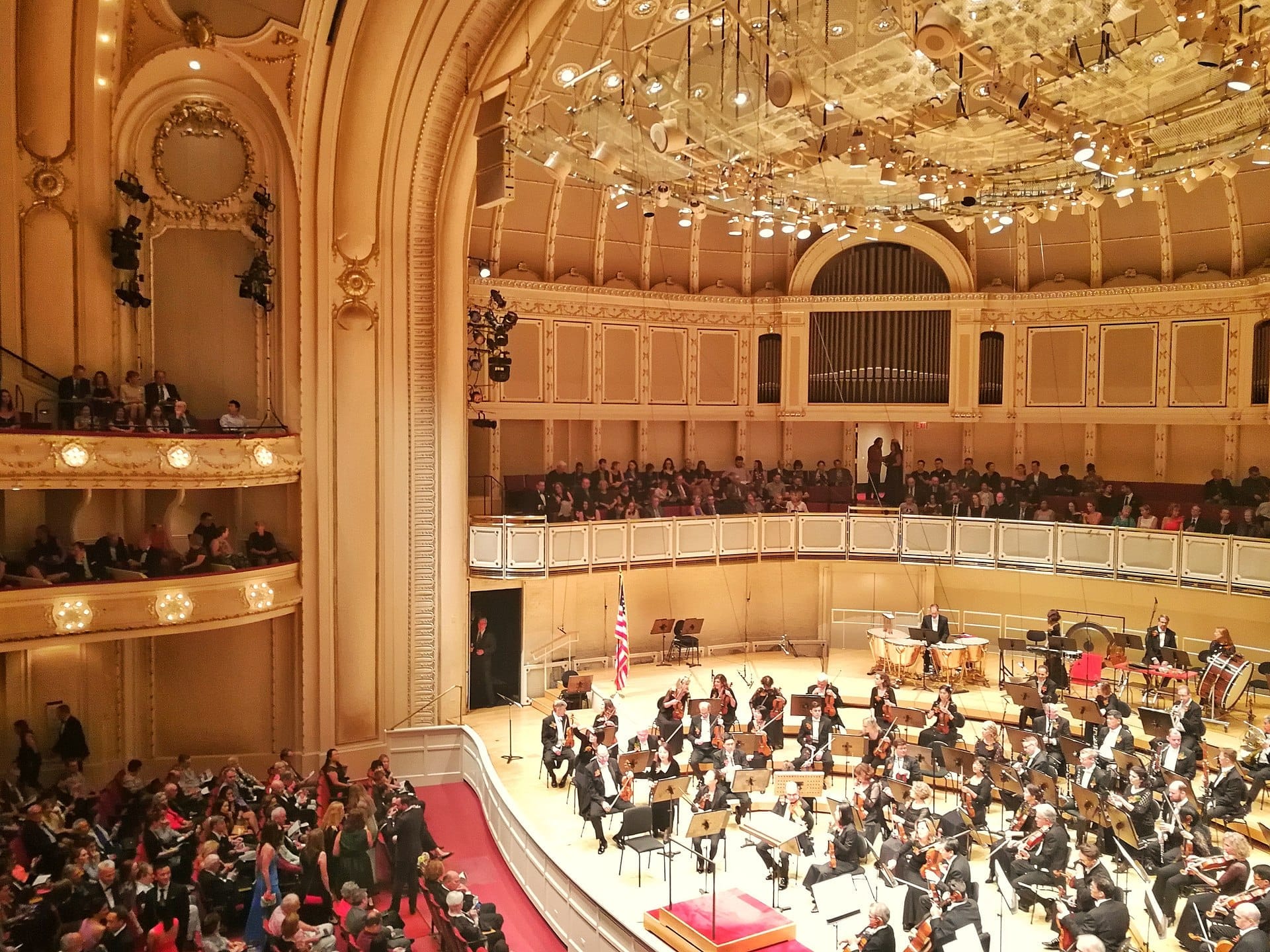
Symphony Center is the performance complex at 220 South Michigan Avenue that serves as the permanent home of the Chicago Symphony Orchestra (CSO), the Chicago Symphony Chorus, and the Civic Orchestra of Chicago. The heart of the complex is Orchestra Hall, a 2,522-seat auditorium that opened on December 14, 1904 and remains one of the most acoustically respected concert halls in North America. The building was designed by Daniel H. Burnham’s firm, D.H. Burnham & Company, Burnham himself being a Chicago architect and CSO trustee responsible for reshaping much of the city's built environment, and it was completed in fulfillment of a vision held by Theodore Thomas, the CSO's founder and first music director.
The Center sits directly on the edge of the Loop, facing Grant Park and positioned almost exactly opposite the Art Institute of Chicago. That address places it at the geographical and symbolic center of Chicago's cultural corridor, a stretch of Michigan Avenue that concentrates more serious arts institutions per block than almost anywhere else in the American Midwest.
ℹ️ Good to know
There are no fixed public visiting hours for the concert spaces themselves — general public access largely follows the concert and event schedule, aside from the separately operated Symphony Store. Plan your visit around a specific performance, not a drop-in browse.
The Building: Daniel Burnham's Enduring Design
Walking up to Orchestra Hall from Michigan Avenue, the facade reads as restrained and dignified rather than ostentatious, which says something about the civic seriousness with which Chicago approached the project in 1904. Burnham designed a Georgian Revival structure in red brick and limestone, with arched windows at street level and a proportioned cornice line that holds its own against the taller commercial towers that grew up around it across the twentieth century. The building does not try to overpower the street. It simply stands there, solid and unhurried, and Michigan Avenue is better for it.
The interior lobby spaces reward attention even before a single note is played. The main floor lobby features coat check stations and security desks, but the real discovery is in the upper-level lobbies on the terrace and fifth and sixth floors, where you can look out at the park-side view that Burnham would have known. The building sits comfortably within the wider architectural landscape of Chicago, and a visit to Symphony Center pairs naturally with a walk through the surrounding Loop blocks, where Burnham's influence on the city's grid is everywhere.
Tickets & tours
Hand-picked options from our booking partner. Prices are indicative; availability and final rates are confirmed when you complete your booking.
Chicago city center walking audio tour
From 5 €Instant confirmationArchitecture cruise on the Chicago River from Michigan Ave
From 39 €Instant confirmationFree cancellationGo City | Chicago All-Inclusive Pass
From 127 €Instant confirmationFree cancellationiFLY Chicago Lincoln Park indoor skydiving experience
From 126 €Instant confirmationFree cancellation
The Chicago Symphony Orchestra: Why It Matters
The CSO is not merely a local institution. It consistently ranks among the top orchestras in the world, with a recorded legacy that spans more than a century and a roster of music directors that has included Georg Solti, Daniel Barenboim, and Riccardo Muti. Attending a CSO concert at Orchestra Hall is not comparable to catching a symphony performance at a regional venue. The playing standard is exceptional, the programming is often ambitious, and the acoustic environment of the hall itself rewards the live experience in a way that recordings cannot fully replicate.
The orchestra's regular subscription season runs from roughly September through June, with the main Masterworks series at the core of the schedule. The CSO also programs chamber music, family concerts, holiday performances, and guest artist recitals throughout the year. The Civic Orchestra of Chicago, the training ensemble associated with the CSO, performs separately and offers a more accessible price point for listeners who want the Symphony Center experience at lower cost.
For visitors planning a trip around the concert season, the best months to visit Chicago for classical music are October through April, when the main season is in full swing and programming is at its densest. Summer brings a lighter schedule of special programs and festivals, often focused on guest artists and themed series rather than the full regular season, though the schedule is lighter than during the academic year.
What a Performance Night Actually Feels Like
Arrive at least 30 minutes before curtain, ideally earlier on weekend evenings when the lobby fills quickly. Michigan Avenue in the hour before a major CSO concert takes on a particular character: taxis and rideshares pulling up, people in everything from formal black-tie to smart casual, the collective low hum of an audience that knows it is about to hear something worth hearing. The lobby doors open well before the performance, and the main floor concourse offers a bar where you can get a drink to take to your seat.
Inside Orchestra Hall itself, the first impression is one of warm wood tones and a sense of vertical height that feels generous rather than overwhelming. The sight lines from most sections are good, though the upper balcony seats at the sides require some adjustment. The acoustic quality becomes apparent the moment the orchestra tunes. Sound carries cleanly and the hall does not impose itself on the music in the way that over-reverberant spaces can. Quiet passages genuinely feel quiet, and the full orchestra in fortissimo fills the room without distortion.
Intermissions at Symphony Center run roughly 20 minutes and are social occasions in themselves. The upper lobby bars see a steady flow of concert-goers, and the atmosphere is considerably more relaxed than the formality of the performance space suggests. The dress code in practice leans toward smart casual on weekday evenings, with more formal dress common on Fridays and weekend nights, particularly for season-opening galas or special programs.
💡 Local tip
Photography inside Orchestra Hall is not permitted during performances. The building exterior and lobby spaces can be photographed freely when not in a performance.
Planning Your Visit: Tickets, Access, and the Symphony Store
There is no general admission to Symphony Center. Access to the building is through tickets to specific performances or events, purchased through the CSO's official website at cso.org. Prices vary significantly by performance, series, and seat location, and the best seats for popular programs sell out well in advance. The CSO offers subscription packages that typically provide priority access and some discount over single-ticket pricing, which is worth considering if you are spending more than a few days in Chicago.
The Symphony Store, located within the complex, keeps regular hours of Tuesday through Saturday from 11:30 a.m. to 5 p.m., and is also open before all CSO and select Symphony Center Presents concerts. It carries recordings, scores, books, and CSO merchandise, and is one of the more thoughtfully stocked music shops in the city. Hours are subject to change, so verify before making a special trip.
For accessibility needs, including wheelchair seating and assistive listening devices, the CSO handles requests directly through its box office. The building has coat check stations on multiple floors, including the Main Floor, Lower Balcony, and Terrace levels, which is genuinely useful in Chicago winters when leaving a heavy coat at the door improves the concert experience considerably.
💡 Local tip
For a lower-cost entry point, look for Civic Orchestra of Chicago concerts at Symphony Center, which are free or lower-priced and feature a strong ensemble of emerging professional musicians.
Getting There and the Surrounding Area
Symphony Center's Michigan Avenue location makes it straightforward to reach by public transit. The nearest CTA 'L' station is Adams/Wabash on the Brown, Orange, Green, Pink, and Purple lines, a short walk west through the Loop. Multiple bus routes run along Michigan Avenue directly in front of the building. Driving and parking in this part of the Loop on a concert night requires patience; public transit or a rideshare drop-off on Michigan Avenue is a cleaner option for most visitors. Details on navigating Chicago's transit system are covered in the complete guide to getting around Chicago.
The blocks immediately surrounding Symphony Center contain a concentrated selection of pre-concert dining options. The Loop neighborhood has improved substantially as a dining destination over the past decade, and Michigan Avenue's proximity to the riverfront means there are good options within a 10-minute walk in multiple directions. Grant Park is directly across the street, offering a pleasant pre-concert walk in warmer months. The Art Institute of Chicago is literally across the road and shares late hours on select evenings, making it possible to visit both on the same outing.
⚠️ What to skip
Parking in the South Loop on performance nights can be slow and expensive. Budget extra time or use transit.
Who Will Get the Most From a Visit, and Who Might Not
Symphony Center is a serious concert venue, not a tourist attraction in the conventional sense. Visitors who will get the most from it are those with genuine interest in orchestral music, opera, or chamber performance, or those who want to experience the building as an example of early twentieth-century Chicago civic architecture. The CSO performs at a world-class level, and the hall itself is worth hearing in. This is not a casual drop-in experience.
Travelers with young children may find that family-specific programming offered by the CSO is a better fit than standard evening concerts, which require audience quiet and last between 90 minutes and two hours. Those primarily interested in Chicago's jazz and blues heritage have better venues to prioritize; the Chicago blues and jazz scene is a separate world with its own landmarks and schedules.
Insider Tips
- Rush tickets for same-day performances are sometimes available through the CSO box office at a significant discount. Check cso.org or call the box office on the day of a performance if you are flexible about seat location.
- The upper balcony rear seats are among the more affordable options and offer an interesting perspective on the hall's architecture, though they are better suited to large orchestral works than to solo recitals where visual proximity matters.
- Pre-concert talks hosted by CSO staff or guest speakers are often included with your ticket for Masterworks performances. They typically begin about 45 minutes before curtain in one of the lobby spaces and provide useful context without requiring advance registration.
- The Symphony Store on weekday lunch hours is one of the quieter places in the Loop to browse for classical recordings and scores, well before the concert crowd arrives in the evening.
- Michigan Avenue directly outside Symphony Center offers an unobstructed view toward Grant Park and the illuminated Art Institute facade in the evenings, which makes for a strong photograph both before and after a performance.
Who Is Chicago Symphony Center For?
- Classical music listeners who want to hear a world-ranked orchestra in its home hall
- Architecture travelers interested in Daniel Burnham's work and early twentieth-century Chicago civic buildings
- Date nights or special occasion evenings where the setting matters as much as the program
- Solo cultural travelers who want a structured, high-quality evening out in the Loop
- Music students and serious listeners looking for a benchmark live orchestral experience
Nearby Attractions
Other things to see while in The Loop:
- Art Institute of Chicago
One of the largest and most visited art museums in the United States, the Art Institute of Chicago anchors the eastern edge of the Loop with a collection of over 300,000 works spanning 5,000 years. From Georges Seurat's pointillist masterpiece to Grant Wood's American Gothic, the highlights alone demand the better part of a day.
- Buckingham Fountain
The Clarence Buckingham Memorial Fountain is one of the largest decorative fountains in the world, sitting at the heart of Grant Park since 1927. Free to visit during its seasonal run from spring through mid-October, it puts on hourly water displays and a nightly illuminated show that draws crowds from across the city.
- Chicago Architecture Center
Housed in Mies van der Rohe's One Illinois Center on the Chicago River, the Chicago Architecture Center packs nearly 10,000 square feet of exhibition space, a landmark scale model of the city, and access to some of the country's most informative architecture tours. It's the most comprehensive entry point into understanding what makes Chicago's skyline one of the world's most significant.
- Chicago Architecture Foundation River Cruise
The Chicago Architecture Center River Cruise aboard Chicago's First Lady is the most authoritative way to read the city's skyline. In 90 minutes, trained docents walk you through more than 40 landmark buildings across all three branches of the Chicago River, connecting architectural styles to the human decisions that shaped them.