Chicago Pedway: The Secret Underground City Beneath the Loop
The Chicago Pedway is a free, five-mile network of tunnels, sky bridges, and ground-level concourses threading through more than 50 buildings in the Loop. Part practical shortcut, part urban curiosity, it is one of downtown Chicago's most overlooked and genuinely interesting places to explore on foot.
Quick Facts
- Location
- The Loop, Chicago (spans more than 40 downtown blocks)
- Getting There
- Multiple CTA 'L' stations in the Loop; Washington and Jackson stations are major transfer points between the Red and Blue Line subways
- Time Needed
- 30 minutes for a quick walk-through; 2+ hours for a thorough self-guided exploration
- Cost
- Free — no admission fee
- Best for
- Curious walkers, architecture enthusiasts, cold-weather visitors, and commuters avoiding the elements
- Official website
- loopchicago.com
What the Chicago Pedway Actually Is
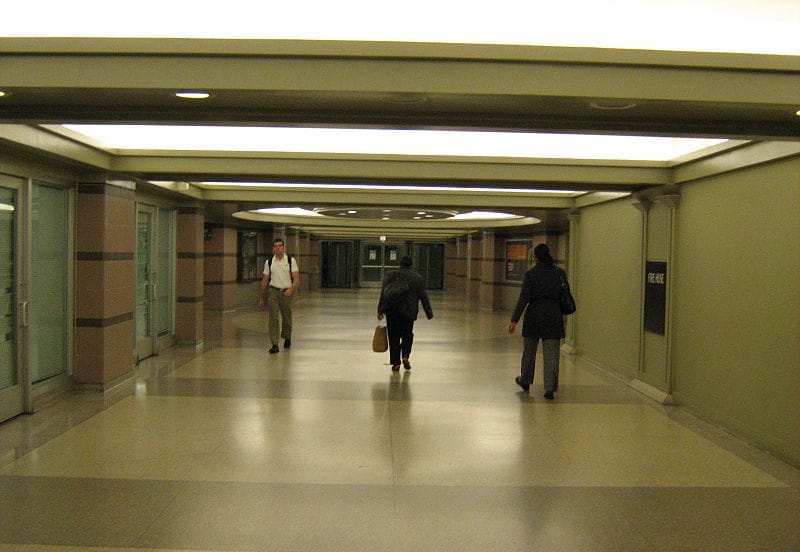
The Chicago Pedway is not one place. It is a system: roughly five miles of interconnected pedestrian passages running beneath, through, and above the streets of the Loop, linking more than 50 public and private buildings across more than 40 city blocks. Sections run underground as tiled tunnels, others pass through the lobbies of office towers and government buildings at street level, and a handful are elevated sky bridges. Walking it end to end means crossing through hotel lobbies, food courts, parking garages, and the concourses of commuter rail stations, sometimes with no clear sense of where one building ends and another begins.
The system began in 1951, initially built to connect the CTA Red and Blue Line subways at Washington Street and Jackson Street. Its original purpose was purely functional: give commuters a way to transfer between 'L' lines without stepping outside. Over the following decades the network expanded organically as private developers chose to connect their new buildings into the existing passages. The result is a system that was never comprehensively planned, which explains why navigating it still feels like a puzzle even today.
💡 Local tip
Access hours vary by section and depend on the buildings the Pedway passes through. Most sections are accessible during standard business hours on weekdays. Some passages close in evenings, on weekends, or for building security reasons. Plan your visit around a weekday morning or midday for the widest access.
What It Feels Like Underground
The first thing you notice stepping into one of the tunnel sections from a CTA station is the temperature: cool and consistent regardless of what is happening above ground. In January, when wind chill on the street might read well below freezing, the Pedway is around 65 degrees Fahrenheit. In August, it offers a quiet escape from summer humidity. The air has that particular quality common to institutional underground spaces, slightly recycled, faintly mineral, with the distant rumble of trains providing a low-frequency soundtrack.
The tunnels themselves range from utilitarian to surprisingly pleasant. Some sections are narrow and low-ceilinged, lit by fluorescent strips and lined with utility pipes. Others open into wide concourses with polished floors, retail storefronts, and natural light filtering down from street-level grates. The Thompson Center section (officially the James R. Thompson Center) is particularly striking: the atrium above is one of Chicago's most architecturally controversial spaces, and the Pedway connection delivers you into it from below in a way that makes the building's scale land with full effect.
The signage was long considered one of the Pedway's biggest problems. For years, wayfinding was inconsistent or simply absent, making it genuinely easy to get disoriented and exit onto an unfamiliar street corner several blocks from where you intended. The Chicago Loop Alliance has worked to improve this with updated map installations at key decision points, but it remains imperfect. Many experienced Loop workers still use landmarks rather than signs to navigate: the Pedway beneath the Ogilvie Transportation Center has a different feel from the section under City Hall, and after a few visits the texture of the route becomes recognizable.
Tickets & tours
Hand-picked options from our booking partner. Prices are indicative; availability and final rates are confirmed when you complete your booking.
Go City | Chicago All-Inclusive Pass
From 127 €Instant confirmationFree cancellationiFLY Chicago Lincoln Park indoor skydiving experience
From 126 €Instant confirmationFree cancellationiFLY Chicago Rosemont indoor skydiving tickets
From 117 €Instant confirmationFree cancellationChicago lakefront neighbourhood bike tour
From 18 €Instant confirmationFree cancellation
How the Experience Changes by Time of Day
On weekday mornings between roughly 7:30 and 9:00, the Pedway near Metra and CTA stations is genuinely crowded. Commuters walk fast, coffee cups in hand, and the food concession counters along the lower concourse of Millennium Station and around City Hall do steady business. The rhythm is purposeful rather than exploratory. This is the Pedway functioning exactly as designed: moving people efficiently from transit to office without a weather penalty.
By midday on a weekday the pace softens. Workers use it for lunch runs, and the occasional tourist with a map or phone out is easy to spot. This is the best window to actually look around without fighting foot traffic, and to notice details like the older tilework in the sections near Jackson station, which still carries the aesthetic of 1950s municipal infrastructure.
On weekends the Pedway is largely quiet, and in some sections it simply is not accessible. Buildings that form key links in the network, including private office towers and government facilities, close their lobbies on Saturday and Sunday. This means a weekend self-guided tour can feel fragmented, with passages you expected to continue through blocked by locked doors. Approach weekend visits with flexibility and a downloaded map rather than an expectation of seamless end-to-end exploration.
⚠️ What to skip
Weekend and evening access is unreliable. Several critical linking sections pass through buildings that close outside business hours. If you are visiting specifically to explore the Pedway as a system, a weekday visit between 9am and 4pm gives you the best chance of continuous passage.
How to Navigate It
There is no single front door to the Chicago Pedway. The most logical starting points for visitors are the CTA 'L' stations themselves. At Washington station, where the Red and Blue Lines intersect, the original Pedway tunnels are directly accessible from the fare-paid zone. The Jackson station connection is similar. From either point, you can begin moving through the network without ever swiping a transit card specifically for Pedway access.
Alternatively, enter through a building lobby. The Pedway connects to the Daley Center, City Hall, the Cultural Center, and several hotels including the Hyatt Regency Chicago; however, the Palmer House is not directly on the main Pedway network. Some of these are excellent starting points because they are open, well-staffed, and positioned near informational maps. The Chicago Cultural Center is a particularly good anchor: it is architecturally spectacular, free to enter, and its Pedway connection places you into the heart of the network within steps of Millennium Park.
Chicago Detours, a local tour operator, runs guided Pedway tours that are well regarded among people who want context rather than just geography. These tours interpret the architecture, history, and the occasionally strange logic of the system in a way that a solo walk cannot replicate. For those who prefer to go independently, the Chicago Detours website offers a downloadable map, which is more accurate and current than anything available inside the Pedway itself.
The Architecture: From Functional to Quietly Fascinating
The Pedway was not designed to be beautiful, and in many places it is not. But it is architecturally interesting precisely because it passes through buildings from different eras and different design philosophies. The older municipal sections carry the utilitarian concrete-and-tile character of postwar infrastructure. More recent connections pass through glass-walled lobbies with marble floors and soaring ceilings. The contrast is jarring in a way that makes you think about how the Loop has layered decades of construction on top of itself. Visitors who enjoy Chicago's architectural history will find the Pedway offers a different kind of architecture tour: horizontal rather than skyward, and more concerned with circulation than with aesthetics.
The bridges are worth seeking out specifically. The elevated sections, particularly around the Hyatt and the Illinois Center complex, offer views down onto street-level activity that you simply do not get from the sidewalk. Standing in a glass-walled corridor several stories above Wacker Drive while traffic moves below is one of those small Loop moments that does not photograph particularly well but that stays with you.
Practical Considerations Before You Go
The Pedway is free. There are no tickets, no passes, and no registration required. You simply walk in through one of the public access points. The retail and food options along the route are independently operated and priced normally: coffee shops, sandwich counters, a pharmacy, and convenience stores all operate within the system, primarily serving the surrounding office population.
Getting to the Pedway is straightforward from anywhere in the Loop. The CTA Blue Line and Red Line both stop at Washington and at Jackson stations one block apart (on Dearborn and State respectively). The Brown, Orange, Green, Pink, and Purple Lines serve multiple Loop stations within easy walking distance of Pedway entrances. For a broader orientation to navigating downtown Chicago, the getting around Chicago guide covers CTA fares, transit cards, and the 'L' map in full detail.
Photography in the Pedway is generally permitted in public sections, though some buildings reserve the right to restrict commercial photography in their lobbies. The older tunnel sections near the CTA stations photograph interestingly in low light, with the long perspective of a tiled corridor and the occasional commuter in motion. Bring a phone with a good low-light camera or a compact with decent ISO performance. Wide-angle lenses work well in the broader concourses.
Accessibility varies. Modern buildings connected to the Pedway are generally ADA-compliant with elevators and level access. Older sections can involve stairs, and some transitions between buildings require navigating escalator banks rather than elevators. Travelers with mobility considerations should review the Chicago Loop Alliance's current map, which notes accessible routes, before visiting.
ℹ️ Good to know
The Pedway is most useful in extreme weather. Chicago winters regularly deliver wind chills below 0°F (-18°C), and the city's summer heat and humidity can be equally draining. If your hotel, office, or destination is connected to the Pedway network, learning the route in advance can make a significant difference to comfort during peak winter or summer months.
Who Will Love It — and Who Should Skip It
The Pedway rewards curiosity and a tolerance for mild disorientation. Travelers who enjoy the texture of everyday urban infrastructure, who are interested in how a city works at the ground level, or who are doing a deep dive into Chicago's built environment will find it genuinely worth an hour or two. It also has obvious practical value for anyone spending time in the Loop during winter or summer extremes.
Travelers with limited time who are prioritizing Chicago's headline attractions will likely find the Pedway more useful as a practical tool than as a destination in itself. It is not a conventional attraction with a payoff moment or a clear endpoint. There are no exhibits, no views, and no performances. It is a working piece of urban infrastructure that happens to be free, navigable, and strangely absorbing if you approach it with the right expectations.
Families with young children may find the Pedway more logistically complicated than rewarding, particularly on a stroller. Solo travelers, architecture students, urban geography enthusiasts, and visitors who have already covered Chicago's major sites will get the most from it. For context on what else the Loop has to offer, the Loop neighborhood guide is a useful companion.
Insider Tips
- Download the Chicago Loop Alliance's Pedway map to your phone before you go. In-system wayfinding has improved but is still inconsistent, and mobile signal can be weak in the deeper tunnel sections.
- Enter through the Chicago Cultural Center or the Daley Center if you want to start with a sense of grandeur. Both buildings are architecturally interesting in their own right and place you near the most navigable sections of the network.
- The Pedway near Millennium Station (at 151 E. Randolph) is particularly lively on weekday mornings and connects directly to Metra commuter rail platforms, making it useful if you are arriving by train from the suburbs.
- Look at the floor transitions between buildings. The seams where one owner's terrazzo ends and another's begins tell the story of the system's piecemeal expansion as clearly as any historical account.
- Avoid treating the Pedway as a primary transit strategy on a Saturday or Sunday. Without confirming which sections are open, you risk dead ends that force you back to street level repeatedly.
Who Is Chicago Pedway For?
- Architecture and urban design enthusiasts who want to experience Chicago's built environment from a different angle
- Visitors during winter months (December through February) looking to move between Loop attractions without repeated cold exposure
- Repeat Chicago visitors who have already seen the headline sites and want something genuinely different
- Commuters and business travelers based in Loop hotels seeking a weather-free route to meetings or transit connections
- Solo travelers with a curiosity for everyday urban infrastructure and a willingness to get slightly lost
Nearby Attractions
Other things to see while in The Loop:
- Art Institute of Chicago
One of the largest and most visited art museums in the United States, the Art Institute of Chicago anchors the eastern edge of the Loop with a collection of over 300,000 works spanning 5,000 years. From Georges Seurat's pointillist masterpiece to Grant Wood's American Gothic, the highlights alone demand the better part of a day.
- Buckingham Fountain
The Clarence Buckingham Memorial Fountain is one of the largest decorative fountains in the world, sitting at the heart of Grant Park since 1927. Free to visit during its seasonal run from spring through mid-October, it puts on hourly water displays and a nightly illuminated show that draws crowds from across the city.
- Chicago Architecture Center
Housed in Mies van der Rohe's One Illinois Center on the Chicago River, the Chicago Architecture Center packs nearly 10,000 square feet of exhibition space, a landmark scale model of the city, and access to some of the country's most informative architecture tours. It's the most comprehensive entry point into understanding what makes Chicago's skyline one of the world's most significant.
- Chicago Architecture Foundation River Cruise
The Chicago Architecture Center River Cruise aboard Chicago's First Lady is the most authoritative way to read the city's skyline. In 90 minutes, trained docents walk you through more than 40 landmark buildings across all three branches of the Chicago River, connecting architectural styles to the human decisions that shaped them.