Chicago Harbor Lighthouse: The City's Sentinel on the Lake
Built in 1893, the Chicago Harbor Lighthouse stands on the breakwater at the entrance to Chicago Harbor, just east of Navy Pier. It cannot be entered, but viewed from the shoreline or water, it offers one of Chicago's most quietly striking lakefront scenes.
Quick Facts
- Location
- South end of the north breakwater, Chicago Harbor entrance — best viewed from Navy Pier
- Getting There
- CTA Red Line to Grand, then east on Illinois St toward Navy Pier; several bus routes also serve the pier
- Time Needed
- 15–30 minutes for a lakefront viewing stop; longer if combined with a harbor boat tour
- Cost
- Free to view from shore; boat tours that pass it charge their own fares
- Best for
- Architecture fans, photographers, and anyone already at Navy Pier looking for a moment of genuine history
- Official website
- savethelighthouse.org
What You're Actually Looking At
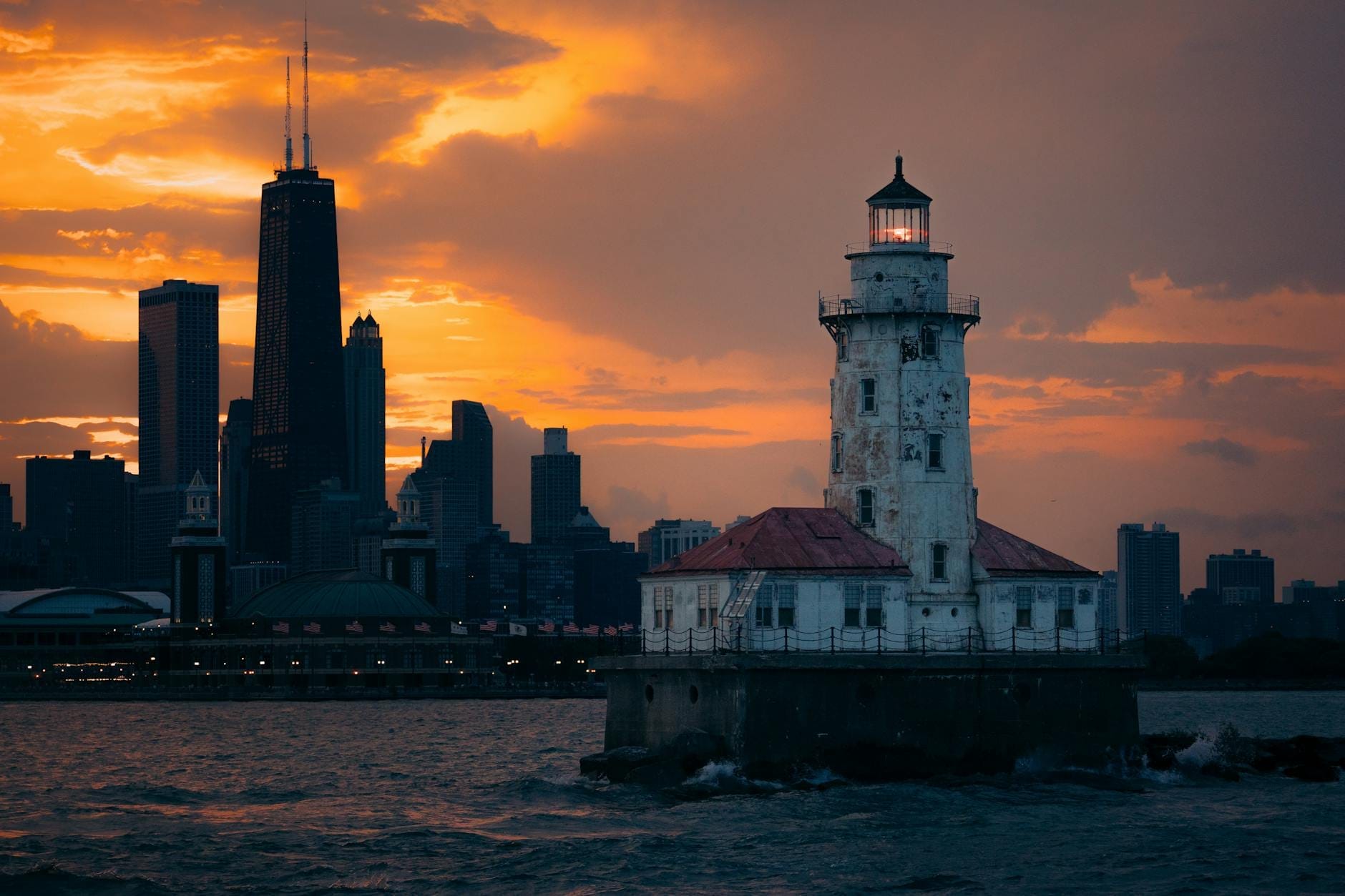
The Chicago Harbor Lighthouse is a roughly 66-foot cast-iron and steel tower painted white with red-roofed attached buildings, sitting at the end of the north breakwater where Chicago Harbor opens onto Lake Michigan. It was built in 1893, the same year the city hosted the World's Columbian Exposition, and was later moved to its current position when the breakwater was extended around 1917–1918. The tower houses a third-order Fresnel lens, a precision optical instrument that once projected a beam far enough out onto the lake to guide commercial vessels and passenger steamers into the harbor.
It is a working navigational aid, not a museum piece. The U.S. Army Corps of Engineers maintains it, and that operational status is part of what makes it feel different from a preserved monument. When you see it from the pier, especially at dusk when its light activates automatically, there is a clarity to what it does that most Chicago landmarks lack.
ℹ️ Good to know
The lighthouse is not open to the public. There is no path, dock, or ticket that gets you onto the breakwater. All visits are by line of sight from the shoreline or by boat.
The View from Navy Pier: Timing and Conditions
The clearest land-based view is from the eastern tip of Navy Pier, where the lighthouse sits roughly 1,000 feet offshore. On a calm morning, before the pier fills with visitors, you get the lighthouse framed against open lake and sky, with very little competing noise or movement. The water can be nearly flat in early summer mornings, with the lighthouse casting a long reflection. By midday, the crowd, wind, and haze combine to make the view busier and less photogenic.
Late afternoon in summer is the most atmospheric time to visit. The sun moves to the west-southwest, so by around 5 p.m. the light hits the red and white tower from the side rather than bleaching it out. The lake chop picks up, waves break against the breakwater, and the lighthouse looks genuinely purposeful rather than decorative. In winter, ice forms along the breakwater and sometimes partially encases the base of the structure, which creates an arresting visual but also means biting winds off the lake.
Weather matters significantly here. On overcast or foggy days, the lighthouse can disappear into grey entirely, visible only as a faint shape. On those same days, if you know the fog signal is active, you may hear the horn, which is one of those sounds that connects the present-day waterfront to Chicago's shipping past more directly than any interpretive plaque could.
💡 Local tip
For photography, a 70–200mm lens or the telephoto mode on a modern smartphone will compress the distance and make the lighthouse fill more of the frame. Shoot from the pier's north side railing in the late afternoon for the best natural light angle.
Tickets & tours
Hand-picked options from our booking partner. Prices are indicative; availability and final rates are confirmed when you complete your booking.
Go City | Chicago All-Inclusive Pass
From 127 €Instant confirmationFree cancellationiFLY Chicago Lincoln Park indoor skydiving experience
From 126 €Instant confirmationFree cancellationiFLY Chicago Rosemont indoor skydiving tickets
From 117 €Instant confirmationFree cancellationChicago lakefront neighbourhood bike tour
From 18 €Instant confirmationFree cancellation
Historical Context: 1893 to Today
A lighthouse has stood at or near the mouth of the Chicago River since the 1830s, reflecting Chicago's reliance on Lake Michigan for commerce from its earliest decades. The current structure dates to 1893, built to replace an earlier light and scaled to the demands of a port city that was then transforming into a major industrial and rail hub. When the breakwater was extended outward around 1917–1918 to improve harbor protection, the lighthouse was physically relocated to the new breakwater end, a logistically complex operation that preserved the structure rather than replacing it.
The lighthouse was added to the National Register of Historic Places on July 19, 1984, and was designated a Chicago Landmark on April 9, 2003. The nonprofit Friends of the Chicago Harbor Lighthouse has led preservation and advocacy efforts for decades, working to ensure the structure is maintained beyond its functional role as a navigational aid. That tension between operational use and historic preservation is part of the lighthouse's ongoing story.
If you want to understand how the lighthouse fits into the broader story of Chicago's relationship with Lake Michigan, the Chicago History Museum has detailed material on the city's maritime and waterfront development. The Chicago lakefront guide is also worth reading before your visit, especially if you plan to walk or cycle the full shoreline trail.
Getting There and Combining It with Other Stops
Navy Pier is the obvious base. The CTA Red Line stops at Grand Avenue, from which it is about a 15-minute walk east along Illinois Street to the pier entrance. Several CTA bus routes serve the pier more directly. Once at Navy Pier, walk to the far eastern end for the best unobstructed view of the lighthouse across the water. The walk from the pier entrance to the eastern tip takes about 10 minutes at a relaxed pace.
For a closer perspective, harbor and architectural boat tours departing from Navy Pier or the Chicago River will often pass near the lighthouse. The Chicago Architecture Foundation River Cruise focuses on the river and downtown towers, but several open-water harbor tours exist that take you out toward the breakwater. Check individual operators for their exact routes, as not all of them approach the lighthouse closely.
The Streeterville neighborhood surrounding Navy Pier is also worth walking through on your way in or out. The Magnificent Mile and Streeterville area has a density of architecture, food, and shopping that makes a lighthouse visit easy to fold into a longer half-day itinerary.
💡 Local tip
Combine the lighthouse view with a walk along the Chicago Riverwalk heading west. It adds about 40 minutes and gives you a complete sense of how the city relates to both its river and its lake.
What It Looks Like Up Close (from the Water)
From a boat approaching the lighthouse, the structure reveals details that are invisible from the pier. The base includes a fog-signal building and a boathouse added during the 1917–1919 breakwater extension. The tower itself is painted white and flanked by red-roofed service buildings, a day-mark pattern that makes it identifiable at distance against varying sky and lake conditions. The lantern room at the top is black, housing the Fresnel lens.
The breakwater it sits on is a riprap structure of large limestone blocks. On summer days, cormorants and gulls use it as a resting platform. The sound at close range on a choppy day is dominated by water slapping and breaking against the rocks, and by the creak of any nearby boats. It smells of lake water, algae, and occasionally diesel from passing harbor traffic. The overall impression is utilitarian and specific to this place, which is the opposite of many Chicago tourist attractions.
Honest Assessment: Is This Worth Your Time?
The Chicago Harbor Lighthouse is not a destination attraction in the way that the Art Institute or Millennium Park are. You cannot go inside, there is no exhibition, no gift shop, and no guided tour. What it offers is something harder to manufacture: an actual historic structure doing an actual job on the edge of a genuinely large body of water.
For travelers focused on indoor experiences, or those with very limited time who need to prioritize, the lighthouse view is something you catch while passing rather than plan a trip around. But if you are the kind of traveler who appreciates physical evidence of how a city was built and sustained, this is worth 20 minutes at the end of the pier. It pairs naturally with a broader lakefront walk, and fits neatly into any Chicago architecture itinerary that extends beyond the downtown skyline.
People who find maritime history uninteresting, or who are visiting Chicago specifically for nightlife, food, or indoor cultural institutions, will likely find the lighthouse unremarkable as a standalone stop. It is also a poor choice on days with very low visibility, heavy rain, or extreme cold, when the lakefront itself becomes an obstacle rather than a draw.
Insider Tips
- The lighthouse activates its light automatically at dusk. If you time your pier visit for around sunset, you can watch it switch on against a darkening sky and open water, which is a different experience from the midday view.
- The north side of Navy Pier's east end gives a slightly cleaner sightline than the south side, which has more structures and the pier's Ferris wheel in the frame.
- Winter visits after a cold snap sometimes produce ice formations on the breakwater that surround the base of the lighthouse. This is one of the more photogenic conditions, but dress for wind-chill temperatures that can be 10–15 degrees colder at the water's edge than inland.
- Kayak tours that go out into the harbor get noticeably closer to the lighthouse than any fixed-deck boat. Chicago River kayak operators sometimes offer harbor routes that approach the breakwater.
- The Friends of the Chicago Harbor Lighthouse (savethelighthouse.org) publishes updates on preservation work and occasionally organizes closer-access events. Worth checking if you have a specific interest in the structure's condition or history.
Who Is Chicago Harbor Lighthouse For?
- Architecture and design travelers who want to see a well-preserved 19th-century navigational structure in its original functional context
- Photographers looking for a lakefront subject that doesn't involve crowds at the foreground
- History-focused visitors already spending time at or near Navy Pier
- Anyone doing the full Chicago lakefront trail who wants a clear landmark at the northern harbor section
- Travelers on a budget who want a genuine Chicago landmark without any entry cost
Nearby Attractions
Other things to see while in Magnificent Mile & Streeterville:
- 360 CHICAGO Observation Deck
Perched on the 94th floor of 875 North Michigan Avenue, 360 CHICAGO delivers panoramic views stretching across the city grid, Lake Michigan, and on clear days, four states. With the TILT ride, interactive displays, and a full bar, it offers more than just a lookout.
- American Writers Museum
Tucked on the second floor of 180 N. Michigan Avenue, the American Writers Museum makes a persuasive case that literature shaped the United States as much as any battlefield or boardroom. It's compact, thoughtfully curated, and rewards visitors who slow down.
- Centennial Wheel
Standing nearly 196 feet above the Lake Michigan shoreline, the Centennial Wheel at Navy Pier offers enclosed, climate-controlled gondola rides with some of the most expansive views of Chicago's skyline. Opened in 2016 to mark Navy Pier's 100th anniversary, it replaced a beloved predecessor and quickly became one of the city's most recognizable structures.
- Chicago Children's Museum
Perched inside Navy Pier on the lakefront, Chicago Children's Museum has been sparking curiosity in kids since 1982. With hands-on exhibits built for children under 10, it rewards an unhurried half-day visit. Here is exactly what to expect, when to go, and how to make the most of your time.