Casa Museo Rafael Núñez: A Presidential Home Frozen in 1894
The Casa Museo Rafael Núñez preserves the lakeside El Cabrero home of Rafael Núñez Moledo, Colombia's most consequential 19th-century statesman. Free to enter and a short walk from the Old City, it offers a rare, unhurried look at the private life of the man who wrote the 1886 constitution and penned the national anthem.
Quick Facts
- Location
- Calle Real Cra 2 #41-89, Barrio El Cabrero, Cartagena de Indias — just outside the Walled City, facing Parque Apolo.
- Getting There
- 10-15 min walk from the Torre del Reloj gate along the waterfront; short taxi or rideshare ride from anywhere in the city
- Time Needed
- 45 minutes to 1.5 hours
- Cost
- Free entry (donations to guides appreciated).
- Best for
- History buffs, architecture lovers, travelers wanting context beyond the colonial postcards
What Is Casa Museo Rafael Núñez?
Casa Museo Rafael Núñez is the preserved Victorian-Caribbean home of Rafael Núñez Moledo, the Cartagena-born statesman who served as president of Colombia four times between 1880 and 1892 and authored the Colombian Constitution of 1886, a document that remained in force for over a century. He also wrote the lyrics to the Colombian national anthem. Few figures shaped the modern Colombian republic as fundamentally as Núñez, which gives this modest lakeside house a weight that far exceeds its size.
The house sits in Barrio El Cabrero, a quiet residential district that curves around a small lagoon just northeast of the Walled City. Historically, El Cabrero was among the first areas where Cartagena's wealthy families built residences outside the original fortifications, making this property an architectural milestone as much as a biographical one. The museum is managed under Colombia's national cultural heritage framework and is free to visit on any open day.
ℹ️ Good to know
Opening hours: Tuesday to Friday 09:00–17:00, Saturday and Sunday 10:00–16:00. Closed Mondays. Entry is free.
The House Itself: Architecture and First Impressions
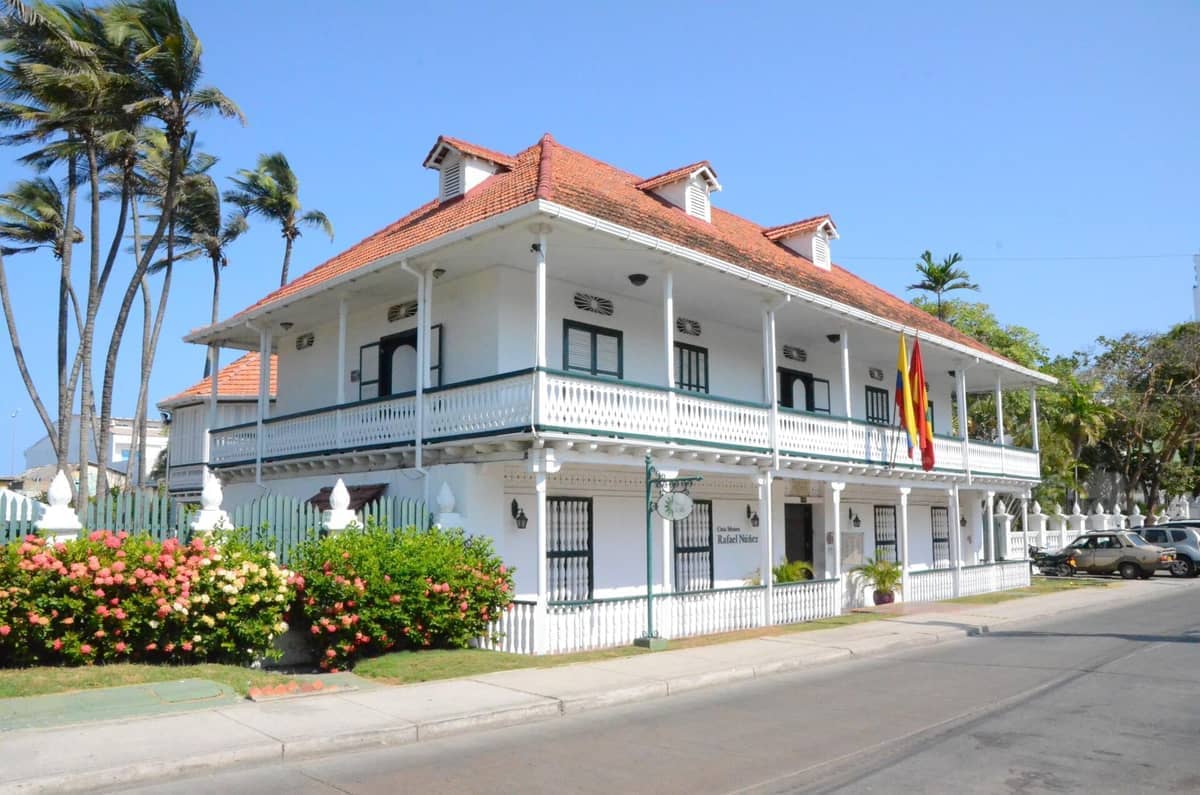
The structure is a two-story Caribbean-Victorian wooden house with an airy veranda, louvered shutters painted in muted colonial tones, and a covered porch that faces Parque Apolo. The architecture reflects a late 19th-century Cartagenero aesthetic that blends Spanish colonial proportions with Caribbean tropical adaptations: high ceilings to encourage airflow, wide balconies for shade, and a layout that opens toward the garden rather than closing inward. It is a noticeably lighter, more domestic style than the thick-walled defensive buildings inside the Walled City.
Approaching from the park, the house reads as a family home rather than a monument, which is part of its appeal. The surrounding neighborhood is calm and largely residential. On weekday mornings, schoolchildren sometimes pass through the park, and the sounds of the city fade considerably here compared to the interior of the historic center. The lagoon nearby adds a faint breeze. It is one of the quieter settings you will find within walking distance of the Old City.
Travelers interested in the broader architectural story of Cartagena de Indias will find this house a useful counterpoint to the fortress-like colonial structures inside the walls. For a deeper look at that built heritage, the Cartagena colonial architecture guide covers both periods and styles in detail.
Tickets & tours
Hand-picked options from our booking partner. Prices are indicative; availability and final rates are confirmed when you complete your booking.
Totumo Volcano and lunch at a VIP hotel from Cartagena
From 34 €Instant confirmationFree cancellationCity tour of Cartagena with entry to San Felipe castle
From 25 €Instant confirmationFree cancellationSan Andres Islands pontoon tour through the inner bay
From 26 €Instant confirmationFree cancellationGlass-bottom boat tour to San Andres aquarium and mangroves
From 21 €Instant confirmationFree cancellation
Inside the Museum: What You Will Actually See
The interior rooms are arranged to reflect how the house functioned during Núñez's lifetime in the 1880s and 1890s. Period furniture, personal objects, documents, and portraits are displayed throughout the main rooms. Guides on-site typically walk visitors through the key spaces and explain the political and personal context of each room, usually in Spanish, though some have working English.
The collection is not encyclopedic. There are no grand gallery halls or exhaustive chronological displays. What the museum does well is intimacy: a writing desk where correspondence was drafted, a rocking chair on the veranda, religious objects that reflect the Catholic conservatism that shaped Núñez's political project, the Regeneración. For visitors who arrive knowing something about 19th-century Colombian history, the experience is genuinely absorbing. For those who arrive with no context at all, the guided walk helps, but some background reading beforehand pays dividends.
One room is dedicated to the 1886 constitution and Núñez's role in the Regeneración political movement, which sought to centralize the Colombian state and restore the Catholic Church's public role after a period of radical Liberal federalism. The room includes reproductions of key documents and photographs. It is compact but gives the whole visit its intellectual backbone.
💡 Local tip
Tip: If you speak Spanish or travel with someone who does, ask the on-site guide specifically about Núñez's complicated legacy — celebrated as a nation-builder by some, critiqued as an authoritarian centralizer by others. That tension makes the visit considerably more interesting than a surface-level tour.
Best Time to Visit and How the Experience Changes
Weekday mornings between 10:00 and 12:00 offer the most relaxed visit. The museum is rarely crowded at any time, but Tuesday and Wednesday mornings in particular tend to have very few other visitors, which gives you more time with the guide and more space to move through the rooms without rushing. Weekend afternoons can attract small school or family groups, which changes the rhythm without making the place feel overwhelmed.
Cartagena's climate means the outdoor walk to El Cabrero is most comfortable in the early morning or late afternoon. The midday heat between roughly 12:00 and 14:00 from December through April makes any walking route from the Walled City feel more demanding than it looks on a map. If you are combining this museum with a walk along the waterfront and back through the city walls, starting before 10:00 or after 15:30 is considerably more pleasant.
The dry season, December through April, brings the most stable conditions for the outdoor walk and the best light for photographing the exterior of the house. During the rainy season, May through November, brief afternoon downpours are common. The museum's covered veranda offers shelter, and the garden takes on a greener, more lush quality after rain, which can actually improve exterior photographs.
Getting There: The Walk and the Route
From the Torre del Reloj, the main gate into the Walled City, a walk of roughly 10 to 15 minutes along Avenida Blas de Lezo and then through the El Cabrero streets brings you to Parque Apolo and the museum entrance. The route passes along the waterfront edge of the city and transitions from the tourism-dense lanes of the historic center into a noticeably quieter residential zone. It is flat, paved, and navigable without a map once you orient toward the lagoon.
Taxis and rideshares (Uber and inDrive both operate in Cartagena) can drop you directly at the entrance. If you are coming from Getsemaní or the beach areas of Bocagrande, a short ride is the most practical option. Fares within the city are generally low; confirm the price before getting in a taxi.
There is no dedicated parking area at the museum, but street parking is available in El Cabrero. If you drive, be aware that the streets near Parque Apolo are narrow.
Photography, Accessibility, and Practical Notes
Photography of the exterior is straightforward and the wooden facade, painted shutters, and tropical garden make for strong images in morning or late-afternoon light. Flash photography inside the museum may be restricted to protect fragile period documents; ask on arrival. The veranda and garden are the best indoor-outdoor transition points for photos.
Accessibility is limited by the building's historic structure. As a preserved 19th-century house, there are stairs and features that have not been significantly modified for mobility access. Visitors with mobility impairments should contact the museum in advance at casamuseorafaelnunez@mincultura.gov.co to understand what is accessible before making the trip.
If you are building a full day around Colombian history and culture, this museum pairs well with the Palacio de la Inquisición and the Museo del Oro Zenú inside the Walled City. Together they cover pre-colonial, colonial, and republican-era Colombian history without significant backtracking.
Practical Assessment: Who This Is For, and Who Should Skip It
Casa Museo Rafael Núñez is a quiet, low-key museum that rewards curious visitors who care about political history and period architecture. It is not a spectacle. There are no interactive exhibits, no audiovisual displays, no gift shop. The experience depends almost entirely on the quality of the guided explanation and your interest in the subject matter.
Travelers who are visiting Cartagena primarily for beaches, nightlife, or the general atmosphere of the Walled City may find this stop too niche for their limited time. Families with young children are unlikely to find enough to hold attention for more than twenty minutes. But for anyone who wants to understand why Cartagena produced a figure of Núñez's national importance, or who is genuinely curious about how Colombia's 19th-century constitutional order was built, this is one of the more intellectually honest stops in the city.
For travelers trying to decide how to structure their time in Cartagena, the 3 days in Cartagena itinerary places this museum in context alongside the city's major draws.
Insider Tips
- The museum sees very few visitors compared to sites inside the Walled City — if you arrive and the guide is occupied with another group, wait five minutes rather than wandering alone. The contextual explanation genuinely transforms the visit.
- Combine the trip to El Cabrero with a walk along the waterfront road back toward the city walls at sunset. The light on the lagoon and the profile of the fortifications from outside is a perspective most visitors never see.
- There is a small church, the Ermita del Cabrero, very close to the museum. It is where Núñez is actually buried, and a brief visit adds a direct biographical bookend to the museum tour.
- The museum is managed by Colombia's Ministry of Culture. If you have specific research interests — documents, photographs, correspondence — contact casamuseorafaelnunez@mincultura.gov.co in advance; curatorial staff can sometimes accommodate more in-depth visits.
- Dress for the walk: lightweight, breathable clothing and sun protection are more important than anything you will need inside the museum. The air-cooled interior is a relief after the walk over, but the return journey in midday heat can be draining.
Who Is Casa Museo Rafael Núñez For?
- History and politics enthusiasts with an interest in 19th-century Latin America
- Architecture travelers who want to see Victorian-Caribbean residential design outside the fortress walls
- Slow travelers who prefer depth over volume in their sightseeing
- Students or academics researching Colombian constitutional history or the Regeneración period
- Repeat visitors to Cartagena who have already covered the main Walled City attractions
Nearby Attractions
Combine your visit with:
- Mercado de Bazurto
Mercado de Bazurto is where Cartagena actually shops for food. Far from the polished streets of the Walled City, this enormous working market is a sensory overload of fresh fish, tropical fruit, and cumbia drifting from open-air stalls. It rewards curious visitors who come prepared.
- Castillo de San Felipe de Barajas
Perched on Cerro San Lázaro just east of Cartagena's walled city, the Castillo de San Felipe de Barajas is the largest Spanish colonial military fortress ever built in the Americas. Its tunnels, ramparts, and sweeping Caribbean views reward visitors who come prepared and arrive early.
- Convento de Santa Cruz de la Popa
Rising roughly 150 meters above sea level in Cartagena de Indias, the Convento de Santa Cruz de la Popa sits on the city’s highest natural point and one of its oldest religious sites. Visitors climb to a 17th-century Augustinian monastery for panoramic views, colonial architecture, and a surprisingly serene escape from the heat of the streets below.
- Isla Tierra Bomba
A short boat ride from Cartagena's historic center, Isla Tierra Bomba offers a compelling mix of Caribbean beach, colonial military history, and everyday Colombian coastal life. It is quieter than better-known island destinations, and honest about that tradeoff.