Mercado de Bazurto: Cartagena's Raw, Real Food Market
Mercado de Bazurto is where Cartagena actually shops for food. Far from the polished streets of the Walled City, this enormous working market is a sensory overload of fresh fish, tropical fruit, and cumbia drifting from open-air stalls. It rewards curious visitors who come prepared.
Quick Facts
- Location
- Cl. 29c Bis #29, Chino, Cartagena de Indias, Bolívar, Colombia
- Getting There
- Taxi or ride-hailing (Uber/inDrive) from Centro Histórico; roughly 10–20 minutes depending on traffic. Head out of the historic center toward Avenida Pedro de Heredia and follow Calle 30 toward Bazurto.
- Time Needed
- 1.5 to 3 hours; guided food tours typically run 2–3 hours
- Cost
- Free to enter. Budget 10,000–30,000 COP for food and drinks inside.
- Best for
- Food lovers, photographers, travelers interested in everyday Colombian life
What Bazurto Market Actually Is
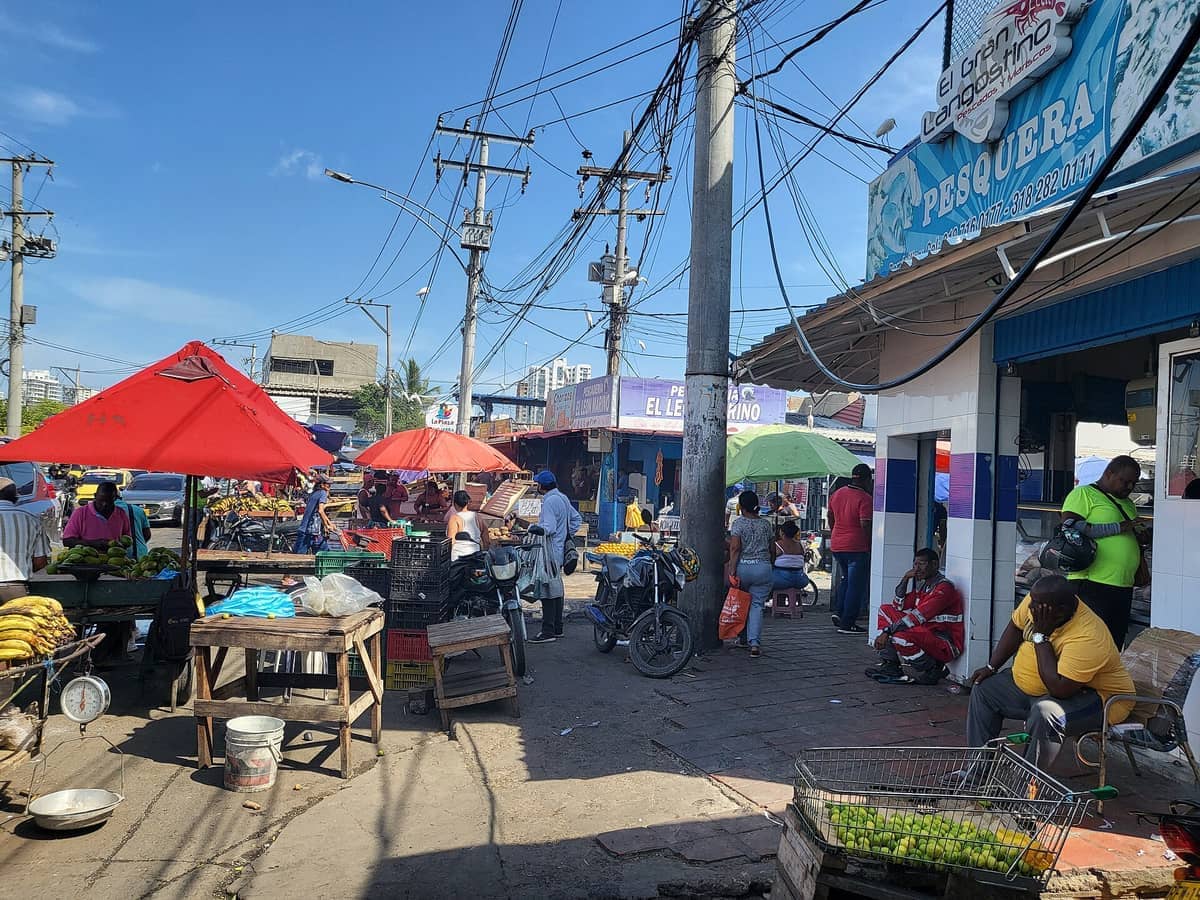
Mercado de Bazurto is Cartagena's primary wholesale and retail food market, a vast, largely open-air complex where the city's cooks, vendors, and everyday residents have come to buy and sell provisions for decades. It sits roughly 4 kilometers outside the historic center, in a working-class area that sees almost no tourist foot traffic outside of organized food tours. That distance from the postcard version of Cartagena is precisely what makes it interesting.
The market spreads across an irregular grid of covered corridors, open concrete aisles, and improvised stalls that spill onto the surrounding streets. Fish sections sit alongside mountains of plantains, yuca, and ñame. Butchers work in the open. Women press fresh fruit juice behind towers of maracuyá and corozo. The smell shifts every twenty meters: raw seafood, frying empanadas, tropical sweetness, and the warm funk of aged cheese.
ℹ️ Good to know
Bazurto is a functioning wholesale and retail market, not a tourist attraction in the conventional sense. Come to observe, eat, and engage — not to browse curios or buy souvenirs.
If you've spent time in the Centro Histórico and want to understand what daily life in Cartagena actually looks like, Bazurto offers a counterweight that no amount of colonial architecture can provide.
How the Market Changes Through the Day
The market operates daily with most activity concentrated in the morning and early afternoon, and the experience varies enormously depending on when you arrive. Early mornings, from around 6 AM to 9 AM, are when the market is at its most alive and its most local. Wholesale buyers arrive first, fishermen offload their catch, and the corridors fill with the sound of crates being dragged across wet concrete. The light at this hour, filtered through corrugated roofing and the haze coming off ice and fish, makes for striking photography.
By mid-morning, the retail crowd swells. Home cooks, restaurant owners, and street-food vendors work through the stalls with practiced efficiency. This is the best time to eat: freshly made sancocho, fried fish with patacones, and cold coconut water are all available from vendors who set up simple tables inside and around the market's edges. Prices are low and portions are generous.
Afternoon visits are possible but less comfortable. Heat builds significantly in the covered sections, and the crowd thins as vendors begin to close or consolidate stock. If you're visiting purely to eat and explore rather than photograph the market at full volume, mid-morning on a weekday represents the most manageable balance of activity and temperature.
💡 Local tip
Arrive between 7 AM and 10 AM on a weekday for the most active atmosphere. Weekends see a slightly different crowd mix but remain busy. Avoid arriving after noon in the covered fish and meat sections — heat and smell intensify significantly.
Tickets & tours
Hand-picked options from our booking partner. Prices are indicative; availability and final rates are confirmed when you complete your booking.
Totumo Volcano and lunch at a VIP hotel from Cartagena
From 34 €Instant confirmationFree cancellationCity tour of Cartagena with entry to San Felipe castle
From 25 €Instant confirmationFree cancellationSan Andres Islands pontoon tour through the inner bay
From 26 €Instant confirmationFree cancellationGlass-bottom boat tour to San Andres aquarium and mangroves
From 21 €Instant confirmationFree cancellation
What You'll Find Inside: A Practical Walkthrough
The market has no formal entrance or ticketing. You simply walk in from any of several street access points near Calle 29c Bis and the surrounding blocks. There are no maps posted and no visitor information desk, so orientation takes a few minutes. The general logic of the market follows the pattern of most Latin American mercados: produce on the outer rings, fish and meat toward the center, prepared food vendors interspersed throughout.
The seafood section is one of the most compelling parts of the market. Whole red snapper, mojarra, sierra, and various crustaceans are laid out on ice slabs, and vendors negotiate prices loudly and quickly. If you're interested in what the Caribbean coast actually eats rather than what it serves tourists, watching the transactions here tells you a great deal. Lobster, often sold at prices far below what restaurants charge, moves quickly in the early hours.
The fruit and vegetable corridors showcase tropical produce that rarely makes it into hotel breakfast buffets: lulo, níspero, mamoncillo, zapote, and the small, deeply flavored costeño tomatoes used in coastal Colombian cooking. Vendors are generally straightforward with prices and will allow you to sample before buying.
For context on how this food tradition connects to broader cultural heritage, the Cartagena street food guide traces the African, Indigenous, and Spanish roots of Caribbean Colombian cooking, many of which are visible in what Bazurto sells and how it's prepared.
Eating at Bazurto
Eating here is one of the most affordable and authentic food experiences available in Cartagena. Prepared food vendors operate from simple setups: a large pot, a cooler of drinks, a few plastic stools. The food is cooked fresh throughout the morning and early afternoon. A plate of fried fish, rice, patacones, and a cold agua de panela or jugo natural will typically cost between 8,000 and 15,000 COP — still only a few US dollars at current exchange rates.
Sancocho de pescado, a hearty fish and root vegetable soup considered one of the defining dishes of the Caribbean coast, is commonly available in the morning hours. You'll also find fritanga vendors selling chicharrón, morcilla, and various fried items. The quality is consistent with what locals eat daily rather than a sanitized presentation for visitors.
⚠️ What to skip
Use common-sense food safety judgment. Stick to cooked items from vendors with visible turnover, and avoid pre-cut fruit that has been sitting out in the heat for extended periods. Bring hand sanitizer, as handwashing facilities are not readily available throughout the market.
Guided Tours vs. Going Alone
Several Cartagena tour operators offer guided food tours of Bazurto, typically running two to three hours and including guided tastings, explanations of ingredients, and transport from the tourist center. These tours have genuine value: a guide who knows the vendors removes uncertainty about what to order and how to navigate, and the social context — who sells what, where their produce comes from — is far richer with someone who knows the market. Tour prices vary by operator and should be confirmed at time of booking.
Going independently is entirely feasible and costs almost nothing. The tradeoff is that you'll navigate by instinct, communication requires basic Spanish or patience with gestures, and you may miss the stories behind specific stalls or ingredients. Solo visitors should be aware that the market draws attention in a straightforward way: vendors will call out to you, not aggressively, but with the energy of a place where every interaction is a potential sale. Engaging back, even with limited Spanish, is usually well received.
If you're combining this with a broader day exploring Cartagena beyond the tourist core, the 3-day Cartagena itinerary includes Bazurto as a morning stop paired with an afternoon in Getsemaní.
Safety, Accessibility, and Practical Notes
Bazurto is located outside the main tourist zone and has a rougher physical environment than anything in the Walled City or Bocagrande. The ground is often wet or uneven, drainage is inconsistent, and the covered sections can feel claustrophobic. None of this is threatening, but it is a departure from the polished streets of the historic center. Wear closed shoes — sandals are a liability on market floors — and carry only what you need: a small amount of cash, your phone, and nothing irreplaceable.
Wheelchair access is not feasible in most parts of the market. The combination of uneven surfaces, narrow corridors, wet floors, and constant foot traffic makes navigation extremely difficult for anyone with limited mobility. This is not a judgment on the market itself but a practical reality that independent visitors should factor in.
Photography is generally accepted but requires some discretion. Vendors and workers are not exhibits. Ask before pointing a camera at anyone directly, and be prepared for some people to decline. The physical environment itself, the stacked produce, the overhead light, the ice and fish, photographs well without requiring portraits.
For general orientation on getting around Cartagena, including taxi and ride-hailing logistics from different parts of the city, see the guide to getting around Cartagena.
Who Should Skip Bazurto
This market is not for everyone, and there is no shame in deciding it is not for you. Travelers who are sensitive to strong smells, uncomfortable in crowded and unstructured environments, or who need reliable accessibility infrastructure will find the experience more stressful than rewarding. Children can do well here if they are adaptable and comfortable in loud, busy spaces, but the fish and meat sections involve sights that some younger children find upsetting.
Visitors with very limited time who want a curated food experience might find Portal de los Dulces in the historic center a more manageable introduction to local flavors, without the distance or sensory intensity.
Insider Tips
- Bring small bills in Colombian pesos. Most vendors work in cash only and won't have change for large denominations early in the morning.
- The freshest seafood moves before 8 AM. If you want to watch the wholesale fish trade at its most active, plan to arrive at or before sunrise.
- Corozo juice, made from a small palm fruit with a tart, almost cranberry-like flavor, is a Cartagena specialty that shows up at Bazurto juice stalls but rarely anywhere else in the city. Order it if you see it.
- If you're taking a taxi rather than Uber or inDrive, agree on a price before getting in. The fare from Centro Histórico to Bazurto should be in the range of 8,000–12,000 COP, though rates change and should be confirmed on arrival.
- The market periphery on the street side has additional vendors and prepared food stalls that are often less crowded and slightly cooler than the interior. If the inner corridors feel overwhelming, the outer ring is a gentler entry point.
Who Is Mercado de Bazurto For?
- Food-focused travelers who want to eat what Cartagena actually cooks, not what it serves tourists
- Photographers looking for unscripted, high-contrast urban scenes away from the colonial center
- Curious visitors interested in everyday Colombian Caribbean life and commerce
- Travelers on tight budgets looking for the most affordable cooked meal in the city
- Anyone on a guided food tour wanting to understand the sourcing behind coastal Colombian cuisine
Nearby Attractions
Combine your visit with:
- Casa Museo Rafael Núñez
The Casa Museo Rafael Núñez preserves the lakeside El Cabrero home of Rafael Núñez Moledo, Colombia's most consequential 19th-century statesman. Free to enter and a short walk from the Old City, it offers a rare, unhurried look at the private life of the man who wrote the 1886 constitution and penned the national anthem.
- Castillo de San Felipe de Barajas
Perched on Cerro San Lázaro just east of Cartagena's walled city, the Castillo de San Felipe de Barajas is the largest Spanish colonial military fortress ever built in the Americas. Its tunnels, ramparts, and sweeping Caribbean views reward visitors who come prepared and arrive early.
- Convento de Santa Cruz de la Popa
Rising roughly 150 meters above sea level in Cartagena de Indias, the Convento de Santa Cruz de la Popa sits on the city’s highest natural point and one of its oldest religious sites. Visitors climb to a 17th-century Augustinian monastery for panoramic views, colonial architecture, and a surprisingly serene escape from the heat of the streets below.
- Isla Tierra Bomba
A short boat ride from Cartagena's historic center, Isla Tierra Bomba offers a compelling mix of Caribbean beach, colonial military history, and everyday Colombian coastal life. It is quieter than better-known island destinations, and honest about that tradeoff.