Convento de Santa Cruz de la Popa: Cartagena's Hilltop Monastery Above the City
Rising roughly 150 meters above sea level in Cartagena de Indias, the Convento de Santa Cruz de la Popa sits on the city’s highest natural point and one of its oldest religious sites. Visitors climb to a 17th-century Augustinian monastery for panoramic views, colonial architecture, and a surprisingly serene escape from the heat of the streets below.
Quick Facts
- Location
- Cerro de La Popa, Calle 37, Cartagena de Indias, Bolívar, Colombia
- Getting There
- Taxi or organized tour from the historic center; driving is the standard approach due to the steep hill road
- Time Needed
- 1 to 1.5 hours on site, plus 15–20 minutes each way from the Walled City
- Cost
- Adults 11,000 COP / children 8,000 COP (verify on-site, prices change)
- Best for
- Panoramic views, colonial history, photography, and a cooler hilltop breeze
- Official website
- santuariolapopa.com
What Is the Convento de Santa Cruz de la Popa?
The Convento de Santa Cruz de la Popa, officially known as the Santuario Nuestra Señora de la Candelaria de la Popa, sits at the highest point in Cartagena de Indias: the summit of Cerro de La Popa, roughly 150 meters above sea level. From up here, the entire city unfolds below. The red-tiled rooftops of the Walled City, the towers of Castillo San Felipe, the resort towers of Bocagrande pushing into the sea, and the dark green smudge of islands on the horizon all come into focus in a single sweeping glance.
This is a working religious sanctuary, not just a tourist site. The Augustinian order established a presence on this hill in the early 17th century (around 1607), and the church and cloister that visitors walk through today reflect centuries of additions, damage, and restoration. The name comes from the hill's shape: from the bay, the ridge resembles the stern (popa in Spanish) of a ship.
ℹ️ Good to know
Opening hours are generally daily 08:00–17:30; some informal listings mention 08:30 as the opening time, so confirm locally before visiting, especially on religious holidays.
The View: What You Actually See from the Top
The panorama from La Popa is the main reason most people make the trip, and it earns its reputation. On a clear morning, the visibility stretches across the entire bay of Cartagena. You can trace the line of the city walls from above, which gives a completely different sense of their scale than walking along them at street level. The fortifications that look imposing from the ground look like a deliberate, calculated system when viewed from above.
To the south and east, the industrial port and the newer parts of the city are visible. To the west, the peninsula of Bocagrande and the beach neighborhoods extend into the Caribbean. On exceptionally clear days, the low profile of the Islas del Rosario archipelago is visible on the horizon. For anyone also visiting Castillo San Felipe de Barajas, it is worth noting that the two sites offer complementary views: San Felipe gives you a ground-level military perspective, while La Popa gives you the aerial one.
Morning light between about 8:30 and 10:30 is ideal for photography. The sun rises over the bay, illuminating the old city from the east with warm, directional light. By midday, the sun is almost directly overhead, and the glare flattens everything. Afternoon light returns drama to the landscape but comes with stronger heat and, in the rainy season (roughly May through November), the risk of afternoon cloud cover that can reduce visibility significantly.
Tickets & tours
Hand-picked options from our booking partner. Prices are indicative; availability and final rates are confirmed when you complete your booking.
Totumo Volcano and lunch at a VIP hotel from Cartagena
From 34 €Instant confirmationFree cancellationCity tour of Cartagena with entry to San Felipe castle
From 25 €Instant confirmationFree cancellationSan Andres Islands pontoon tour through the inner bay
From 26 €Instant confirmationFree cancellationGlass-bottom boat tour to San Andres aquarium and mangroves
From 21 €Instant confirmationFree cancellation
History and Architecture: More Than a Lookout Point
The Augustinian friars who founded this monastery in the early 17th century chose the hilltop for reasons that were partly spiritual and partly strategic. The site commanded visibility over the bay at a time when pirate raids were a recurring threat to Cartagena de Indias. The convent was attacked and damaged during several of these raids and was rebuilt more than once across the colonial period.
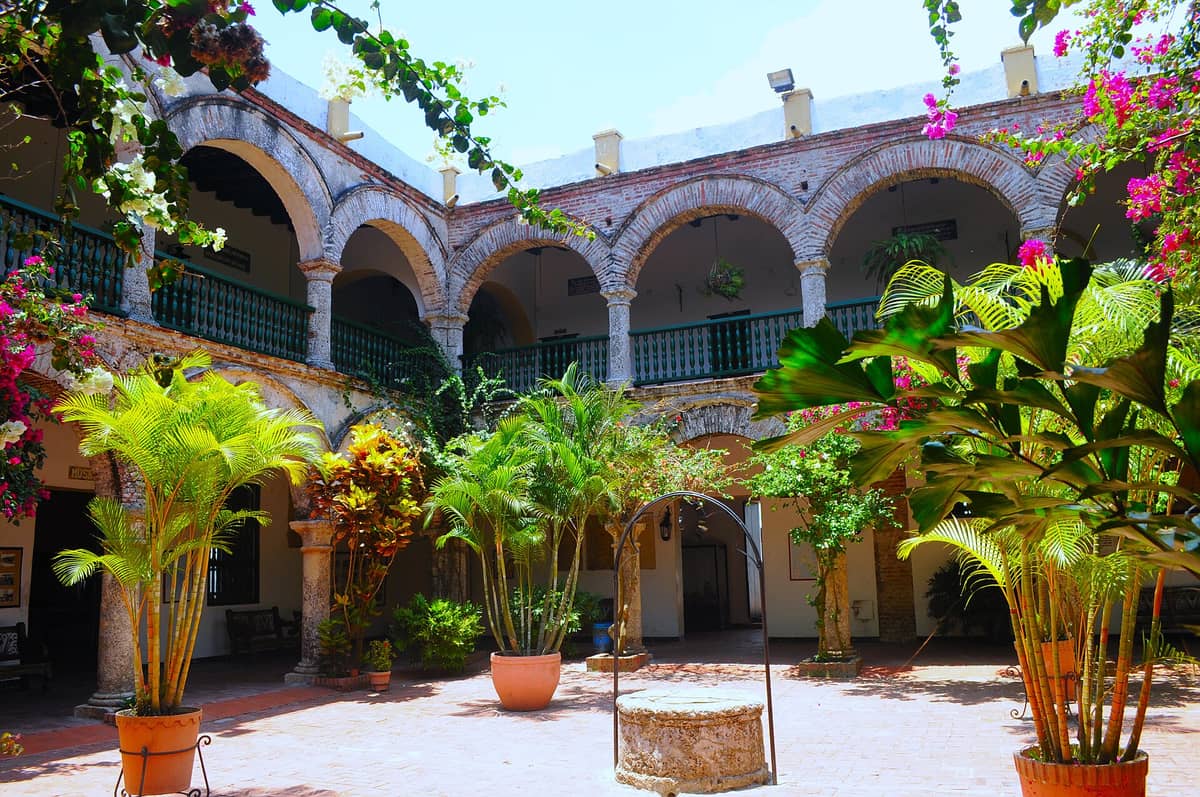
The cloister is small but well-preserved. A central courtyard with a stone fountain anchors the complex, and the surrounding galleries display religious art and artifacts connected to the sanctuary's long history. The chapel holds the venerated image of the Virgen de la Candelaria, patron saint of Cartagena. On February 2nd each year, the sanctuary draws large crowds for the Feast of the Candelaria, one of the city's most significant religious observances.
Understanding the convent in context means understanding Cartagena's broader colonial-era religious architecture. The city's historic center contains several notable churches and convents at street level, including Santuario San Pedro Claver and the Catedral Santa Catalina de Alejandría. La Popa represents the outer edge of that religious landscape, physically removed from the city below but historically bound to it.
Getting There: The Hill Is Not Walkable for Most Visitors
The road up Cerro de La Popa is steep, narrow in sections, and not designed for pedestrians. Walking it is technically possible but strongly discouraged for practical and safety reasons: the climb would be physically demanding in Cartagena's heat and humidity, and the road passes through areas where security concerns have been reported by visitors. The standard approach is to take a taxi from the historic center, arrange a round trip with the driver waiting while you visit, or include La Popa as a stop on an organized city tour.
⚠️ What to skip
Do not attempt to walk up the hill road. Arrange a taxi or tour vehicle and agree on a round-trip fare that includes waiting time. Taxis are readily available from the Walled City and Getsemaní.
From the Walled City or Getsemaní, the drive takes roughly 15 to 20 minutes depending on traffic. Taxi fares from the historic center including waiting time are negotiable; agree on a round-trip price before departing. Many visitors combine La Popa with a stop at Castillo San Felipe de Barajas, which stands on a separate hill (Cerro San Lázaro) along the same approach route, making it logical to visit both in a single half-day outing.
If you are planning a broader half-day with multiple stops, see the 3 days in Cartagena itinerary for suggested combinations that pair La Popa efficiently with other sites.
What the Visit Feels Like on the Ground
Stepping out of a taxi at the summit, the first thing most visitors notice is the wind. La Popa catches the Caribbean breeze that is largely absent in the enclosed streets of the Walled City below, and after the heat of the drive up it feels immediately welcome. The air smells of grass and stone rather than salt water, which gives the hilltop a different sensory quality from the rest of Cartagena.
The entrance to the convent is modest. A small fee is collected at the gate, and inside the complex the pace is quiet. On weekday mornings outside of Colombian school holiday periods, crowds are light and the cloister can feel genuinely peaceful. Weekend visits and holiday periods bring more visitors, including local families and school groups. The site is small enough that even moderate crowds feel present, so early-morning weekday timing makes a noticeable difference.
The view terrace is outside the main cloister structure, and this is where most visitors spend the majority of their time. There are no formal barriers right at the edge in all areas, so parents with young children should keep a close watch. Photography here is straightforward, though the best light is in the morning. A wide-angle lens or phone in panoramic mode captures the full sweep of the bay better than a standard shot.
Practical Notes: Weather, Accessibility, and Timing
Cartagena's main dry season runs from December to April, and these months offer the most reliable visibility from the hilltop. During the rainy season (May through November), afternoon cloud cover regularly settles over the higher elevations of the city, sometimes obscuring the view entirely. If you are visiting during this period, arriving as early as the site opens gives the best chance of clear skies before clouds build.
The site is described as wheelchair accessible in principle, but the approach road and some areas within the complex present challenges. Visitors with limited mobility should note that the road to the summit requires a vehicle, and parts of the cloister involve uneven stone surfaces. The main viewpoint is reachable without significant steps, but confirming current conditions locally is advisable.
For timing your broader visit to Cartagena around weather conditions, the best time to visit Cartagena guide covers seasonal trade-offs in detail, including how the rainy season affects outdoor attractions like La Popa.
💡 Local tip
Bring water and sunscreen. The hilltop terrace is fully exposed, and the combination of elevation, direct sun, and humidity means dehydration happens faster than visitors expect.
Practical Assessment: Is It Worth the Trip?
For most visitors to Cartagena de Indias, the Convento de Santa Cruz de la Popa is worth the trip, with one important caveat: the journey takes more time and logistical effort than most other city attractions. You cannot simply walk over from your hotel the way you can with most Walled City sites. You need to arrange and pay for transportation, factor in waiting time, and accept that the on-site visit itself is brief.
The convent interior is genuinely interesting but not extensive. Visitors who are primarily motivated by sweeping views will get what they came for. Visitors who expect a large museum-quality colonial complex comparable to, say, Castillo San Felipe may feel the site is smaller than anticipated. The most rewarding visits tend to combine genuine interest in the panorama, the religious history, or both.
Travelers on extremely tight schedules, or those who are indifferent to views and colonial church architecture, might reasonably skip La Popa in favor of attractions that are easier to reach on foot from the historic center. That said, no other point in Cartagena offers this particular aerial perspective of the city, and for many visitors that perspective changes how they understand everything else they see at street level.
Insider Tips
- Negotiate a round-trip taxi fare before you depart, explicitly including waiting time at the top. Drivers who wait typically charge more, but it saves the hassle of finding transport back down from the summit.
- Visit on a weekday morning, ideally before 10:00 am. The combination of early-morning light, lower temperatures, and smaller crowds makes a meaningful difference to the experience.
- If you plan to also visit Castillo San Felipe de Barajas, do La Popa first and San Felipe on the way back toward the city center. The drive passes the castle, and the sequence saves backtracking.
- Carry small bills in Colombian pesos for the entrance fee. The ticket booth does not always have change for larger notes.
- During the rainy season, check sky conditions from your hotel before committing to the trip. If clouds are already sitting over the hill in the morning, the view from the summit will be limited. Clear mornings in the wet season do exist but require flexibility.
Who Is Convento de Santa Cruz de la Popa For?
- Photographers wanting the definitive aerial panorama of Cartagena de Indias
- History-focused travelers interested in colonial religious architecture and Augustinian heritage
- First-time visitors to Cartagena who want a geographic overview of the city before exploring at street level
- Couples looking for a dramatic viewpoint away from the crowded Walled City streets
- Travelers visiting during the December to April dry season, when visibility from the hilltop is most reliable
Nearby Attractions
Combine your visit with:
- Mercado de Bazurto
Mercado de Bazurto is where Cartagena actually shops for food. Far from the polished streets of the Walled City, this enormous working market is a sensory overload of fresh fish, tropical fruit, and cumbia drifting from open-air stalls. It rewards curious visitors who come prepared.
- Casa Museo Rafael Núñez
The Casa Museo Rafael Núñez preserves the lakeside El Cabrero home of Rafael Núñez Moledo, Colombia's most consequential 19th-century statesman. Free to enter and a short walk from the Old City, it offers a rare, unhurried look at the private life of the man who wrote the 1886 constitution and penned the national anthem.
- Castillo de San Felipe de Barajas
Perched on Cerro San Lázaro just east of Cartagena's walled city, the Castillo de San Felipe de Barajas is the largest Spanish colonial military fortress ever built in the Americas. Its tunnels, ramparts, and sweeping Caribbean views reward visitors who come prepared and arrive early.
- Isla Tierra Bomba
A short boat ride from Cartagena's historic center, Isla Tierra Bomba offers a compelling mix of Caribbean beach, colonial military history, and everyday Colombian coastal life. It is quieter than better-known island destinations, and honest about that tradeoff.