Casa Museo Bagatti Valsecchi: Milan's Most Atmospheric House Museum
Tucked behind the designer boutiques of Via Montenapoleone, Casa Museo Bagatti Valsecchi preserves the personal residence of two aristocratic brothers who spent decades filling their home with Renaissance art and furnishings. Open since 1994, it offers an unusually intimate window into 19th-century Milanese patrician life.
Quick Facts
- Location
- Via Gesù 5, 20121 Milan (Quadrilatero della Moda)
- Getting There
- Metro M3 (yellow line) – Montenapoleone station, 3-minute walk
- Time Needed
- 60–90 minutes
- Cost
- €12 regular / €9 reduced / €2 children (6–17)
- Best for
- Art lovers, architecture enthusiasts, anyone wanting a crowd-free alternative to the major museums
- Official website
- museobagattivalsecchi.org
What Is Casa Museo Bagatti Valsecchi?
The Casa Museo Bagatti Valsecchi is one of Milan's best-preserved house museums, occupying a 19th-century residence that spans two street addresses: Via Gesù 5 and Via Santo Spirito 10. Unlike the city's great public galleries, this is not a purpose-built exhibition space. It is a home that was designed to look, feel, and function like a Renaissance palazzo, and it has remained almost exactly as its creators intended.
Barons Fausto and Giuseppe Bagatti Valsecchi began assembling their Neo-Renaissance interiors and art collection toward the end of the 19th century. They were not passive collectors; they were obsessive curators of an entire domestic environment, sourcing original 15th- and 16th-century furniture, ceramics, textiles, and artworks to furnish rooms designed in deliberate imitation of Lombard Renaissance architecture. The house opened to the public in 1994 and has changed remarkably little since. For context on how this fits into Milan's broader cultural landscape, see our guide to the best museums in Milan.
💡 Local tip
Opening hours are limited: Wednesday–Friday 13:00–17:45, Saturday–Sunday 10:00–17:45. The museum is closed Monday and Tuesday. Plan your visit on a Saturday morning to get the most time inside.
The Rooms: What You Actually See
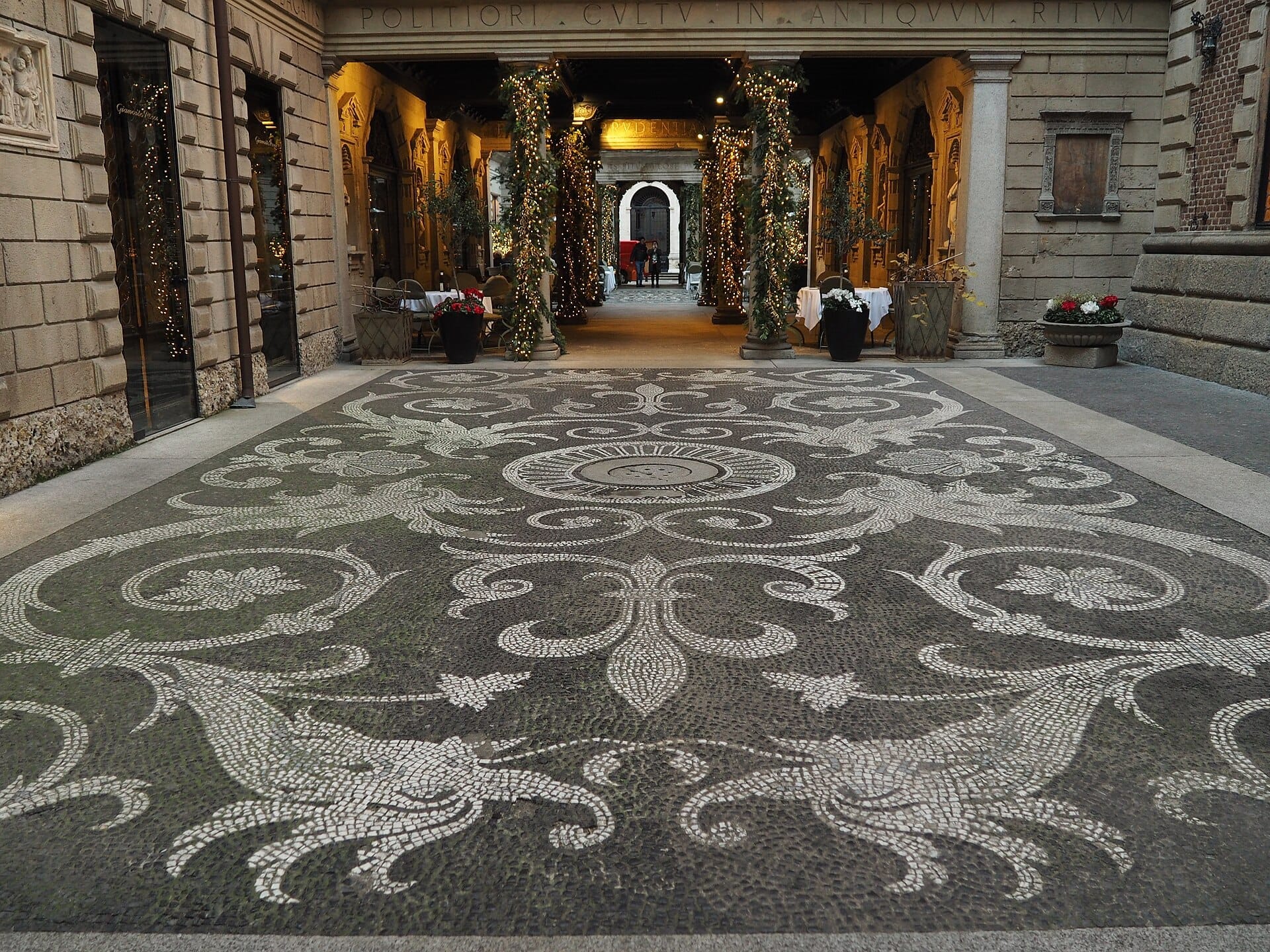
Entering from Via Gesù, the courtyard immediately signals that this is no ordinary museum. The facade and internal architecture were built in the 1880s with stone carvings, arched loggias, and decorative detailing modeled on 15th-century Lombard palace design. It looks old because it was meant to. The Bagatti Valsecchi brothers wanted their home to read as a continuation of Renaissance Milan, not a reproduction of it.
Inside, the sequence of rooms covers both private and public areas of the residence. The Great Hall (Sala Grande) is the formal centerpiece: wooden beamed ceilings, carved fireplaces, tapestries, and display cabinets filled with majolica and bronzes. The scale is generous but not overwhelming. Natural light comes through large windows, and the effect on a clear morning is closer to visiting a working noble house than to walking through a museum.
The bedroom suites are where the house becomes genuinely surprising. The Valtellinese bed, a monumental carved piece with an elaborate canopy, dominates one room. Nearby cases display personal objects: razors, combs, inkwells, prayer books. These are not arranged for distance; they are positioned as they would have been in use. The bathroom preserves a Renaissance-style bathtub and a late-19th-century shower system that the brothers cleverly concealed behind period-appropriate cabinetry so as not to break the historical illusion.
Tickets & tours
Hand-picked options from our booking partner. Prices are indicative; availability and final rates are confirmed when you complete your booking.
Casa Milan: Mondo Milan Museum tickets
From 17 €Instant confirmationMilan Museo Del Novecento entry ticket with audio guide
From 14 €Instant confirmationFree cancellationMuseum of the 900 self-guided audio tour in Milan
From 4 €Instant confirmationNatural History Museum self-guided audio tour in Milan
From 4 €Instant confirmation
The Collection: Art and Objects in Context
What distinguishes this collection from a standard decorative arts museum is that nothing here is decontextualized. Paintings hang where they were hung. Armour stands in the spaces for which it was acquired. The brothers purchased work spanning the 15th and 16th centuries, with particular strengths in Lombard and Venetian art: altarpieces, devotional panels, portrait busts, and a small Giovanni Bellini Madonna that rewards close attention.
The library holds hundreds of volumes alongside carved walnut furniture and illuminated manuscripts. Visitors who take time here often remark on the quality of the bookbindings and the completeness of the shelving, which reads more like a working scholar's room than a period recreation. The fireplace in this room is original 16th-century stonework, relocated to the house from elsewhere in Lombardy.
For those building an itinerary around Milan's Renaissance heritage, the Bagatti Valsecchi collection pairs well with the Pinacoteca Ambrosiana and the permanent collection at Pinacoteca di Brera, both of which hold major works from the same period.
How the Experience Changes by Time of Day
Arriving at opening time on a Saturday, around 10:00, gives you the building largely to yourself. The light at that hour enters low and oblique through the courtyard windows, catching the carved stone details on the upper loggia in a way that afternoon visits simply do not replicate. The rooms smell of old wood and wax polish, and the near-silence makes it easier to read the objects as they were intended: as a coherent domestic world rather than an exhibition.
By early afternoon, especially on Sundays, small guided groups can make certain rooms feel compact. The rooms are fully furnished, not staged with minimal pieces, so circulation space is limited in several areas. If you prefer to move slowly and read the room labels at your own pace, a Wednesday or Thursday afternoon is ideal: visitor numbers on weekday afternoons tend to be low, and the building has a quality of stillness that is hard to find in the surrounding neighborhood.
ℹ️ Good to know
Photography is generally permitted inside the museum without flash. The low light levels in some rooms mean a phone camera will struggle; a camera with good low-light performance makes a real difference.
Location and Getting There
The museum sits on Via Gesù in the heart of the Quadrilatero della Moda, Milan's luxury fashion district. The immediate surroundings are Bottega Veneta, Versace, and Prada flagship stores, which creates a jarring but interesting contrast: one of the city's quietest cultural spaces is located within a few hundred meters of some of its most expensive retail real estate.
The nearest metro station is Montenapoleone on the M3 (yellow) line, a three-minute walk from the museum entrance on Via Gesù. From the Duomo, the walk takes about ten minutes through streets lined with boutiques. The area is extremely walkable, and most visitors combine the museum with time in the surrounding district.
The neighborhood itself is worth exploring before or after your visit. For a broader overview of what the area offers beyond shopping, see our Milan architecture guide, which covers the 19th-century palazzo context that frames this entire part of the city.
Practical Notes: Accessibility and Timing
The museum's physical layout poses some challenges for visitors with mobility limitations. The building is a 19th-century residential palazzo, and while the museum communicates about accessibility via its official channels and invites visitors with specific needs to contact them in advance, anyone using a wheelchair or with limited mobility should contact the museum directly before visiting to confirm which areas are accessible.
There is no dedicated café or gift shop to speak of, and the visit is entirely self-guided unless you book a guided tour separately. Audio guides may be available; check the official website before arrival. The museum is small enough that 60 to 90 minutes is sufficient for a thorough visit, unlike many institutions where that estimate is optimistic.
Who might not enjoy this: visitors expecting a traditional art gallery with wall labels explaining artistic movements and historical chronology may find the house-museum format disorienting. The objects here are presented in situ, not didactically. Children under ten are unlikely to sustain engagement with the interiors, though the armour and carved furniture tend to hold attention briefly. The space is also not suited to visitors in a hurry; the rooms reward patience and close looking.
⚠️ What to skip
The museum is closed Monday and Tuesday. Check the official website before visiting, as hours may vary during public holidays or special events.
How It Fits Into a Wider Milan Itinerary
The Bagatti Valsecchi museum works well as a complement to the larger civic collections rather than a standalone day. Pair it with the nearby Museo Poldi Pezzoli, another 19th-century house museum just a five-minute walk away, and you have a full morning of intimate, crowd-free art that covers comparable ground from different collecting perspectives.
If your interest is specifically in how wealthy Milanese families lived and collected in the 19th century, combining the Bagatti Valsecchi with the Gallerie d'Italia nearby provides useful broader context. For travelers planning a full trip around the city's cultural offerings, our Milan 3-day itinerary suggests how to structure time efficiently across the major and secondary collections.
Insider Tips
- Book tickets directly on the museum's official website before you arrive. The museum is small and timed-entry slots on Saturday mornings, in particular, can fill up. Walk-in is often fine on weekday afternoons, but don't assume it.
- The bathroom is one of the most talked-about rooms in the house: a late-19th-century shower and bathing system hidden inside Renaissance-style cabinetry. It is easy to miss if you move quickly through that corridor. Pause and look at the fitted joinery.
- The museum occasionally hosts evening events, including chamber concerts in the main hall. These are listed on the official website and sell out quickly; they offer a distinctly different experience of the rooms than a standard daytime visit.
- If you are visiting the Quadrilatero della Moda primarily for shopping, note that the museum is generally quietest on the Wednesday and Thursday afternoon slots, when retail foot traffic in the surrounding streets is lower and the building has a noticeably different atmosphere.
- The Via Santo Spirito entrance (the secondary address at number 10) occasionally provides a different approach through a quieter part of the building. Ask staff at arrival whether access via both courtyards is currently available.
Who Is Casa Museo Bagatti Valsecchi For?
- Art and decorative arts enthusiasts who want to see Renaissance-period objects in their original domestic context rather than on gallery walls
- Architecture lovers interested in 19th-century Neo-Renaissance residential design in Milan
- Travelers who have already visited the major collections (Brera, Ambrosiana) and want a less-visited but equally rewarding experience
- Anyone looking for a quiet, unhurried cultural visit in the middle of Milan's most hectic shopping district
- History-focused visitors curious about how wealthy Milanese families lived, collected, and constructed identity through objects in the late 1800s
Nearby Attractions
Other things to see while in Quadrilatero della Moda:
- Palazzo Morando – Costume Moda Immagine
Set inside an 18th-century aristocratic residence on Via Sant'Andrea, Palazzo Morando – Costume Moda Immagine is one of Milan's civic museums dedicated to the history of fashion, costume, and the visual image of the city. Entry is free, the collections are genuinely absorbing, and the location, deep inside the Quadrilatero della Moda, could not be more fitting.