Carlsberg District (Carlsberg Byen): Copenhagen's Former Brewery Reborn
The Carlsberg District is one of Copenhagen's most ambitious urban transformations: a 160-year-old brewery site in Vesterbro, now evolving into a full neighborhood of converted industrial buildings, new architecture, cultural venues, and independent businesses. Entry to the district is free, and the streets reward unhurried exploration.
Quick Facts
- Location
- Vesterbro, Copenhagen (between Frederiksberg and Valby), 1799 København V
- Getting There
- Carlsberg Station (S-train, opened July 2016) — the most direct rail access to the district
- Time Needed
- 1.5 to 3 hours for a relaxed walk; longer if you stop for food, drinks, or exhibitions
- Cost
- Free to enter the district; individual venues, cafés, and exhibitions have their own pricing
- Best for
- Architecture enthusiasts, design lovers, history-minded walkers, and anyone curious about how cities reinvent themselves
- Official website
- www.carlsbergbyen.dk
What Is the Carlsberg District?
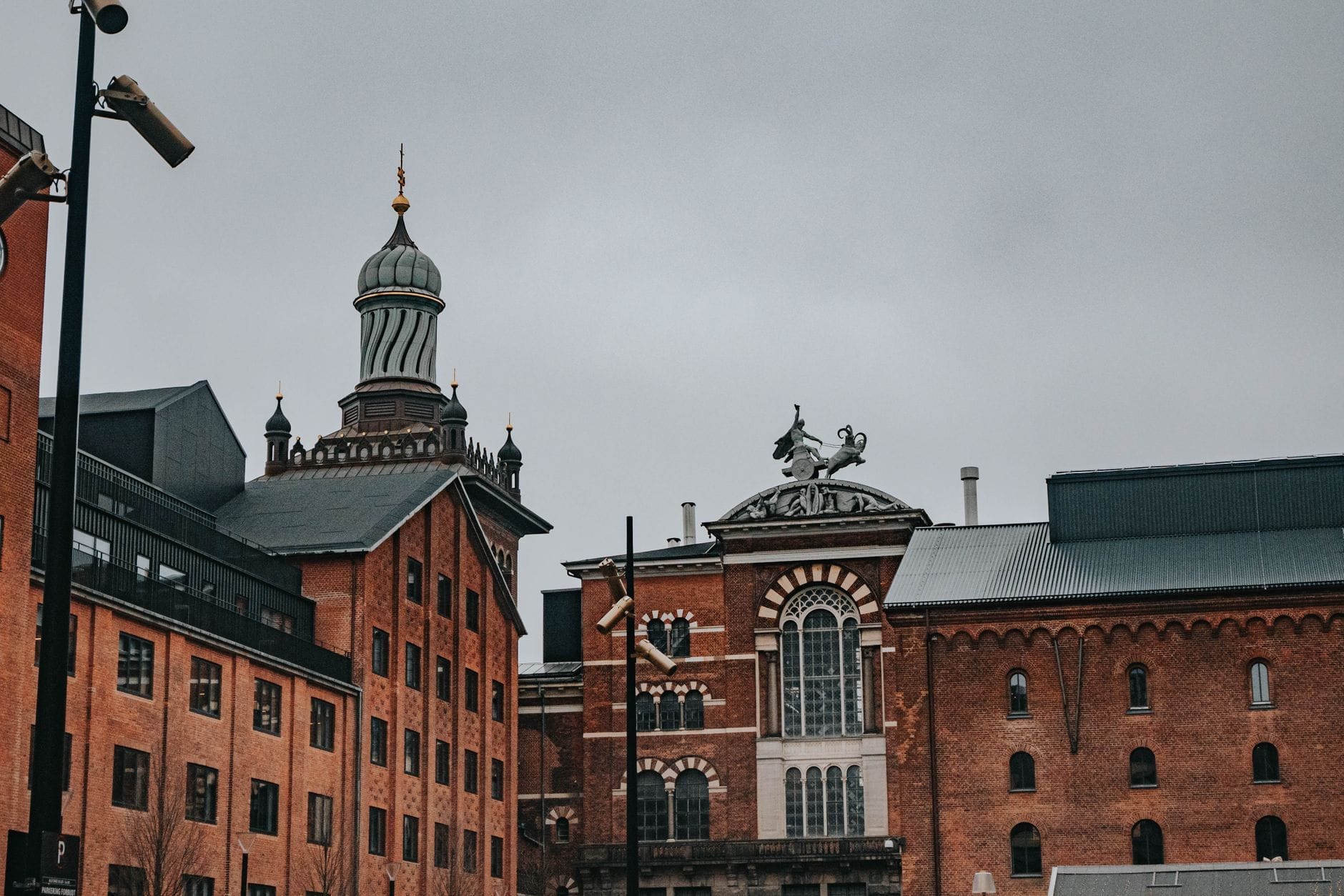
Carlsberg Byen, officially the Carlsberg City District, is what happens when one of Europe's most recognizable beer brands closes its production doors after more than a century and a half, and a city decides to build a neighborhood on the bones of the old factory. Carlsberg brewed on this Vesterbro site from 1847 until 2008. What was left behind was a sprawling campus of 19th-century brick buildings, monumental gates, cobblestone yards, and storage cellars — in the middle of a district already dense with creative energy.
The transformation is ongoing. Carlsberg Byen is not a finished theme park version of a former brewery; it is a genuine urban development project, with residential buildings rising alongside renovated warehouses, galleries taking root in old fermentation halls, and restaurants opening in spaces that once stored malt and hops. That in-progress quality is part of what makes it interesting. You are walking through a city actively deciding what it wants to be.
ℹ️ Good to know
The district has no gates or entry fees. Streets and public spaces are open at all times. Individual venues set their own hours — check ahead if you have a specific bar, café, or exhibition in mind.
The Architecture: Industrial Heritage Meets Contemporary Design
The visual identity of Carlsberg Byen is defined by its surviving 19th-century industrial architecture. The most photogenic entry point is the Elephant Gate on Gamle Carlsberg Vej, flanked by four large granite elephants that have marked the brewery's main entrance since 1901. The gate columns are decorated with swastikas — a symbol that, in its pre-Nazi form, was used widely as a good-luck motif across European and Asian cultures. Carlsberg has retained and contextualized these rather than removing them, which makes for an unexpectedly educational pause before you even step inside.
Beyond the gate, the scale of the original brewery becomes apparent. Red-brick buildings with arched windows, loading dock ironwork, and tall chimneys define the skyline at eye level. New residential buildings are rising at the edges of the district, and the contrast between old brick and contemporary Scandinavian construction is sharp in places. Whether that contrast works aesthetically is a matter of taste, but it gives the district a layered quality that more uniform neighborhoods lack.
Architecture enthusiasts visiting Copenhagen will likely already have plans for the Danish Architecture Center — Carlsberg Byen is a useful real-world counterpart, showing adaptive reuse at neighborhood scale rather than in exhibition form.
Tickets & tours
Hand-picked options from our booking partner. Prices are indicative; availability and final rates are confirmed when you complete your booking.
Home of Carlsberg entrance ticket and guided tour of the beer cellars
From 49 €Instant confirmationFree cancellationEntry Ticket to the Home of Carlsberg Exhibition in Copenhagen
From 29 €Instant confirmationFree cancellation1-hour boat harbour tour in Copenhagen
From 26 €Instant confirmationFree cancellationSmall group 3-hour walking tour in Copenhagen
From 45 €Instant confirmationFree cancellation
How the Experience Changes by Time of Day
On a weekday morning, the district is quiet in ways that let you pay proper attention to the buildings. The cobblestones in the older sections of the yard are uneven and worn smooth from decades of heavy cart traffic — worth noting if you are walking with a pram or mobility aids. Early morning light falls across the brick facades from the east, and the absence of crowds gives the place a slightly melancholic, post-industrial atmosphere that is genuinely affecting.
By midday, the cafés and lunch spots fill up, especially on weekends. The area attracts a mix of local residents from the new apartment blocks, students, and visitors drawn by the novelty of the development. Weekend afternoons in summer bring the most activity: outdoor seating spills onto the yards, and the overall mood shifts from contemplative to social. If you want the buildings and the space rather than the scene, a Tuesday or Wednesday morning is more rewarding than a Saturday afternoon.
In the evenings, the restaurants and bars take over. The lighting in the older sections of the district is low and warm, which makes the brick and ironwork look their best. The smell of hops that once defined this site is largely gone, replaced by coffee in the mornings and grilled food in the evenings, but if you walk past the old cellar entrances you occasionally get a cool, slightly mineral draft from below ground — a faint memory of the brewery era.
💡 Local tip
Visit on a weekday morning if you want to photograph the architecture without crowds. Weekend afternoons are better if you want to sit, eat, and absorb the neighborhood atmosphere.
History and Cultural Context
J.C. Jacobsen founded the original Carlsberg Brewery on this site in 1847, choosing the hill above Copenhagen — Valby Bakke — partly for its natural cellars, ideal for lager fermentation. His son Carl Jacobsen later founded the New Carlsberg Brewery next door, and the rivalry between father and son is one of Danish industrial history's more colorful subplots. Both branches eventually merged under the Carlsberg Foundation, which still owns the Ny Carlsberg Glyptotek art museum in the city center — a direct legacy of Carl Jacobsen's cultural philanthropy.
The Carlsberg Foundation's art collecting instincts produced one of Copenhagen's most underrated institutions. If the history of the brewery's cultural patronage interests you, the Ny Carlsberg Glyptotek near Tivoli is the direct descendant of that tradition, housing an exceptional collection of ancient Mediterranean art alongside French Impressionist works.
Production at the Vesterbro site ceased in 2008, and the redevelopment project that followed is one of the largest urban renewal efforts in Denmark's recent history. The goal set out by the developers was to create a new urban district with around 3,100–3,500 households alongside thousands of workplaces, cultural institutions, and retail. The process has been gradual and at times contentious — as large-scale urban development projects typically are — but the area now has a functioning street life and a recognizable identity.
What to Do and See Inside the District
The Home of Carlsberg visitor experience is the most structured stop inside the district, offering an introduction to the brewery's history through permanent displays and guided tours. It occupies one of the older buildings in the complex and is worth a stop if you want historical context before you walk the yards. Check current opening times before visiting, as hours can vary by season.
The Jacobsen Brewhouse is perhaps the most immediately satisfying single destination for most visitors: a microbrewery and restaurant housed in one of the original production spaces, with exposed brick, copper brewing equipment visible from the dining area, and a menu designed around beer pairing. It is not a cheap lunch, but the setting is exceptional and it delivers something the rest of the district's more generic café scene does not.
Beyond those anchors, the district rewards wandering. Walk into the older cobblestoned yards, look for the original signage and ironwork that has been preserved on building facades, and follow the sight lines down the longer streets toward the new residential blocks at the perimeter. There are small galleries, design studios, and creative businesses scattered throughout — the kind of tenant mix that makes early-stage urban regeneration areas interesting before they stabilize into something more predictable.
Vesterbro as a neighborhood has its own distinct character worth understanding before you visit. The nearby Meatpacking District (Kødbyen) is a comparable reinvention story — former slaughterhouse buildings converted into bars, galleries, and restaurants — and doing both in the same afternoon gives you a clear picture of how Copenhagen handles industrial heritage.
Getting There and Practical Logistics
Carlsberg Station opened in July 2016 specifically to serve the growing district. It sits on the S-train network (lines A and E run through it, but verify current routing before your visit), making it straightforward to reach from the city center in under 15 minutes. From Central Station (København H), the journey is short and direct.
The district is also reachable by bicycle, which is the default Copenhagen approach. From the city center, the ride takes roughly 15 to 20 minutes along Vesterbrogade and then south toward the brewery entrance on Gamle Carlsberg Vej. Bike parking is plentiful inside the district. Several bus lines also serve the surrounding streets — check the Rejseplanen app for real-time routing from your location.
If you are using a Copenhagen Card, the S-train is included, which makes the trip to Carlsberg Byen effectively free as part of a broader day of sightseeing. The Copenhagen Card guide breaks down whether the card makes financial sense depending on your itinerary.
⚠️ What to skip
Parts of the district are active construction zones. Some streets and viewpoints may be temporarily obstructed as development continues. The edges of the site, particularly toward Valby, can feel unfinished and are less interesting to walk.
Footwear matters here. The oldest cobblestoned sections are genuinely uneven, and the streets in the newer residential zones are standard paved sidewalks. There are no steep hills to contend with — Copenhagen is flat — but anyone using a wheelchair or mobility aid should be aware that the heritage cobblestone areas are not smooth. The newer construction zones have standard accessible paving.
Honest Assessment: Who Will Love It and Who Might Not
Carlsberg Byen is genuinely interesting if you care about urban design, industrial history, or the mechanics of how cities change. The architecture is substantial, the history is well documented, and the surviving original structures have real presence. For a certain kind of traveler, watching a city actively negotiate its past against its future ambitions is exactly the kind of experience they travel to find.
But if you are visiting Copenhagen for its famous harbor, its royal palaces, or its design museums, Carlsberg Byen might feel thin. It is not a finished place with a polished visitor experience. Some sections feel more like a work site than a neighborhood. The food and drink options are decent but not uniformly excellent, and the area does not yet have the density of independent character that makes, say, Nørrebro worth a long afternoon.
Travelers with limited time in Copenhagen should weigh the district against higher-density alternatives. If your Copenhagen day is short, a focused two-day Copenhagen itinerary will help you allocate time to the attractions most likely to match your interests.
Families with young children may find the district underwhelming unless the brewery history is something the kids are already curious about. There are no dedicated play areas or child-focused programming in the district itself, and the cobblestone terrain complicates pushchair navigation in the older sections.
Insider Tips
- The Elephant Gate on Gamle Carlsberg Vej is the most iconic entry point and produces the best architectural photographs. Morning light from the east hits the facade directly — arrive before 10am on a clear day for the best results.
- The old cellar entrances along the main brewery yards occasionally release a cool, mineral-scented draft from below ground, especially in warmer months. It is one of the few genuinely sensory remnants of the brewing era that has not been designed away.
- Combine Carlsberg Byen with the nearby Meatpacking District (Kødbyen) in a single Vesterbro afternoon. The two sites are about 15 minutes apart on foot and tell a complementary story about how Copenhagen treats its industrial past.
- The former Jacobsen Brewhouse was once the most atmospheric place to eat or drink inside the district, with copper equipment from the historical brewery visible from the dining area, but it is no longer operating in its original form—check current listings for up‑to‑date options and consider booking ahead on weekends.
- The swastika motifs on the Elephant Gate columns predate Nazi appropriation by decades and are preserved as part of the original 1901 design. Reading the information panels before moving on adds meaningful context to what you are looking at.
Who Is Carlsberg District (Carlsberg Byen) For?
- Architecture and urban design enthusiasts who want to see large-scale industrial heritage reuse in progress
- Beer history and brewing culture visitors interested in the Carlsberg legacy beyond the commercial brand
- Design-minded travelers who want to understand how Copenhagen approaches neighborhood development and adaptive reuse
- Photographers looking for industrial textures, brick, ironwork, and the visual contrast between old and new construction
- Visitors who enjoy exploring neighborhoods that are still in the process of becoming something, rather than fully finished tourist destinations
Nearby Attractions
Other things to see while in Vesterbro:
- Cykelslangen (The Bicycle Snake)
Cykelslangen, or The Bicycle Snake, is an approximately 230-metre elevated cycling bridge in Copenhagen's Vesterbro district. Opened in 2014 and designed by Dissing+Weitling, it curves above the harbor at up to 7 metres height, connecting Fisketorvet and Kalvebod Brygge to Bryggebroen, which leads onward to Islands Brygge. Entry is free, access is 24/7, and the views of the inner harbor are worth the detour.
- Meatpacking District (Kødbyen)
Once the industrial heart of Copenhagen's meat trade, Kødbyen in Vesterbro has transformed into one of the city's most compelling after-dark destinations. Functionalist white-tiled buildings, protected as national monuments, now house some of the best restaurants and bars in Denmark. Entry to the district is free, and the atmosphere shifts dramatically between day and night.