Kødbyen: Inside Copenhagen's Meatpacking District
Once the industrial heart of Copenhagen's meat trade, Kødbyen in Vesterbro has transformed into one of the city's most compelling after-dark destinations. Functionalist white-tiled buildings, protected as national monuments, now house some of the best restaurants and bars in Denmark. Entry to the district is free, and the atmosphere shifts dramatically between day and night.
Quick Facts
- Location
- Vesterbro, Copenhagen — immediately behind Copenhagen Central Station
- Getting There
- 5–10 min walk from Copenhagen Central Station (København H); city buses serve Halmtorvet
- Time Needed
- 1–2 hours to explore the district; an entire evening if dining and bar-hopping
- Cost
- Free to enter the district; costs depend on individual venues (food, drinks, events)
- Best for
- Architecture enthusiasts, food lovers, nightlife seekers, design-curious travelers
- Official website
- kodbyen.kk.dk/en/visit-us
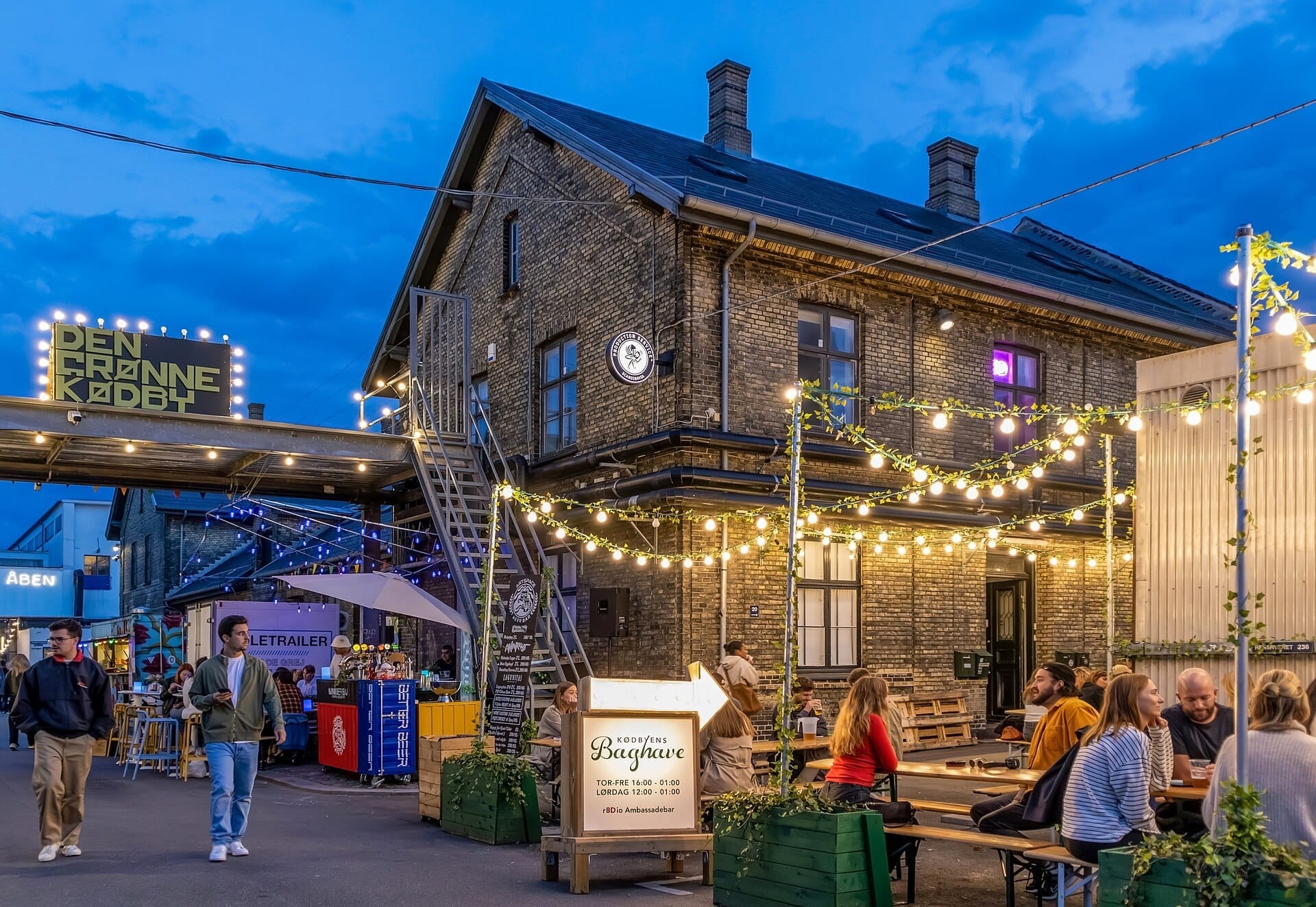
What Is Kødbyen?
The Meatpacking District, known in Danish as Kødbyen, is a preserved industrial quarter in Vesterbro, positioned just a few minutes on foot from Copenhagen Central Station. It was purpose-built as the city's central municipal meat-processing district beginning in the 1870s, with the most architecturally significant expansion arriving in the 1930s. Today it functions as an open urban district with no gates or entry fees, where slaughterhouse buildings have been repurposed as restaurants, bars, galleries, and creative offices, while some commercial meat businesses still operate alongside them.
The district is divided into three color-coded zones: the White Meatpacking District (Hvide Kødby), the Grey Meatpacking District (Grå Kødby), and the Brown Meatpacking District (Brune Kødby). The Brown section dates from 1878, making it the oldest. The White section, completed in 1934, is the most photogenic and most visited, built in functionalist style with pale rendered facades, large industrial windows, and tiled interiors. The White section, completed in 1934, is the most photogenic and most visited, built in functionalist style with pale rendered facades, large industrial windows, and tiled interiors. The White and much of the Brown districts are now protected heritage areas.
ℹ️ Good to know
Kødbyen is an open public district. Accessing the streets and courtyards is free at all hours. You only pay when you enter individual restaurants, bars, clubs, or galleries.
The Architecture: Functionalism Preserved in Meat Hooks and Tiles
What makes Kødbyen more than just a nightlife destination is the quality of the buildings themselves. The White Meatpacking District is a coherent ensemble of 1930s functionalist architecture, built to serve hygienic industrial purposes. The exteriors feature rendered white facades, steel-framed windows designed to maximize natural light for food inspection, and loading-dock proportions that gave these spaces their generous ceiling heights. Walk through the central alleyways on a quiet afternoon and you can still read the industrial logic in every doorway and drain.
Inside individual venues, the conversion work is often deliberately light-touch. Tiled walls from the meat-processing era are left exposed. Hooks, rails, and industrial fittings sometimes remain as decorative details or functional coat storage. The contrast between the cold, hard infrastructure and what now happens inside these rooms — carefully plated Danish food, cocktails, contemporary art — is part of the experience that cannot be replicated in purpose-built spaces.
If the architecture interests you as part of a broader engagement with Danish design history, the Danish Architecture Center at the Black Diamond runs exhibitions and resources on exactly this kind of urban transformation. It is worth pairing the two visits.
Tickets & tours
Hand-picked options from our booking partner. Prices are indicative; availability and final rates are confirmed when you complete your booking.
1-hour boat harbour tour in Copenhagen
From 26 €Instant confirmationFree cancellationSmall group 3-hour walking tour in Copenhagen
From 45 €Instant confirmationFree cancellationCopenhagen to Malmo one-day tour
From 56 €Instant confirmationFree cancellationFull-day tour to Forest Tower and Forgotten Giants from Copenhagen
From 110 €Instant confirmationFree cancellation
How the District Changes Through the Day
Arriving in the mid-morning on a weekday, Kødbyen can feel almost deserted. A few delivery vans idle at loading docks. The smell of damp concrete and, occasionally, something harder to place from the remaining commercial meat operations is present in certain passages, particularly in the Grey zone. This is worth knowing before you visit. The area is still a working district in parts, not a sanitized theme park version of one.
By midday, the food and lunch crowd begins to arrive. Several spots open for lunch service, and the courtyards attract office workers from surrounding Vesterbro. Afternoon light hits the white facades at an angle that makes the buildings look cleaner and sharper than they do at any other time. Photographers working in natural light will find the hour or two before sunset particularly productive, when long shadows cut across the pale rendered surfaces.
After 9 PM on Thursday, Friday, and Saturday, Kødbyen becomes a different place. The entrances to clubs and bars fill with queues. Sound bleeds from doorways. Groups of people move between venues with that specific Copenhagen evening energy: unhurried, well-dressed without being formal, comfortable in the cold air in a way that suggests they do this regularly. The district earns its nightlife reputation on these nights. On Sunday through Wednesday, it quietens considerably, and several venues are closed or operate reduced hours.
💡 Local tip
Thursday evening is often the best compromise: the full nightlife atmosphere, but with shorter queues and more chance of getting into venues without a reservation. Weekends in summer see the highest crowds.
Eating and Drinking in Kødbyen
The food scene in Kødbyen ranges from casual counter-service spots to restaurants with Michelin recognition. The concentration of quality within such a compact area is genuinely high by any international standard. That said, prices reflect Copenhagen's general cost of living: a dinner for two with wine at a mid-range restaurant will cost significantly more than the equivalent in most European cities. Budget accordingly.
The district is one of the best places in the city to experience how Copenhagen's food culture has evolved, sitting alongside Nørreport's Torvehallerne market as a destination that captures local eating habits without requiring a special-occasion booking. Several venues in Kødbyen offer informal formats with high-quality produce.
Bars in the White district tend to open in the early evening and run until the early morning on weekends. The indoor-outdoor dynamic changes by season: in summer, the courtyards fill with people drinking outside under the long Danish daylight. In winter, the atmosphere shifts inside, and the industrial interiors take on a different warmth entirely. Both versions are worth experiencing.
For broader context on eating in Copenhagen before your visit, the Copenhagen food guide covers the city's dining culture, price expectations, and neighborhood-by-neighborhood options.
Practical Walkthrough: Getting There and Getting Around
Reaching Kødbyen requires almost no navigation from the city center. From Copenhagen Central Station (København H), walk west along Vesterbrogade or through the back streets of Vesterbro and you will reach Halmtorvet, the square that marks the edge of the district, in five to ten minutes. The walk takes you through the residential character of Vesterbro, past cafes and small shops that are worth slowing down for.
Multiple city buses serve the Halmtorvet and Sønder Boulevard area. If you are arriving by car, the City of Copenhagen manages guest parking in the district, though weekend evenings make this difficult. Cycling is practical and recommended: Vesterbro is one of the most cycle-friendly parts of the city, and bike parking at the district is plentiful.
Copenhagen's transit network is integrated and generally reliable. For a full overview of getting around the city without confusion, including the Metro, S-trains, and buses, the guide to getting around Copenhagen is the clearest starting point.
Accessibility
The streets and courtyards within Kødbyen are generally flat and manageable for most mobility levels. However, the historic industrial buildings were not designed with modern accessibility in mind. Individual venues vary significantly in their provision of ramps, step-free access, and accessible toilets. If this is a priority, contact specific restaurants or bars in advance to confirm their setup before visiting.
Photography and What to Expect Visually
Kødbyen photographs well, but requires some thought. The White district's uniform pale facades reflect and diffuse light unpredictably in overcast weather, which in Copenhagen is most of the year. Overcast conditions can actually produce cleaner architectural images than direct sun, as the shadows are softer and the detail in the render stays visible. Sunrise and late afternoon in summer are the clearest light windows.
At night, the district is lit in a way that is functional rather than atmospheric: the warm light spilling from bar windows and doorways contrasts with the cold concrete outside. Long exposure shots of the empty courtyards after midnight have a quality that is genuinely hard to find elsewhere in Copenhagen. Wide-angle lenses suit the industrial scale of the spaces.
⚠️ What to skip
Some of the courtyards and passages in the working sections of the district (particularly Grey Kødby) are not public thoroughfares. Look for signage and do not enter areas marked for commercial use only.
Who Should Skip Kødbyen
If you are visiting Copenhagen primarily for royal palaces, classical museums, or family-friendly attractions, Kødbyen is unlikely to be a priority. It does not have the landmark drama of Rosenborg Castle or the waterfront appeal of Nyhavn. The district rewards curiosity about urban transformation and contemporary food and nightlife culture, not a checklist approach to sightseeing.
Travelers with young children may find the daytime version of the district interesting as a short detour, but it is not designed for families. For a Vesterbro experience that works across age groups, the Vesterbro neighborhood as a whole has more to offer, including parks, markets, and cafes.
The district is also, frankly, not a daytime destination for most visitors. If you can only see it during business hours on a weekday, you will get a sense of the architecture but miss most of what makes the area compelling. It is at its best after dark, and specifically on the evenings when the venues are running at full capacity.
Insider Tips
- The White district's courtyards are at their most atmospheric between 10 PM and midnight on a Friday in summer: enough people to give it energy, not so crowded that navigation becomes difficult. Arrive before the late-night surge.
- Some of the most interesting small galleries and creative studios in Kødbyen are not signposted at street level. Look for open doorways in the afternoon: many are informal spaces that welcome walk-ins during working hours.
- If you want to eat at one of the better-known restaurants in the district without booking weeks in advance, try a Tuesday or Wednesday evening in spring or autumn. Weekend reservations at the most popular spots fill far ahead of time.
- The Grey Meatpacking District (Grå Kødby) sees fewer visitors and retains the most authentic industrial character. It is less polished but gives a clearer sense of what the whole area looked like before the cultural transformation.
- Tipping in Copenhagen is not expected, but rounding up on a card payment or leaving small change is appreciated in casual bar settings. Service charges are typically included in restaurant bills.
Who Is Meatpacking District (Kødbyen) For?
- Architecture enthusiasts interested in Danish functionalism and adaptive reuse of industrial buildings
- Food travelers wanting to explore Copenhagen's contemporary restaurant scene in a concentrated area
- Nightlife seekers looking for a bar and club circuit that feels local rather than tourist-facing
- Photographers interested in industrial spaces, contrast between day and night, and light on pale facades
- Design-oriented visitors who want to understand how Copenhagen's creative culture has claimed older urban infrastructure
Nearby Attractions
Other things to see while in Vesterbro:
- Carlsberg District (Carlsberg Byen)
The Carlsberg District is one of Copenhagen's most ambitious urban transformations: a 160-year-old brewery site in Vesterbro, now evolving into a full neighborhood of converted industrial buildings, new architecture, cultural venues, and independent businesses. Entry to the district is free, and the streets reward unhurried exploration.
- Cykelslangen (The Bicycle Snake)
Cykelslangen, or The Bicycle Snake, is an approximately 230-metre elevated cycling bridge in Copenhagen's Vesterbro district. Opened in 2014 and designed by Dissing+Weitling, it curves above the harbor at up to 7 metres height, connecting Fisketorvet and Kalvebod Brygge to Bryggebroen, which leads onward to Islands Brygge. Entry is free, access is 24/7, and the views of the inner harbor are worth the detour.