Bocca della Verità: Rome's Ancient Lie Detector
The Bocca della Verità is a 1st-century Roman marble disc set into the portico of the church of Santa Maria in Cosmedin. Free to visit and steeped in medieval legend, it draws long queues of curious travelers who dare to test the myth. Here is what you actually need to know before you go.
Quick Facts
- Location
- Piazza della Bocca della Verità 18, Rome
- Getting There
- Metro Line B: Circo Massimo (10-min walk); Bus lines 44, 95, 160, 170, 716, 781
- Time Needed
- 20–40 minutes (longer if queues are heavy)
- Cost
- Free (no ticket required)
- Best for
- History lovers, families, photographers, first-time Rome visitors
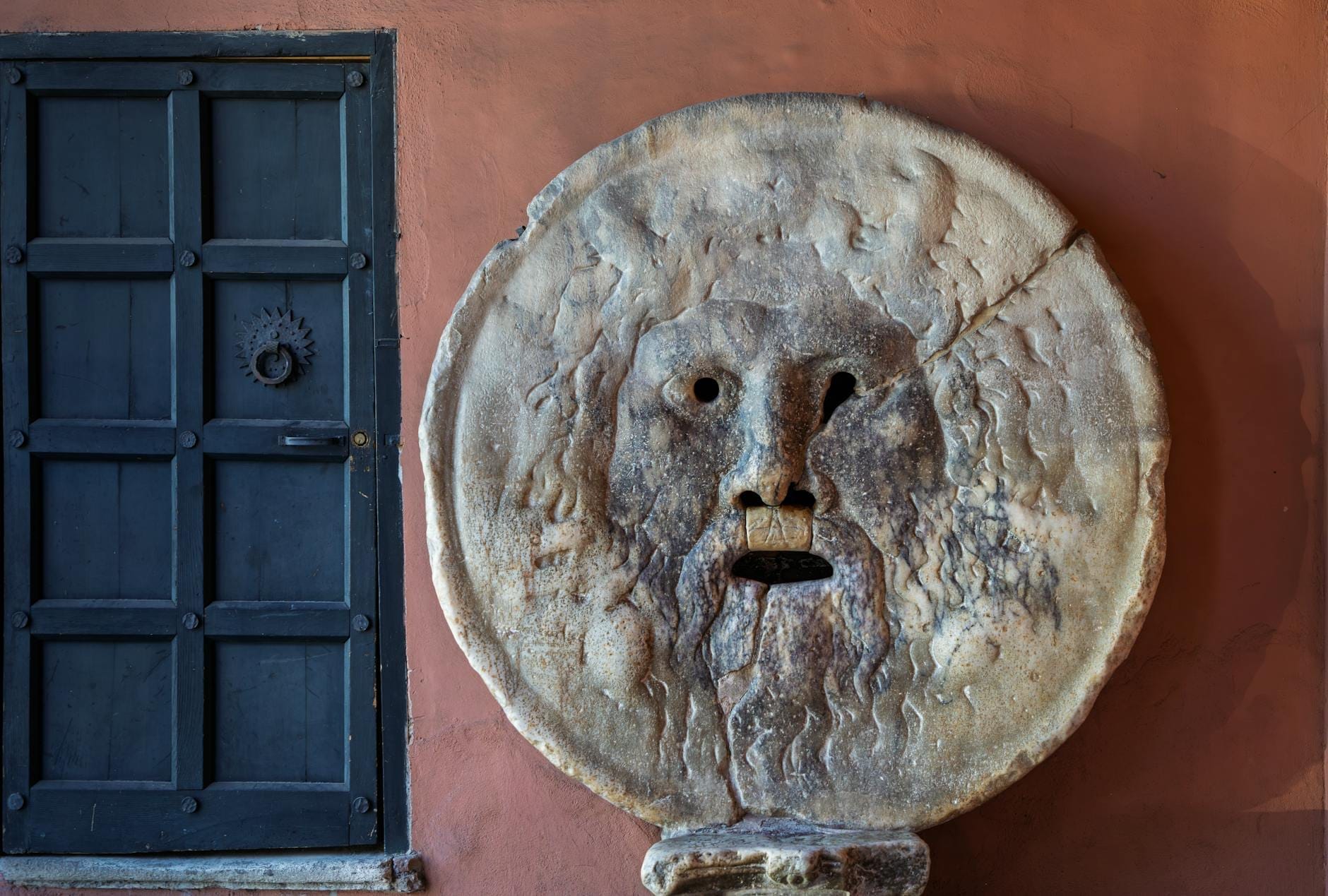
What Is the Bocca della Verità?
The Bocca della Verità, Italian for Mouth of Truth, is a circular marble disc measuring roughly 1.75 metres in diameter, carved with a male face whose mouth is open in a hollow void. It sits propped upright against the interior wall of the portico of Santa Maria in Cosmedin, one of Rome's best-preserved early medieval churches. The disc dates to approximately the 1st century CE and was almost certainly a drain cover or decorative element from the ancient Forum Boarium, the cattle market that once occupied this low-lying stretch of the Tiber riverbank. It was moved to its current location in 1632.
Scholars believe the face represents a river god, possibly the Tiber or the sea deity Oceanus, based on its leafy beard and broadly classical features. The exact original function is debated: some historians propose it served as a manhole cover for an ancient drainage channel; others suggest it was a temple ornament. What is not in doubt is the medieval legend that attached itself to it: liars who placed their hand in the mouth would find it bitten off. By the 11th century this superstition was well established, and papal courts reportedly used the stone to administer informal oaths.
ℹ️ Good to know
Opening hours: daily 9:30 a.m. to 1:00 p.m. and 2:00 p.m. to 5:00 p.m. Last admission is around 5:00 p.m. Entry is free. The church itself (Santa Maria in Cosmedin) may have separate visiting conditions for its interior.
The Setting: Santa Maria in Cosmedin and the Forum Boarium
The church of Santa Maria in Cosmedin was built in the 6th century over the foundations of a Roman food distribution hall (statio annonae) and expanded in the 8th and 12th centuries. Its slender Romanesque bell tower, rising in seven brick tiers, is one of the most distinctive on Rome's skyline. The dark, cool interior contains Cosmatesque marble floors, geometric inlay work characteristic of medieval Roman craftsmen, and a carved marble choir screen that dates to the 12th century. Most visitors never step past the portico to see any of this, which is a genuine oversight.
The church stands in the Forum Boarium, Rome's oldest commercial district and one of its most archaeologically layered corners. Two remarkably intact Republican-era temples stand just metres away: the round Temple of Hercules Victor and the rectangular Temple of Portunus, both dating to the 2nd century BCE. Combining these sites with a visit to the nearby Circus Maximus and the Aventine Keyhole makes for one of the most rewarding half-days in Rome, entirely free of charge.
Tickets & tours
Live prices and dates from our booking partner. If you book, we may earn a commission at no extra cost to you.
St. Peter's Basilica, Vatican Museums, Sistine Chapel reserved entry
From 81 €Instant confirmationFree cancellationGuided tour of Galleria Borghese and of Villa Borghese gardens
From 69 €Instant confirmationFree cancellationVatican: Basilica, Dome and underground early bird tour
From 50 €Instant confirmationFree cancellationPasta-making class, tasting and prosecco with local chef in Rome
From 79 €Instant confirmationFree cancellation
What the Visit Actually Feels Like
The portico is a shallow, shaded space with stone columns and a low ceiling. The disc leans against the far wall behind a rope barrier. Up close, the marble shows centuries of wear: the surface is slightly rough to the touch in photographs taken by visitors, pitted from age and smoothed by millions of hands. The face has an almost theatrical gravity, the hollowed eyes and open mouth more solemn than sinister. It is smaller than many visitors expect, though 1.75 metres across is substantial once you are standing in front of it.
The queue moves in small batches, and a brief window opens for photographs with your hand in the mouth. The whole process for most visitors takes under five minutes at the disc itself. What surprises people is that the experience feels genuinely atmospheric despite the crowds, partly because of the age and weight of the stone, and partly because the medieval church behind you provides real architectural context rather than a tourist-only setting.
💡 Local tip
Arrive at 9:30 a.m. when the portico opens, or in the final 30 minutes before the midday closure (1:00 p.m.). These windows consistently have the shortest queues. Midmorning from 10:30 a.m. to noon is the busiest period, particularly for tour groups.
How the Experience Changes by Time of Day
Early morning is the clear winner for atmosphere. The Piazza della Bocca della Verità catches low eastern light before 10:00 a.m., the bell tower of Santa Maria in Cosmedin casts long shadows across the square, and the nearby temples glow amber against a still-quiet street. The scent of bread from a nearby bar drifts through the piazza, and the sound of traffic on the Lungotevere is distant enough to ignore. At this hour the portico is rarely crowded and the stone's texture is easier to appreciate without people pressing forward.
By late morning the space becomes uncomfortably tight. Tour groups arrive in succession, and the queue for the photo opportunity stretches beyond the portico into the open piazza. The midday closure from 1:00 p.m. to 2:00 p.m. disperses the crowd, and the afternoon session starting at 2:00 p.m. begins relatively calmly before building again around 3:30 p.m. Late afternoon, particularly the last hour before 5:50 p.m., is another quieter window, though the light on the stone by then is flat.
The Legend and Its Cultural Life
The lie-detector legend reached its modern global audience largely through a single scene in the 1953 film Roman Holiday, in which Gregory Peck pretends his hand has been bitten off inside the mouth, terrifying Audrey Hepburn. That moment has done more for the site's international profile than centuries of Roman folklore. Visitors from Japan, the United States, South Korea, and Brazil arrive with that specific scene in mind, and the queue often has the quality of a gentle, good-humoured pilgrimage.
The medieval belief, however, predates Hollywood considerably. Documents from the 10th and 11th centuries describe the stone being used in oath-taking rituals, and the name Bocca della Verità appears in Roman civic records well before the Renaissance. Some historians connect the open-mouthed face to a broader tradition of apotropaic masks, stone faces designed to ward off evil or bind oath-takers to the truth. Whether the original Roman craftsmen intended anything of the sort is unknown, but the folklore attached itself plausibly to a face that already looked like it was waiting to swallow something.
Getting There and Getting Around
The most straightforward route from central Rome is Metro Line B to Circo Massimo, then a 10-minute walk north along the Tiber. Several bus lines also stop on Via Luigi Petroselli nearby, including 44, 95, 160, 170, 716, and 781. The location sits at the southern edge of the Jewish Ghetto, meaning you can easily combine this visit with a walk through the Ghetto's portico ruins, the Portico d'Ottavia, and a meal at one of the neighborhood's Roman-Jewish restaurants.
Visitors staying near the Trastevere neighborhood can reach the site on foot in about 15 minutes by crossing the Tiber at Ponte Palatino. From the Colosseum, the walk takes around 20 minutes through the Palatine's southern flank, past the Circus Maximus. For broader context on moving around the city efficiently, the getting around Rome guide covers transit options in useful detail.
Practical Details for Photographers and Accessibility
Photography is permitted and free. The portico is shaded, which means bright midday light actually helps rather than hinders, bouncing off the white marble in ways that early morning shade can suppress. A 35mm or 50mm lens is ideal for a portrait-style shot with the disc. Wide-angle shots from inside the portico, pulling back to include the columns and the piazza beyond, work well in the afternoon when light filters in from the south.
The piazza in front of the church is flat and accessible by wheelchair. The portico itself has a shallow step at its entrance; specific accessibility information beyond this point is not confirmed in official sources. Visitors with significant mobility needs should contact the church directly to confirm current conditions before visiting.
⚠️ What to skip
The Bocca della Verità is frequently photographed through iron railings or behind a rope barrier depending on the time of year and visitor volume. Do not assume you will always have direct unobstructed access. Conditions can vary.
Is It Worth Your Time?
Honestly, the disc itself takes about three minutes to photograph and absorb. The value of the visit lies in combining it with the surrounding area. If you arrive expecting the Bocca della Verità to anchor a two-hour experience on its own, you may feel the queue-to-payoff ratio is off. If you treat it as one node in a half-day loop through this undervisited part of Rome, including the Republican temples, the riverbank walk, and the Ghetto, it becomes a satisfying stop rather than a destination in itself.
Visitors who are primarily interested in ancient Rome and want something beyond the well-trodden Colosseum circuit will find this whole corner of the city rewarding. The Forum Boarium predates the Imperial fora and holds layers of history that most tourists walk past without noticing. For those planning a full Rome itinerary, the Rome in 3 days guide suggests how to sequence this area alongside the city's other major sites.
Those with very limited time in Rome and a strict priority list may find this stop dispensable. It is not a replacement for the Pantheon, the Roman Forum, or the Capitoline Museums. But its free admission, genuine antiquity, and compact footprint make it an easy addition for anyone already in the neighborhood.
Insider Tips
- Do not skip the church interior after photographing the disc. The 12th-century Cosmatesque floor, geometric marble inlay in deep reds and greens, is one of the finest in Rome and takes only five minutes to appreciate.
- The two pagan temples in the piazza, the round Temple of Hercules Victor and the rectangular Temple of Portunus, are free to view from outside and are in extraordinary condition for structures over 2,000 years old. They are almost always crowd-free.
- The midday break from 1:00 p.m. to 2:00 p.m. is a natural prompt to eat nearby. The Jewish Ghetto, a five-minute walk north, has several restaurants serving Roman-Jewish specialties including artichokes alla giudia and fried baccalà.
- If you want the classic Roman Holiday photo angle, position yourself slightly to the left of the disc to capture the full face with the portico columns framing the shot. The straight-on angle flattens the features and loses depth.
- The portico closes promptly. Staff begin moving visitors out several minutes before the official closure times. Do not plan to arrive in the final 10 minutes before 1:00 p.m. or 5:00 p.m. if you want a calm visit.
Who Is Bocca della Verità For?
- First-time Rome visitors who want to tick off an iconic site without paying admission
- Families with children who enjoy interactive legends and the dare of putting a hand in the mouth
- History-focused travelers interested in the Forum Boarium and Rome's pre-Imperial past
- Photographers looking for atmospheric morning shots with Romanesque architecture
- Anyone building a free half-day itinerary through the Jewish Ghetto and Aventine area
Nearby Attractions
Other things to see while in Jewish Ghetto & Aventine:
- Aventine Keyhole
Through a simple iron gate on the Aventine Hill, one small keyhole frames St. Peter's Basilica with uncanny precision, the dome centered in a tunnel of manicured hedgerow. It takes ten seconds to look through, but the image stays with you far longer. Free to visit, open around the clock, and still underused by most Roman itineraries.
- Giardino degli Aranci (Orange Garden)
Perched on Aventine Hill, the Giardino degli Aranci (also known as Parco Savello) is a free public garden offering one of Rome's most rewarding views across the Tiber toward St. Peter's Basilica. Shaded by rows of bitter-orange trees and largely overlooked by mass tourism, it rewards those who make the uphill walk with calm, fragrance, and perspective.
- Jewish Ghetto
The Ghetto Ebraico di Roma is the historic heart of one of the world's oldest continuous Jewish communities, predating the destruction of the Temple in Jerusalem. Today it functions as a living neighborhood layered with Roman ruins, Baroque synagogues, and some of the best Jewish-Roman food in the city.
Planning a trip? Discover personalized activities with the Nomado app.