Giardino degli Aranci: Rome's Finest Hilltop Garden
Perched on Aventine Hill, the Giardino degli Aranci (also known as Parco Savello) is a free public garden offering one of Rome's most rewarding views across the Tiber toward St. Peter's Basilica. Shaded by rows of bitter-orange trees and largely overlooked by mass tourism, it rewards those who make the uphill walk with calm, fragrance, and perspective.
Quick Facts
- Location
- Piazza Pietro d'Illiria, Aventine Hill, Rome 00153
- Getting There
- Metro Line B: Circo Massimo (~15-minute walk uphill)
- Time Needed
- 30–60 minutes
- Cost
- Free entry, no booking required
- Best for
- Panoramic views, quiet escapes, photography, picnics
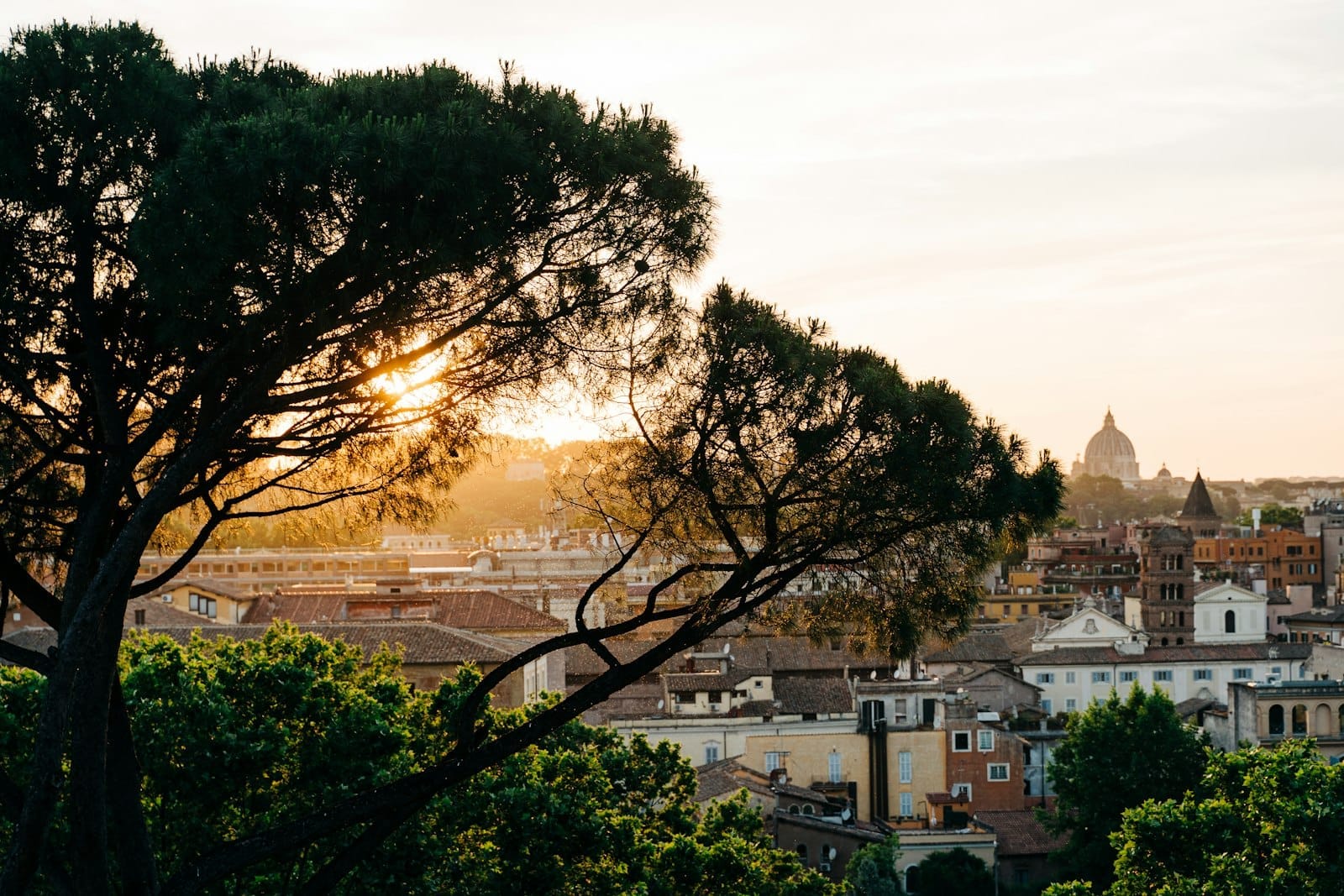
What the Giardino degli Aranci Actually Is
The Giardino degli Aranci, officially known as Parco Savello, sits on the crest of Aventine Hill in Rome's southern historic center. The name refers to the bitter Seville oranges (Citrus aurantium) planted in orderly rows across the garden. These are not the sweet oranges you might pick and eat: they are decorative and highly fragrant, particularly from late winter through spring when the blossoms release a sharp, clean scent across the whole terrace.
The garden is compact, roughly rectangular, and fully enclosed by medieval walls. Its main draw is the Terrazza Belvedere Aventino at its northern edge: a low stone parapet from which you look directly across the Tiber toward the dome of St. Peter's Basilica. It is one of the few viewing points in Rome where the proportions feel right, the dome fully centered, the rooftops of Trastevere spread below, and the Janiculum ridge visible behind. No kiosk, no selfie-stick vendor, no queue.
💡 Local tip
The garden is open daily from sunrise to sunset. Arrive at opening for the quietest experience of the day.
A Brief History: Fortress Walls Beneath the Orange Trees
The Aventine Hill has a long civic and religious identity in Rome. In ancient times, it sat just outside the original city boundaries and was associated with plebeian communities, a symbolic counterweight to the patrician hills. The site itself was transformed significantly in the medieval period when the powerful Savelli family built a fortress here toward the end of the 13th century. Fragments of those fortification walls are still visible today, running along the garden's perimeter, incorporated now into the boundary that separates the terrace from the steep Clivio di Rocca Savella path below.
The garden's history extends back even further, with records of activity on this site reaching as far as the 10th century. The Savelli stronghold was one of several noble family fortresses that once dominated Rome's hilltops, and its transformation into a public garden reflects the broader civic reclamation of Rome's elevated spaces in the modern era. The orange trees themselves give the space a formal, almost cloister-like quality, a reminder that this part of Aventine Hill sits directly adjacent to the Basilica of Santa Sabina, one of the earliest surviving Christian basilicas in Rome.
Tickets & tours
Live prices and dates from our booking partner. If you book, we may earn a commission at no extra cost to you.
St. Peter's Basilica, Vatican Museums, Sistine Chapel reserved entry
From 81 €Instant confirmationFree cancellationGuided tour of Galleria Borghese and of Villa Borghese gardens
From 69 €Instant confirmationFree cancellationVatican: Basilica, Dome and underground early bird tour
From 50 €Instant confirmationFree cancellationPasta-making class, tasting and prosecco with local chef in Rome
From 79 €Instant confirmationFree cancellation
How the Experience Changes by Time of Day
In the early morning, the garden feels like it belongs to a different city. The benches are mostly empty, the light comes in low from the east and cuts between the orange trees, and the only sounds are birdsong and the distant hum of traffic from Lungotevere below. The view of St. Peter's dome at this hour, with soft diffused light from behind, is worth the early start.
By late morning, particularly on weekends between April and October, the terrace becomes moderately popular with local families, couples, and the occasional group of tourists. It never reaches the density of Pincio or Gianicolo. The garden has no café, no gift shop, and limited shade away from the tree canopy, which naturally discourages the kind of lingering that would fill it to capacity.
The golden hour before the garden closes is worth considering for photographers. In summer, the late-afternoon light turns the dome of St. Peter's a warm amber, and the Trastevere rooftops below shift from gray to terracotta. Bring a wide-angle lens if photography matters to you: the best panoramic composition requires stepping back from the parapet, not pressing against it.
ℹ️ Good to know
For a comparison of Rome's hilltop panoramas, the Pincio Terrace offers a wider but busier view from the north, while Gianicolo Hill is broader and more dramatic. The Orange Garden is the most intimate of the three.
Getting There and Navigating the Approach
The nearest Metro stop is Circo Massimo on Line B, approximately a 15-minute walk away. The route from Circo Massimo station takes you past the long flank of the Circus Maximus track, then uphill through the quiet Aventine residential streets. It is a genuine uphill climb on uneven paving stones: comfortable walking shoes are not optional.
The main entrance is on Piazza Pietro d'Illiria. There are also entrances along Via di Santa Sabina and via the Clivio di Rocca Savella path, the latter being the steeper and more atmospheric approach from below. If you are combining this with a visit to the Aventine Keyhole (the famous Knights of Malta keyhole on Piazza dei Cavalieri di Malta, just a two-minute walk away), you can do both in a single visit without backtracking.
Buses also serve the Aventine area. Check current ATAC routes before your visit, as bus lines in this part of the city have been subject to service changes. For a broader sense of how to get around the city's historic hills, the getting around Rome guide covers public transport options in detail.
What to Combine It With
The Aventine Hill clusters several worthwhile stops within ten minutes of each other. The Aventine Keyhole is the obvious pairing: a short queue, a precise view of St. Peter's framed through a hedge, and entirely free. From there, the Basilica of Santa Sabina is immediately adjacent to the garden's south side, one of Rome's oldest and least-altered basilicas, with a carved wooden door dating to the 5th century. Below the hill, the Circus Maximus offers a sense of ancient Roman scale before you head uphill.
The broader neighborhood to the north, the Jewish Ghetto, is a 20-minute walk down toward the Tiber and offers some of Rome's most layered street history, with ruins, medieval layers, and Renaissance architecture compressed into a small area. It pairs well with an Aventine morning as an afternoon continuation, particularly if you want to explore the city's older inhabited districts without fighting through Centro Storico crowds.
Honest Assessment: Who This Suits and Who It Does Not
The garden is compact. You will see it fully in 20 minutes if you walk briskly. If you are expecting something on the scale of Villa Borghese Gardens or a manicured botanical experience, this is not that. There are no formal floral displays, no sculptures, no café. The orange trees are visually uniform rather than spectacular, and in summer, parts of the garden can feel dusty and sun-bleached.
What it offers is proportion and calm: a terrace-scale garden with one of the most directly composed views in Rome, in a part of the city where the tourist density is low enough that you can actually stand still and look. Visitors who find the Gianicolo Hill panorama too crowded or too far from the center tend to appreciate the Orange Garden more. It is the choice of someone who has already seen the obvious things and wants to absorb the city rather than just document it.
Travelers with significant mobility limitations should be aware that the approach from Circo Massimo involves sustained uphill walking on uneven stone surfaces. The Clivio di Rocca Savella entrance is particularly steep. The main entrance from Piazza Pietro d'Illiria is the most accessible, though still uphill from the metro. Check the official Turismo Roma accessibility information before planning your visit.
⚠️ What to skip
There is no café, water fountain, or shade-shelter inside the garden. Bring water, especially between June and September when temperatures regularly exceed 28°C and the stone terrace reflects heat directly.
Photography and Practical Notes
The standard panorama shot from the terrace parapet places St. Peter's dome at the center of the frame, with Trastevere's rooftops in the foreground and the Janiculum ridge behind. To get the dome cleanly above the roofline rather than obscured by foreground buildings, position yourself toward the left side of the viewing platform. A 24–35mm equivalent focal length works well for the full panorama; a 50–85mm equivalent isolates the dome cleanly.
For those building a broader photography itinerary of Rome's viewpoints, the best views in Rome guide ranks and compares the main vantage points across the city with practical details on access and light direction.
Insider Tips
- Visit on a weekday between 7 AM and 9 AM for the quietest experience. By 11 AM on weekends in spring and summer, the terrace sees steady foot traffic, though it never becomes crowded in the way Trevi Fountain or the Spanish Steps do.
- The bitter-orange blossom fragrance peaks in late February and March. If your visit falls in this window, the scent along the main avenue of trees is genuinely remarkable and largely unmentioned in standard guides.
- Combine with the Aventine Keyhole (Piazza dei Cavalieri di Malta, a 2-minute walk) for back-to-back free viewpoints. Both together take under an hour and cost nothing.
- The Clivio di Rocca Savella path, which winds up the hill from the Lungotevere, is quieter and more atmospheric than approaching from the piazza. Use it as your ascent route and exit via the main piazza entrance for the easiest downhill path.
- In summer, the garden remains open until sunset, making it a reasonable pre-dinner stop for catching the late-afternoon light on the dome without the midday heat.
Who Is Giardino degli Aranci (Orange Garden) For?
- Travelers seeking a free, uncrowded panorama of Rome without the scale of Gianicolo or Pincio
- Photographers wanting a clean, centered composition of St. Peter's dome in morning or late-afternoon light
- Visitors combining Aventine Hill's cluster of free attractions: the Keyhole, Santa Sabina, and the garden in a single 90-minute loop
- Anyone needing a quiet pause mid-itinerary away from the noise and density of the historic center
- Spring visitors who can experience the bitter-orange blossom fragrance alongside the garden's formal avenue
Nearby Attractions
Other things to see while in Jewish Ghetto & Aventine:
- Aventine Keyhole
Through a simple iron gate on the Aventine Hill, one small keyhole frames St. Peter's Basilica with uncanny precision, the dome centered in a tunnel of manicured hedgerow. It takes ten seconds to look through, but the image stays with you far longer. Free to visit, open around the clock, and still underused by most Roman itineraries.
- Bocca della Verità
The Bocca della Verità is a 1st-century Roman marble disc set into the portico of the church of Santa Maria in Cosmedin. Free to visit and steeped in medieval legend, it draws long queues of curious travelers who dare to test the myth. Here is what you actually need to know before you go.
- Jewish Ghetto
The Ghetto Ebraico di Roma is the historic heart of one of the world's oldest continuous Jewish communities, predating the destruction of the Temple in Jerusalem. Today it functions as a living neighborhood layered with Roman ruins, Baroque synagogues, and some of the best Jewish-Roman food in the city.
Planning a trip? Discover personalized activities with the Nomado app.