The Aventine Keyhole: Rome's Most Perfectly Framed Secret
Through a simple iron gate on the Aventine Hill, one small keyhole frames St. Peter's Basilica with uncanny precision, the dome centered in a tunnel of manicured hedgerow. It takes ten seconds to look through, but the image stays with you far longer. Free to visit, open around the clock, and still underused by most Roman itineraries.
Quick Facts
- Location
- Piazza dei Cavalieri di Malta, Aventine Hill, Rome
- Getting There
- Circo Massimo (Metro Line B), then 10-min uphill walk
- Time Needed
- 15–30 minutes, including the walk up and queue
- Cost
- Free. No ticket, no booking required.
- Best for
- Photography, couples, curious walkers, early risers
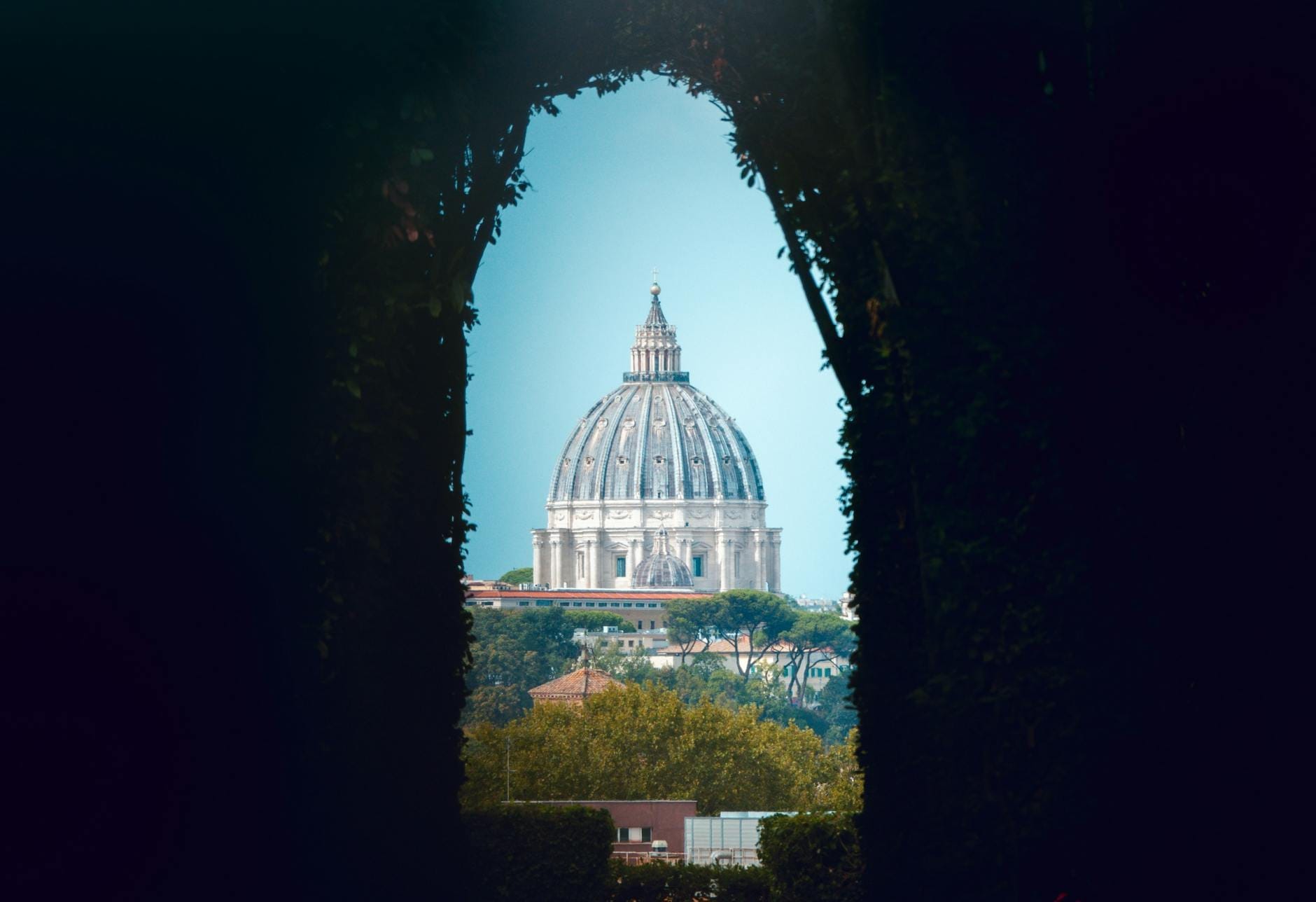
What the Aventine Keyhole Actually Is
The Aventine Keyhole, officially called the Buco della serratura del Priorato di Malta, is a small keyhole set into the heavy wooden gate of the Priory of the Knights of Malta, on Piazza dei Cavalieri di Malta. When you bend down and look through it, you see a perfectly composed view: a long tunnel of immaculately trimmed green hedging that opens onto St. Peter's Basilica, its dome suspended exactly in the center of the circular frame. Three sovereign territories align in that sight line — Italy, the Vatican, and the property of the Order of Malta, which holds extraterritorial status similar to an embassy.
The effect is not accidental. The garden avenue and the gate position were designed in the 18th century by Giovanni Battista Piranesi, the architect and engraver famous for his dramatic etchings of Roman ruins. Piranesi was commissioned to redesign the entire square and the Priory church of Santa Maria del Priorato around 1765. The keyhole view is understood to be an intentional compositional device, though Piranesi left no written explanation of it. The garden has been maintained to preserve the alignment ever since.
💡 Local tip
The keyhole is at waist height for most adults. Taller visitors need to crouch slightly. Children can usually look through without bending at all, which makes this a rare attraction where they genuinely have the better vantage point.
The History Behind the Gate
The Aventine Hill has carried layers of significance across centuries. This precise plot held the palace of Alberico II, the ruler of Rome in the 10th century, then passed to a Benedictine monastery. It passed to the Knights Templar in the 12th century (1100s), then to the Knights Hospitaller (Knights of Malta); the Order has held the property since the 1400s.
The Order of Malta is one of the world's oldest surviving chivalric orders, founded in Jerusalem in the 11th century to care for sick pilgrims. Today it functions as a sovereign entity under international law, issuing its own passports and maintaining diplomatic relations with over 100 countries. The Priory on the Aventine is one of its two headquarters in Rome, the other being the Palazzo Malta near the Spanish Steps. None of this is visible from the street. The gate reveals nothing about what lies beyond — which is exactly what makes the keyhole so effective.
Tickets & tours
Live prices and dates from our booking partner. If you book, we may earn a commission at no extra cost to you.
Aventine hill and Orange Garden guided walking tour
From 105 €Instant confirmationFree cancellationSt. Peter's Basilica, Vatican Museums, Sistine Chapel reserved entry
From 81 €Instant confirmationFree cancellationGuided tour of Galleria Borghese and of Villa Borghese gardens
From 69 €Instant confirmationFree cancellationVatican: Basilica, Dome and underground early bird tour
From 50 €Instant confirmationFree cancellation
What You See and How the Light Changes It
The view through the keyhole is the same composition at any hour, but the quality of light transforms it considerably. In the morning, especially between 8 and 10am, soft angled light catches the hedges on one side and leaves the dome in gentle shadow. The contrast is subtle and the mood feels contemplative. Midday flattens everything into bright uniformity — still striking, but with less depth.
The most photographed light arrives in the late afternoon, roughly 4 to 6pm in spring and summer, when the sun drops behind the Vatican and the dome glows with warm backlight. The hedging takes on a deep green, and the dome appears almost luminous at the far end of the tunnel. At sunset, if the sky carries any color, the view shifts again: the dome silhouettes against orange or rose tones and the framing becomes graphic rather than painterly.
At night, the Priory is illuminated and the dome is lit by Vatican floodlights, making the keyhole view a white circle of light at the end of a dark tunnel. It is different from the daytime experience — less botanical, more architectural — and worth seeing if you happen to be in the neighborhood after dark. The piazza itself is quiet at night, with almost no foot traffic.
ℹ️ Good to know
The keyhole is open 24 hours a day, 365 days a year. The gate belongs to the Priory, but the keyhole is accessible from the public piazza. No entry to the Priory grounds is required or permitted for standard visitors.
Getting There and Managing the Queue
The Priory sits at the top of Aventine Hill, at Piazza dei Cavalieri di Malta. The most direct route from public transit starts at Circo Massimo station on Metro Line B. From there, the walk takes about ten minutes, almost entirely uphill along Via di Santa Sabina and past the park of Sant'Alessio. The street is uneven in places — original cobblestones, not resurfaced — so sturdy footwear matters more than people expect. The same street passes Circus Maximus and the park of Sant'Alessio, so the walk has its own rewards.
A queue forms at busy periods, particularly weekend afternoons between April and October. It moves quickly because each person typically spends only 30 to 60 seconds at the keyhole: look, take a photo if you have a phone ready, step aside. The bottleneck is usually people fumbling with camera settings mid-view. If you go on a weekday morning before 9am, you may find no queue at all. Weekend afternoons in summer can stretch to 20 or 30 people, which means a wait of 15 to 20 minutes.
Wheelchair access to the piazza itself is limited by the uphill cobblestone approach. There is no ramp or lift at the gate, and the keyhole position requires bending or crouching. Visitors with restricted mobility should weigh whether the approach is manageable before making the trip specifically for this viewpoint.
Photography Through the Keyhole
Getting a usable photograph through the keyhole is harder than it looks. The circular aperture is small, the depth of field is enormous, and the camera needs to lock focus on the dome rather than on the gate or the hedges. Smartphone cameras with automatic scene detection sometimes focus on the gate itself and render the dome as a blurred blob. The fix is to tap the dome on your screen to shift focus before shooting.
For dedicated cameras, a standard or short telephoto lens works better than a wide angle, which tends to distort the circular frame into an oval. The keyhole itself is roughly 5 centimeters in diameter, so pressing the lens close to the brass fitting helps exclude peripheral light. Bracketing exposures is worthwhile in late afternoon, when the contrast between the dark hedges and bright dome can exceed what a single exposure handles cleanly.
⚠️ What to skip
Be considerate of the queue behind you. Have your camera settings ready before you reach the keyhole. Spending more than a minute or so blocks everyone else for a view that does not change in that time.
Combining the Keyhole with the Aventine Hill
The keyhole is best visited as part of a longer Aventine exploration rather than as a standalone trip. The Giardino degli Aranci (Garden of Oranges) is a five-minute walk from the piazza and offers one of Rome's most honest open panoramas: the city from the Tiber bend to the Vatican, with no fence or admission charge. The Basilica of Santa Sabina, just along Via di Santa Sabina, is a 5th-century church with original wooden doors that include some of the earliest known carved images of the Crucifixion. None of these cost anything to see.
From the Aventine, it is a short downhill walk to the Testaccio neighborhood, which has some of the city's most concentrated and honest eating. The Mercato di Testaccio runs Tuesday through Saturday mornings and is worth timing into the same half-day if you come early. The combination of keyhole at 8am, Garden of Oranges at 9am, Santa Sabina at 9:30am, and Testaccio market by 10am makes for a compact, low-cost, and mostly uncrowded Roman morning.
Honest Assessment: Worth It or Not?
The Aventine Keyhole is genuinely worth the detour for travelers who care about the odd, the composed, or the historically layered. It is also free, open all day, and takes almost no time. For visitors whose Rome itinerary is already strained by the Colosseum queue, the Vatican, and getting across the city by lunch, it may be a lower priority. If you are looking for free things to do in Rome that feel genuinely surprising rather than merely convenient, this belongs near the top of the list.
Travelers who find viewing a sight through a tiny hole less satisfying than standing in front of it may be disappointed. The keyhole view is compositional and photographic in nature: it rewards those who appreciate framing as a concept. If you tend to prefer immersive scale over intimate precision, the Giardino degli Aranci next door will likely mean more to you.
Insider Tips
- Arrive before 8:30am on any day of the week and you will almost certainly be alone at the gate. The piazza is silent that early, the light is soft, and the experience feels like a genuine discovery rather than a tourist queue.
- Have your camera or phone focused and settings adjusted before you step up to the keyhole. Tap the far end of the view (the dome) to lock focus, then shoot quickly. Holding up the line is the one social misstep possible here.
- The view is equally compelling at night, when Vatican floodlights illuminate the dome and the hedges form a dark frame around it. Virtually no one comes at 10pm, and the piazza has a quality that feels unchanged since the 18th century.
- Combine the keyhole with the Giardino degli Aranci, which is a five-minute walk away. Together they take under an hour and cover two of the Aventine's most rewarding viewpoints without any admission cost.
- The Priory church of Santa Maria del Priorato, also designed by Piranesi and located just inside the gate, is occasionally open to the public. Check ahead through the Order of Malta website if this interests you, as access is not guaranteed.
Who Is Aventine Keyhole For?
- Photography enthusiasts who appreciate compositional precision and challenging low-light shots
- Travelers interested in obscure history, sovereign oddities, and the layers beneath Rome's obvious monuments
- Couples looking for a quiet, cinematic moment away from major crowds
- Early risers who want a meaningful start to the day before the city wakes up
- Budget travelers building a full morning from free Aventine sites combined with Testaccio market
Nearby Attractions
Other things to see while in Jewish Ghetto & Aventine:
- Bocca della Verità
The Bocca della Verità is a 1st-century Roman marble disc set into the portico of the church of Santa Maria in Cosmedin. Free to visit and steeped in medieval legend, it draws long queues of curious travelers who dare to test the myth. Here is what you actually need to know before you go.
- Giardino degli Aranci (Orange Garden)
Perched on Aventine Hill, the Giardino degli Aranci (also known as Parco Savello) is a free public garden offering one of Rome's most rewarding views across the Tiber toward St. Peter's Basilica. Shaded by rows of bitter-orange trees and largely overlooked by mass tourism, it rewards those who make the uphill walk with calm, fragrance, and perspective.
- Jewish Ghetto
The Ghetto Ebraico di Roma is the historic heart of one of the world's oldest continuous Jewish communities, predating the destruction of the Temple in Jerusalem. Today it functions as a living neighborhood layered with Roman ruins, Baroque synagogues, and some of the best Jewish-Roman food in the city.
Planning a trip? Discover personalized activities with the Nomado app.