Bibliothèque François Mitterrand: Inside Paris's Most Ambitious Library
The Bibliothèque nationale de France's François-Mitterrand site is one of Paris's boldest architectural statements: four L-shaped glass towers framing a vast sunken forest garden on the Seine. Open to visitors and readers alike, it rewards curiosity whether you come to study, see an exhibition, or simply stand on the esplanade and absorb the scale of a building that reshaped an entire district.
Quick Facts
- Location
- Quai François Mauriac, 75013 Paris
- Getting There
- Métro 14 / RER C: Bibliothèque François-Mitterrand; Métro 6: Quai de la Gare
- Time Needed
- 1–3 hours (half-day if using reading rooms)
- Cost
- Free for esplanade & certain areas; reader ticket required for reading rooms; free entry to Public Library 5–8 pm Tuesday–Saturday
- Best for
- Architecture lovers, researchers, exhibition visitors, design-curious travelers
- Official website
- www.bnf.fr/en/francois-mitterrand
What the Bibliothèque François Mitterrand Actually Is
The Bibliothèque nationale de France, site François-Mitterrand, is the principal site of France's national library, one of the largest in the world. It sits on the left bank of the Seine in the 13th arrondissement, roughly 3 km southeast of Notre-Dame, on land that was industrial wasteland until the early 1990s. The building's full official name is long enough to confuse even Parisians; most simply call it the BnF or the 'TGB' (très grande bibliothèque), the nickname the press coined when President Mitterrand announced the project in 1988 as one of his grands travaux, the series of monumental public buildings intended to reshape Paris for the 21st century.
The library opened to researchers in 1994 and to the general public in 1996. It holds roughly 14 million books across all BnF sites, with the François-Mitterrand building serving as the main repository for printed works from the 20th century onward, complementing the historic Richelieu site in the 2nd arrondissement, which houses manuscripts, prints, maps, and coins. If you want to understand how France thinks about knowledge as a public resource, this building is a direct physical argument for that position.
ℹ️ Good to know
The Public Library is open to anyone aged 14 and over. Entry to the Public Library reading rooms is free of charge every Tuesday to Saturday from 5 pm to 8 pm — the most visitor-friendly window if you simply want to experience the interior without paying for a day ticket.
The Architecture: Four Towers and a Hidden Forest
Dominique Perrault won the design competition at age 36 with a concept that remains startling decades later: four identical L-shaped towers, each rising 80 metres, positioned at the corners of a vast rectangular esplanade. The towers are clad in glass and fitted with movable wooden shutters that open or close to regulate light and heat, giving the facades a texture that shifts constantly through the day. Perrault intended each tower to evoke an open book, which sounds like an architect's conceit until you actually stand on the riverside path and find the image genuinely convincing.
What the towers enclose is the surprise: a sunken pine forest of more than a hectare, planted with mature trees transplanted from Normandy. It sits roughly 20 metres below the esplanade, invisible from street level and not accessible to visitors. Looking down into it from the reading room windows is one of the more unusual experiences Paris's modern architecture offers: dense green pine canopy in the middle of a city, sealed behind glass, existing purely for the psychological benefit of readers seated above it. The contrast between the industrial scale of the exterior and the quietness of that interior courtyard is the building's central architectural idea.
The esplanade itself, surfaced in warm Amazonian hardwood (ipê), is worth extended time. It runs at an elevated level above the Seine, offering unobstructed views across the water toward Bercy and the Passerelle Simone de Beauvoir footbridge. Travelers interested in how this building catalyzed the reinvention of eastern Paris will find it useful to pair a visit here with a walk through the wider Bastille-Bercy district, where the BnF's arrival in the 1990s triggered a decade of regeneration that transformed former freight yards and warehouses into one of Paris's most architecturally self-conscious neighborhoods.
Tickets & tours
Hand-picked options from our booking partner. Prices are indicative; availability and final rates are confirmed when you complete your booking.
Paris Essential dinner cruise at 6.15pm
From 99 €Instant confirmationFree cancellationEiffel Tower reserved elevator entrance to 2nd floor with walking tour and Seine cruise
From 94 €Instant confirmationFree cancellationBest of Paris city tour with Eiffel Tower lunch and Seine cruise
From 144 €Instant confirmationFree cancellationBike tour of Versailles Palace with skip-the-line tickets
From 109 €Instant confirmationFree cancellation
What You Can See and Do Inside
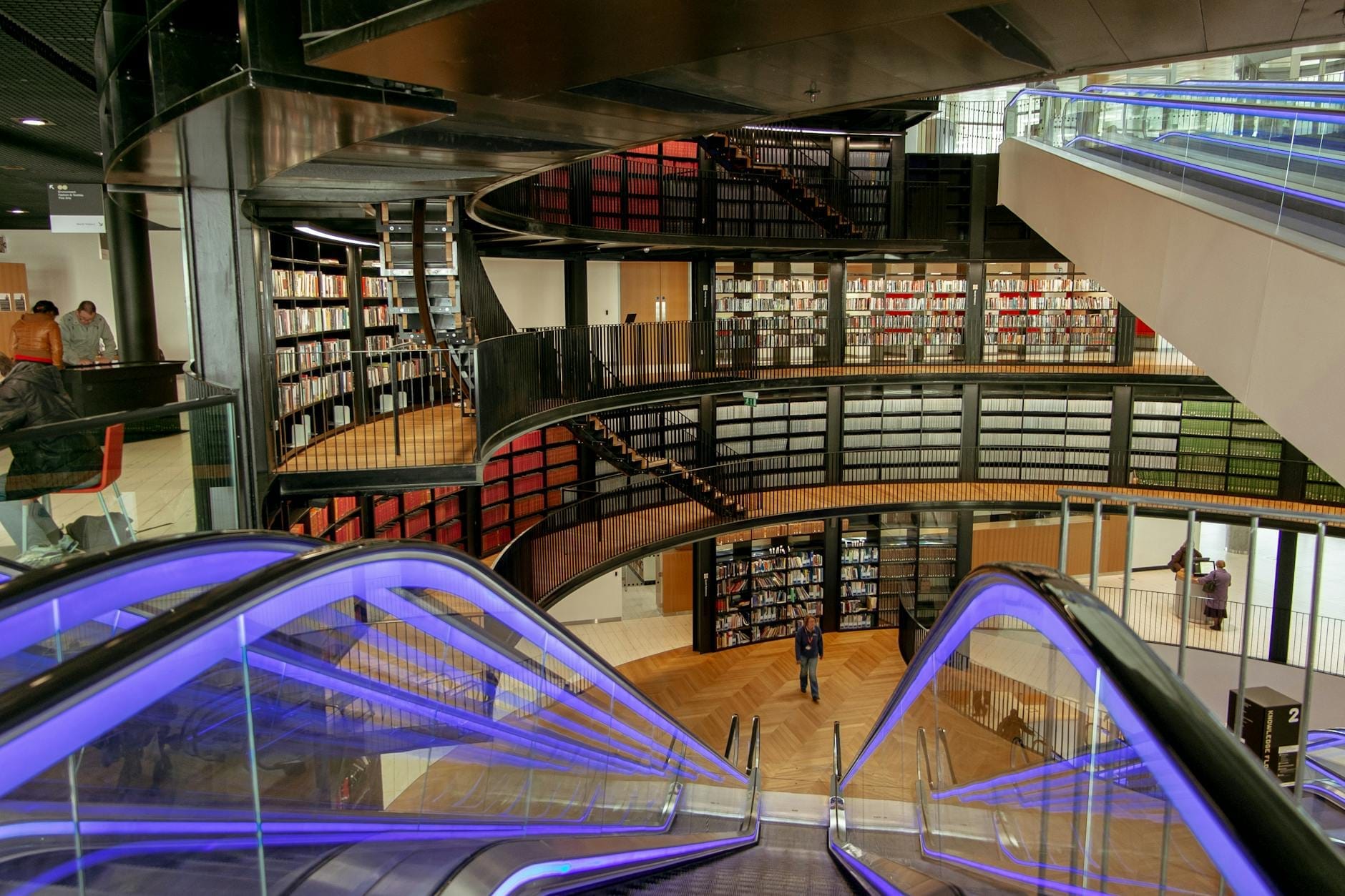
The building divides into two distinct libraries. The upper level houses the Public Library, open to anyone over 14. Its reading rooms are arranged in a ring around the sunken forest: Room A for audiovisual media, Room B for press and media, Room C for science and technology, Room D for law and economics, Room E for bibliographic research, Room F for arts, Room G for world literature, Room H for French literature, Room I for children's literature (free for accompanied under-16s on Saturdays and during school holidays), and Room J for philosophy, history, and humanities. Each room has its own character, natural light, and view of either the courtyard or the Seine.
The lower level, the Rez-de-jardin, is the research library for credentialed academics, holding the BnF's rare and specialized collections. For most visitors, the Public Library floor is the relevant space. With 1,500 seats, computer and multimedia workstations, and wifi, it functions as something between a great reading room and a civic co-working space at monumental scale. Documents can only be consulted on-site; no home loans are permitted.
Beyond reading rooms, the BnF runs a substantial exhibition and cultural program. Temporary exhibitions in the Grande Galerie draw frequently from the library's own collections, covering photography, typography, maps, illustrated manuscripts, and archival material rarely seen outside specialist contexts. Admission to exhibitions is separate and varies by show. Tickets for everything that requires payment are sold in the East Hall on site, and the BnF Pass 'Lecture/Culture' is also available online.
💡 Local tip
Check the BnF's program online before visiting. The cultural calendar regularly includes evening concerts, lectures, and film screenings. Combining one with the 5–8 pm free-entry window gives you architecture, live programming, and the reading room experience at minimal cost.
How the Experience Changes by Time of Day
Arriving on a weekday morning, you encounter the library as a working institution. Researchers gather before opening, regulars know which rooms have the best seats by window, and the esplanade is crossed by people in purposeful transit rather than lingering. The scale of the building is most legible at this hour, when the plaza stretches toward the river without obstruction. The light on the towers' wooden shutters is warmest in morning sun, the timber's grain and depth flattened by noon glare.
Late afternoon is the turning point. From around 4 pm, the esplanade shifts from institutional to social. Students stretch on the steps, people eat outside in warmer months, and the reading rooms take on a quieter, more contemplative atmosphere. After 5 pm, free access to the Public Library makes this the most generous window for first-time visitors: find a seat by a window overlooking the forest courtyard, and the building reveals itself in a way that no exterior photograph prepares you for.
Weekends have a different rhythm. The research library closes on Sundays, but the Public Library runs on Saturdays, and the esplanade draws a mixed crowd including families, runners on the riverbank path, and visitors crossing the Passerelle Simone de Beauvoir from Bercy. Saturday morning works well if you plan to combine the BnF with a walk along the Seine before the early afternoon crowd builds on the esplanade.
Getting There and Moving Around the Site
The most direct arrival is Métro Line 14, which stops at Bibliothèque François-Mitterrand — the station name doubles as the clearest wayfinding in Paris. RER C stops here as well, making it practical from the Latin Quarter, central arrondissements, and even Versailles via a single line. Métro Line 6 at Quai de la Gare is a 10-minute walk and suits visitors combining the BnF with Bercy Village on the opposite bank or a longer riverside walk. Verify current RATP fares before travel, as Paris public transport prices adjust periodically.
From street level on Quai François Mauriac, a wide staircase leads up to the esplanade plateau. The main entrance to the reading rooms is on the east side of the plateau, signed for 'Haut-de-jardin' for the Public Library. First-time visitors sometimes spend several minutes orienting themselves on the large open plaza before finding the entrance; follow the signs rather than the architecture. Accessibility lifts connect street level to the esplanade.
Photography, Atmosphere, and Honest Limitations
The BnF is not a conventional sightseeing destination in the way that the Louvre or Musée d'Orsay are, and that is precisely its strength. There are no queues of tourists, no audio guides, and no gift shop pressure. The architecture rewards slow looking: the grain of the esplanade's wooden planks, the four towers' reflections in the Seine at dusk, the precise geometry of the corner L-shapes seen from the river path below. Photographers will find the building's graphic lines most striking at low sun angles, particularly in autumn afternoons when the ipê timber turns amber.
Inside the reading rooms, photography of other readers is not permitted. The forest courtyard cannot be entered or accessed by visitors, only observed from above through glass. These constraints, once accepted, actually direct attention toward what matters: the quality of light in the rooms, the hush of concentrated work, the unusual pleasure of being in a space designed to make intellectual life physically comfortable.
The building is honest about its structural tensions. The glass towers create significant solar gain, which is why the wooden shutters exist but were reportedly difficult to operate reliably in early years. The esplanade's exposed riverside position makes it noticeably cold and windy even in mild weather. Dress in layers if you plan to spend time outside, particularly between October and March.
⚠️ What to skip
The sunken forest courtyard is off-limits to all visitors and library staff without specific authorization. If you have seen aerial photographs and come expecting to walk among the pine trees, adjust expectations: you will view the forest from above through reading room windows — atmospheric, but categorically different from being inside it.
Who Will Connect With This Place, and Who Might Not
Travelers drawn to contemporary architecture, French intellectual culture, or the legacy of Mitterrand's grands travaux will find this one of the most rewarding sites in Paris east of the center. It pairs naturally with a walk through the surrounding 13th arrondissement, or with a longer itinerary through the Bastille-Bercy district that takes in the Passerelle Simone de Beauvoir, the Parc de Bercy, and Bercy Village in a single half-day loop. For a broader view of Paris's ambitious modern public buildings, the guide to things to do in Paris places this in useful context alongside the Centre Pompidou and the Grande Arche de la Défense.
Visitors expecting an ornate 19th-century interior, the kind of gilded reading room associated with the Richelieu site or the old Bibliothèque Sainte-Geneviève, will be disappointed. The BnF François-Mitterrand's aesthetic is rigorously modern and functional. Its emotional register is not grandeur but a cool civic seriousness, a building that trusts you to understand why it was built. If that sounds compelling rather than cold, the journey east is worth it.
Families with children under 14 cannot access the reading rooms, but are welcome on the esplanade and at specific family programming events. Children's literature Room I, dedicated to the national collection of children's books, is open to accompanied under-16s on Saturdays and during school holidays for all school regions, making it a viable weekend option for literary-minded families.
Insider Tips
- The free 5–8 pm entry window applies Tuesday through Saturday for the Public Library. Arrive at 5 pm for the best seat selection. Room H (French Literature) and Room G (World Literature) tend to have the most generous natural light from the Seine-facing windows.
- The Passerelle Simone de Beauvoir footbridge, directly in front of the BnF esplanade, offers the best exterior view of all four towers in a single frame. Cross to the Bercy bank and look back: it's the composition most architectural photographers use, and it costs nothing.
- The BnF regularly runs free introductory discovery sessions ('séances de découverte') explaining how to navigate the collections. They are conducted in French, but even with basic language skills the orientation is worthwhile. Check the website for the current schedule.
- International researchers with institutional affiliation can apply for an unlimited Research Pass, which grants access to the lower Rez-de-jardin research library and its specialized collections. Ask at the East Hall information desk with a valid academic ID.
- Combine a BnF visit with the covered market at Marché d'Aligre — about 20 minutes on foot or two stops on Métro Line 8 — on a Saturday morning for a half-day that covers ambitious modernist architecture and one of Paris's best working food markets.
Who Is Bibliothèque François Mitterrand (BNF) For?
- Architecture and design enthusiasts drawn to late 20th-century French modernism and the grands travaux legacy
- Researchers and students wanting access to one of Europe's largest national library collections
- Exhibition visitors: BnF temporary shows draw on archival holdings not exhibited anywhere else
- Travelers exploring the Seine's eastern banks and the post-industrial character of the 13th arrondissement
- Anyone seeking a genuinely quiet, uncommercial Paris experience outside the central tourist circuit
Nearby Attractions
Other things to see while in Bastille & Bercy:
- Bercy Village
Bercy Village transforms 42 stone wine storehouses, classified as Historic Monuments, into a pedestrian-only courtyard of boutiques, restaurants, and terraces in the 12th arrondissement. Free to enter and open daily, it draws around 12 million visitors a year yet feels quieter and more local than much of central Paris.
- Marché d'Aligre
Marché d'Aligre is one of Paris's oldest and most authentic markets, occupying Place d'Aligre in the 12th arrondissement since the late 18th century. It combines an open-air produce market, the historic covered Beauvau hall, and a small flea market into a single square that locals treat as a Saturday morning ritual rather than a tourist stop.
- Opéra Bastille
Rising above Place de la Bastille, the Opéra Bastille is one of the world's largest and most technically advanced opera houses. Whether you're attending a performance or taking a guided tour, this modernist landmark rewards curiosity at every level.
- Rue Crémieux
A 144-metre pedestrianized lane in the 12th arrondissement, Rue Crémieux is lined with pastel-painted townhouses dating to the 1860s. Free to visit and open at any hour, it rewards early risers with quiet cobblestones and vivid colour, while weekend afternoons can feel genuinely overcrowded.