Rue Crémieux: Paris's Most Photographed Residential Street
A 144-metre pedestrianized lane in the 12th arrondissement, Rue Crémieux is lined with pastel-painted townhouses dating to the 1860s. Free to visit and open at any hour, it rewards early risers with quiet cobblestones and vivid colour, while weekend afternoons can feel genuinely overcrowded.
Quick Facts
- Location
- Rue Crémieux, 75012 Paris (12th arrondissement), between Rue de Lyon and Rue de Bercy
- Getting There
- Gare de Lyon (Métro lines 1 & 14; RER A & D) — 5-min walk; Quai de la Rapée (line 5) also nearby
- Time Needed
- 15–30 minutes to walk and photograph; longer if you combine with Gare de Lyon area
- Cost
- Free — public street, no admission
- Best for
- Architecture lovers, photographers, and anyone curious about Paris beyond the postcard landmarks
What Rue Crémieux Actually Is
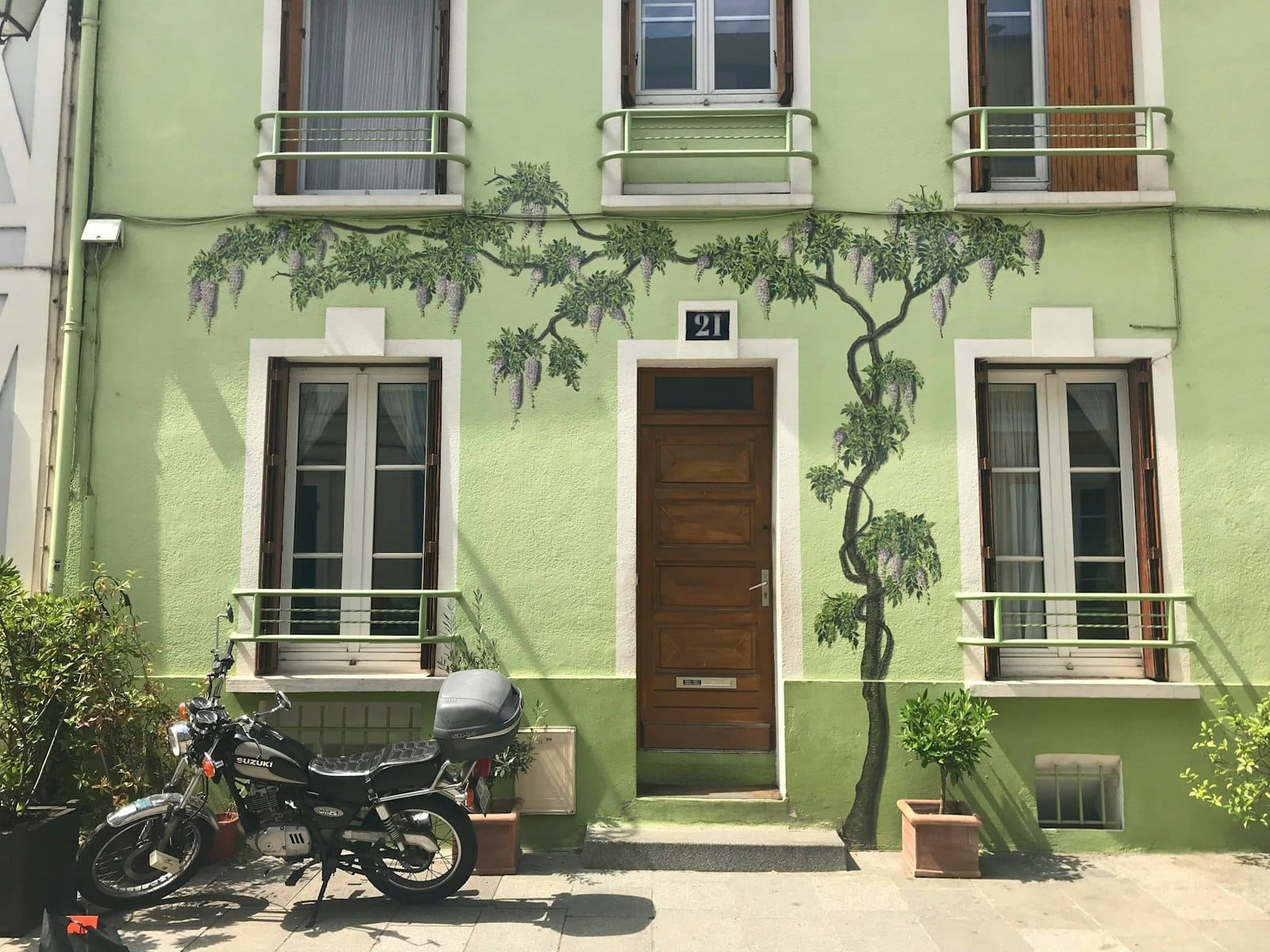
Rue Crémieux is a short residential street in Paris's 12th arrondissement, running just 144 metres and barely 7.5 metres wide between Rue de Lyon and Rue de Bercy. It is pedestrianized, cobblestoned, and flanked on both sides by two- to three-storey terraced houses whose facades are painted in consecutive shades of pink, yellow, green, mint, and coral. The effect, especially in soft morning light, is striking.
The street was laid out in 1865 under the name Avenue Millaud, built to house workers involved in the construction of the nearby Gare de Lyon. It was renamed Rue Crémieux in 1897 in honour of Adolphe Crémieux, a French statesman and lawyer. The pastel colour scheme, though it looks Victorian, is more recent: residents began painting their facades in these cheerful tones from around 1993 onward, gradually turning the street into the photogenic corridor it is today.
This is not a museum, a monument, or a commercial district. It is a functioning residential street where real Parisians live. That distinction matters for how you visit. For more context on the wider neighbourhood, see the Bastille-Bercy area guide.
The Experience by Time of Day
💡 Local tip
Arrive before 8:30am on any day of the week for the best light, near-empty cobblestones, and no crowds. Weekday mornings are quieter than weekends by a significant margin.
Early morning is when Rue Crémieux earns its reputation. The low sun catches the painted facades at an angle that makes the colours almost luminous — the coral pinks and lemon yellows read differently than they do under flat midday light. The street is narrow enough that direct sunlight hits one side in the morning and the other in the afternoon, so the 'golden' facade depends entirely on what time you arrive. By 9am on a weekday, you might share the street with a handful of dog walkers and a couple heading to the RER at Gare de Lyon. That calm rarely lasts past 10am.
By late morning and through the afternoon, especially on weekends, the street fills quickly. On busy Saturdays, the resident association has noted up to 200 people at a time occupying the lane, most of them positioning for photographs. The cobblestones become an obstacle course of tripods, ring lights, and people stepping backward into each other. The ambiance shifts from charming to chaotic, and any sense of discovering something quiet is gone.
Late afternoon on a weekday brings a second, softer window. The light shifts to the opposite facades, the crowd thins, and the street recovers some of its character. Evenings are occasionally used for professional photo shoots and small celebrations, which can mean noise and blocked sightlines.
Tickets & tours
Hand-picked options from our booking partner. Prices are indicative; availability and final rates are confirmed when you complete your booking.
Paris Essential dinner cruise at 6.15pm
From 99 €Instant confirmationFree cancellationEiffel Tower reserved elevator entrance to 2nd floor with walking tour and Seine cruise
From 94 €Instant confirmationFree cancellationBest of Paris city tour with Eiffel Tower lunch and Seine cruise
From 144 €Instant confirmationFree cancellationBike tour of Versailles Palace with skip-the-line tickets
From 109 €Instant confirmationFree cancellation
History and Neighbourhood Context
The 12th arrondissement was historically a working-class district, shaped by the railway infrastructure at Gare de Lyon and the old wine warehouses of Bercy. Rue Crémieux sits right at the edge of that industrial heritage, a block from one of Paris's main rail terminals. The street's modest proportions and worker-housing origins mean it was never grand in the Haussmann sense; its appeal comes precisely from that human scale.
Adolphe Crémieux, after whom the street is named, was a significant figure in 19th-century French legal history. He served twice as Minister of Justice, championed the abolition of the death penalty for political crimes, and is best remembered for the 1870 Crémieux Decree granting French citizenship to Algerian Jews. The street is a small but concrete piece of Paris's habit of embedding its civic memory into everyday geography. The neighbourhood as a whole rewards exploration: the Bercy Village complex, converted from 19th-century wine warehouses, is a 15-minute walk east and offers a very different kind of architectural character.
Photography: What Works and What Doesn't
The street's photographic appeal is real, but it requires some planning to capture effectively. The facades photograph best with a 24–35mm equivalent lens that can take in an entire townhouse from the narrow lane without excessive distortion. A longer focal length lets you compress the perspective and stack the coloured houses into a repeating pattern. Neither approach requires specialist equipment; a smartphone with a wide and a telephoto mode will cover both.
The cobblestones add texture to foreground shots but can be slippery when wet. In rain, the painted facades pick up reflections from puddles on the stone, which can produce genuinely interesting images — though most visitors avoid the street in poor weather. The street runs roughly east-west, so the southern-facing facades (the ones with window boxes and more ornamental detailing) catch better light in the morning hours.
⚠️ What to skip
This is a residential street. Photograph the architecture freely, but be considerate of residents' windows, doors, and private spaces. Commercial shoots and large productions have caused significant friction with locals. Keep groups small and noise low.
If you want more context on where this street fits among Paris's most photogenic spots, the best photo spots in Paris guide covers a wider range of settings and lighting conditions across the city.
The Overtourism Issue
It would be dishonest to describe Rue Crémieux without addressing its central tension. The street's residents have been vocal about the impact of social-media tourism on their daily lives. The neighbourhood association has formally requested restricted access during peak hours and weekends, describing conditions on busy days as untenable. That request has not (as of this writing) resulted in formal closures, but the friction is real and ongoing.
The irony is that the colour scheme driving the footfall is itself a relatively recent community project, not a centuries-old heritage feature. The pastel facades were a grassroots beautification effort, and the unintended consequence was turning the street into a backdrop for tens of thousands of social media posts annually. For a traveller making a conscious choice about where to spend their time, this context is worth weighing.
If you visit, the most respectful approach is brief: walk the length of the street, take your photographs, and move on. Do not set up equipment that blocks passage, do not linger in front of residential windows, and absolutely avoid the street at weekends if you want both a pleasant experience and a cleaner conscience about the impact of your visit.
Getting There and Practical Details
Rue Crémieux is in the 12th arrondissement, tucked between the Gare de Lyon rail complex and the Seine embankment. The simplest approach is from Gare de Lyon: exit onto Rue de Lyon heading toward the river, then turn right onto Rue Crémieux after roughly 300 metres. The walk takes about five minutes from the metro platforms.
Gare de Lyon is served by Métro lines 1 and 14 as well as RER lines A and D, making it one of the best-connected stations in the city. If you're arriving from central Paris on line 1, the journey from Châtelet takes around seven minutes. Alternatively, Quai de la Rapée on line 5 puts you at the river end of the street.
Combining Rue Crémieux with a broader walk along the Seine embankment works well. From here you can continue west along the quays toward the Seine river cruise departure points, or east toward Bercy Park, one of the most underrated green spaces in the city. For a full itinerary that incorporates this part of Paris, see the 3-day Paris itinerary.
ℹ️ Good to know
Accessibility note: The street is cobblestoned throughout, with no smooth surface alternative. Wheelchair users and pushchairs may find the uneven stones difficult to navigate. There are no steps, but the cobble texture is pronounced.
Who Should Skip Rue Crémieux
Travellers with limited time in Paris who have not yet visited the major monuments should probably deprioritize Rue Crémieux. It is a short, free street walk with no interior to enter and no secondary programming — you see it, photograph it, and leave. If you have only two or three days in the city, the time could more usefully go toward the Marais, the Left Bank, or a river crossing at Pont Neuf.
It is also a poor choice for visitors who are sensitive to crowds and find tourist-saturated settings stressful: arriving at the wrong hour turns the experience from pleasant to frustrating within minutes. For genuinely crowd-free architectural walks in Paris, the hidden gems in Paris guide points toward streets and passages that haven't yet reached Rue Crémieux's level of social media saturation.
Insider Tips
- Arrive before 8:30am, especially in spring and summer when the light is already good at that hour. You will frequently have the street to yourself for 15–20 minutes before the first other visitors appear.
- The house at the Rue de Bercy end of the street has the most elaborate window box plantings, which peak in late spring. It photographs better from a slight distance than up close.
- Gare de Lyon's Le Train Bleu brasserie, located on the station's first floor, is a lavishly decorated Belle Époque restaurant that almost nobody visits despite being steps away. It makes an excellent breakfast stop before or after your visit.
- The cobblestones are particularly photogenic just after rain, when they hold a mirror-like reflection of the facades. Check the forecast: a light morning shower followed by clearing skies is the ideal setup.
- If you want a crowd-free version of the pastel-house concept, consider the Cité Florale in the 13th arrondissement (around Rue Brillat-Savarin) — a cluster of residential lanes with flower-named streets and almost no tourist footfall.
Who Is Rue Crémieux For?
- Photographers and visual travellers looking for a colour-rich, architecturally specific subject in early morning light
- Repeat visitors to Paris who already know the main monuments and are exploring the city's residential texture
- Travellers combining a Gare de Lyon connection with an hour of local exploration before catching a train
- Architecture and urban history enthusiasts interested in 19th-century worker housing and the social geography of the 12th arrondissement
- Families with older children who want a short, easy walk with high visual payoff and no queues or admission fees
Nearby Attractions
Other things to see while in Bastille & Bercy:
- Bercy Village
Bercy Village transforms 42 stone wine storehouses, classified as Historic Monuments, into a pedestrian-only courtyard of boutiques, restaurants, and terraces in the 12th arrondissement. Free to enter and open daily, it draws around 12 million visitors a year yet feels quieter and more local than much of central Paris.
- Bibliothèque François Mitterrand (BNF)
The Bibliothèque nationale de France's François-Mitterrand site is one of Paris's boldest architectural statements: four L-shaped glass towers framing a vast sunken forest garden on the Seine. Open to visitors and readers alike, it rewards curiosity whether you come to study, see an exhibition, or simply stand on the esplanade and absorb the scale of a building that reshaped an entire district.
- Marché d'Aligre
Marché d'Aligre is one of Paris's oldest and most authentic markets, occupying Place d'Aligre in the 12th arrondissement since the late 18th century. It combines an open-air produce market, the historic covered Beauvau hall, and a small flea market into a single square that locals treat as a Saturday morning ritual rather than a tourist stop.
- Opéra Bastille
Rising above Place de la Bastille, the Opéra Bastille is one of the world's largest and most technically advanced opera houses. Whether you're attending a performance or taking a guided tour, this modernist landmark rewards curiosity at every level.