Jimbaran is Bali's most celebrated seafood destination, a crescent-shaped bay lined with open-air grills and luxury resorts. It offers a noticeably quieter rhythm than the island's southern party zones, making it a natural base for travelers who want beach access, great food, and proximity to the airport without the chaos of Kuta or Seminyak.
Jimbaran sits on a wide, calm bay on Bali's southwest coast, best known for its rows of seafood warungs serving grilled fish on the sand at sunset. It is one of the few places in southern Bali where a genuine fishing village and a five-star resort strip exist side by side, and that tension between the local and the luxurious defines the neighborhood's character entirely.
Orientation
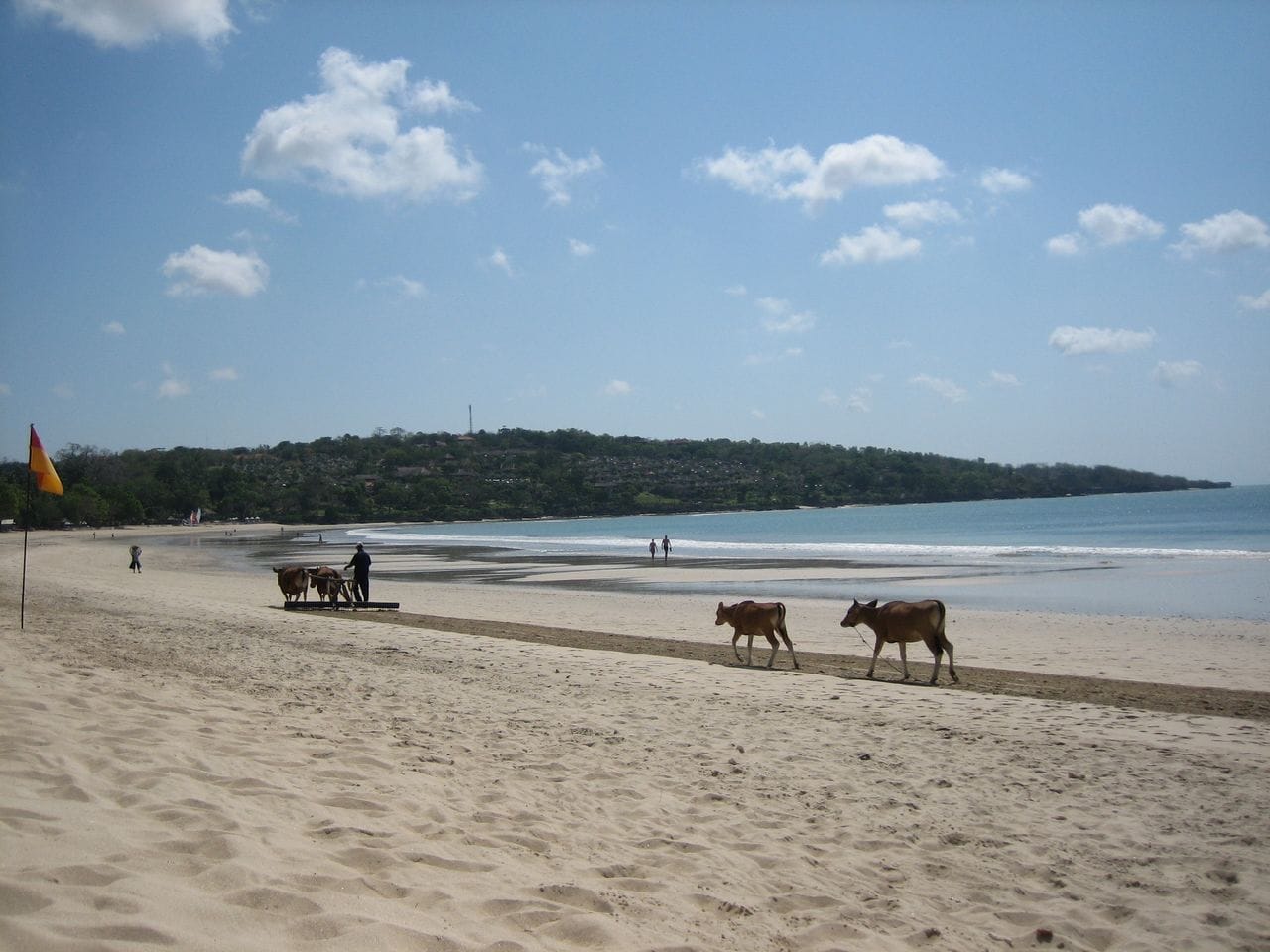
Jimbaran occupies a southwest-facing bay roughly 8 kilometers south of Ngurah Rai International Airport and about 10 kilometers south of Kuta. The bay curves gently from the Kedonganan fish market area in the north down to the Four Seasons and Bulgari resort headland in the south, with the main seafood dining strip running along the central section of beach. The Indian Ocean here is noticeably calmer than the surf beaches to the north and west, which is partly why the resorts clustered here.
Inland from the beach, Jimbaran's town center sits around the central market and the main road running parallel to the coast. The Bukit Peninsula, Bali's limestone southern promontory, begins just south of Jimbaran, meaning the land rises sharply once you pass the resort headland. Uluwatu, Padang Padang, and the surf breaks of the Bukit are all accessible from here within 20 to 30 minutes by motorbike. To the north, Jimbaran connects seamlessly into the airport zone and then into Kuta and Seminyak beyond it.
Think of Jimbaran as the southern anchor of the Kuta-Seminyak coastal corridor, but quieter and more self-contained. Most visitors either base themselves here for the entire trip or pass through for a seafood dinner on the way back from Uluwatu. Both approaches make complete sense depending on your priorities.
Character & Atmosphere
Early mornings in Jimbaran belong to the fishing community. The Kedonganan fish market on the northern edge of the bay opens before dawn, and by 5am the docks are active with returning boats unloading yellowfin tuna, snapper, prawns, and squid onto concrete slabs. The smell is sharp and oceanic, the light is pale gray and flat, and the transactions are fast and in Bahasa Indonesia. This is one of the few moments in southern Bali where the tourist economy completely disappears and you are watching working Bali operate on its own terms.
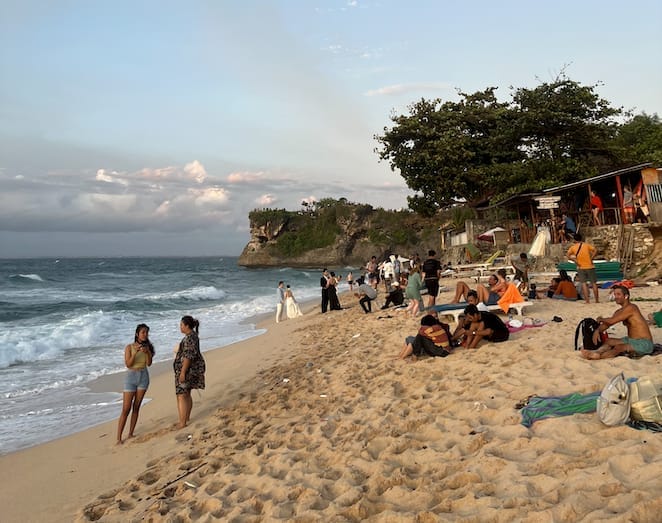
By mid-morning the beach is quiet. The seafood warung staff begin setting up their plastic tables and lanterns in the sand, arranging displays of fresh catch on ice. A few local families walk along the waterline. The water is flat, greenish-blue, and genuinely swimmable, unlike the shore break conditions at Kuta. The bay is wide enough that even at peak season it rarely feels crowded. This is Jimbaran's selling point in clear daylight: a beach that looks and behaves more like a beach than an event.
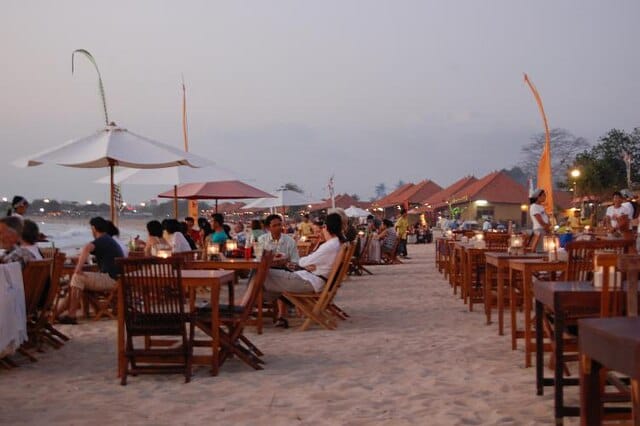
Sunset transforms everything. From around 5pm onward, the central beach section fills with couples and groups settling into plastic chairs facing the water, ordering seafood priced by weight, cold Bintang beers arriving in buckets of ice. The light turns orange and gold over the sea, planes from Ngurah Rai bank south overhead in a steady rhythm, and the smell of charcoal and grilled fish drifts down the sand. The atmosphere is genuinely romantic by Balinese standards without being manufactured. After dark, the strip stays lit and lively until around 10pm, then winds down quickly. Jimbaran is not a nightlife destination.
ℹ️ Good to know
The aircraft on approach to Ngurah Rai fly low and frequently over Jimbaran Bay, especially in the early evening. For most visitors this is a quirky backdrop to the sunset. For light sleepers staying in hotels directly under the flight path, it is worth researching your hotel's position relative to the runway before booking.
What to See & Do
The primary activity in Jimbaran is the seafood beach dinner, which is not a single restaurant but a collection of competing warungs that together form a long stretch of open-air dining on the sand. The three main clusters are at Kedonganan in the north, the central bay area near the main road access, and the southern end closer to the luxury resorts. Each cluster has slightly different pricing and atmosphere, with the northern Kedonganan section being the most local in character and the southern section catering more to resort guests.
The Kedonganan fish market itself is worth visiting independently of dinner, ideally early morning if you are an early riser. The market sells fresh catch directly to the public and is one of the largest fish markets in Bali, supplying restaurants across the island's south. Even if you have no intention of buying anything, walking through gives you a sense of the scale of the local fishing operation and is entirely accessible to visitors.
Jimbaran Bay is calm enough for swimming through most of the year. The beach shelves gently, there is rarely a strong current in the central section, and the absence of surf schools and board rentals means the water is not crowded with beginners. There are no major temples or cultural sites within Jimbaran itself, but the neighborhood serves well as a base for day trips to Uluwatu Temple on the cliff edge of the Bukit Peninsula, about 20 minutes south by road.
If you are planning your time in the south, reading up on the best months to visit Bali will help you understand when the bay is at its calmest and when the rainy season might affect beach dining. The dry season months from May to September are when Jimbaran operates at its best.
Sunrise or early morning walk along the full length of Jimbaran beach
Kedonganan fish market visit before 7am
Swimming in the calm central bay throughout the day
Sunset seafood dinner on the sand with fresh grilled fish chosen from the display
Day trip to Uluwatu Temple and Kecak fire dance performance in the late afternoon
Spa treatments at the luxury resort hotels, some of which open facilities to non-guests
Eating & Drinking
The seafood warungs are the reason most people come to Jimbaran, and the formula is straightforward: you choose your fish, prawns, squid, or crab from the ice display at the front, it gets grilled over coconut-husk charcoal, and it arrives at your table with steamed rice, plecing kangkung (water spinach in chili dressing), grilled corn, and a selection of Balinese sambal. Pricing is by weight, and the cost varies depending on which section of the beach you eat in and whether you are eating at a local warung or one of the more tourist-oriented operations. Budget roughly 150,000 to 400,000 IDR per person depending on how much seafood you order.
The quality difference between the warung clusters is real but not dramatic. The northern Kedonganan section generally has lower prices, a more local crowd, and fish that was quite literally unloaded from boats at the same dock a few hours earlier. The central section has more English-speaking staff and better sunset views from the sand. The southern cluster near the resort hotels caters heavily to guests who walk down from the Five-star properties and prices reflect that.
Beyond the beach, the town center inland has a modest selection of warungs serving Balinese and Indonesian standards for local prices. If you are staying in Jimbaran for more than two or three nights, you will want to explore this inland strip for the kind of nasi campur, soto, and mie goreng that costs a fraction of beach dining. There are also a few minimarts and a traditional market near the central crossroads that opens in the morning.
Jimbaran has almost no bar scene in the way that Seminyak or Canggu does. A few beachfront warungs serve cold beer late into the evening, and the resort hotels have their own cocktail bars, but anyone expecting nightlife or a social bar crawl will find Jimbaran a poor match. The neighborhood powers down relatively early and its after-dark appeal is specifically about sitting on a beach with cold drinks and good fish, not clubs or live music venues.
💡 Local tip
Arrive at the seafood warungs between 5pm and 5:30pm to secure a good table before peak sunset hour. By 6:30pm the central beach section can fill up, and the most desirable waterline tables are gone. Many warungs accept reservations via WhatsApp, which is worth doing for larger groups.
Getting There & Around
Jimbaran is one of the easiest neighborhoods in Bali to reach from the airport. Ngurah Rai International Airport is roughly 8 kilometers north of the seafood beach strip, and a metered taxi or ride-hailing app journey takes 15 to 25 minutes depending on traffic. This proximity makes Jimbaran a genuinely practical first-night and last-night option for travelers who want to minimize transfer stress.
Within Jimbaran, getting around on foot is feasible if you are staying near the beach strip. The distance from the northern Kedonganan market to the southern resort headland is about 3.5 kilometers along the beach, which is a manageable walk at any pace in the morning or evening. In the heat of midday, most people use motorbike taxis or rent a scooter. Scooter rental is available near the town center and costs roughly 70,000 to 140,000 IDR per day.
For day trips to Uluwatu, Nusa Dua, or Seminyak, ride-hailing apps like Gojek and Grab work reliably in Jimbaran. Conventional taxis are available outside the main resort hotels. There is no useful local bus service for tourists. If you are planning to explore the Bukit Peninsula independently, renting a scooter for a full day gives you the most flexibility and costs about the same as two short taxi rides.
Jimbaran's location also makes it a convenient base for exploring other parts of southern Bali. Canggu is roughly 35 to 45 minutes north by road, and the inland cultural hub of Ubud is about 90 minutes away through traffic.
⚠️ What to skip
Traffic on the main road connecting Jimbaran to Kuta and the airport can be severe between 4pm and 7pm on weekdays and at any time during peak tourist season. If you have an early morning flight and are staying in Jimbaran, leave significantly more buffer time than Google Maps suggests. Confirm with your hotel the evening before departure.
Where to Stay
Jimbaran has one of the most polarized accommodation markets in Bali: it is either very expensive or quite modest, with limited in between. The luxury end is anchored by internationally recognized resort brands concentrated on the southern headland and along the beachfront, offering large grounds, multiple pools, private beach sections, and full resort facilities. These properties are among the finest in Bali and genuinely justify the price for travelers who will use them properly.
Away from the beachfront, the town center and inland areas have guesthouses and small hotels at significantly lower price points, generally targeting independent travelers who want proximity to the seafood strip without paying resort rates. These options are serviceable but basic, and the trade-off is that you will be walking or taking a scooter to the beach rather than stepping directly onto it.
Jimbaran is best suited to couples traveling for a relaxed beach holiday, families who want calm swimming water and manageable logistics, and anyone using it as a buffer zone around airport arrival and departure. It is a poor fit for solo travelers looking for a social scene, budget backpackers, or anyone whose primary goal is nightlife. For that profile, the stretch from Kuta through to Seminyak and on to Canggu offers far more.
Honest Assessment: Who Should Stay Here
Jimbaran earns its reputation as one of Bali's most pleasant places to spend a few nights without any particular agenda. The beach is genuinely beautiful, the seafood dinner is a real experience rather than a tourist contrivance, and the quieter pace is a relief after the noise and congestion of Kuta. But it would be misleading to present it as a neighborhood with layers of exploration. There is one main reason people come here, and that reason is excellent. Beyond it, the neighborhood asks you to be content with quiet.
The airport proximity cuts both ways. It makes logistics simple but also means the neighborhood sits in an active flight path, and the industrial zone surrounding the airport creates a transition that is less than picturesque on the northern approach. Travelers whose idea of Bali is ricefields and temples will find Jimbaran disappointing unless they are willing to drive 20 minutes in either direction. As a base for exploring the Bukit Peninsula's dramatic clifftop scenery and beaches, however, it works very well.
TL;DR
Jimbaran Bay is Bali's premier destination for fresh seafood grilled on the beach at sunset, and the experience delivers on its reputation when you choose the right warung cluster.
The neighborhood is ideally located between the airport and the Bukit Peninsula, making it a logical base for both resort-style relaxation and day trips to Uluwatu.
Accommodation is polarized between genuine luxury resorts and basic guesthouses, with little in the mid-range tier.
Jimbaran suits couples, families, and travelers who want a calm beach with swimmable water and good food rather than nightlife or cultural immersion.
Those looking for a social scene, budget options with amenities, or deep neighborhood character will find more value in Canggu, Seminyak, or Ubud.
Bali's weather, crowds, and costs vary dramatically throughout the year. This guide breaks down every month so you can choose the right time based on your priorities, not just the travel brochure version.
From ancient sea temples and volcano sunrise treks to hidden beaches and Nusa Penida's dramatic cliffs, this guide covers 20 of the best things to do in Bali with a deep dive on each, honest opinions and planning advice.
Choosing where to stay in Bali can make or break your trip. From the surf-soaked lanes of Canggu to the rice-field serenity of Ubud and the polished resorts of Nusa Dua, this guide cuts through the noise and matches every travel style to the right neighborhood.