Pura Luhur Uluwatu: Bali's Sacred Cliff Temple Above the Ocean
Pura Luhur Uluwatu sits on a sheer limestone cliff 70 meters above the Indian Ocean on Bali's Bukit Peninsula. One of the island's six directional temples, it combines genuine spiritual weight with some of the most cinematic coastal scenery in Southeast Asia. The Kecak fire dance performed at sunset here is among Bali's most compelling cultural experiences.
Quick Facts
- Location
- Pecatu, Kuta sub-district, Badung Regency
- Getting There
- No public transit. Hire a driver or rent a scooter.
- Time Needed
- 1.5 to 3 hours — longer if you stay for the Kecak dance at sunset
- Cost
- Adult: IDR 50,000 - Child: IDR 30,000 (Foreign Visitor). Parking and Kecak dance tickets extra.
- Best for
- Sunset seekers, culture travelers, architecture enthusiasts, photographers
- Official website
- uluwatutemple.id
What Pura Luhur Uluwatu Actually Is
Pura Luhur Uluwatu is not a postcard backdrop with a temple tacked on. It is one of Bali's Sad Kahyangan Jagat, the six directional temples believed to spiritually protect the island. The complex guards the southwestern point of Bali and is dedicated to the spirits of the sea. Its origins are traditionally attributed to the 11th-century Javanese sage Mpu Kuturan, with later contributions credited to the wandering priest Dang Hyang Nirartha in the 16th century. That layered history gives the site a weight that purely scenic clifftop viewpoints lack.
The temple structures themselves are built in the black coral stone characteristic of the Bukit Peninsula. The split gate, or candi bentar, and the multi-tiered meru shrines are draped in black-and-white poleng cloth, a Balinese symbol of cosmic balance. Non-Hindu visitors are not permitted to enter the innermost sanctuary, but the outer courtyards and the cliff-edge pathways offer plenty of access and extraordinary views.
ℹ️ Good to know
Dress code is strictly enforced: covered shoulders and a sarong below the waist are required. Sarong wraps are loaned at the entrance, but wearing your own lightweight sarong avoids the queue. Women menstruating are respectfully asked not to enter the temple inner sanctums, per Balinese Hindu custom.
The Cliff Path: What You See When You Walk It
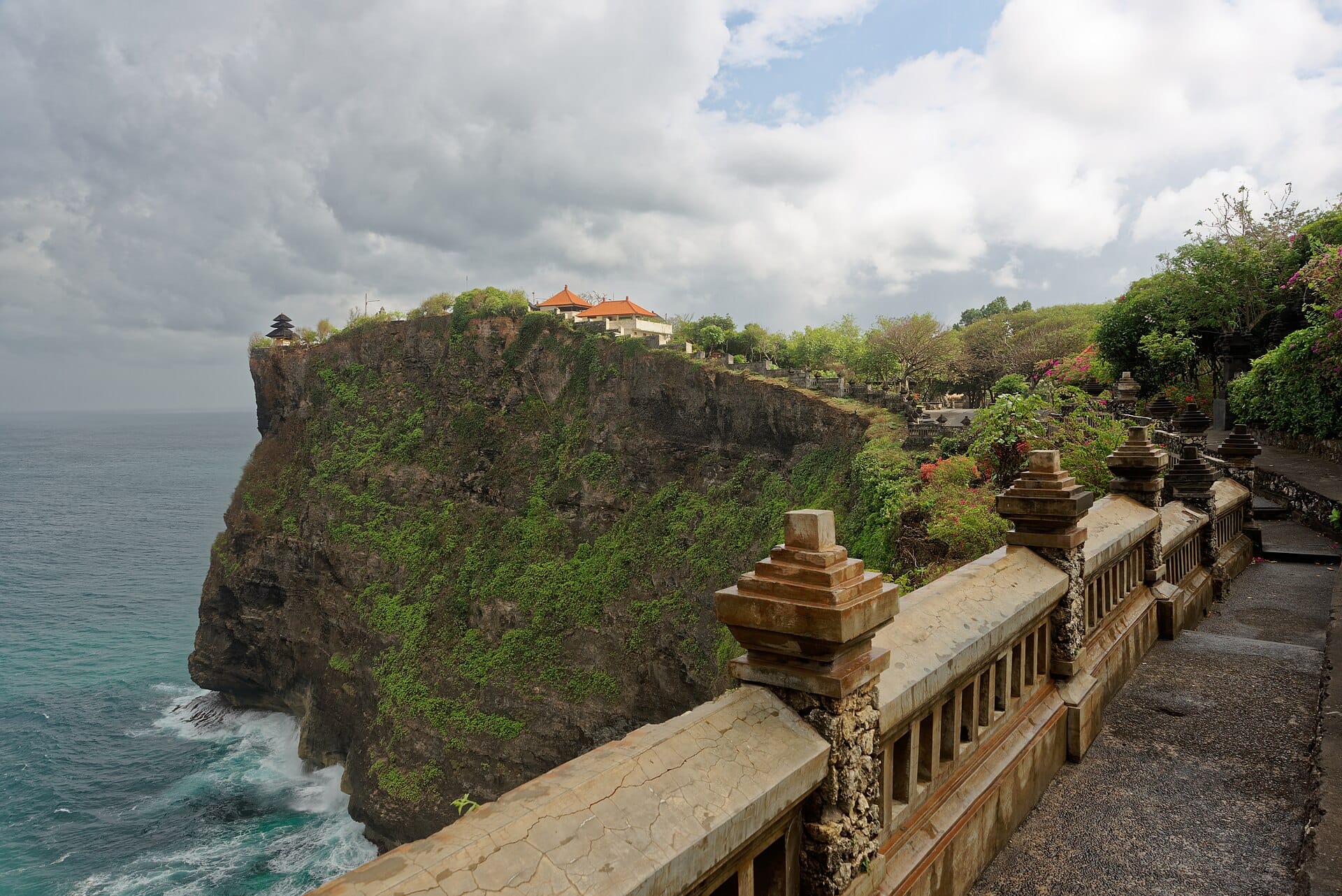
From the entrance, a wide stone path curves around the cliff edge, flanked by frangipani trees and low stone walls. The Indian Ocean sits directly below, 70 meters down, crashing against the base of the limestone. On a clear day, the horizon is unbroken. The color of the water shifts from deep indigo offshore to a lighter turquoise where the reef shallows, and the sound of the surf carries all the way up, a constant low roar beneath the wind.
The path is manageable for most visitors with moderate mobility, though sections are uneven and there are no handrails close to the edge. Surfaces can be slippery in the wet season, particularly from November through March. Flat, closed-toe footwear is a smarter choice than sandals here. The western section of the path gives the clearest view of the main temple pagodas silhouetted against the sky, and this is where most photographers position themselves in the hour before sunset.
Long-tailed macaques are a fixed feature of the cliff walk. They are bold, habituated to tourists, and notorious for snatching sunglasses, hats, cameras, and water bottles. This is not an overblown warning: they move fast and target shiny or dangling objects without hesitation. Keep bags zipped and avoid eating in the open areas.
⚠️ What to skip
Monkeys at Uluwatu are more aggressive than at most Balinese temples. Secure all loose items before entering the grounds. Temple staff may intervene in case of need, but recovery of stolen items is not guaranteed.
Tickets & tours
Live prices and dates from our booking partner. If you book, we may earn a commission at no extra cost to you.
Sunset at Uluwatu Temple with spa option
From 38 €Instant confirmationFree cancellationSunset at Uluwatu Temple with optional spa and Kecak dance
From 38 €Instant confirmationFree cancellationPrivate day trip to Denpasar and Uluwatu temple with Kecak dance
From 16 €Instant confirmationFree cancellationBALI Private tour Tanah Lot,Uluwatu Temple Sunset & Kecak Dance
From 54 €Instant confirmationFree cancellation
Timing Your Visit: Morning, Afternoon, and the Sunset Hour
Uluwatu receives the bulk of its visitors in the two hours before sunset, typically between 4:30 PM and 7:00 PM. The light in this window is extraordinary, particularly in the dry season from April through October, when the sky clears and turns amber and pink as the sun drops toward the water. The tradeoff is genuine crowds: pathways fill, the amphitheater sells out, and finding a clear photography angle requires patience and early positioning.
Arriving in the morning, between 8:00 AM and 11:00 AM, is a fundamentally different experience. The temple is quieter, the light is softer and comes from the east, and the air carries a coolness that disappears entirely by midday. This is the time to observe the architecture without competing for space, to watch the ocean from the cliff edge in relative stillness, and to notice small details: the moss on the stone carvings, the offerings placed at the temple gates, the sound of the wind through the banyan trees.
Midday visits are the least rewarding. Heat on the open cliff path is intense, light is harsh and flat for photography, and the site is neither at its quietest nor its most atmospheric. If you plan to combine the temple with the Uluwatu area beaches below, a morning temple visit followed by an afternoon at Padang Padang or Bingin is a natural pairing.
The Kecak Fire Dance: Spectacle Rooted in Tradition
Every evening at sunset, an open-air amphitheater built into the cliff edge at Uluwatu hosts a Kecak dance performance. The Kecak, sometimes called the Monkey Dance, depicts the Hindu epic Ramayana, with a chorus of up to 50 bare-chested men providing the percussion by chanting a rhythmic interlocking "cak" vocal pattern in place of instruments. No gamelan orchestra is used. The sound is entirely human, layered and hypnotic.
The performance lasts approximately one hour. The backdrop is the cliff, the temple, and the ocean, and if the timing aligns, the sun sets directly behind the performers during the final act. Seats are tiered stone steps curving around a circular stage. There is no bad seat in the amphitheater, but the upper tiers offer a wider view of the ocean behind the dancers. Tickets are purchased at a separate counter near the amphitheater entrance and should be secured well before showtime, as performances sell out regularly in peak season.
The dance form itself was developed in the 1930s in collaboration with German artist and musician Walter Spies, drawing on older Sanghyang trance rituals. It has since become central to Balinese performing arts, and the version staged at Uluwatu is one of the most atmospheric settings for it anywhere on the island. It is not a cynical tourist attraction: the performers are trained dancers and the ritual context is genuine.
💡 Local tip
Arrive at the amphitheater at least 30 minutes before the performance starts to get a seat on the upper tiers with the clearest ocean view. Later arrivals end up in lower central seats with obstructed sightlines during the fire sequence.
Getting There and Practical Logistics
Uluwatu sits at the southern tip of the Bukit Peninsula, about 25 kilometers from Kuta and 30 kilometers from Seminyak. There is no public bus service. The most practical options are hiring a private driver for a half-day or full-day trip, which also allows stops at other Bukit points of interest, or renting a scooter if you are comfortable riding one on Balinese roads. Scooter parking at the temple is available and inexpensive.
Ride-hailing apps like Grab and Gojek operate in Bali but can be refused by local drivers near tourist sites. Arrange a return pickup in advance or use a driver who waits. Combining Uluwatu with a stop at nearby coastal points is less logical than it sounds given Bali's road layout — give the temple its own dedicated afternoon slot rather than squeezing it into a day of scattered stops.
A small warung strip outside the main temple entrance sells food and drinks, and there is a larger restaurant area with cliff views a short walk away. Dining here at sunset, after the Kecak performance, is a reasonable way to decompress before the drive back — prices are tourist-level but not extreme, and the view remains excellent past dusk.
Who Will Love This and Who Should Think Twice
Pura Luhur Uluwatu rewards visitors who approach it with patience and some cultural curiosity. If you read a little about the Ramayana before attending the Kecak dance, or about Balinese Hinduism before walking through the temple gates, the experience deepens considerably.
Visitors who struggle with heat, uneven terrain, or large crowds at sunset should consider a morning visit and skip the Kecak performance. Travelers with a genuine phobia of monkeys will find the cliff path stressful rather than enjoyable, because the macaques are everywhere and cannot be avoided. Anyone expecting a tranquil spiritual retreat in the evening hours will be disappointed by the volume of visitors. For a quieter temple experience in Bali, Tirta Empul Temple or Goa Gajah offer more contemplative atmospheres.
Children generally enjoy the monkeys and the Kecak performance, though the stone seating in the amphitheater is hard and a one-hour performance can test younger attention spans. The cliff-edge pathways have no barriers in places, so close supervision is needed with small children.
Insider Tips
- Position yourself on the western cliff path about 20 minutes before the Kecak performance ends. The amphitheater empties in one direction and the path back to the car park floods with people. Heading to the cliff overlook at this moment gives you the temple silhouette against the last light with far fewer people around.
- The sarong wraps loaned at the entrance are one-size, loosely tied, and tend to slip. Wearing your own lightweight sarong or a sarong-style skirt means you can focus on the temple rather than adjusting your clothing every few minutes.
- If you hire a driver for the evening, confirm they are willing to wait through the Kecak performance — some drivers expect a flat sunset-visit rate that ends at dusk. The drive back through Jimbaran for a seafood dinner on the beach is a natural conclusion to the evening.
- The inner temple is an active place of worship. On ceremonially significant days, the grounds fill with worshippers in white and yellow dress. If your visit coincides with a ceremony, exercise extra discretion with cameras and give significant space to the processions.
- Photography of the temple is best from the northern cliff path in the late afternoon, when the pagodas are lit from the side rather than silhouetted. Front-lit temple shots are more detailed than the dramatic but detail-free silhouette images most visitors go home with.
Who Is Pura Luhur Uluwatu For?
- Sunset and ocean view seekers who want more than a beach cliff
- Culture travelers interested in Balinese Hinduism and performing arts
- Photographers looking for iconic architecture with a coastal backdrop
- First-time Bali visitors building a classic Bukit Peninsula itinerary
- Couples looking for a dramatic and atmospheric evening out
Nearby Attractions
Other things to see while in Uluwatu:
- Kecak Fire Dance
Every evening at Uluwatu Temple, dozens of bare-chested men chant in hypnotic unison as the Ramayana epic unfolds against a backdrop of cliffs and open ocean. The Kecak Fire Dance is one of Bali's most photographed events, and when conditions align, it genuinely earns that reputation.
- Padang Padang Beach
Padang Padang Beach is a compact, cliff-framed cove on Bali's Bukit Peninsula with a surf reputation that reaches well beyond Indonesia. Accessible through a narrow rock passage, it rewards visitors with turquoise water and striking scenery — but it gets crowded, and knowing when to arrive makes a significant difference.
Planning a trip? Discover personalized activities with the Nomado app.