Kecak Fire Dance at Uluwatu: Bali's Most Dramatic Sunset Performance
Every evening at Uluwatu Temple, dozens of bare-chested men chant in hypnotic unison as the Ramayana epic unfolds against a backdrop of cliffs and open ocean. The Kecak Fire Dance is one of Bali's most photographed events, and when conditions align, it genuinely earns that reputation.
Quick Facts
- Location
- Pura Luhur Uluwatu, Pecatu, Kuta sub-district, Badung Regency
- Getting There
- Hire a driver or use a ride-hailing app (Gojek/Grab).
- Time Needed
- 2.5 to 3.5 hours total: explore the temple cliffs before the 6 PM show, which runs approximately 60–70 minutes.
- Cost
- IDR 150,000 Adult / IDR 75,000 Child. Sarong rental included. Separate temple entry fee applies.
- Best for
- Cultural immersion, sunset photography, couples, first-time Bali visitors
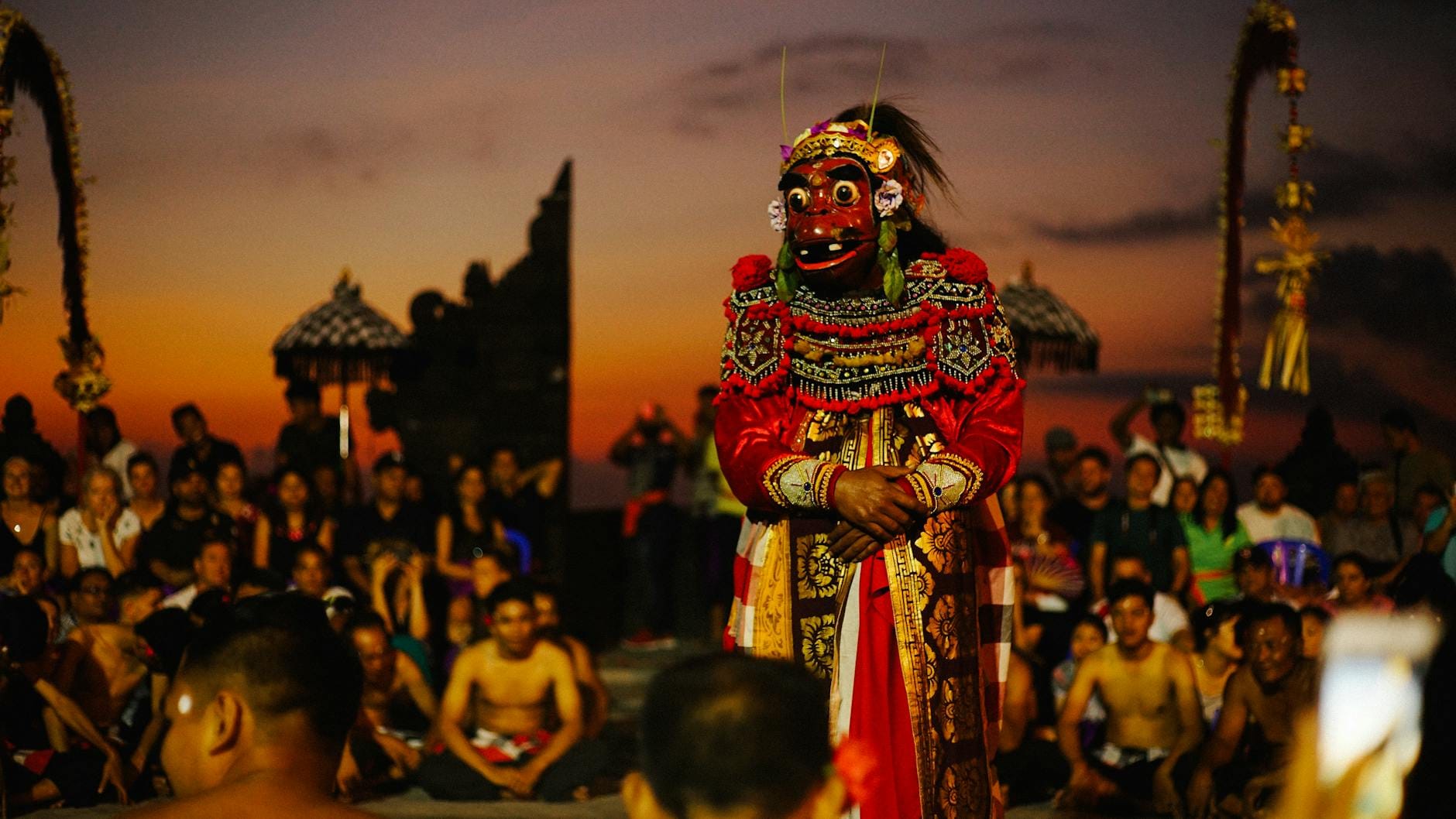
What the Kecak Fire Dance Actually Is
The Kecak Fire Dance is a Balinese performance art rooted in the Hindu epic Ramayana, dramatizing the story of Prince Rama, his wife Sita, and the monkey god Hanuman. What distinguishes it from other traditional dances is the absence of any musical instruments. The entire soundscape is created by a choir of 50 to 150 men seated in concentric circles, producing a rhythmic, interlocking chant of 'cak-cak-cak' that rises and falls like ocean waves. This vocal technique, called kecak, gives the dance its name.
The form was developed in the 1930s by Balinese artist Wayan Limbak and German painter Walter Spies, who adapted a trance ritual called Sanghyang into a theatrical format for outside audiences. This origin story is worth knowing: Kecak as performed today is a hybrid creation, not an ancient unbroken tradition. That doesn't diminish the experience, but it adds honest context. What you witness is a living art form that has evolved with Bali's tourism culture while retaining genuine ceremonial energy.
ℹ️ Good to know
Performances at Uluwatu begin at 6:00 PM daily and typically end by 7:15–7:30 PM. Arrive by 5:00 PM to secure a good seat and have time to explore the cliff paths beforehand.
The Setting: Why Uluwatu Changes Everything
Kecak performances happen across Bali, including in Ubud and other venues, but the version staged at Pura Luhur Uluwatu is widely considered the most dramatic. The open-air amphitheater sits on a limestone cliff roughly 70 meters above the Indian Ocean, and the stage itself has no backdrop except sky, sea, and the silhouette of the temple gate. As the performance unfolds, the sun descends directly behind the performers, casting the scene in deep orange and copper light before disappearing into the water.
The cliff setting isn't just visually striking. The wind comes off the ocean in steady gusts, carrying salt and the smell of the sea into the performance space. Swallows nest in the cliff face and wheel overhead during the performance. The Pura Luhur Uluwatu temple complex itself is one of Bali's six directional temples, believed to protect the island from evil spirits entering from the sea. Attending the Kecak here is not just watching a show in a scenic location; the site carries genuine spiritual weight for Balinese Hindus.
Be aware that sunset timing shifts throughout the year. In the dry season months of June through September, the sun sets squarely behind the stage, producing the postcard effect. In the wet season, cloud cover sometimes obscures the sunset entirely, and occasional drizzle is possible. The performance continues regardless of weather, but the visual impact varies considerably.
Tickets & tours
Live prices and dates from our booking partner. If you book, we may earn a commission at no extra cost to you.
Arriving Early: The Cliffs Before the Show
Arriving at 5:00 PM gives you a full hour before the performance begins. Use this time to walk the cliff-edge paths that wind south from the main temple complex. The views here are some of the most expansive in southern Bali, looking out across open ocean with no land visible on the horizon. If you are also planning to spend time in the Uluwatu area, the coastal warung below the cliffs and the surf breaks at Uluwatu Beach are worth building into your day before the evening performance.
Monkeys are present throughout the temple grounds and are a well-documented nuisance. They target sunglasses, hats, phones, and anything shiny or dangling. Temple staff intervene and will try to recover stolen items, usually in exchange for a small offering of bananas or peanuts. Keep bags zipped, hold your phone close, and remove sunglasses before entering the monkey zone. This is not a mild suggestion. Thefts happen all the time.
⚠️ What to skip
Monkeys at Uluwatu are bold and fast. Store sunglasses in a bag or pocket before entering the temple grounds. Secure earrings and avoid dangling lanyards. Do not feed them or make eye contact.
Inside the Performance: What Unfolds on Stage
The amphitheater seats fill up fast. Rows closest to the stage offer an immersive view of the performers, but the chanting choir wraps in a full circle, so central seating gives you the best perspective on the formation. The outer rows are elevated, which actually benefits photographers looking to capture the full circle of men with the sunset behind it. By 5:30 PM, the front and center sections are usually full.
The performance moves through several acts: Rama and Sita's encounter in the forest, the golden deer deception, Sita's abduction by the demon king Rahwana, Hanuman's arrival bearing Rama's ring, and the climactic fire scene where Hanuman escapes from flames. The fire segment is the finale many visitors wait for. A performer playing Hanuman moves through a field of burning coconut husks lit on stage, kicking and scattering embers in practiced choreography. It is genuinely striking, not a gimmick.
The chanting men wear only black-and-white checkered cloth (poleng) around their waists. Their movements are coordinated through years of practice: arms raised in unison, torsos swaying, voices rising and falling in complex interlocking patterns. No conductor directs the choir. The coordination emerges from collective training and muscle memory. Watching this aspect alone, independent of the dramatic story being told, is worth the admission.
Practical Logistics and Getting There
Uluwatu sits at the southern tip of the Bukit Peninsula, roughly 30 kilometers south of central Kuta. There is no direct public transport. Most visitors arrange a private driver for the evening, which typically costs IDR 300,000 to 500,000 for a round-trip from Seminyak or Kuta, including driver waiting time. Ride-hailing apps work for the outbound journey but can be slow to find a driver heading back to central Bali after the show, since many cars avoid the area post-performance.
Tickets for the Kecak performance are sold at the venue entrance. The performance fee is IDR 150,000 per adult and IDR 75,000 per child, separate from the general temple admission fee. A sarong and sash are required to enter the temple complex; rental is included in the entry fee for those who do not bring their own. Shoulders should be covered, or a sarong can be worn over bare shoulders.
💡 Local tip
Book a driver who can wait for you during the performance. Arrange the return journey before you enter the grounds. After the show ends, traffic out of Uluwatu can add 20–30 minutes to an otherwise straightforward ride.
Who Will Love This and Who Should Consider Skipping
The Kecak at Uluwatu is one of those rare experiences in Bali that consistently delivers, provided expectations are calibrated correctly. First-time visitors with an interest in culture, movement, and storytelling tend to find it genuinely moving. Couples visiting at dusk, especially during peak dry-season months when the sunset is most reliable, often describe it as a highlight of their entire trip.
Travelers who are primarily seeking beach time or nightlife in Canggu or Seminyak may find the two to three hour investment, including travel, harder to justify. Young children sometimes struggle with the 70-minute seated performance, particularly if they cannot follow the narrative. If your group is easily fatigued or the weather forecast shows heavy cloud cover, it is worth knowing that the performance itself, without the sunset backdrop, is a significantly reduced experience visually, though the chanting remains powerful regardless.
Visitors with limited mobility should note that the path from the parking area to the temple and amphitheater involves uneven stone surfaces and some steps. The amphitheater seating is tiered stone benches without backs. Bringing a thin cushion or folded sarong to sit on makes the experience considerably more comfortable.
Photography and Practical Tips for Getting the Best Shot
The combination of low light, fast movement, and a backlit sunset makes the Kecak genuinely difficult to photograph on a smartphone without some adjustment. Switch to night or pro mode if your phone supports it, or increase ISO manually. Shoot toward the performers with the sunset behind them for the silhouette effect that defines this venue. Wide-angle shots work well from elevated back rows; tighter portraits of individual performers require front placement.
Flash photography is generally discouraged and largely ineffective at the distances involved. The fire segment offers the best natural light of the evening for phone cameras, since the burning coconut husks provide a warm, directional source. At that moment, the scene practically photographs itself.
Insider Tips
- Sit on the right side of the amphitheater (from the stage's perspective, the left as you face it) for the best angle of the sun descending behind the temple gate and performers simultaneously.
- Wear a light layer or bring a scarf. The clifftop wind picks up significantly after 6:30 PM and temperatures drop faster than expected, especially in June and July.
- If you want a quieter experience of the temple itself, visit in the morning on a separate day. The evening performance crowd is large and the atmosphere is almost entirely tourism-oriented by 5 PM.
- The warung stalls just outside the temple entrance sell decent cold drinks and snacks. Prices are inflated but reasonable by tourist-site standards. Buy before entering, as nothing is sold inside the amphitheater.
- Confirm your return transport before the show starts, not after. Drivers tend to drift to shaded areas and can be hard to locate in the post-performance crowd.
Who Is Kecak Fire Dance For?
- First-time visitors to Bali seeking a culturally grounded, visually spectacular experience
- Couples looking for a memorable sunset activity beyond beach bars
- Photography enthusiasts interested in performance art, silhouette conditions, and natural light
- Travelers with a broader interest in Hindu mythology and Balinese performing arts
- Anyone combining an evening in Uluwatu with a full-day Bukit Peninsula itinerary
Nearby Attractions
Other things to see while in Uluwatu:
- Pura Luhur Uluwatu
Pura Luhur Uluwatu sits on a sheer limestone cliff 70 meters above the Indian Ocean on Bali's Bukit Peninsula. One of the island's six directional temples, it combines genuine spiritual weight with some of the most cinematic coastal scenery in Southeast Asia. The Kecak fire dance performed at sunset here is among Bali's most compelling cultural experiences.
- Padang Padang Beach
Padang Padang Beach is a compact, cliff-framed cove on Bali's Bukit Peninsula with a surf reputation that reaches well beyond Indonesia. Accessible through a narrow rock passage, it rewards visitors with turquoise water and striking scenery — but it gets crowded, and knowing when to arrive makes a significant difference.
Planning a trip? Discover personalized activities with the Nomado app.