Flights to Antalya: Airlines, Airports & Tips for Getting There
Antalya Airport (AYT) is one of Europe's busiest summer gateways. This guide covers which airlines fly there, how the terminals work, how to get into the city, and how to avoid the most common arrival headaches.
Plan and book this trip
Tools from our partner Travelpayouts help you compare flights and hotels. If you book through them, we may earn a commission at no extra cost to you.
Flights
Hotels map
TL;DR
- Antalya Airport (IATA: AYT) has three terminals — T1 and T2 handle international flights, T3 handles domestic routes.
- Major European carriers including British Airways, Jet2, and TUI fly direct to AYT, mostly from April through October.
- The airport sits about 13 km east of the city centre — taxis take 20-30 minutes; public buses (lines 600, 800, LC07) are cheaper and run every 30-60 minutes to the centre, Lara Beach, and Konyaaltı.
- During peak summer (July-August), plan to arrive at the departure terminal at least 3 hours before your flight — queues are serious.
- Spring and autumn flights are significantly cheaper and avoid the crowds — see our best time to visit Antalya guide for the full seasonal breakdown.
Antalya Airport (AYT): What You Need to Know Before You Land
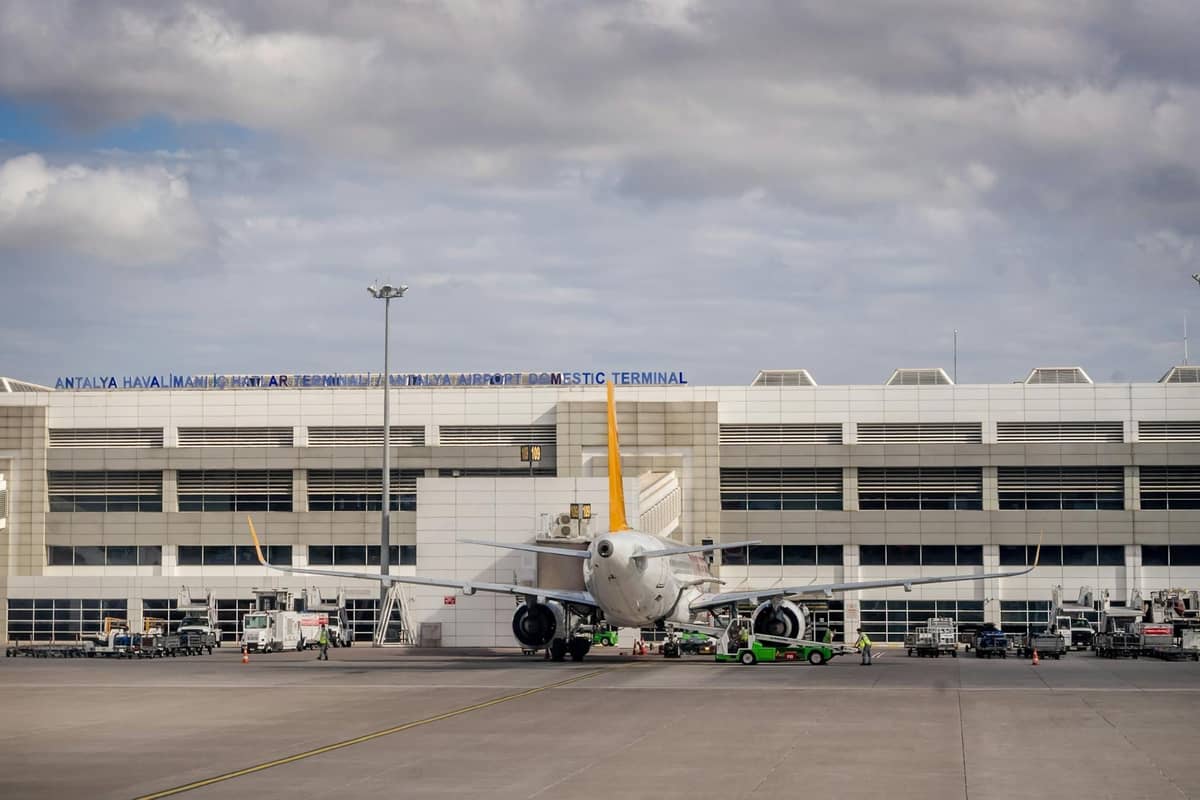
Antalya Airport (AYT) is the main entry point for the Turkish Riviera and one of the top ten busiest airports in Europe by summer passenger volume. The airport handled a record 39.2 million passengers in 2025, a useful benchmark for how busy the route has become. For context, AYT handles more summer charter traffic than most regional airports on the continent, which explains both its efficiency on arrival and its chaos on departure during July and August.
The airport has three terminals. Terminal 1 (the older building) and Terminal 2 (the larger, more modern structure) both handle international flights. Terminal 3 is dedicated to domestic routes, including connections to Istanbul (Sabiha Gökçen and Istanbul Airport), Ankara, and Izmir. All three terminals are connected by free shuttle buses and walkways, so if you land at T2 but need to pick up a rental car or exit via a different zone, navigation is straightforward. Signage is in both Turkish and English throughout.
ℹ️ Good to know
Terminal 2 is the primary international hub. Most European charter and scheduled flights arrive here. If you're flying with a package holiday operator like TUI or Jet2, T2 is almost certainly your terminal. Always confirm at booking.
Arrivals at AYT are generally smooth. Passport control for non-EU nationals typically takes 10-25 minutes outside peak hours. The baggage claim and customs exit are well-organised, and the car rental desks, taxi ranks, and bus stops are all within a short walk of arrivals. The official airport website at antalya-airport.aero publishes real-time arrival and departure boards, plus visa requirement information — worth bookmarking before you travel.
Which Airlines Fly to Antalya and From Where
Flights to Antalya operate on a strongly seasonal schedule. The bulk of international services run from late April through early November, with the summer peak (mid-June to mid-September) seeing near-daily frequency from dozens of European cities. Outside this window, scheduled flight options thin out considerably, though Turkish Airlines operates year-round connections via Istanbul, and a handful of low-cost carriers maintain winter services on high-demand routes.
- British Airways Operates direct flights from London Heathrow to AYT in summer. Typically runs April through October with good frequency during peak weeks.
- Jet2 One of the most popular options for UK travellers, flying from multiple regional UK airports including Manchester, Leeds Bradford, Edinburgh, and Birmingham. Strong on-time record and competitive on luggage allowances.
- TUI Airways Primarily serves package holiday customers from UK and German-speaking markets. Flights are often bundled with hotel packages rather than sold as standalone seats.
- Turkish Airlines The best option for year-round travel, connecting Antalya via Istanbul Atatürk (IST) and Sabiha Gökçen (SAW). Useful for travellers from North America, Asia, or the Middle East who need a reliable hub connection.
- Pegasus Airlines Turkish low-cost carrier with strong domestic and European routes. Competitive fares from Germany, Netherlands, and various Turkish cities.
- Wizz Air / easyJet Both operate routes from Central and Eastern European cities and various UK airports. Fare sales can bring prices very low in shoulder season, but baggage fees add up quickly — read the small print.
💡 Local tip
For the cheapest standalone flights, search 4-8 weeks in advance for shoulder season (May, June, September, October). July and August prices spike sharply and availability narrows fast. If you're flexible on dates, Tuesday and Wednesday departures typically price lower than weekend flights.
Getting from Antalya Airport to the City and Resorts

The airport sits roughly 13 km east of Antalya city centre, which makes it close enough to reach by several methods without serious effort. Your best option depends on budget, group size, and where you're staying.
- Public Bus (Antalya Ulaşım) Lines 600, 800, and LC07 connect the airport to the city centre, Lara Beach, and Konyaaltı. Air-conditioned, frequent (every 30-60 minutes), and very affordable. Buy an Antalya Kart at the airport or pay with the card system onboard. Best option for solo travellers or couples on a budget.
- HAVAŞ Airport Shuttle Operates fixed-route shuttle services between the airport and key city points. More comfortable than the city bus and slightly faster. Check the HAVAŞ website for current departure times and stops, as the schedule shifts seasonally.
- Taxi Metered taxis from the official rank outside arrivals. Expect around 500-700 TRY to the city centre (prices change with fuel and exchange rates — treat this as a rough guide and confirm the meter is running). The journey takes 20-30 minutes in normal traffic, longer during summer rush hours.
- Private Transfer Pre-booked private transfers through licensed operators offer fixed prices, a name board at arrivals, and no negotiating. Worth the premium for families with luggage or late-night arrivals. Book through your hotel or a verified platform before you fly.
- Rental Car All major international rental companies (Hertz, Avis, Europcar, Sixt) have desks at the airport. Useful if you're planning day trips or staying outside the city. Traffic around the airport on summer evenings can be heavy — factor that in.
⚠️ What to skip
Avoid accepting rides from unlicensed drivers who approach you inside the arrivals hall. Use only the official taxi rank outside, or a pre-booked transfer service. Overcharging is the most common airport-related scam in Antalya — our guide to Antalya scams and safety covers this in detail.
If you're heading to resort areas outside the city, distances vary significantly. BelekLara is about 35 km east of the airport (30-40 minutes by car), making it one of the most convenient resort areas to reach. Side is further east at around 65 km. Kemer sits approximately 45 km to the west. Always factor in summer traffic when estimating journey times — the coastal roads can slow to a crawl in July and August.
Seasonal Patterns: When to Fly and What to Expect

Antalya's flight market is one of the most seasonally skewed in Europe. Summer is when everything converges: flights are expensive, fully booked, and the airport operates under serious pressure. Winter sees the opposite, with limited international options but dramatically lower prices and a more relaxed experience all around.
The sweet spots are May to early June and September to October. Temperatures are still warm enough for the beach (25-30°C), hotels drop their rates noticeably, and flights are easier to find at reasonable prices. These are also the best months to explore Kaleiçi, the old town, and visit ancient sites without the summer heat. Read the detailed breakdown in our Antalya in summer guide if you're committed to a July or August trip — it covers heat management, crowd strategy, and the events worth planning around.
One thing that catches travellers off guard: Antalya Airport's departure experience in peak season is genuinely difficult. Passport control and security queues at T2 can run 60-90 minutes during morning departure banks (typically 5am-9am and 3pm-7pm). The advice to arrive 3 hours before departure is not overcautious — it reflects real conditions. The airport has acknowledged this publicly and works to manage it, but the structural constraint of a charter-heavy airport during an 8-week peak is hard to solve completely.
✨ Pro tip
If departing in peak summer, check in online and travel with only cabin baggage if possible — it cuts 20-30 minutes from your airport experience. The shopping and dining options airside at T2 are decent, so arriving early is not a hardship once you're through security.
Visas, Entry Requirements, and Practical Arrival Details
Turkey operates an e-Visa system for many nationalities, while others are visa-exempt or need a different visa type. Requirements depend on your passport, so check the official Turkish government portal before travel rather than relying on airline summaries or third-party visa sites. If you do need an e-Visa, apply through evisa.gov.tr and avoid third-party websites charging inflated fees.
Your passport must be valid for the duration of your stay. Turkey does not apply the same 6-month passport validity requirement that some other destinations do, but your passport must not expire before your return date. Currency at the airport is Turkish Lira (TRY). There are ATMs at arrivals and exchange desks airside, but exchange rates at airport desks are typically worse than in the city. Withdraw a modest amount for immediate transport needs and exchange the rest in town.
- Visa rules depend on your passport — check evisa.gov.tr or official Turkish government guidance before departure
- Passport valid through your stay is the core requirement — double-check expiry dates
- Turkey Time (TRT) is UTC+3, with no daylight saving changes
- Electricity: Type C/F plugs, 230V, 50Hz — standard European adapters work fine
- Emergency number across Turkey is 112
Once You Land: First Steps in Antalya

After clearing customs, orient yourself quickly. The airport tourist information desk can help with maps and basic queries. If you haven't already sorted accommodation, our where to stay in Antalya guide breaks down every neighbourhood by traveller type and budget. For first-timers, Kaleiçi puts you in walking distance of history and restaurants; Lara or Konyaaltı suit beach-focused trips; Belek is the resort and golf corridor.
For most visitors, Antalya works best as a base with day trips rather than a point-to-point itinerary. The 3 days in Antalya itinerary gives a structured framework if you're working with limited time. If you want to push further, consider that day trips from Antalya reach everything from the ruins at Aspendos Theatre to the canyon at Köprülü Canyon without needing to move hotels.
FAQ
Which terminal does my flight arrive at in Antalya?
International flights use Terminal 1 or Terminal 2 (T2 is the larger, newer building and handles most European scheduled and charter flights). Domestic flights use Terminal 3. Check your booking confirmation or the airline's website — the terminal is usually listed on your boarding pass or itinerary. All terminals are connected by free shuttles.
How long does it take to get from Antalya Airport to the city centre?
Around 20-30 minutes by taxi or private transfer in normal traffic. The airport is about 13 km east of the city centre. Allow 40-50 minutes in peak summer evening traffic. Public buses take slightly longer due to stops but are reliable and air-conditioned.
Do I need a visa to fly to Antalya?
Most Western nationalities (US, UK, EU, Canada, Australia) require a Turkish e-Visa, which you apply for online before travel at evisa.gov.tr. Some nationalities are visa-exempt. Policies change — always verify the current requirement for your specific passport well before your trip.
When are flights to Antalya cheapest?
Shoulder season, specifically May, early June, and September-October, offers the best combination of affordable fares and good weather. Prices peak sharply in July and August when charter demand is at its highest. Winter flights (November-March) can be very cheap but direct routes are limited and the weather, while mild, is wetter.
How early should I arrive at Antalya Airport for departure?
3 hours before departure during peak summer (June-September), particularly for morning and late-afternoon departure banks. Outside peak season, 2 hours is usually sufficient. Security and passport control queues at Terminal 2 are the main bottleneck — the airport itself recommends arriving early, and traveller reports consistently confirm queues can run 60-90 minutes on busy days.