Aspendos Theater: The Roman Stage That Still Performs After 1,800 Years
Built between 161 and 169 CE, the Roman Theatre of Aspendos stands 40 km east of Antalya as one of the most complete ancient theaters on earth. Its 41 tiers, towering two-story stage wall, and exceptional acoustics draw both history enthusiasts and opera-goers every summer.
Quick Facts
- Location
- Serik district, 40 km east of Antalya city center, Antalya Province, Turkey
- Getting There
- Bus from Antalya's main otogar toward Serik, then local dolmuş or taxi; easiest by organized tour or rental car via D400 highway
- Time Needed
- 1.5 to 2.5 hours on site; allow extra time for the wider Aspendos archaeological area
- Cost
- Paid entry; Müze Kart accepted (verify current ticket prices on-site or at muze.gov.tr)
- Best for
- Ancient history lovers, architecture enthusiasts, photography, classical music fans during festival season
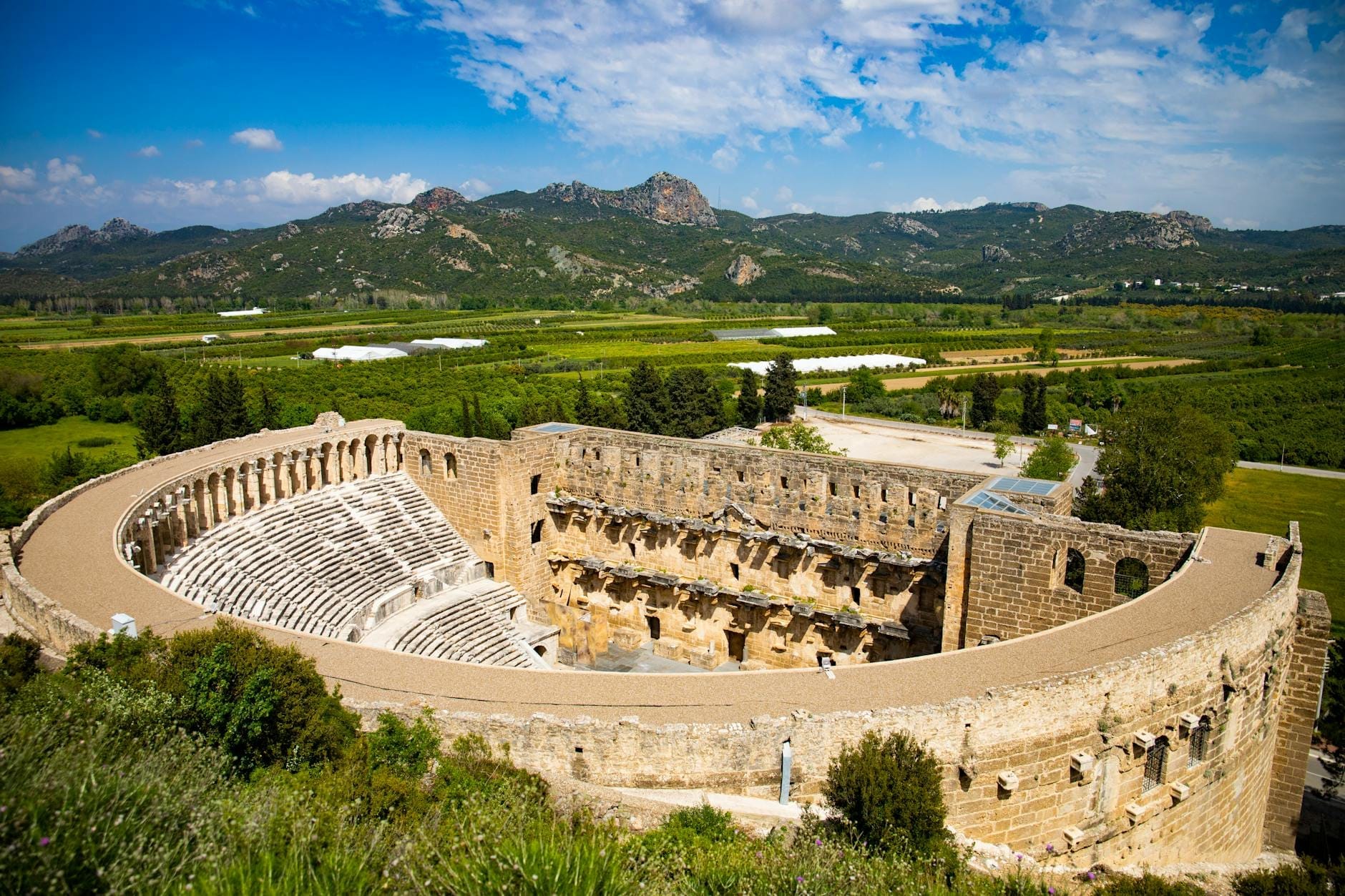
What You're Actually Looking At
The Roman Theatre of Aspendos, known in Turkish as Aspendos Tiyatrosu, is not a ruin in the conventional sense. When you walk through the vaulted entrance tunnels and step into the cavea for the first time, what stops you is completeness. The two-story stage building, the scaenae frons, still stands to its original height of roughly 22 meters. The 41 rows of seating, carved into and built upon a natural hillside, remain largely intact. Historians and architects often cite it among the best-preserved Roman theaters in the world, and standing inside, that claim is easy to believe.
The theater was built between 161 and 169 CE during the reign of Marcus Aurelius. Its architect, Zenon, was a local son of Aspendos, and he inscribed his name proudly on the structure. The diameter of 96 meters, and seating capacity estimates range from 7,000 to 15,000 depending on how densely the tiers were filled. The sheer scale of the place only registers when other visitors appear on the opposite side of the cavea and look tiny against the stone.
💡 Local tip
If you have a Müze Kart (Turkish museum card), it covers entry here. Pick one up if you plan to visit multiple sites around Antalya. It pays for itself quickly.
The Experience by Time of Day
Arriving early morning, around opening time, gives you the theater with minimal crowds and cool air. The stone seats absorb warmth slowly, and in the first hour you can sit almost anywhere in the cavea without another visitor in your frame. The light hits the stage wall at a low angle, throwing the relief carvings and blind arcades into sharp shadow, making it one of the better windows for photography.
By mid-morning, tour buses begin arriving from Antalya and the larger all-inclusive resorts around Belek and Side. The site is large enough that it never feels genuinely cramped, but the lower tiers and the stage level fill quickly with guided groups. If you want space to yourself at the orchestra level, aim to get there before 10 AM or wait until after 1 PM when the first wave of tours has moved on.
Midday in summer is brutal. The stone reflects heat aggressively, there is almost no shade inside the main cavea, and temperatures regularly exceed 35 degrees Celsius from June through August. Bring at least a liter of water per person beyond what you think you need. A hat is not optional. Midday is when the site feels most exposed, but it is also when the stage wall's colors shift to a deep ochre that photographs warmly.
⚠️ What to skip
Avoid visiting between 12 PM and 3 PM in July and August unless you are specifically heat-tolerant. The theater offers almost no natural shade, and the heat radiating off the stone seats is intense.
Tickets & tours
Hand-picked options from our booking partner. Prices are indicative; availability and final rates are confirmed when you complete your booking.
Perge, Aspendos and Kursunlu Waterfall tour with lunch
From 49 €Instant confirmationFree cancellationTazı Kanyon, Safari, Rafting, Buggy Safari, and Zipline in Turkey
From 65 €Instant confirmationFree cancellationAntalya guided city tour with lunch
From 45 €Instant confirmationFree cancellationTraditional Turkish bath experience in Antalya
From 45 €Instant confirmationFree cancellation
Architectural Details Worth Looking For
The scaenae frons, the monumental stage backdrop, is the theatrical centerpiece. It is divided into two stories of arched niches, columns, and blind windows that once held statuary. Look at the triangular and segmental pediments alternating across the upper register — that deliberate rhythm is a hallmark of Roman imperial theater design. The central niche, the porta regia, is the largest and most prominent, framing whatever action took place at stage center for millennia.
The covered upper gallery, the diazoma, separates the lower tiers from the upper ones and runs the full semicircle. You can walk it to get a different perspective on the stage wall and to look down the length of the seating tiers. The arched vaults beneath the seating, the vomitoria, are in remarkably good condition and still serve as the primary entry and exit points visitors use today, the same paths 15,000 Romans would have funneled through.
A Seljuk sultan reportedly used the theater as a caravanserai during the 13th century, and some of the painted plaster visible on sections of the stage wall dates to that era. The Seljuks also reinforced elements of the structure, which partially explains why it survived so well when other Roman theaters did not. This layering of Roman, Seljuk, and Ottoman-era intervention is visible to an attentive eye and makes Aspendos more than a single-period monument.
The Festival Season: Opera Under the Stars
Each summer, the theater becomes a working venue again. The Aspendos Opera and Ballet Festival draws international companies for performances of opera and ballet staged inside the ancient structure. Watching a performance here is a genuinely different experience from watching one in a conventional concert hall. The acoustics, famously engineered, allow unamplified sound to carry clearly to the upper tiers. The backdrop is the real Roman stage wall, not a painted set. The air smells of dust and herbs from the surrounding fields.
Festival tickets sell well in advance. If you plan to attend, book through the official Turkish State Opera and Ballet website or through a reputable local tour operator well before your trip. The festival typically runs across several weeks in June and July, though exact dates shift year to year. Performances begin after sunset, so the heat is manageable and the mood shifts completely from the daytime tourist site.
ℹ️ Good to know
Even if you visit outside festival season, the theater's acoustic quality is noticeable. Stand at the center of the orchestra level, clap once, and listen to the return from the stone. It carries in a way modern venues engineer for deliberately.
Beyond the Theater: The Wider Aspendos Site
Most visitors spend all their time in the theater and leave without exploring the wider ancient city. On the plateau above, accessible by a short walk, there are the remains of a basilica, an agora, a nymphaeum, and a remarkably preserved Roman aqueduct that stretches across the valley to the north. The aqueduct, visible from the road before you reach the site, is one of the longest surviving Roman water systems in the ancient world and deserves more attention than it typically gets.
The acropolis area gets far fewer visitors than the theater, which means you can often have it to yourself. The views from the plateau across the Köprüçay River valley are wide and quiet. Wear closed shoes if you plan to walk up — the paths are uneven and the ground is dry and loose in summer. Allow an extra 45 to 60 minutes if you want to do the acropolis justice.
Aspendos pairs naturally with other ancient sites in the region. The theater at SideSide's ancient theater is roughly the same era and just 30 km further east, making a combined day trip straightforward. Perge, another well-preserved Roman city, sits between Antalya and Aspendos and can anchor a full day of ancient site visits.
Getting There and Practical Planning
Aspendos is 40 km east of Antalya city center, in the Serik district. The most independent approach is to take a bus from Antalya's central bus terminal (otogar) toward Serik, then pick up a local dolmuş or taxi the remaining few kilometers to the site entrance. This works but requires some flexibility with timing, especially for the return trip. A rental car is straightforward: take the D400 coastal highway east and follow signs for Aspendos after Serik. For travelers on a tighter schedule, organized day trips from Antalya depart regularly and often combine Aspendos with Perge and sometimes Side. See the guide to ancient ruins near Antalya for how to combine multiple sites efficiently.
There is a small car park at the site entrance and usually a few vendors selling water, cold drinks, and light snacks just outside the ticket booth. Do not rely on this for a full meal. The nearest proper restaurants are in Serik town. If you are driving, it is worth stopping in Serik before or after your visit rather than expecting facilities at the site itself.
Wheelchair access inside the theater is limited by the terrain and the original Roman construction. The main orchestra level is reachable, but the seating tiers involve significant climbing on uneven stone steps. The pathway from the car park to the entrance is manageable on flat ground, but the site overall is not designed for mobility aids. Anyone with limited mobility should factor this in when planning.
Photography Notes
The best single shot at Aspendos is from the upper tiers looking straight down across the orchestra to the full height of the stage wall. Get there by climbing to the diazoma level and then continuing to the upper section of the cavea. A wide-angle lens captures the full sweep of the theater without significant distortion. Early morning light from the east catches the front of the stage building; late afternoon turns the stone warm but the stage wall falls into shadow faster than you might expect.
For interior architectural details, the vaulted corridors beneath the seating tiers have interesting light contrast, particularly when sunlight enters from one end. These spaces are worth a few minutes even if the main theater is your priority. The approach road also offers a clear shot of the Roman aqueduct stretching across the plain, best photographed in the morning before haze builds.
Insider Tips
- Arrive within the first 30 minutes of opening to experience the theater with minimal foot traffic and the best light on the stage wall. Tour groups tend to arrive between 9:30 and 10:30 AM.
- The acoustic test is real: stand at the exact center of the orchestra floor and speak or clap at normal volume. The return from the stone cavea is immediate and clear even in an empty theater.
- Walk up to the acropolis plateau after the theater. The Roman aqueduct view from up there is one of the best in the Antalya region and almost no one bothers to make the climb.
- If you are visiting in summer and considering the opera festival, book tickets at least 6 to 8 weeks ahead. Performances on weekends in June fill completely, and the experience of hearing opera in this space justifies the extra planning.
- Bring cash for the car park and any small vendor purchases near the entrance. Card readers are not reliably present at smaller site facilities outside the main ticket booth.
Who Is Aspendos Theater For?
- Ancient history and Roman architecture enthusiasts who want to see a genuinely intact structure rather than reconstructed ruins
- Opera and classical music lovers visiting during the summer festival season
- Photographers looking for dramatic architectural scale and texture in natural light
- Day-trippers from Antalya combining multiple ancient sites in one trip
- Travelers who appreciate context and want to understand how a Roman city functioned beyond its most famous monument
Nearby Attractions
Combine your visit with:
- Altınbeşik Cave
Altınbeşik Cave (Altınbeşik Mağarası) in the mountains above Manavgat is one of Turkey's most extraordinary natural sites. A horizontal cave system with three levels contains an underground river, Europe's third-largest underground lake, and a boat tour that floats visitors through cathedral-scale chambers of stalactites. It takes planning to reach, but nothing else in the Antalya region comes close to this experience.
- Aspendos Opera and Ballet Festival
Annually, typically in late summer, the 2,000-year-old Aspendos Ancient Theatre becomes the stage for one of Turkey's most distinctive performing arts events. The International Aspendos Opera and Ballet Festival draws productions from Turkish and international companies to a venue where the acoustics are so precise, no amplification is needed. Around 70 percent of the audience travels from abroad to attend.
- Köprülü Canyon
Köprülü Canyon National Park stretches 14 kilometres through the Taurus Mountains northeast of Antalya, combining serious natural scenery with a genuine Roman road, two ancient bridges, and the Köprülü River. Most visitors come for the rafting; the history and hiking are just as rewarding for those who stay longer.
- Kurşunlu Waterfall
Kurşunlu Waterfall drops 18 meters into a series of seven turquoise ponds inside a 586.5-hectare nature park in the Aksu district. Ancient water mills, dense pine cover, and resident wildlife make this one of the more rewarding half-day escapes from Antalya's coast.