Side Ancient Theater: Where Roman Ruins Meet the Mediterranean Coast
The Side Ancient Theater is one of the largest and best-preserved Roman theaters in all of Anatolia, rising dramatically from the center of a resort town that was once a major port city. Built to seat between 13,700 and 17,200 spectators, it still dominates the skyline and rewards close inspection. This guide covers what you'll actually see, when to visit, and what makes it different from Aspendos nearby.
Quick Facts
- Location
- Side town center, Manavgat district, Antalya Province, Turkey
- Getting There
- Buses and minibuses (dolmuş) run from Antalya and Manavgat to Side. The theater is a short walk from the main entrance road into town.
- Time Needed
- 45 minutes to 1.5 hours for the theater alone; plan a half-day if combining with Side's other ruins and shoreline
- Cost
- Paid entry (part of the broader Side ruins site); verify current prices at the gate, as fees change seasonally. Turkish Museum Pass accepted.
- Best for
- History enthusiasts, photographers, travelers combining beach and culture, families with older children
What the Side Ancient Theater Actually Is
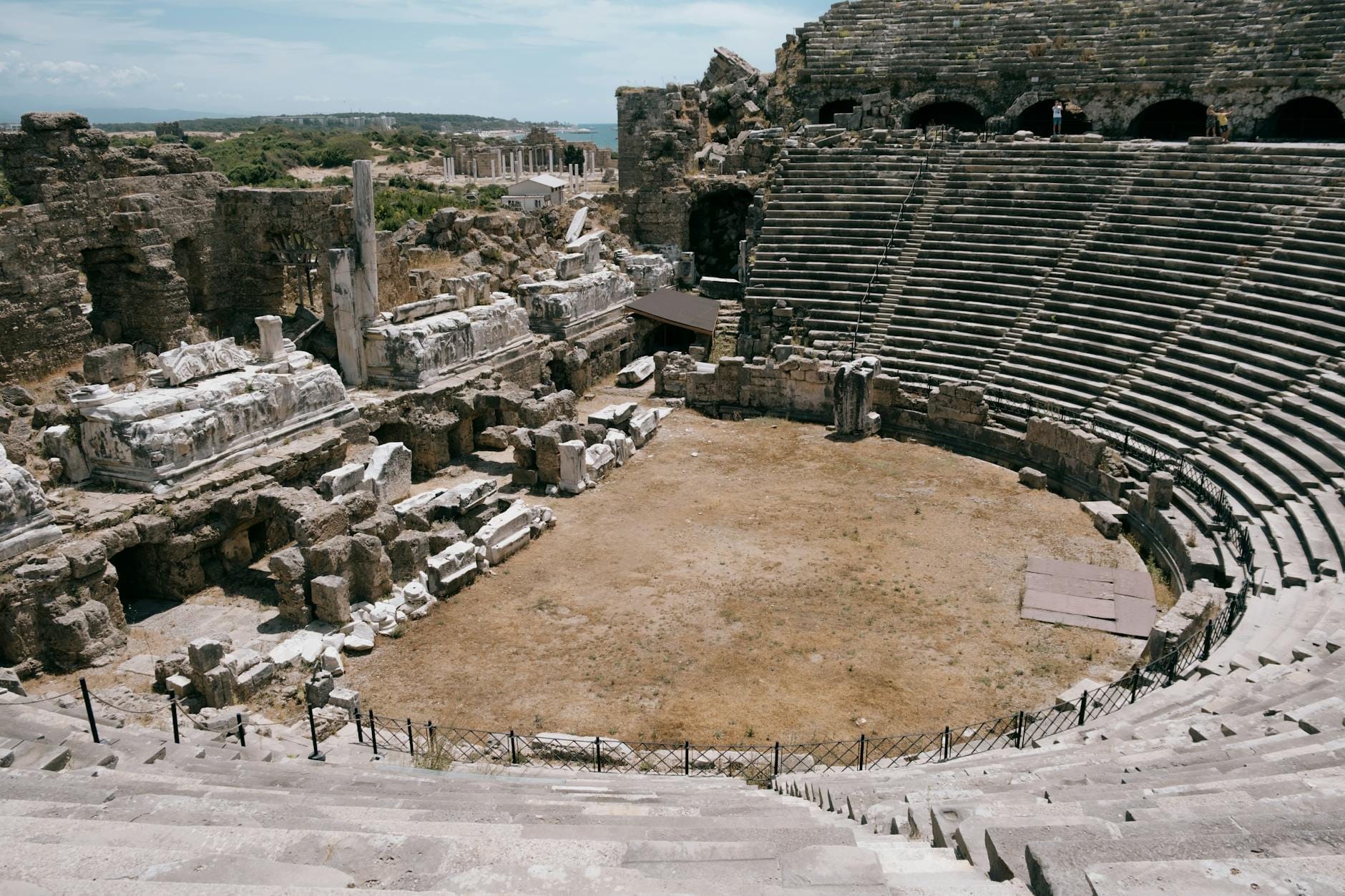
The Side Ancient Theater sits in the middle of a working resort town on a narrow peninsula jutting into the Mediterranean, which immediately sets it apart from most ancient sites in the region. You are not driving out to an isolated archaeological park in the countryside. You walk through souvenir stalls and past restaurants, then round a corner, and a vast Roman theater simply appears in front of you, its curved stone seating rising above the surrounding streets.
This is a theater of considerable size and age. Built during the Roman imperial period, it is among the largest ancient theaters in Anatolia, with a seating capacity estimated at between 13,700 and 17,200. The structure is built largely on vaulted substructures at ground level rather than carved into a hillside, which required sophisticated engineering. That choice, unusual for Roman theaters, gives it a presence that feels almost monumental even against the backdrop of a modern beach town.
Side itself was once a significant Hellenistic and Roman port city, and the theater reflects that scale. If you want to understand how the theater fits into the wider ancient city, the Side neighborhood overview provides useful context on the full archaeological footprint of the peninsula.
ℹ️ Good to know
The Side Ancient Theater is not the same as the Aspendos Ancient Theatre. Aspendos is a separate site approximately 37 km to the northwest, near Belkıs village. Both are impressive, but they are different ruins. Many tour itineraries cover only Aspendos, so Side's theater gets far less international attention than it deserves.
The Architectural Scale Up Close
Unlike the Aspendos theater, which was carved into a natural hillside for support, the Side theater is built largely on vaulted substructures at ground level. This means the outer facade rises above the street in a series of arched passageways and buttressed walls that you can walk along before you even enter. The stonework is worn but intact enough to read clearly, and those barrel-vaulted corridors under the seating give the structure a labyrinthine quality at close range.
Inside, the cavea (the semicircular seating area) is divided into upper and lower sections. Many of the seats are still in place, though some have crumbled or shifted over centuries of exposure. The orchestra level and the remains of the stage building (scaenae frons) are visible from the seating tiers, though the scaenae frons is far less intact than the extraordinary example preserved at Aspendos. Still, the sense of scale hits you properly from the upper rows, where the town, the surrounding ruins, and on a clear day a strip of sea, all come into view at once.
Travelers who arrive expecting perfection comparable to Aspendos may find the partial decay a slight disappointment. Those who prefer a site with genuine archaeological texture rather than a restored showpiece will find Side's theater more compelling precisely because of its rougher condition.
Tickets & tours
Hand-picked options from our booking partner. Prices are indicative; availability and final rates are confirmed when you complete your booking.
Turkiye village small group guided tour from Side or Belek
From 39 €Instant confirmationFree cancellationMevlana Museum and Whirling Dervishes Show from Antalya, Belek, Side
From 109 €Instant confirmationFree cancellationAntalya full-day guided tour from Side
From 80 €Instant confirmationFree cancellationLake Beyşehir and Esrefoglu Mosque Tour from Antalya, Belek, Side
From 99 €Instant confirmationFree cancellation
How the Experience Changes by Time of Day
Morning is the clear winner for visiting the theater. Between roughly 8:00 and 10:00 AM, the light falls across the stone at a low angle that picks out the texture of the carved blocks, and the site has not yet filled with the tour groups that arrive mid-morning. The air is cooler, the surrounding town is quiet, and you can stand in the orchestra without anyone else nearby.
By late morning, particularly in summer, the stone radiates heat intensely. There is almost no shade inside the theater itself. Bring water, and if you are visiting with children or anyone sensitive to heat, plan to be finished by 11:00 AM at the latest during July and August. A hat is not optional; it is necessary.
Late afternoon light, from around 4:30 PM onward, creates dramatic long shadows across the cavea and gives the stone a warm amber tone that works well for photography. The crowds have usually thinned by then too, as many day-trippers have returned to their hotels. If you plan your day around the beach first and the theater second, the late afternoon slot is a solid choice.
⚠️ What to skip
Midsummer heat between noon and 3 PM makes the theater genuinely uncomfortable. The open stone amplifies temperature. Morning visits (before 10 AM) or late afternoon visits (after 4 PM) are strongly preferable from May through September.
Getting to Side and Finding the Theater
Side is approximately 75 km east of Antalya city center and about 5 km from Manavgat town. The most practical public transport option from Antalya is a dolmuş (shared minibus) or intercity bus to Manavgat, followed by a local dolmuş to Side itself. The journey takes roughly 90 minutes to two hours depending on connections. Taxis from Manavgat to Side are short and relatively inexpensive.
From the main entrance road into Side, the theater is visible and within easy walking distance. The town is small enough that navigation is simple; follow the main pedestrian street (the former Colonnaded Street of the ancient city) and you will reach the theater without needing a map. Parking for those arriving by private car or rental is available near the town entrance, as private vehicles are restricted in much of the old town area.
If you are combining Side with a day trip to Aspendos, the Aspendos theater guide covers logistics for that site in detail. The two are different enough in character that seeing both on the same trip is worthwhile, not repetitive.
Side's Ruins Beyond the Theater
The theater does not stand alone. It sits within a much larger ancient city, and the ruins extend across the entire peninsula. The Temple of Apollo, just a short walk to the south toward the harbor, is arguably the more photogenic site at Side: five standing columns silhouetted against the sea make for a striking image at any time of day.
The Temple of Apollo at Side pairs naturally with the theater as a two-stop walk. Budget at least a full morning to cover both sites plus the remains of the agora, the nymphaeum, and the old city walls without feeling rushed.
The Side Museum, housed in a former Roman bath building near the theater, contains statuary and artifacts recovered from excavations across the site. It is compact but well-curated, and adds meaningful context to what you see in the open air. If you are interested in how the city functioned as a port, the museum's collection of relief carvings and inscriptions fills in details that no amount of standing in the ruins can convey.
For travelers planning a longer stay in the region, the guide to ancient ruins near Antalya places Side in context alongside Perge, Aspendos, and Termessos.
Photography Notes and What to Prioritize
The exterior arched facade of the theater catches light well from early morning and again in late afternoon. If you position yourself on the street to the northwest of the structure around 8:30 AM, the low sun illuminates the barrel vaults and picks out the depth of the stonework without blowing out the highlights.
From inside the theater, the best compositional choice is from the upper seating rows, looking down across the orchestra toward the stage ruins with the town visible beyond. At peak summer, the stone is intensely bright and midday shooting produces flat, overexposed results. A polarizing filter helps cut the glare from the pale limestone.
Smartphone cameras perform adequately here in good light, though the wide span of the cavea benefits from a slightly wider lens. The site is large enough that one frame cannot capture it, so shooting in sections and considering a panoramic stitch from the top rows gives a better sense of the full scale.
Accessibility and Practical Considerations
The terrain at the theater involves uneven ancient stone and some staircases without modern handrails. Mobility-impaired visitors will find the ground-level orchestra area and immediate surroundings accessible, but the upper seating tiers are not wheelchair-accessible without significant assistance. Sturdy footwear with grip is strongly recommended for everyone; smooth-soled sandals are a poor choice on worn limestone steps.
There are no food or drink vendors inside the theater site itself, but the streets surrounding the theater have no shortage of cafes and shops. Buy water before you enter, not after you realize you need it inside. During peak season, the lanes immediately around the theater have vendors selling cold drinks.
Travelers managing a tighter budget should check whether the Turkish Museum Pass covers entry, as it does for many major sites in the region. The Antalya on a budget guide covers how to make the most of the Museum Pass across multiple sites.
Insider Tips
- Visit on a weekday morning rather than a weekend if you want the site to yourself. Weekend day-trippers from Antalya and Alanya can make the town center genuinely crowded by 10 AM in summer.
- The upper exterior of the theater is partially visible from the street at no cost. If you are short on time or budget, you can still appreciate the scale of the arched substructure from outside without entering the paid site.
- The Side Museum (housed in the old Roman bath near the theater) is easy to overlook but worth the extra time. The statuary inside, including some well-preserved figures, provides context that the open-air ruins cannot.
- Combine the theater with the Temple of Apollo in a single walk south toward the harbor. The two sites together take about two hours at a relaxed pace and cover the most significant structures in the ancient city.
- Side's narrow entrance road gets congested with tourist traffic in July and August. If arriving by private car, park near the town entrance and walk in rather than attempting to drive close to the theater.
Who Is Side Ancient Theater For?
- History and archaeology travelers who want Roman sites with fewer international crowds than Aspendos
- Photographers looking for ancient ruins combined with coastal scenery in a single location
- Families with older children who can handle uneven terrain and benefit from the combination of ruins and beach
- Day-trippers from Antalya or Belek who want a culturally substantial half-day excursion
- Travelers on the Turkish Museum Pass working to maximize value across multiple sites
Nearby Attractions
Other things to see while in Side:
- Temple of Apollo, Side
The Temple of Apollo stands at the southwestern tip of Side's ancient peninsula, its five surviving Corinthian columns rising against a backdrop of open Mediterranean water. Built around 150 AD during the reign of Emperor Antoninus Pius, this Roman sanctuary is one of the most photographed ancient sites in Turkey, and for good reason. The setting alone makes the journey from Antalya worthwhile.