Temple of Apollo in Side: Ancient Ruins at the Edge of the Sea
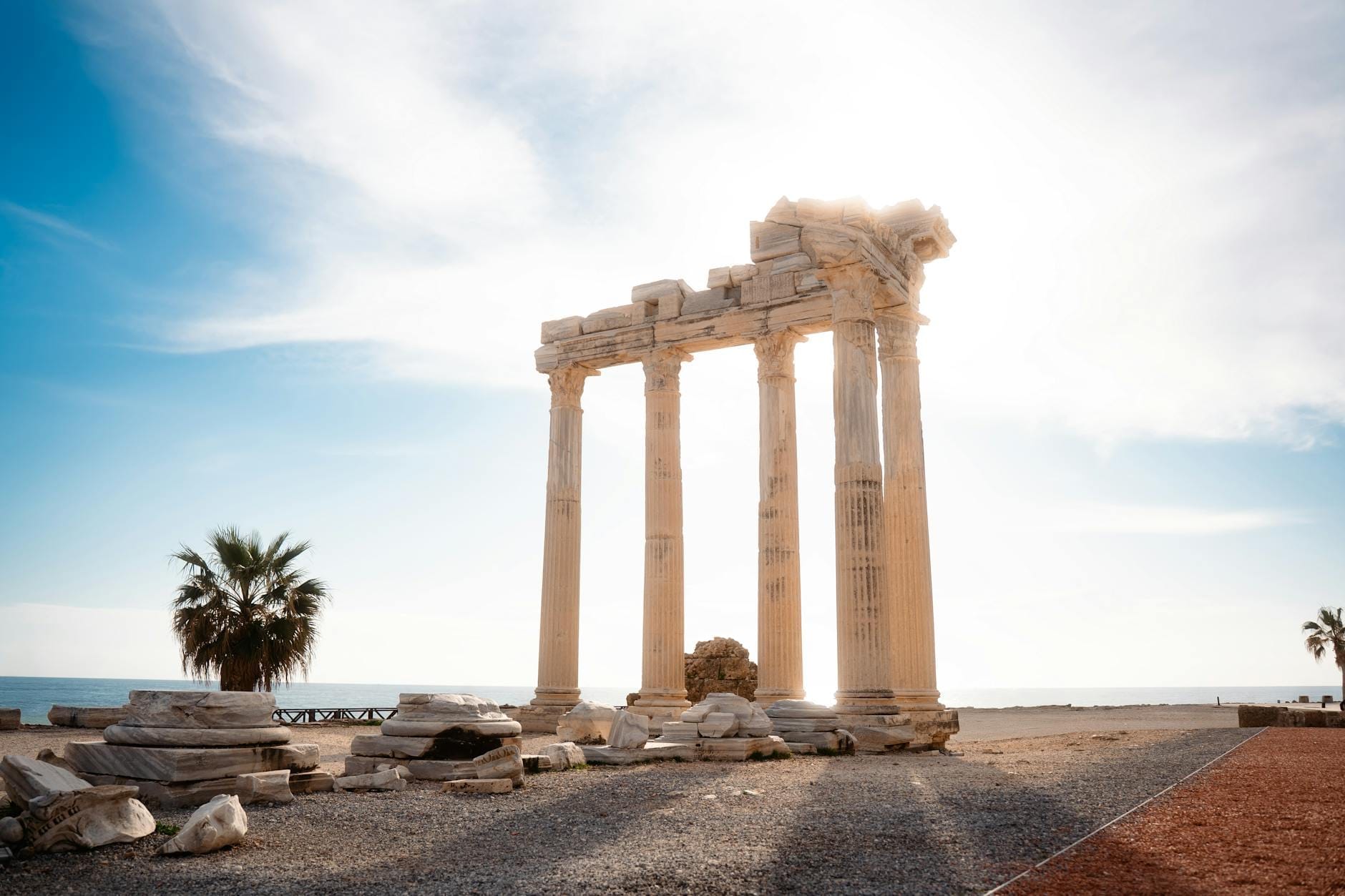
The Temple of Apollo stands at the southwestern tip of Side's ancient peninsula, its five surviving Corinthian columns rising against a backdrop of open Mediterranean water. Built around 150 AD during the reign of Emperor Antoninus Pius, this Roman sanctuary is one of the most photographed ancient sites in Turkey, and for good reason. The setting alone makes the journey from Antalya worthwhile.
Quick Facts
- Location
- Ancient city of Side, Antalya Province, Turkey (36°45′51″N 31°23′12″E)
- Getting There
- 78 km from Antalya via D400 highway; ~1 hr by car or ~90 min by bus from Antalya city center
- Time Needed
- 30–60 minutes at the temple; allow 2–3 hours combined with the surrounding ancient city
- Cost
- Part of Side Ancient City site; verify current admission fees locally before visiting
- Best for
- History enthusiasts, photographers, sunset chasers, architecture lovers
What You're Actually Looking At
The Temple of Apollo, officially known in Turkish as Apollon Tapınağı, sits at the far southwestern end of Side's ancient peninsula, where the land narrows and the sea presses in on two sides. What remains today are five Corinthian columns still standing in their original positions, their capitals intricately carved with acanthus leaves worn soft by centuries of salt wind. Fragments of the entablature rest against the columns and lie scattered on the stone platform below, giving the site a quality that feels less like a ruin and more like a site frozen mid-collapse.
Beside it stands the Temple of Athena, sharing the same raised platform and largely the same archaeological period. The two sanctuaries once formed a religious complex at the edge of the ancient city, with the sea on three sides. That positioning was almost certainly deliberate: Apollo was associated with light, order, and in some coastal traditions, with maritime protection. Standing on the platform today, with the water audible below the seawall, that original intention still reads clearly.
ℹ️ Good to know
The temple was built around 150 AD during the Pax Romana, under Emperor Antoninus Pius (r. 138–161 AD). A major restoration project ran from 1984 to 1990, with additional work completed in 2017, which is why the standing columns look structurally sound rather than precariously balanced.
How the Experience Changes by Time of Day
Morning visits, especially before 9 AM in summer, offer something the midday crowd cannot: relative quiet and soft directional light that picks out the texture of the column fluting without flattening it. The stone has a warm honey color that photographs particularly well in the first two hours after sunrise, when the sun comes in at an angle from the east and the columns cast long shadows across the platform.
Midday in July and August brings two things simultaneously: the strongest light (which bleaches out details in photographs) and the heaviest foot traffic. Tour groups from the all-inclusive resorts in Manavgat and Belek typically arrive between 10 AM and 1 PM. The site is open-air, so there is no escape from the heat. Bring water, wear a hat, and expect to share the viewpoint with a significant number of people.
Sunset is when the temple genuinely earns its reputation. The columns face west-southwest, and in the late afternoon the light turns the stone amber, then deep orange. The sea behind the columns reflects the same palette. This is one of the few ancient sites in Turkey where the visual reward at golden hour is not exaggerated by guidebooks. Arrive 45 minutes before sunset to secure a position on the seawall facing the temple. By the time the light peaks, photographers and casual visitors pack the surrounding area, but the scene justifies the company.
💡 Local tip
For sunset photography, position yourself slightly north of the temple platform along the seawall rather than directly in front. From that angle you get the columns framed against open water rather than against the opposing shoreline.
Tickets & tours
Hand-picked options from our booking partner. Prices are indicative; availability and final rates are confirmed when you complete your booking.
Turkiye village small group guided tour from Side or Belek
From 39 €Instant confirmationFree cancellationMevlana Museum and Whirling Dervishes Show from Antalya, Belek, Side
From 109 €Instant confirmationFree cancellationAntalya full-day guided tour from Side
From 80 €Instant confirmationFree cancellationLake Beyşehir and Esrefoglu Mosque Tour from Antalya, Belek, Side
From 99 €Instant confirmationFree cancellation
Historical and Architectural Context
Side was one of the most prosperous cities of ancient Pamphylia, the coastal region stretching across what is now the Antalya coast. At its peak during the 2nd and 3rd centuries AD, the city was a major trading port and, less flatteringly, one of the Mediterranean's significant slave markets. The wealth generated by that commerce funded the city's grand public buildings: a theater, colonnaded streets, bath complexes, and temple precincts including this one.
The Temple of Apollo was constructed in the Corinthian order, the most ornate of the three classical Greek orders, characterized by its elaborate capital carved to resemble the leaves of the acanthus plant. Roman architects adopted and adapted this style widely across the empire during the 2nd century AD. The columns at Side stand approximately 9 meters tall, and the care of their carving, even in its current weathered state, speaks to the civic ambitions of the city that commissioned them.
For travelers interested in experiencing more of Pamphylia's ancient cities, the region offers remarkable variety. Aspendos TheatreAspendos, roughly 30 km west of Side, contains one of the best-preserved Roman theater buildings anywhere in the world, and Perge Ancient City adds a colonnaded street and stadium to the itinerary. None of these sites look much like each other, which makes combining them genuinely worthwhile rather than repetitive.
Getting There and Navigating the Site
Side sits about 70 kilometers east of Antalya city center along the D400 coastal highway. By car the drive takes roughly an hour in normal traffic conditions; note that summer weekend traffic on the D400 can extend this considerably. Buses from Antalya's main otogar (bus terminal) run regularly to Side and take approximately 90 minutes. From the Side town center, the temple is reachable on foot in about 10 to 15 minutes, walking south through the ancient city along the main colonnaded street.
Parking in Side town is limited and the historic center is pedestrianized during summer months. If you arrive by car, park near the town entrance and walk in. The route through the ancient city to the temple passes the theater, the agora, and several excavated structures, effectively turning the approach into a self-guided archaeological walk. There are no formal paths to miss; follow the main street south toward the water.
If you're combining the temple with other stops in the region, the day trips from Antalya guide covers practical options for structuring a full-day itinerary. Side also makes sense as part of a broader ancient ruins near Antalya circuit, particularly if you're dividing two or three days between sites.
⚠️ What to skip
The site is fully exposed with no shade structures over the temple platform. In summer (June through August), temperatures regularly exceed 35°C by midday. If you are not a dedicated heat-tolerant traveler, visit before 9 AM or after 5 PM.
Photography and What to Bring
The temple photographs exceptionally well, partly because the setting gives you multiple compositional options within a compact area: columns against sky, columns against sea, columns at ground level, and the wide platform shot that includes both the Apollo and Athena temple remains together. A wide-angle lens handles the full platform comfortably. A telephoto or zoom lens is useful for isolating individual capital details from the ground without needing to climb anything.
Beyond a camera, bring sun protection, a water bottle (there are vendors near the site entrance but not immediately at the temple), and comfortable flat-soled shoes. The platform stones are uneven and in some sections edged with gaps. Sandals work fine for younger and agile visitors, but closed shoes give better grip on the weathered stone surface, particularly when it is wet after rain.
Honest Limitations
Five columns, however beautifully placed, are five columns. Visitors whose primary interest is in well-preserved ancient structures with substantial standing remains may find the Temple of Apollo underwhelming compared to Aspendos, which has an almost intact theater, or Termessos, which has ruins spread across an entire mountainside. The Apollo temple's power is almost entirely about its location and its light, not its state of preservation.
Travelers seeking a full immersion in the ancient world should consider pairing Side with a visit to Termessos, which offers a dramatically different experience: a hilltop city above the treeline with extensive ruins in a near-wilderness setting. Together, the two sites show the range of what ancient Pamphylia looked like at different scales and in different landscapes.
The surrounding town of Side has developed heavily as a resort destination. Immediately outside the ancient city zone you encounter souvenir shops, restaurants with laminated menus in five languages, and hotels built right up to the archaeological boundaries. This does not diminish the temple itself, but it affects the overall atmosphere of the visit for travelers expecting a quiet archaeological experience away from the tourist trade.
Insider Tips
- Visit on a weekday rather than a weekend if possible. The D400 highway and the Side parking area are noticeably quieter Monday through Thursday, and the temple platform feels less crowded by mid-morning.
- The seawall running along the western side of the peninsula offers a lower vantage point looking up at the columns against the sky. This angle is less photographed than the standard straight-on view from the platform approach.
- If you visit at sunset and want to walk back to town comfortably, note that lighting in the ancient city area drops off quickly after dark. Bring a phone flashlight for the return walk along the stone-paved street.
- The temple and the adjacent Athena ruins are on the same platform. Most visitors focus only on the Apollo columns, which means the Athena side is often less crowded and worth a few minutes of attention on its own.
- Side Museum, located in a converted Roman bath building near the town entrance, holds many of the sculptural finds from the temple precinct and surrounding area. Seeing the museum first gives the on-site ruins considerably more context.
Who Is Temple of Apollo, Side For?
- Photographers and visual travelers, especially at golden hour
- History and classical archaeology enthusiasts with an interest in Roman Pamphylia
- Couples looking for a genuinely scenic ancient site with sea views
- Travelers combining multiple ancient sites across a 2–3 day Antalya region itinerary
- Anyone already visiting Side's beach or town who wants to add a worthwhile cultural stop
Nearby Attractions
Other things to see while in Side:
- Side Ancient Theater
The Side Ancient Theater is one of the largest and best-preserved Roman theaters in all of Anatolia, rising dramatically from the center of a resort town that was once a major port city. Built to seat between 13,700 and 17,200 spectators, it still dominates the skyline and rewards close inspection. This guide covers what you'll actually see, when to visit, and what makes it different from Aspendos nearby.