Termessos Ruins: The Ancient City Alexander the Great Could Not Conquer
Perched at roughly 1,000 metres in the Taurus Mountains, Termessos is one of the best-preserved and least-excavated ancient cities in Turkey. Rocky trails, pine forest, and dramatic views make this a serious half-day commitment — and one of the most rewarding archaeological sites near Antalya.
Quick Facts
- Location
- Bayatbademleri, Döşemealtı, Antalya — approx. 17 km northwest of Antalya city center, inside Mount Güllük-Termessos National Park
- Getting There
- No direct public transit. By car or taxi via the Antalya–Korkuteli road; most visitors join a guided day tour from Antalya
- Time Needed
- 2 to 4 hours on site; allow extra time for the drive and the uphill approach trail
- Cost
- National park entry fee applies; site admission fees — verify current prices before visiting as these change seasonally
- Best for
- History enthusiasts, hikers, archaeology buffs, and travelers who want to see an ancient city without tour-bus crowds
- Official website
- www.muze.gov.tr
What Termessos Actually Is — And Why It Matters
Termessos — also recorded as Termessos Major — is an ancient Pisidian city built on a natural rock platform inside the Taurus Mountains, roughly 17 kilometres northwest of Antalya. Unlike most major archaeological sites in Turkey, it has never been fully excavated. What visitors walk through today is largely as nature left it: collapsed columns half-swallowed by tree roots, necropolis chambers open to the sky, and an agora surrounded by pines rather than gift shops.
The city is referenced as far back as Homer's Iliad under its founders, the Solymi people. In 333 BC, Alexander the Great marched through the region and chose not to besiege Termessos — the terrain made it too costly. The city later allied with Rome around 70 BC and flourished through the Imperial period, with its most significant construction dating to the 2nd and 3rd centuries CE. Then, likely due to a combination of earthquake damage and the severing of its water supply, Termessos was abandoned. No later settlement obscured it. That is exactly why it still looks the way it does.
ℹ️ Good to know
Opening hours are 08:30–19:00 (April–October) and 08:30–17:30 (November–March); verify current times on the official site. An early start is strongly recommended — not just for cooler temperatures, but because the site becomes far more atmospheric in the low morning light filtering through the pine canopy.
The Approach: What the Hike Feels Like
The road from Antalya passes through Mount Güllük-Termessos National Park before reaching the parking area. The park itself is worth slowing down for: dense pine and cedar forest with occasional views across the Antalya plain. After parking, the trail climbs steeply through the ancient city walls — some of the most intact Hellenistic fortifications in the region. The stones are large, rough, and reassuringly solid even after two millennia. You will feel the altitude shift within the first fifteen minutes.
The path is rocky and uneven throughout. Loose gravel, exposed roots, and sections with no formal steps are standard. Wear proper closed-toe shoes with grip — trainers will do, but hiking boots are better. Bring at least 1.5 litres of water per person; there are no shops or vendors on site. In summer, temperatures at this altitude stay cooler than Antalya proper, but the exposed sections of the trail can still be taxing between 11:00 AM and 3:00 PM.
⚠️ What to skip
Termessos is not accessible for visitors with limited mobility. The trails are steep, irregular, and in places require careful footing across broken stone. There are no paved paths, handrails, or wheelchair access on the main route.
Tickets & tours
Hand-picked options from our booking partner. Prices are indicative; availability and final rates are confirmed when you complete your booking.
Tazı Kanyon, Safari, Rafting, Buggy Safari, and Zipline in Turkey
From 65 €Instant confirmationFree cancellationAntalya guided city tour with lunch
From 45 €Instant confirmationFree cancellationTraditional Turkish bath experience in Antalya
From 45 €Instant confirmationFree cancellationTurkiye village small group guided tour from Side or Belek
From 39 €Instant confirmationFree cancellation
The Site Itself: What You Will See
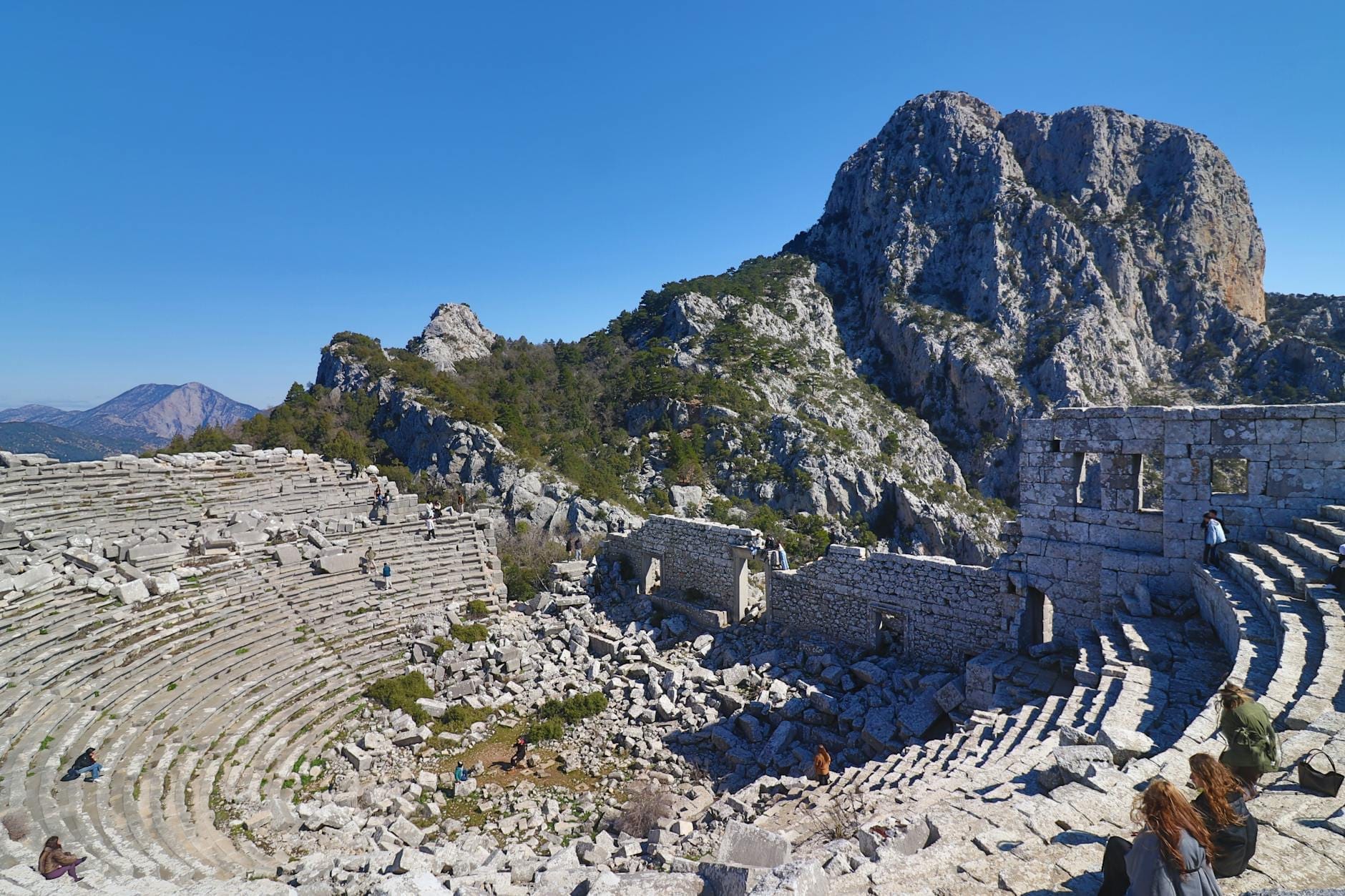
The theatre is the centrepiece, and it earns the attention. Cut into the mountainside at around 1,000 metres, it seats roughly 5,000 people and still feels structurally coherent. On a clear day — and most days here are clear — the stage backdrop frames a view across the Antalya plain to the Mediterranean coast. It is one of the more quietly extraordinary views in the entire region, made more affecting by the near-silence and the fact that you are likely sharing it with very few other people.
Beyond the theatre, the colonnaded avenue stretches approximately 500 metres, flanked by the remains of a gymnasium, cisterns, and the agora. The 6-metre-high structure known as the House of the Founder stands among the most recognisable ruins on the upper plateau. Throughout the site, Corinthian capitals and inscribed blocks lie exactly where they fell, making Termessos feel less like a managed monument and more like a place that stopped mid-sentence.
The necropolis, spread across the hillside below the main civic area, contains rock-cut chamber tombs and sarcophagi in remarkable quantity. Some remain sealed; others have been opened over centuries. Walking through it is a different experience from the main ruins — quieter, wilder, and more overgrown. For context on how Termessos fits into the broader landscape of ancient sites around Antalya, the guide to ancient ruins near Antalya covers the key comparisons and logistics.
How the Experience Changes Through the Day
Arrive before 9:00 AM and you will likely have entire sections of the site to yourself. The pine forest traps morning mist at this altitude in spring and autumn, and the smell of resin mixes with cool air in a way that makes the theatre and agora feel genuinely remote. The light is also softer and more useful for photography before 10:00 AM.
Midday brings the peak of any crowds, which at Termessos means perhaps two or three dozen people rather than hundreds. The site never becomes congested in the way that, for example, the more accessible ruins closer to the coast can during high season. By mid-afternoon, most guided tour groups have left, and the site quiets again. Late afternoon light hitting the theatre's upper tier is worth waiting for if you have the stamina. Budget at minimum three hours for a thorough visit, four if you want to explore the necropolis properly.
Getting There and Practical Logistics
There is no public bus service to Termessos. The practical options are: renting a car, hiring a taxi for a half-day (negotiate the return fare before departure), or booking a guided tour from Antalya city center. Tours typically combine Termessos with one or two other sites, which can dilute the time on site but handles the navigation and transport. The drive from central Antalya takes around 40 to 50 minutes depending on traffic on the Korkuteli road.
If you are combining Termessos with a broader day itinerary, the ancient city of Perge lies in the opposite direction from Antalya and works better as a separate outing. For an overview of how to structure multiple days in the city, the 3-day Antalya itinerary includes timing guidance for both sites.
💡 Local tip
Fuel up before leaving Antalya. The road through the national park has no petrol stations, and the nearest services past the park entrance are limited. Pack lunch if you plan a full morning — there is nowhere to eat at the site.
Photography and What to Expect Visually
Termessos rewards patience with a camera. The combination of ancient stonework, dense pine canopy, and mountain backdrop is unlike anything at the coastal sites. The theatre is the obvious centrepiece, but the necropolis offers better textures — lichen-covered sarcophagi, collapsed tomb facades with carved pediments, and wild vegetation framing stone in every direction. A wide-angle lens handles the theatre well; something tighter works better for the detail shots in the necropolis.
Avoid visiting on overcast days if photography is a priority. The site sits deep enough in a mountain valley that flat light flattens the stonework significantly. Clear mornings between April and June, and again in September and October, give the best combination of light quality and tolerable temperatures.
Honest Assessment: Who This Site Is For, and Who Should Skip It
Termessos is not for everyone, and it is worth being direct about that. If your interest in ancient ruins runs to well-signed, flat-access sites with clear interpretation panels and on-site facilities, you will find Termessos frustrating. There is limited formal signage, no café, no toilets near the upper ruins, and the physical demands are real. Visitors who struggle with uneven terrain or altitude should consider sites like Aspendos Theater instead, which is equally impressive historically and fully accessible.
For visitors who want precisely what Termessos offers — an unpolished, physically demanding encounter with a well-preserved ancient city in a mountain wilderness setting — it is genuinely difficult to overstate how good this site is. The absence of commercialisation is the point. The silence is part of the experience. The fact that Alexander turned back from these walls and the city eventually chose its own end rather than being conquered or absorbed makes the atmosphere feel earned rather than staged.
For those planning to visit multiple historical sites around Antalya, the day trips from Antalya guide covers transport logistics and combinations for the most significant sites in the region.
Insider Tips
- The path forks near the city walls early in the hike — take the left branch to reach the theatre first, which is the most demanding climb. Doing it early while legs are fresh makes the rest of the circuit considerably easier.
- Bring cash for the national park and site entrance. Card payment availability at the ticket booth is unreliable and varies by season.
- The necropolis is the least-visited section of the site and worth a deliberate detour. Most tour groups stick to the theatre and agora and miss the tomb fields entirely.
- Mobile signal disappears quickly inside the park. Download an offline map of the site before arriving — getting turned around among the trail junctions wastes significant time.
- Spring visits (April to early June) bring wildflowers throughout the forest and occasional views of snow still visible on the higher Taurus peaks above the site. This is the best season for both photography and comfortable hiking.
Who Is Termessos Ruins For?
- History and archaeology enthusiasts who want an unexcavated site without the crowds of major tourist attractions
- Hikers and active travelers comfortable with a half-day mountain outing in terrain above 1,000 metres
- Photographers looking for unusual combinations of ancient ruins, mountain forest, and Mediterranean light
- Travelers who have already done the main Antalya sites and want something that requires more effort and rewards it accordingly
- Those interested in Alexander the Great's campaigns and the Hellenistic period in Anatolia
Nearby Attractions
Combine your visit with:
- Altınbeşik Cave
Altınbeşik Cave (Altınbeşik Mağarası) in the mountains above Manavgat is one of Turkey's most extraordinary natural sites. A horizontal cave system with three levels contains an underground river, Europe's third-largest underground lake, and a boat tour that floats visitors through cathedral-scale chambers of stalactites. It takes planning to reach, but nothing else in the Antalya region comes close to this experience.
- Aspendos Opera and Ballet Festival
Annually, typically in late summer, the 2,000-year-old Aspendos Ancient Theatre becomes the stage for one of Turkey's most distinctive performing arts events. The International Aspendos Opera and Ballet Festival draws productions from Turkish and international companies to a venue where the acoustics are so precise, no amplification is needed. Around 70 percent of the audience travels from abroad to attend.
- Aspendos Theater
Built between 161 and 169 CE, the Roman Theatre of Aspendos stands 40 km east of Antalya as one of the most complete ancient theaters on earth. Its 41 tiers, towering two-story stage wall, and exceptional acoustics draw both history enthusiasts and opera-goers every summer.
- Köprülü Canyon
Köprülü Canyon National Park stretches 14 kilometres through the Taurus Mountains northeast of Antalya, combining serious natural scenery with a genuine Roman road, two ancient bridges, and the Köprülü River. Most visitors come for the rafting; the history and hiking are just as rewarding for those who stay longer.