Xinbeitou Hot Spring Area: Taipei's Sulfur Springs District
Tucked into the green hills of Beitou District, the Xinbeitou Hot Spring Area is Taipei's most accessible thermal bathing destination. From a NT$60 public outdoor pool to private ryokan-style bathhouses, this compact district blends Japanese-era architecture, volcanic geology, and genuine neighborhood character into a half-day escape from the city.
Quick Facts
- Location
- Between Zhongshan Rd and Guangming Rd around Beitou Park, Beitou District, Taipei City
- Getting There
- Xinbeitou Station (Xinbeitou Branch Line, MRT)
- Time Needed
- 2–4 hours for the district; half-day if including a private bathhouse
- Cost
- Park & streets: free. Outdoor public pools: NT$60 (concession NT$30). Private bathhouses vary.
- Best for
- Couples, solo travelers, families, history enthusiasts, cold-weather visits
- Official website
- www.travel.taipei/en/attraction/details/436
What the Xinbeitou Hot Spring Area Actually Is
The Xinbeitou Hot Spring Area is not a single attraction with a ticket gate. It is a living district: a compact corridor of bathhouses, hotels, tree-lined streets, and public pools centered on Beitou Park and the Beitou Creek, all fed by natural sulfuric spring water sourced from the volcanic terrain above. The area is officially listed by Taipei City Government under its formal name, 新北投溫泉區, and spans Beitou Park between Zhongshan Road and Guangming Road in Beitou District.
There are two distinct ways to experience it. The first is the NT$60 public outdoor hot spring bathing pool inside Beitou Park, open to anyone who follows the swimwear rules and arrives during one of the scheduled time slots. The second is the network of private bathhouses and hot-spring hotels ranging from bare-bones to surprisingly elegant, where you pay for the water, the tub, and the privacy. Both options are worth considering, and choosing between them depends on your budget, your company, and how much atmosphere you want around your soak.
💡 Local tip
The outdoor public pool operates in 90-minute sessions: 05:30–07:30, 08:00–10:00, 10:30–13:00, 13:30–16:00, 16:30–19:00, and 19:30–22:00. Arrive at least 15 minutes before a session opens — the first morning slot draws regulars and fills quickly.
How the Area Changes Through the Day
Early mornings in Xinbeitou are the closest thing to a neighborhood secret. Before 8am, the streets along Beitou Creek are quiet except for elderly residents doing tai chi near the park benches and the faint smell of sulfur drifting from the water channel. The air temperature drops noticeably in winter months, making those first steam-lit moments stepping into a hot pool genuinely memorable. At NT$60, the 05:30 slot is one of the best-value experiences in Taipei.
By mid-morning on weekends, the character shifts. Tour groups arrive from the MRT, the souvenir shops along Zhongshan Road open their shutters, and the line outside the outdoor pool grows. The surrounding streets see foot traffic moving between the Beitou Hot Spring Museum, the historic library building nearby, and the various bathhouses. The area handles crowds reasonably well because the district is linear and walkable rather than concentrated at a single gate.
Late afternoon, especially in the cooler months from October through March, is the other sweet spot. The light falls softer through the tree canopy over Beitou Creek, the thermal steam becomes more visible as the air cools, and the 16:30 pool session draws a mix of locals finishing work and travelers on their way back from Yangmingshan. On winter evenings, the glow of bathhouse windows and the sulfur-tinged air give the area a genuinely atmospheric quality that photos rarely capture accurately.
The Geology: Why This Water Is Different
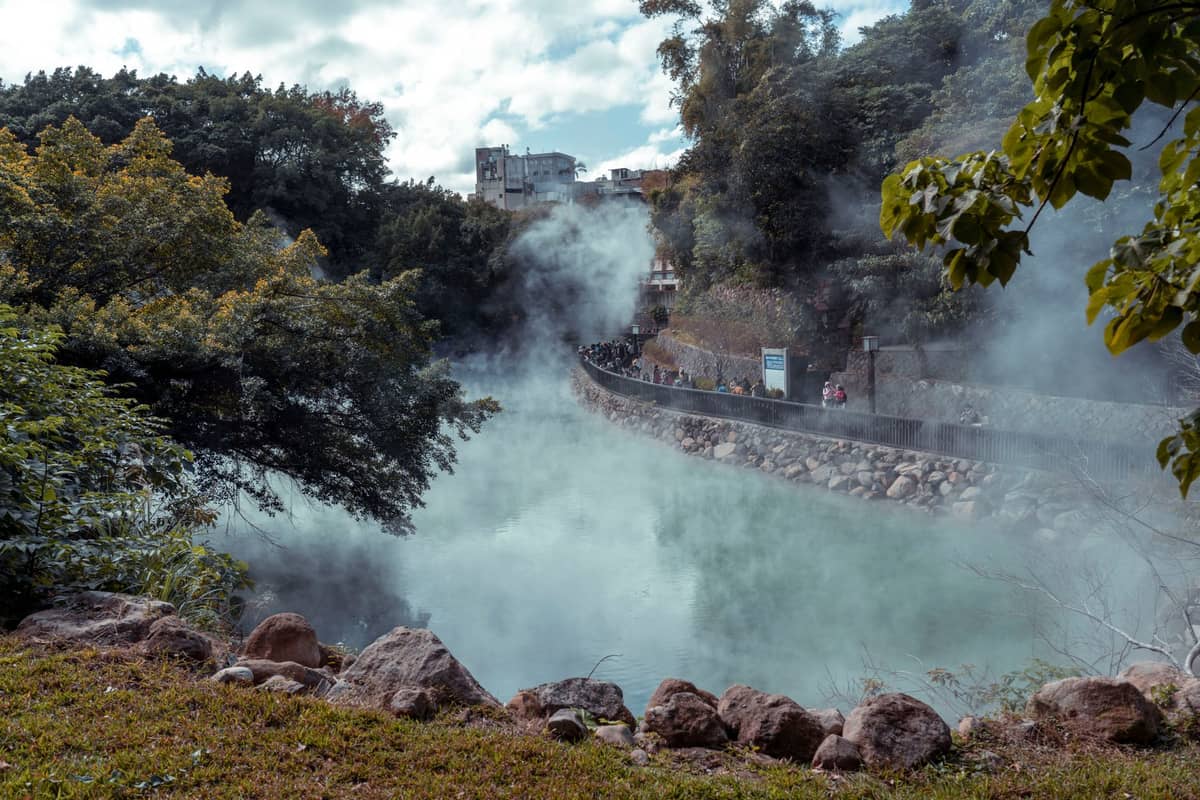
The hot springs of Xinbeitou are not generic thermal water. The district sits within the volcanic zone that extends through Yangmingshan National Park, and the springs here are classified into two distinct types based on their chemical composition. White sulfur springs, with a milky, slightly opaque appearance and a mildly acidic pH, are widely used in commercial bathhouses in the Beitou area. Green sulfur springs, also called radium springs, are rarer globally and more acidic, and are historically associated with the upper reaches of Beitou Creek near the Thermal Valley, known locally as Diyu Gu or Hell Valley.
The mineral that made Beitou scientifically significant is hokutolite, a mildly radioactive mineral first identified in these springs in 1906 and named after Hokuto, the Japanese name for Beitou. While the radiation levels are not a health concern for visitors, the discovery put Beitou on the map in the scientific community and contributed to its reputation as a therapeutic destination throughout the Japanese colonial period.
Japanese Colonial History and the Architecture Around You
The hot spring culture in Xinbeitou was substantially shaped by Japanese rule from 1895 to 1945. Japan had a deep tradition of onsen culture, and when the colonial government identified Beitou's thermal resources, the area developed rapidly as a spa retreat for officials, military personnel, and civilians. Several of the buildings that survive today date from this period or were directly inspired by it.
The most significant survivor is the Beitou Hot Spring Museum, which occupies a 1913 Japanese public bathhouse building with red-brick walls, a Moorish arcade, and a mosaic-tiled pool hall on the ground floor. The building itself is a heritage structure, and the museum inside traces the development of the hot spring district through the colonial era and into the present. It sits at the top of Beitou Park, a five-minute walk from the MRT station, and entry is free.
Beitou Park itself, the green spine of the district, was also laid out during the Japanese period and retains a deliberate, formal landscape design with stone steps, lantern posts, and a creek path that feels distinct from the more utilitarian parks in central Taipei. Walking the park from the MRT station uphill toward the museum and the thermal creek takes roughly fifteen minutes and passes most of the key landmarks in the area.
Practical Walkthrough: What to Do and In What Order
The most sensible approach is to arrive at Xinbeitou Station, walk up Zhongshan Road through the park, and orient yourself around the creek before deciding where to soak. The outdoor public pool (Beitou Park Outdoor Hot Spring Bath) is on your left near the base of the park at No. 6 Zhongshan Road. The Beitou Hot Spring Museum is further up the hill. The private bathhouses are scattered along the side streets and along Guangming Road to the north.
If you are using the public outdoor pool, bring a swimsuit (swimwear is required; nudity is not permitted), a towel, and shower sandals if you have them. Lockers are available. The water temperature in the outdoor pools is warm rather than scalding, which makes them accessible even for those not accustomed to very hot soaks. The setting is open-air, with the creek and park greenery visible around you, which is considerably more pleasant than a generic indoor pool.
For those who want a more complete hot spring experience, the private bathhouses along Guangming Road and the surrounding streets offer room rentals by the hour for solo or couple use. Quality and price vary significantly, so it helps to read recent reviews before committing. If this is your first time in the area, pairing it with a visit to the Beitou Hot Spring Museum and a walk through the park gives the trip enough context to feel like more than just a spa outing. For a full Taipei itinerary that incorporates Beitou, see the 3-day Taipei itinerary.
ℹ️ Good to know
Beitou Park's paths are level and paved, making them accessible by stroller or wheelchair. The outdoor hot spring pools have step access that may present difficulty for visitors with limited mobility. Individual private bathhouses vary in accessibility, so contact them directly before visiting.
Getting There and Getting Around the District
Xinbeitou is one of the easiest excursions from central Taipei. Take the Red Line (Tamsui–Xinyi Line) to Beitou Station, then transfer to the Xinbeitou Branch Line, a single-stop spur that deposits you directly at Xinbeitou Station. The branch line runs frequently and the transfer is seamless; total journey time from Taipei Main Station is approximately 30–40 minutes. The MRT is the practical choice here, as parking near the hot spring district is limited and the streets are narrow.
From Xinbeitou Station, the entire district is walkable. The outdoor pool and park entrance are less than five minutes on foot; the museum is about ten to fifteen minutes uphill. If you are planning a broader day trip that combines Beitou with the coastal areas north of Taipei, see the Taipei north coast day trip guide for routing options.
When to Visit and What the Weather Does to the Experience
The Xinbeitou Hot Spring Area is genuinely better in cool weather. From October through March, the contrast between the cold air and the hot mineral water is sharp and satisfying, the steam rising from the pools and creek is photogenic, and the crowds, while still present on weekends, are more manageable than during the summer peak. Taipei's humid subtropical climate means summers are hot and muggy, which reduces the appeal of soaking in thermal water outdoors. If you are visiting during the warmer months, the early morning sessions remain worthwhile, but it is not the optimal time. For more on timing your Taipei trip, the best time to visit Taipei guide covers seasonal patterns in detail.
Rain is not a dealbreaker here. The outdoor pool operates in all but severe weather, and the covered walkways and indoor bathhouses make the district functional even in a downpour. In fact, light rain adds a particular mood to the creek path and the Japanese-era buildings that is hard to replicate on a clear day. Bring a compact umbrella regardless.
⚠️ What to skip
Avoid visiting on national holidays and the first weekend of Chinese New Year if you want any calm. The outdoor pool queue can stretch long enough to miss multiple sessions on peak days. Weekday mornings are consistently the least crowded time across the district.
Who Should Think Twice
The Xinbeitou Hot Spring Area works best for travelers who are willing to slow down and let the district reveal itself at walking pace. If you are short on time and expecting a polished, resort-style thermal complex, you may find the mix of public infrastructure, modest bathhouses, and workaday neighborhood streets underwhelming. The district is charming rather than glamorous, and the public pool in particular is a no-frills civic facility, not a wellness center.
Travelers whose primary interest is hot springs with a higher-end experience may find better options at Wulai's hot spring resorts, which offer a more developed spa infrastructure, albeit further from central Taipei. Xinbeitou is the better choice for convenience, authenticity, and value.
Insider Tips
- The 05:30 morning session at the outdoor public pool is the most atmospheric and least crowded of the day. Regulars are often elderly residents who treat it as a daily ritual, and the quiet, steam-lit park at dawn is unlike anything the same spot offers at noon.
- The smell of sulfur is genuine and noticeable throughout the district, particularly near the creek and the upper end of the park. If you find sulfur odors unpleasant, this is worth knowing before you plan a long stay.
- The Beitou Hot Spring Museum is free to enter and often overlooked by visitors who come only to soak. The restored 1913 bathhouse interior, including the original mosaic-tiled pool room, is one of the best-preserved pieces of Japanese colonial architecture in all of Taipei.
- Several private bathhouses advertise prominently on the main street but are not necessarily the best value. Walking one block off Zhongshan Road toward the side streets often surfaces smaller, locally-run operations with comparable water quality at lower prices.
- Xinbeitou has a public library building, the Xinbeitou Branch of Taipei Public Library, completed in 2006 and notable for its green architecture and rooftop garden. It is a two-minute detour from the main route and worth a quick look even if you have no use for the books inside.
Who Is Xinbeitou Hot Spring Area For?
- Couples looking for a relaxing half-day soak without leaving Taipei
- Budget travelers who want a genuine hot spring experience at NT$60
- History and architecture enthusiasts interested in Japanese colonial-era buildings
- Families with children who want a comfortable, accessible nature outing
- Cold-weather visitors who want to make the most of Taipei's winter months
Nearby Attractions
Other things to see while in Beitou District:
- Beitou Hot Spring Museum
Built in 1913 as the largest public bath in East Asia, the Beitou Hot Spring Museum is a rare surviving piece of Japanese colonial architecture in Taipei. Admission is free, the building is extraordinary, and it pairs perfectly with a soak at one of Beitou's nearby bathhouses.
- Guandu Nature Park
Sitting at the confluence of the Tamsui and Keelung rivers in northern Taipei, Guandu Nature Park (關渡自然公園) protects one of Taiwan's most important urban wetlands. With boardwalk trails, observation hides, and seasonal waves of migratory birds, it offers a rare pocket of quiet nature inside the city limits for under NT$60.
- Guandu Temple
Founded in 1712 and dedicated to Mazu, the sea goddess, Guandu Temple is the oldest Mazu temple in northern Taiwan. Built into a hillside at the northern edge of Beitou District, it draws local worshippers, pilgrims, and curious travelers in roughly equal measure. Entry is free, the atmosphere is genuine, and the surrounding wetlands add a scenic reward that most temple visits in Taipei simply cannot match.