Guandu Temple (關渡宮): Taipei's Oldest Mazu Shrine
Founded in 1712 and dedicated to Mazu, the sea goddess, Guandu Temple is the oldest Mazu temple in northern Taiwan. Built into a hillside at the northern edge of Beitou District, it draws local worshippers, pilgrims, and curious travelers in roughly equal measure. Entry is free, the atmosphere is genuine, and the surrounding wetlands add a scenic reward that most temple visits in Taipei simply cannot match.
Quick Facts
- Location
- No. 360, Zhixing Rd., Beitou District, Taipei City
- Getting There
- Guandu Station (Tamsui–Xinyi Line / Red Line), then 10–15 min walk or short bus ride to Guandu Temple stop (關渡宮站)
- Time Needed
- 45 minutes to 1.5 hours; longer if you walk the wetland path
- Cost
- Free entry
- Best for
- Temple architecture, Taiwanese folk religion, riverside scenery, half-day escapes from central Taipei
- Official website
- http://www.kuantu.org.tw
What Guandu Temple Actually Is
Guandu Temple (關渡宮) is a Taoist and folk-religion complex built into the rocky face of Guandu Mountain at the northwestern edge of Taipei's Beitou District. It was first constructed in 1712, making it the oldest Mazu temple in northern Taiwan and one of the most historically significant places of worship in the entire city. Mazu, the sea goddess who protects fishermen and sailors, was venerated here by early settlers who arrived by water along the Danshui River — the broad tidal estuary that still flows directly below the temple today.
Unlike many temples that function primarily as tourist showpieces, Guandu remains an actively working religious site. On any ordinary weekday morning you will find elderly worshippers conducting serious, methodical prayer rituals: burning spirit money, consulting oracle blocks, lighting incense bundles the size of small trees. The devotional energy here is not performed for visitors. It simply continues whether you are watching or not, which gives the place a weight that more photographed temples sometimes lack.
💡 Local tip
The temple hours listed on Taipei City's official tourism portal are daily 07:00–21:00. Some sources indicate opening as early as 05:00 on regular days, with 24-hour access during the Lunar New Year period (from New Year's Eve through the 4th day). Verify directly before planning an early-morning or late-evening visit.
The Architecture: Stone Caves, Golden Halls, and a Hillside Carved Out Over Centuries
The most striking architectural feature of Guandu Temple is the cave sanctuary carved directly into the mountain behind the main hall. A narrow tunnel leads visitors through the rock to a series of shrines illuminated by red lanterns and the orange flicker of oil lamps. The air inside is thick with incense smoke, the walls are blackened with centuries of burning, and the ceiling descends low enough in places that taller visitors need to duck. It is one of the more genuinely atmospheric passages in any Taipei temple, and it takes only a few minutes to walk through.
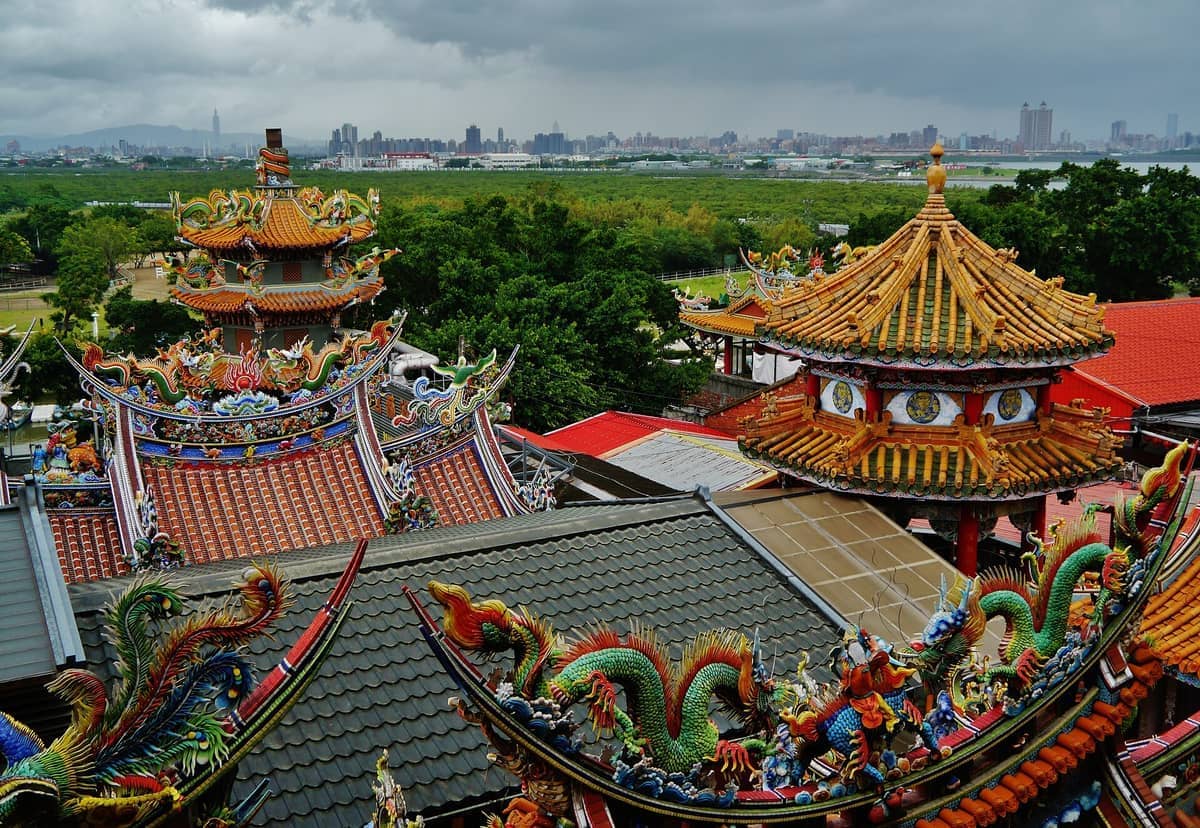
The main facade facing the road is a layered composition of glazed ceramic roof ridges, carved stone columns, and painted wooden eaves in the southern Fujian temple style that migrated to Taiwan with early settlers from Fujian Province. The ornamental detail is dense: coiling dragons on the ridgelines, bas-relief soldiers flanking the main gate, and porcelain figures depicting scenes from Chinese mythology set into the roof corners. Each figure has been added or restored over the temple's three-hundred-year history, so the complex reads less like a single architectural statement and more like an accumulation of devotional effort across many generations.
The rear sections of the complex extend up the hillside in terraced halls connected by stairways. These upper areas are quieter than the main hall and often empty of other visitors. The views from the upper terraces over the Danshui River estuary and the surrounding wetlands are unexpectedly good, particularly in the late afternoon when the light softens over the water.
How the Experience Changes Through the Day
Mornings between roughly 08:00 and 10:00 are when the temple is at its most genuinely active. The incense smoke has not yet thinned, the sound of wooden percussion blocks and murmured prayers fills the main hall, and vendors along the approach road are setting up offerings of fruit, flowers, and spirit goods. The smell at this hour — sandalwood smoke, fresh chrysanthemums, and the mineral dampness coming off the nearby river — is something worth arriving early to experience.
Midday brings tour groups, particularly on weekends, and the main forecourt becomes noticeably crowded between about 11:00 and 14:00. If you are arriving by MRT on a Saturday or Sunday, expect the narrow lane leading to the temple entrance to be congested with people. Weekday afternoons are considerably calmer. By 16:00 on most weekdays the crowd has thinned substantially, and the softer light makes this a better window for photography of the roof details and facade.
Festival periods change the character of the place entirely. During Mazu's birthday celebration (the 23rd day of the third lunar month, usually in April or May), the temple draws pilgrims from across Taiwan and the crowds are immense. The ceremonial atmosphere is extraordinary if you can tolerate the noise and density. For first-time visitors who are not specifically interested in the festival, a weekday outside of major religious occasions gives a more navigable experience.
⚠️ What to skip
Photography inside the cave sanctuary and the inner shrine halls requires sensitivity. Avoid pointing a camera directly at worshippers during prayer. No sign prohibits photography, but conspicuous camera use during active ceremonies is considered intrusive by local standards.
The Surrounding Area: Wetlands, River, and the Road to Beitou
One of the underappreciated aspects of visiting Guandu Temple is what surrounds it. The Guandu Nature Park, a significant wetland reserve managed by the Taipei Wild Bird Society, sits immediately to the northwest of the temple and borders the Danshui River. The flat walking paths through the wetland take you past egrets, herons, and migratory waterbirds depending on the season, and the contrast between the dense incense smoke inside the temple and the open salt-marsh air outside is genuinely refreshing. The wetland area requires a separate, small admission fee and is worth combining into the same half-day trip if you have the time.
The road from Guandu MRT Station to the temple passes through a low-key commercial strip with temple-supply shops, small restaurants, and stalls selling traditional snacks. After visiting the temple, it is straightforward to continue by MRT or bus south to the hot spring district of Xinbeitou. For context on the wider Beitou area, the Beitou neighborhood guide covers the district's hot spring facilities, history, and other points of interest.
If you are planning a longer day out, Guandu sits on the Tamsui–Xinyi Line, which connects it directly to Tamsui's old street and waterfront in about 20 minutes. The combination of Guandu Temple in the morning and Tamsui in the afternoon is a logical and well-worn pairing that uses a single MRT line with no transfers.
Getting There and Getting Around
The most practical route from central Taipei is the Tamsui–Xinyi Line (Red Line) to Guandu Station. From the station, you can walk to the temple in about 10 to 15 minutes, following Dadu Road and then Zhixing Road. The walk is mostly flat with a gentle rise near the end. Alternatively, several bus routes stop at the dedicated Guandu Temple stop (關渡宮站), which puts you within a short walk of the entrance: useful routes include the 216 Express, 223, 302, and 550, among others.
By car or taxi, navigate to No. 360, Zhixing Road, Beitou District. Parking is available near the temple and at the adjacent Guandu Waterfront Nature Park. YouBike public bicycle docking stations are located near the temple entrance, making a riverside cycling approach from Danshui a viable option for visitors who want a more scenic route.
ℹ️ Good to know
Dress modestly when visiting Guandu Temple. Shoulders and knees do not need to be covered by strict rule, but overly casual beach-style clothing reads as disrespectful in an actively functioning place of worship. Closed-toe shoes are a practical choice given the uneven stone surfaces in the cave section.
What This Attraction Is Not
Guandu Temple is not a museum of Taiwanese religion and does not present itself as one. There are no English-language interpretive panels, no audio guides, and no organized tours in English originating from the temple itself. Visitors who want to understand what they are looking at will need to do reading in advance. The official website (kuantu.org.tw) is primarily in Chinese.
The temple also sits far from the main tourist corridor of central Taipei. It is not something you pass by on the way to somewhere else; you come here specifically. Travelers on a short itinerary who are only in Taipei for two or three days and have not yet covered more centrally located religious sites might consider starting with Longshan Temple in Wanhua or Xingtian Temple in Zhongshan, both of which are easier to combine with other central Taipei sightseeing. Guandu rewards visitors who are specifically seeking the combination of temple architecture, genuine devotional atmosphere, and natural scenery in a single trip, and who are comfortable making a half-day excursion to the northern edge of the city.
For those interested in the broader context of temple culture in Taipei, the Taipei temples guide covers the major sites across the city with comparisons of scale, style, and accessibility.
Insider Tips
- The cave tunnel exit brings you out at a small rear courtyard with a direct view over the river valley. Most visitors turn around at the first altar and miss this entirely. Continue through to the end.
- Street-food vendors clustered on Zhixing Road near the temple entrance sell traditional glutinous rice dishes and red tortoise cakes (紅龜粿) that are primarily sold here as temple offerings but are perfectly edible as snacks. They are not found with the same regularity in central Taipei.
- The upper terrace halls reached by stairs behind the main complex are almost always uncrowded and provide the best unobstructed views of the Danshui River estuary. They are also the quietest part of the complex for unhurried observation of the architecture.
- On the 23rd day of the third lunar month (Mazu's birthday), the evening ceremonies are more atmospheric than the daytime processions, with lanterns, live ceremonial music, and a dense but navigable crowd of serious pilgrims rather than casual visitors.
- If you have a YouBike membership or are willing to register for one at the dock near the station, cycling the riverside path from Guandu toward Danshui is a flat, well-maintained route that extends the natural aspect of the visit without additional cost.
Who Is Guandu Temple For?
- Travelers with a genuine interest in Taiwanese folk religion and temple architecture beyond the most-visited central sites
- Half-day trip planners who want to pair a temple visit with wetland birdwatching at Guandu Nature Park
- Visitors continuing north to Tamsui who want a substantive stop along the Red Line
- Photographers looking for incense smoke, ornate ceramic roofwork, and river light without the crowd density of central Taipei temples
- Repeat visitors to Taipei who have covered the main sightseeing circuit and want something with more depth and fewer tour groups
Nearby Attractions
Other things to see while in Beitou District:
- Beitou Hot Spring Museum
Built in 1913 as the largest public bath in East Asia, the Beitou Hot Spring Museum is a rare surviving piece of Japanese colonial architecture in Taipei. Admission is free, the building is extraordinary, and it pairs perfectly with a soak at one of Beitou's nearby bathhouses.
- Guandu Nature Park
Sitting at the confluence of the Tamsui and Keelung rivers in northern Taipei, Guandu Nature Park (關渡自然公園) protects one of Taiwan's most important urban wetlands. With boardwalk trails, observation hides, and seasonal waves of migratory birds, it offers a rare pocket of quiet nature inside the city limits for under NT$60.
- Xinbeitou Hot Spring Area
Tucked into the green hills of Beitou District, the Xinbeitou Hot Spring Area is Taipei's most accessible thermal bathing destination. From a NT$60 public outdoor pool to private ryokan-style bathhouses, this compact district blends Japanese-era architecture, volcanic geology, and genuine neighborhood character into a half-day escape from the city.