Westerpark Amsterdam: Green Space, Industrial Heritage, and Local Life
Westerpark is a free public park in Amsterdam's west that combines a classically landscaped green space with the Westergasfabriek, a repurposed gasworks complex dating to 1883. It draws locals more than tourists, making it one of the best places in the city to experience everyday Amsterdam life alongside genuine industrial heritage.
Quick Facts
- Location
- Haarlemmerweg 4, 1013 RW Amsterdam (Haarlemmerbuurt / Amsterdam West border)
- Getting There
- Bus 21 from Centraal Station to Van Hallstraat; tram options have changed and should be checked locally
- Time Needed
- 1.5 to 3 hours for a relaxed walk; longer if attending a Westergas event
- Cost
- Free entry to the park; Westergas events vary by programme
- Best for
- Local atmosphere, picnics, photography, and weekend market visits
- Official website
- www.iamsterdam.com/en/explore/neighbourhoods/westerpark
What Westerpark Actually Is
Westerpark is a public urban park in western Amsterdam, open at all hours of the day at no charge. It covers a significant stretch of green space along the Haarlemmerweg and connects directly to the Westergasfabriek, a cluster of restored red-brick industrial buildings that now house restaurants, event spaces, a cinema, creative studios, and regular markets. The two zones function as one destination for most visitors, but they have distinct characters: the park is quiet and residential, while the Westergas complex pulses with activity, especially on weekends.
The present landscaped park was designed around 1890 by Dutch landscape architect Leonard Springer, replacing an earlier municipal park from 1845. Springer gave it the structured English-garden style typical of late 19th-century urban parks: gently curved paths, open lawns, mature trees, and a central water feature. It is a functional neighborhood park first, and a tourist attraction second. That ordering matters. Unlike Vondelpark, which has been partially taken over by sightseers, Westerpark retains a genuinely local feel on most days of the week.
💡 Local tip
If you are deciding between Westerpark and Vondelpark, come here for a more relaxed, less crowded experience. Vondelpark draws large tour groups; Westerpark draws Amsterdam residents.
The Westergasfabriek: Industrial Heritage Worth Understanding
The Westergasfabriek complex was built in the mid‑1880s (completed in 1885) by the British Imperial Continental Gas Association to supply gas to Amsterdam's street lamps. The factory operated for most of the 20th century before closing in the late 1960s. Its red-brick Victorian industrial buildings, including the enormous gasometer hall, the purification house, and the meter house, received protected industrial monument status by the late 1980s, helping safeguard them from demolition.
After years of debate about how to repurpose the site, the complex reopened to the public in 2003 as a cultural park. The conversion is worth paying attention to architecturally: the buildings have been repurposed rather than restored to a sanitized version of themselves. Exposed brick, original steel frameworks, and the scale of the industrial structures remain legible. You are not looking at a theme-park version of a gasworks; you are inside the actual buildings, with most of the industrial fabric intact.
The Westergas complex hosts regular markets, film screenings, food festivals, and club nights. The Westergas cultural venue programme changes seasonally, so check ahead if a specific event is your reason for visiting. On a quiet Tuesday morning, the complex can feel almost empty. On a Sunday afternoon during a market or festival, it can be genuinely packed.
Tickets & tours
Live prices and dates from our booking partner. If you book, we may earn a commission at no extra cost to you.
Gray Line Canal Cruise with snackbox & Heineken Experience
From 48 €Instant confirmationFree cancellationAmsterdam evening canal cruise
From 18 €Instant confirmationFree cancellationJewish Museum and Portuguese Synagogue entrance ticket
From 20 €Instant confirmationFree cancellationAdmission ticket for Artis Royal Zoo and Micropia
From 39 €Instant confirmationFree cancellation
What the Park Feels Like at Different Times
Early mornings in Westerpark are calm in a way that few Amsterdam green spaces manage. By around 7:30am, joggers and dog owners are moving through the tree-lined paths, and the light through the mature canopy has a particular quality that makes the park photogenic before the day heats up. The sounds are mostly birds and the distant hum of the city; the smell of damp grass is noticeable after rain. This is the best time to appreciate Leonard Springer's original layout, before the park fills.
Weekend afternoons shift the energy considerably. In spring and summer, the lawns fill with picnickers, families, and groups of friends who have brought their own food and drinks. The grass near the central pond and along the southern edge of the park gets crowded from roughly noon onward on warm days. Cyclists cut through on the dedicated paths. The Westergas terrace restaurants fill up, and the queue for coffee at some of the courtyard cafes can stretch outside the buildings.
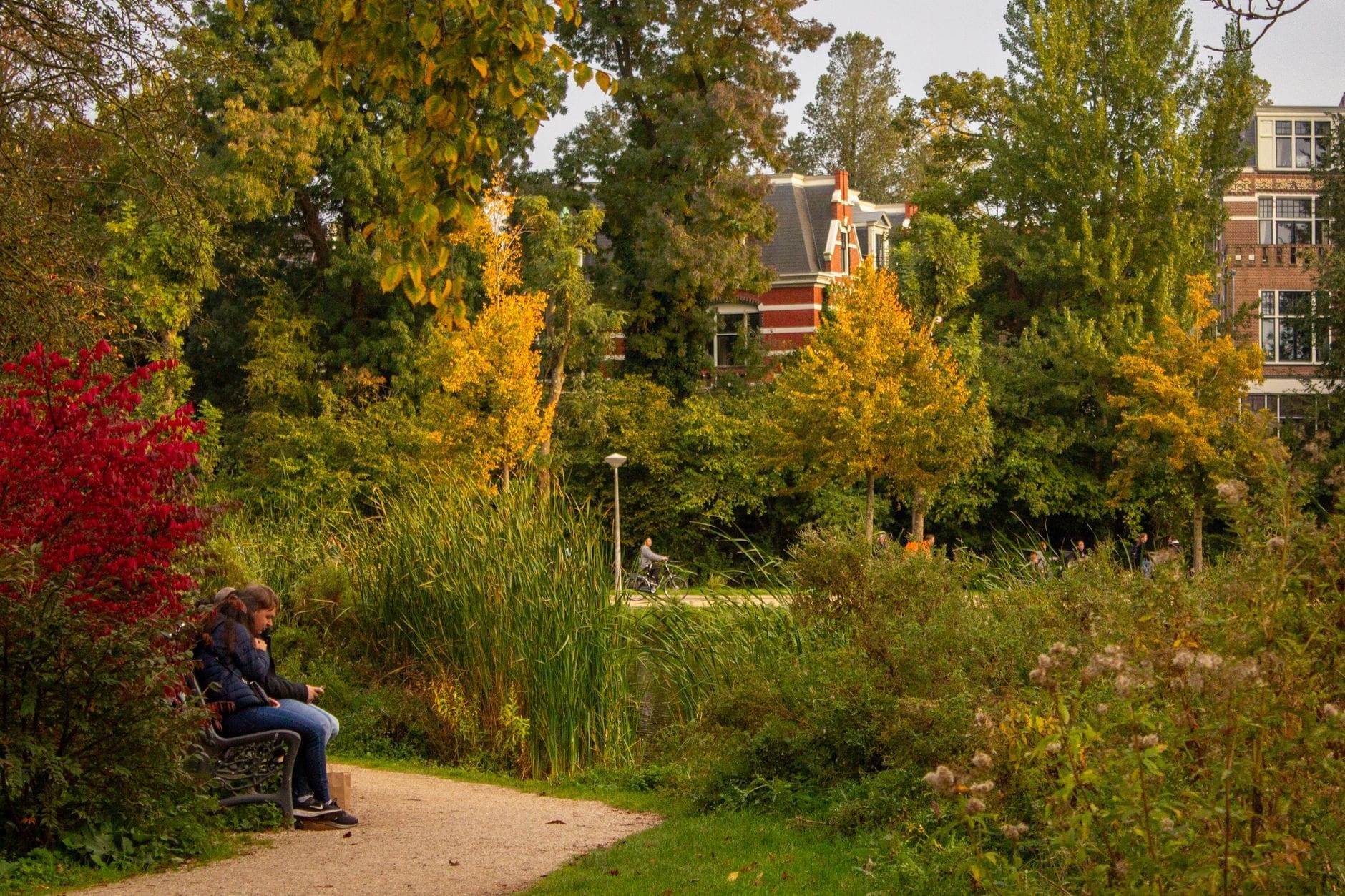
Autumn brings a different appeal. The tree cover, which includes a mix of horse chestnuts, oaks, and limes, turns amber and gold from late September onward. The park thins out, the light is lower, and the industrial buildings of the Westergasfabriek look particularly striking against grey skies. Winter is quiet and sometimes cold enough to feel raw, but the park stays open and a handful of the Westergas indoor venues provide warmth.
ℹ️ Good to know
Weather matters here more than at Amsterdam's indoor attractions. On rainy weekdays outside summer, the park has little shelter. The Westergas complex provides indoor options, but check in advance whether the venue you want is open on that day.
How to Navigate the Park and Complex
The park entrance most visitors use sits along the Haarlemmerweg, near the address Haarlemmerweg 4. From Amsterdam Centraal, Bus 21 runs to the Van Hallstraat stop, which puts you within a short walk of both the park and the Westergas entrance. Tram service patterns have changed in recent years, so check current GVB information for the latest routes to Van Hallstraat. From the Jordaan neighborhood, it is a walkable distance of about 10 to 15 minutes heading west from Haarlemmerplein.
Once inside, the layout is straightforward. The landscaped park occupies the eastern and central zone, with open lawns, tree-lined paths, and the water feature at the center. The Westergasfabriek buildings cluster at the western end, arranged around a central courtyard. A path runs the full length of the park from east to west, connecting the two zones. Allow at least an hour if you want to walk the park properly and spend time in the Westergas courtyard.
The park is reported to be largely accessible for wheelchair users, with paved and compacted paths covering most of the main routes. Some of the lawned areas and informal paths may be less manageable after heavy rain. The Westergas buildings themselves have varying levels of accessibility depending on the specific venue.
Food, Drink, and the Sunday Market Scene
Several restaurants and cafes operate within the Westergas complex, ranging from a large terrace restaurant inside one of the converted industrial halls to smaller coffee stands in the courtyard. Quality and opening times vary by venue. On the first Sunday of most months, the Westergas grounds host a popular organic and artisan Sunday Market, drawing locals from across the west side of the city. If you are visiting on a weekend, this is worth timing your visit around. For other Amsterdam market options, the Noordermarkt in the Jordaan runs a well-regarded Saturday farmers market.
Bring a picnic if the weather looks reasonable. The park's lawns are genuinely used for this purpose by Amsterdam residents, and there is nothing performative about eating outside here. The combination of the green space and the industrial backdrop of the Westergas buildings gives the park a texture that most city parks lack.
Photography and Practical Considerations
The strongest photographic subjects in Westerpark are the Westergas industrial buildings themselves, particularly the large gasometer structure and the brick chimneys, which create clean geometric shapes against the sky. The contrast between the ornate Victorian-industrial brickwork and the surrounding lawns and trees is the visual identity of the place. Morning light from the east hits the western buildings directly; late afternoon light reverses this and adds warmth to the brick.
If you are building a day around the western part of Amsterdam, Westerpark pairs naturally with a walk through the Jordaan neighborhood and the nearby canals. The Haarlemmerstraat, which connects central Amsterdam to Haarlemmerplein at the park's eastern approach, is one of the city's better streets for independent shops and cafes. A canal cruise departing from central Amsterdam can also drop you near the Jordaan, making a combined afternoon practical.
Wear comfortable shoes. The park paths are mostly flat and paved, but the lawned areas can be uneven and muddy after rain. Bring a layer in spring and autumn; Amsterdam's oceanic climate means temperatures can drop quickly when the sun goes in.
Who This Park Is and Is Not For
Westerpark suits travelers who are interested in how Amsterdam actually functions as a city, not just as a backdrop for landmarks. It is a good choice if you want time outdoors, if you are visiting on a weekend when the market or a Westergas event is running, or if you are staying in the Jordaan or Amsterdam West and want a park close to your accommodation.
If you are on a short visit and prioritizing the major museum collections, Westerpark is lower on the list. It is not a landmark attraction in the same category as the Rijksmuseum or the Anne Frank House. Its value is atmospheric and contextual rather than sightseeing. Travelers who find urban parks uninteresting will not find enough here to justify a dedicated trip. Those who appreciate industrial architecture, open space, and local daily life will find it worthwhile.
Insider Tips
- The monthly Sunday organic market in the Westergas courtyard typically runs from roughly 12pm to 6pm and is substantially more relaxed than the tourist-facing markets in the city center. Arrive before noon for the best selection of fresh produce and artisan food stalls.
- The large gasometer building (the cylindrical structure at the western end of the complex) is the architectural centerpiece. Walk around the full exterior rather than just the main entrance side; the back elevation is more photogenic and rarely has people in frame.
- If you are cycling through Amsterdam, the park paths connect to the broader cycling network heading west toward the ring road. You can enter from the Haarlemmerweg side and exit near the Westergasfabriek onto routes that continue into the wider city without touching major traffic roads.
- Several of the Westergas venue spaces host club nights and cultural events on Friday and Saturday evenings. These are ticketed separately and tend to be attended by Amsterdam locals rather than tourists. Check the Westergas website for the current programme before your visit.
- The park is notably less crowded on weekday mornings year-round. If you want the full space to yourself for a quiet walk or photography, Tuesday or Wednesday mornings before 10am are reliably quiet.
Who Is Westerpark For?
- Travelers who want a genuine local park experience away from the main tourist circuit
- Architecture enthusiasts interested in adaptive reuse of industrial heritage buildings
- Visitors staying in the Jordaan or Amsterdam West looking for nearby green space
- Weekend visitors who want to combine a market visit with outdoor time
- Photographers looking for the contrast of Victorian industrial brick against landscaped parkland
Nearby Attractions
Other things to see while in Jordaan:
- Amsterdam Cheese Museum
Tucked into a building on Prinsengracht, often described as dating from around 1600, the Amsterdam Cheese Museum offers a free, compact introduction to Dutch cheese culture, complete with tastings and exhibits. It sits two minutes from the Anne Frank House, making it a natural addition to a Jordaan afternoon.
- Amsterdam Tulip Museum
Tucked into a canal house on Prinsengracht, directly across from the Anne Frank House, the Amsterdam Tulip Museum traces 400 years of tulip history, from Ottoman origins to the chaos of Tulip Mania and the flower's enduring grip on Dutch identity. Small in scale but precise in focus, it rewards curious visitors who want context beyond the postcard.
- De Negen Straatjes (The Nine Streets)
De Negen Straatjes, or The Nine Streets, is a grid of nine historic cross-streets threading through Amsterdam's Canal Ring between the Singel and Prinsengracht. Free to explore at any hour, the area blends 17th-century canal architecture with independent boutiques, specialist food shops, and unhurried café culture. It rewards slow walkers and curious browsers far more than shoppers with a checklist.
- Het Schip Museum
Museum Het Schip occupies a landmark 1919 public housing complex designed by Michel de Klerk, the defining genius of the Amsterdam School movement. Part architecture museum, part social history, it offers one of Amsterdam's most distinctive and undervisited cultural experiences.
Planning a trip? Discover personalized activities with the Nomado app.