Wat Phra That Doi Suthep: Chiang Mai's Most Sacred Temple
Perched 1,073 metres above sea level on the forested slopes of Doi Suthep mountain, Wat Phra That Doi Suthep is the spiritual heart of Chiang Mai. With a gold-plated chedi that catches the light at every hour and panoramic views stretching across the city below, it rewards visitors who come prepared and time their arrival well.
Quick Facts
- Location
- Doi Suthep-Pui National Park, approx. 15 km northwest of Chiang Mai Old City
- Getting There
- Red songthaew from Chiang Mai Zoo or Nimman Road (shared, ~40–50 THB/person); private taxi or Grab also available
- Time Needed
- 1.5 to 2.5 hours including the climb and temple circuit
- Cost
- 30 THB entry for foreign adults; funicular (Naga tram) up the staircase ~20 THB one way
- Best for
- History lovers, photography, spiritual seekers, first-time visitors to Chiang Mai
Why Doi Suthep Belongs on Your Itinerary
Wat Phra That Doi Suthep is not simply a popular attraction. It is the defining symbol of Chiang Mai and one of the most revered Buddhist sites in northern Thailand. The temple was founded in 1383, reportedly after a sacred white elephant carried a relic of the Buddha up the slopes and died here, marking the site as spiritually significant. Nearly six and a half centuries later, the chedi that crowns the compound still holds that relic, drawing both pilgrims and travellers in roughly equal measure every single day.
Understanding this dual purpose shapes how you experience the site. On weekday mornings, monks chant inside the covered galleries, incense drifts through the air, and Thai worshippers press gold leaf onto bronze Buddha images with quiet concentration. On weekend afternoons, tour groups from across Asia move through in guided clusters. The temple can hold both crowds gracefully, but if you want the contemplative version, you need to choose your timing deliberately. For broader context on planning your visit to the city's sacred sites, the Chiang Mai temples guide offers a useful overview of how Doi Suthep compares to other key wats.
💡 Local tip
Arrive by 7:30 AM to experience the morning chanting, cooler air, and the chedi glowing in low-angle sunlight without the tour-bus crowds. The temple opens at 6:00 AM.
The Climb: Naga Staircase and the Funicular Option
From the lower car park, you face the famous Naga staircase: 309 steps flanked by two enormous multi-headed serpents, their ceramic-tiled bodies rippling down the full length of the climb. The balustrades are believed to date from the 16th century, and every head and scale has been restored and repainted multiple times since. Walking up takes most visitors around 10 to 15 minutes at a moderate pace. The steps are uneven in places, and on rainy days they become genuinely slippery, so footwear with grip matters.
For those who prefer not to climb, a small funicular tram runs parallel to the staircase for about 20 THB per ride. It operates during temple hours, though it occasionally stops for maintenance with no advance notice. The tram is a practical choice for visitors with limited mobility, but note that inside the temple compound itself, the terrain involves further steps and uneven stone surfaces. There is no fully flat circuit through the main chedi area.
⚠️ What to skip
After heavy rain, the Naga staircase steps become very slippery. Sandals with no grip are a real risk. If you are visiting during the wet season (June to October), bring or wear closed-toe shoes with rubber soles.
Tickets & tours
Live prices and dates from our booking partner. If you book, we may earn a commission at no extra cost to you.
Chiang Mai private van day trip to Doi Suthep, Sticky Waterfall
From 146 €Instant confirmationFree cancellationHalf-day private van tour to Doi Suthep and Wat Pha Lat
From 79 €Instant confirmationFree cancellationHalf-day tour to Doi Suthep and White Hmong Hill Village
From 146 €Instant confirmationFree cancellationDoi Suthep and Wat Pha Lat temples hiking tour
From 16 €Instant confirmationFree cancellation
Inside the Temple Compound: What You're Looking At
The entrance fee (30 THB for foreign visitors) is collected at a booth just before the top of the stairs. Dress code is strictly enforced: shoulders and knees must be covered. Sarongs and wraps are available to borrow or rent at the entrance if you arrive underprepared, but the selection is limited in busy periods.
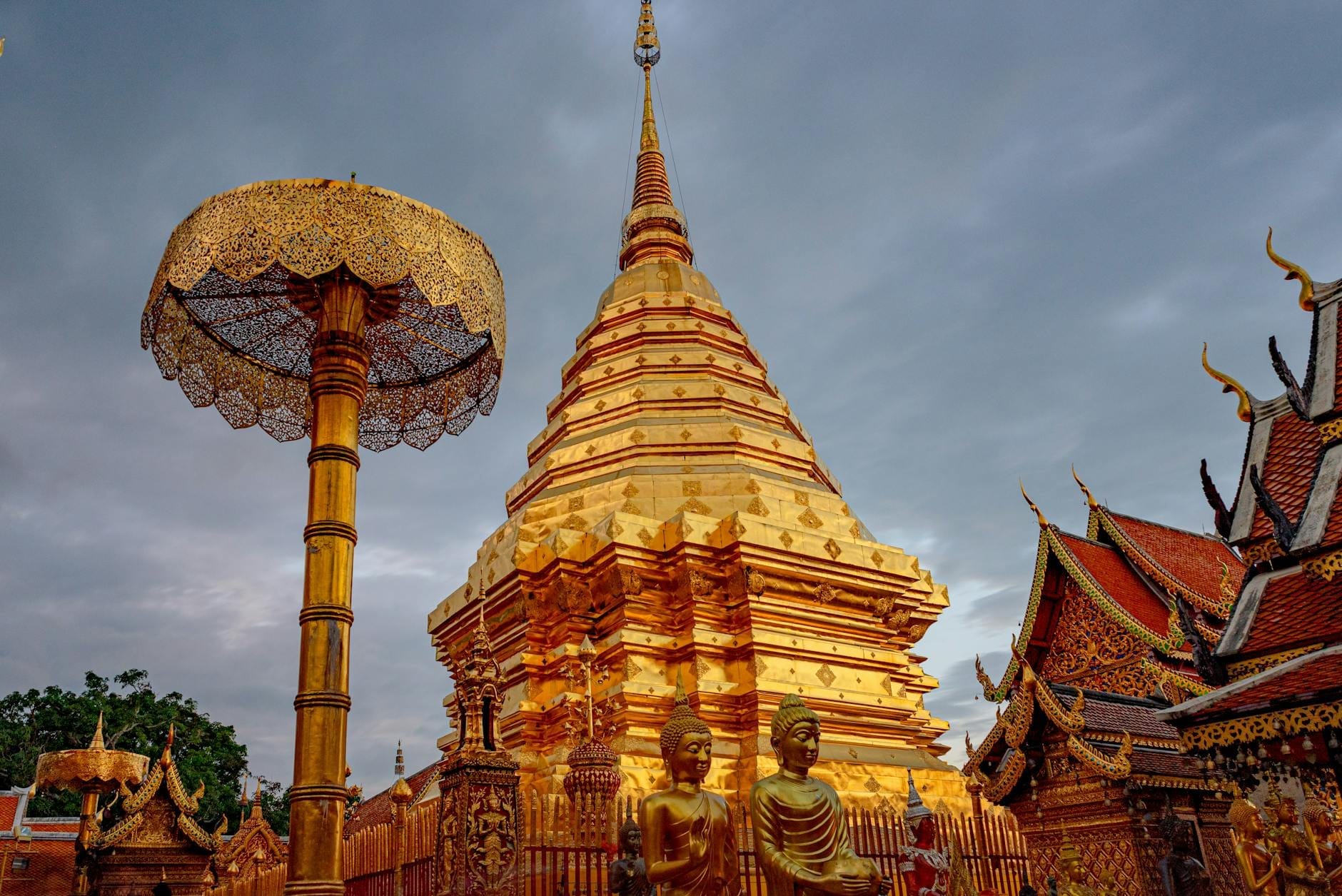
The central chedi, plated in copper gilded with gold, rises approximately 22 metres above its square base and is surrounded by four smaller chedis and a series of bronze Buddha images at each cardinal point. Worshippers walk clockwise around the central structure, ringing the line of bells as they pass. The sound is rhythmic and layered when multiple people are doing it simultaneously, one of those small details that shifts the sensory experience from tourist site to genuinely atmospheric place.
The covered gallery that wraps the inner compound contains murals depicting the life of the Buddha and the founding legend of the temple. They are partially faded in sections but legible enough to follow the narrative. Informational plaques in English are present but unevenly written, so reading ahead about the founding legend before your visit pays off.
The wider compound includes several viharns (assembly halls), a bronze statue of the white elephant central to the founding legend, and various shrines. Photography inside the covered wiharn buildings is often restricted, though rules are inconsistently enforced. The outer terrace, however, offers sweeping views of Chiang Mai below, particularly clear in the cool season. For photographers planning their visit strategically, the Chiang Mai photography guide has specific advice on light conditions at Doi Suthep and other key locations.
How the Experience Changes Through the Day
Early Morning (6:00 AM to 9:00 AM)
This is the most rewarding window for most visitors. The air at 1,073 metres is noticeably cooler than the city below, especially from November through February when you may need a light layer. The chedi catches the early sun from the east, and the gold surface shifts from copper-toned to brilliant yellow as the light strengthens. Morning mist sometimes fills the valley, so the views from the terrace can be dramatic or completely obscured depending on the day.
Mid-Morning to Afternoon (9:00 AM to 3:00 PM)
Tour buses begin arriving from around 9:00 AM and the staircase fills steadily. By 10:30 AM on weekends, the compound holds several hundred people simultaneously and the circuit around the chedi slows to a shuffle. This is not an experience-breaking crowd level, but it is noticeably different from the early morning quiet. The heat also builds significantly by noon, and the stone surfaces reflect considerable warmth.
Late Afternoon (3:00 PM to 6:00 PM)
Crowds thin between 3:00 and 4:00 PM as tour groups return to the city. The late afternoon light is golden and flattering for photography. Sunset from the terrace can be exceptional, particularly from October through January when the sky is usually clear. The inner temple area generally closes around 6:00 PM while the grounds remain accessible longer, so arriving at 4:30 PM gives you roughly 90 minutes in softening light with fewer people.
Getting There and Back: Practical Routes
The most common approach is to take a shared red songthaew (pickup truck taxi) from the area near Chiang Mai Zoo or from Nimman Road. Drivers collect passengers until the vehicle fills, typically charging 40 to 50 THB per person. The road to the temple winds upward through Doi Suthep-Pui National Park for about 15 kilometres from the city centre (around 11–13 kilometres from the zoo area), taking 20 to 30 minutes depending on traffic. For a broader orientation of how to move around the city efficiently, the getting around Chiang Mai guide covers songthaew logistics in detail.
Private taxis and Grab cars are available for those who prefer a door-to-door option, typically costing 200 to 300 THB one way from the Old City. Motorbike rental is feasible if you are a confident rider, as the road has consistent uphill curves. Parking at the temple is available for those driving themselves.
ℹ️ Good to know
Return songthaews fill from the lower car park area throughout the day. In the late afternoon, waits can stretch to 20 minutes. If you are on a schedule, arranging a private return in advance avoids uncertainty.
Many visitors combine Doi Suthep with other sites in the surrounding area, including Bhuphing Palace, the royal winter residence a short drive further up the mountain, and the nearby Doi Pui Hmong Village. Factor in an extra hour for each if you plan to combine them.
Who This Temple Suits and Who Might Be Disappointed
For first-time visitors to Chiang Mai, Doi Suthep is genuinely worth the trip. The combination of architectural scale, historical depth, mountain setting, and city views is hard to match at any single site in the region. It belongs in any serious Chiang Mai itinerary precisely because it is central to understanding the city's identity.
That said, visitors who have already explored northern Thailand's temple circuit may find the experience familiar rather than revelatory. Travellers specifically seeking off-the-path discoveries should supplement Doi Suthep with lesser-visited sites rather than replacing it. The Chiang Mai hidden gems guide suggests alternatives for those who want to go beyond the standard circuit.
Visitors with significant mobility limitations should know that while the funicular bypasses the Naga staircase, the compound itself involves uneven stone paving, steps between terraces, and no continuous accessible route around the central chedi. The views from the lower terrace are accessible without climbing further, but the full circuit is not wheelchair-friendly.
Visiting During Special Periods
Doi Suthep draws especially large crowds during Buddhist holidays, when candlelit processions and offerings create an atmosphere entirely different from a standard visit. Visakha Bucha, Makha Bucha, and Asalha Bucha are the three most significant dates. During the Yi Peng Lantern Festival in November, the temple grounds are particularly atmospheric after dark. Read the Yi Peng lantern festival guide if you are planning your visit around that period.
During the burning season from February through April, haze from agricultural burning in the region can reduce visibility from the temple terrace to near zero and make outdoor time at altitude unpleasant. The chedi itself remains worth seeing regardless of air quality, but the panoramic view over the city that many visitors anticipate may be absent entirely. This is an honest limitation of visiting in that window.
Insider Tips
- The small market stalls at the base of the Naga staircase sell fresh-cut fruit, spring rolls, and Thai iced tea at reasonable prices. Eat before you climb rather than after, when hunger and heat both peak.
- The temple's monks give morning blessings to visitors who approach respectfully and ask. Arrive before 8:00 AM and sit quietly near the main wiharn to observe, or participate if invited. This is not a scheduled tourist activity, so approach with genuine respect rather than as a photo opportunity.
- If you want the clearest possible view of Chiang Mai from the terrace, come between November and January after several days of rain, which scrubs the air clean. Mid-January mornings often offer the sharpest visibility of the year.
- The botanical path along the outer edge of the upper car park area leads to a quieter viewpoint away from the main terrace crowds. It is unmarked and easy to overlook, but worth finding if you want five minutes of stillness.
- Dress code is enforced at the gate but enforcement varies inside. Bring your own lightweight long pants or a scarf rather than relying on the temple's loaner sarongs, which are often damp or poorly fitting during peak hours.
Who Is Wat Phra That Doi Suthep For?
- First-time visitors to Chiang Mai wanting to understand the city's spiritual and historical identity
- Photographers seeking golden-hour shots of a major gilded chedi against mountain and valley backdrops
- Travellers interested in Lanna Buddhist architecture and iconography
- Families with older children who can manage the staircase climb
- Anyone combining a temple visit with the national park scenery of Doi Suthep-Pui
Nearby Attractions
Other things to see while in Doi Suthep & Mountain Area:
- Bhuphing Palace (Bhubing Palace)
Perched on the slopes of Doi Buak Ha in Doi Suthep-Pui National Park at around 1,000–1,200 metres elevation, Bhuphing Palace is the Thai royal family's official winter residence in the north. When the royals are not in residence, the palace grounds open to visitors who come for the manicured formal gardens, cool mountain air, and sweeping valley views across Chiang Mai.
- Chiang Mai Night Safari
Chiang Mai Night Safari is Thailand's largest night zoo, where open-air tram rides carry visitors through illuminated savannah and forest zones after dark. It's a family-oriented attraction with genuine nocturnal animal encounters, though the experience varies significantly depending on when you go and which zones you prioritize.
- Chiang Mai Zoo
Spread across forested hillside terrain at the base of Doi Suthep, Chiang Mai Zoo is one of northern Thailand's most visited family attractions. Home to giant pandas, big cats, reptiles, and hundreds of species, it offers a full day of wildlife encounters in a setting that feels closer to a nature park than a concrete enclosure.
- Doi Pui Hmong Village
Perched at over 1,200 meters on the slopes above Chiang Mai, Doi Pui Hmong Village offers a window into northern Thailand's Hmong hilltribe communities, complete with a small opium history museum, traditional textile vendors, and cool mountain air. It sits just beyond Wat Phra That Doi Suthep, making it a logical extension of any mountain day trip.
Planning a trip? Discover personalized activities with the Nomado app.