Wat Chalong (Wat Chaiyathararam): Phuket's Most Sacred Temple
Wat Chalong is the most visited and most spiritually significant Buddhist temple in Phuket. Free to enter and open daily, it combines active religious life with genuine historical depth — from a 19th-century rebellion to a relic brought from Sri Lanka.
Quick Facts
- Location
- 70/6 Moo 6, Chao Fah Tawan Tok Road, Chalong, Mueang Phuket District
- Getting There
- Taxi or Grab from Phuket Town (~20 min), Patong (~30 min), or Kata (~15 min); free on-site parking
- Time Needed
- 45 minutes to 1.5 hours
- Cost
- Free entry
- Best for
- Culture seekers, history lovers, photography, combining with a Rawai-Chalong half-day
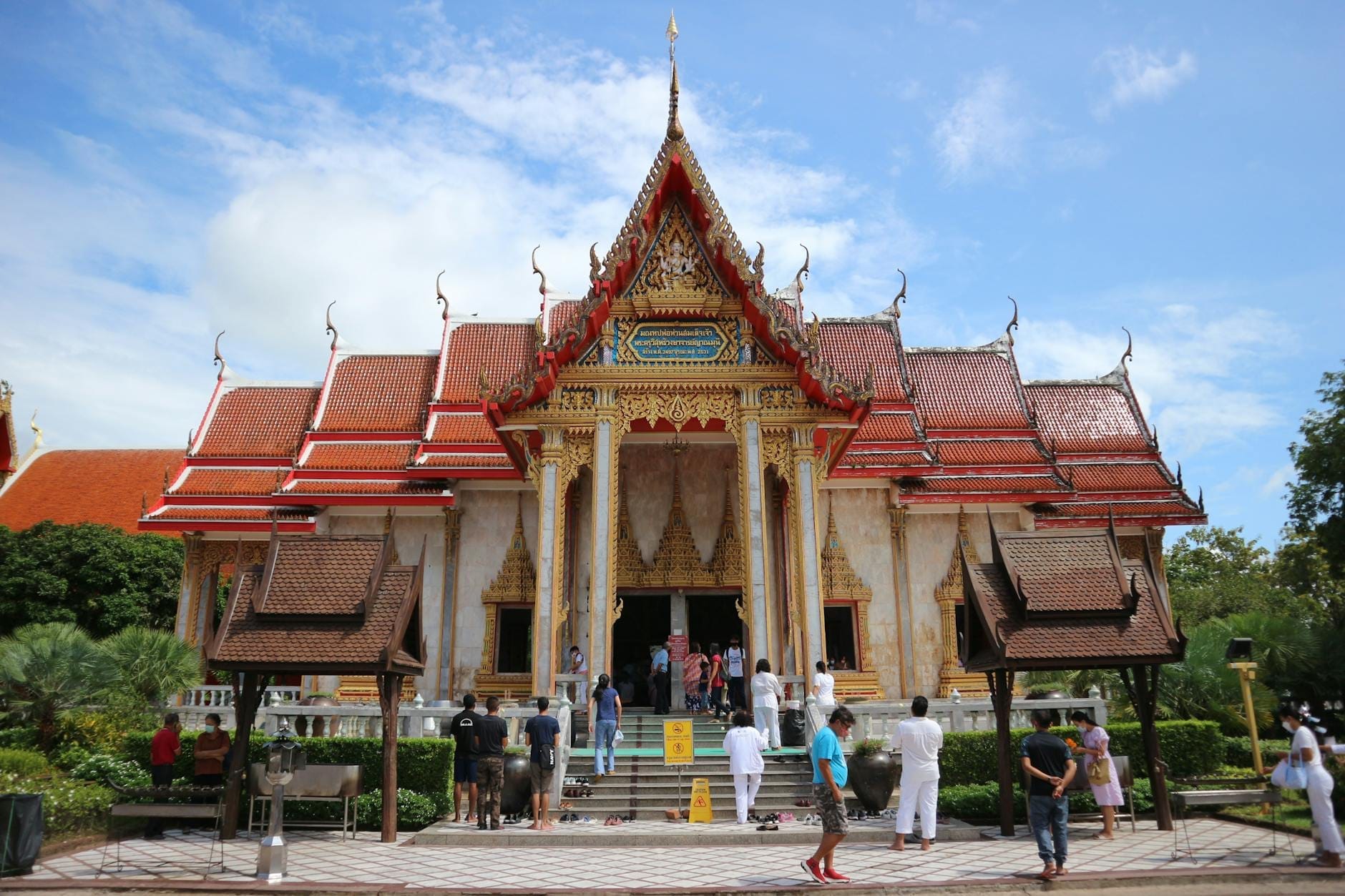
What Wat Chalong Actually Is
Wat Chalong, officially named วัดไชยธาราราม (Wat Chaiyathararam), is the largest and most visited Buddhist temple complex on Phuket island. Unlike many temples that have become purely tourist spectacles, Wat Chalong remains a functioning place of worship where local families, students, and monks go about daily religious life. That tension between sacred space and high visitor footfall is something you feel immediately when you walk through the gates.
The complex sits roughly 8 to 9 kilometres south of Phuket Town along Chao Fah Tawan Tok Road, in the Chalong subdistrict. It is easy to spot on approach: the 60-metre Phra Mahathat Chedi dominates the skyline, its white-and-gold spire rising above the surrounding palms and low-rise rooftops. Several ornate buildings cluster around it, connected by wide paved courtyards. Entry is free, and the grounds are open daily from 7:00 AM to 5:00 PM.
ℹ️ Good to know
Dress code strictly enforced: shoulders and knees must be covered. No shorts, sleeveless tops, or short skirts. Sarongs are sometimes available at the entrance, but bringing your own is more reliable.
History: Why This Temple Matters
The temple was founded around 1837, making it nearly two centuries old, though its prominence grew significantly from 1846 onward. The event that cemented Wat Chalong's place in Phuket's collective memory came in 1876, during the violent Angyee rebellion, when Chinese tin-mine workers rose against their conditions and the unrest spread across the island.
Two revered abbots, Luang Pho Chaem and Luang Pho Chuang, opened the temple grounds as a refuge and used traditional herbal medicine to treat the injured on both sides of the conflict. Their compassion during a period of bloodshed earned them a status close to sainthood in local memory. Wax effigies of both monks are enshrined inside the main viharn, and you will see worshippers praying directly to these figures, placing flowers, incense sticks, and gold leaf. It is not theatrical — the reverence is genuine.
The towering Phra Mahathat Chedi, which visually dominates the site today, is a more recent addition. Construction began in 1991 and was completed in 2001. Inside the chedi, a fragment of bone believed to be a relic of the Buddha was enshrined in 1999, brought from Sri Lanka. This relic is the primary reason the chedi holds such religious weight for Theravada Buddhist visitors.
Tickets & tours
Hand-picked options from our booking partner. Prices are indicative; availability and final rates are confirmed when you complete your booking.
Morning guided tour at hidden forest elephant reserve in Chalong
From 72 €Instant confirmationFree cancellationAfternoon guided tour at hidden forest elephant reserve in Chalong
From 72 €Instant confirmationFree cancellationMuay Thai Boxing Tickets at Patong Boxing Stadium
From 56 €Instant confirmationFree cancellationPhuket Island and Big Buddha Private Tour
From 125 €Instant confirmationFree cancellation
A Walkthrough of the Complex
Most visitors enter from the main car park and walk toward the first major hall, the Grand Viharn Luang Pho Chaem, which houses the life-size wax figures of the two revered monks seated in meditation. The interior is cool and heavily decorated with murals depicting scenes from Buddhist cosmology. Incense smoke hangs in the air. Worshippers kneel on tiled floors, and the quiet here is different from the quiet outside — it has weight to it.
Crossing the courtyard, you pass smaller shrines and spirit houses before reaching the base of the Phra Mahathat Chedi. A staircase leads to interior galleries where painted murals illustrate the life of the Buddha across three floors. The higher you climb, the fewer visitors you encounter, and from the upper level you get an unobstructed view across the Chalong rooftops toward the hills to the east.
Several other buildings in the complex include the Ubosot (ordination hall), additional viharns with Buddha images in various mudras (hand gestures), and open pavilions where monks read or receive laypeople. Each structure has its own character. Rushing through the entire site takes 30 minutes; taking your time takes 90.
💡 Local tip
Photography inside the main viharns is generally permitted, but always ask before photographing worshippers in prayer. A small nod of acknowledgment before pointing your camera toward a monk goes a long way.
How the Experience Changes by Time of Day
Morning visits, between 7:30 and 9:30 AM, offer the most authentically Thai experience. Local worshippers arrive early, monks are visible moving through the grounds, and the light is soft and angled, which helps enormously for photography. The incense at the main shrines is freshest, and the courtyards are quiet enough that you can hear the temple bells and distant prayer chants.
By mid-morning, tour buses begin arriving in groups, and the energy shifts noticeably. From roughly 10:30 AM through to 2:00 PM, the main courtyards fill with visitors from resort areas across the island. This is not necessarily a bad time to come, but managing expectations is useful: it feels more like sightseeing than contemplation during these hours.
Late afternoon, from around 3:30 PM onward, sees the tour groups thin out. Light turns golden well before closing time. The monks return from their afternoon duties and the temple settles back into a quieter rhythm. If you are coming from the southern beaches like Rawai or Kata, late afternoon fits naturally into a half-day itinerary.
Combining Wat Chalong with nearby Chalong Bay or a drive up to the Big Buddha (visible from the chedi and only a 10-minute drive away) makes for a coherent half-day in the south of the island.
Practical Information and Getting There
There is no reliable public bus that drops directly at the temple gate, so most independent travellers arrive by taxi, Grab, motorbike rental, or as part of a guided tour. From Phuket Town the drive takes roughly 20 minutes; from Patong, allow 30 to 35 minutes depending on traffic at Chalong Circle. From Kata and Karon beaches, the journey is closer to 15 minutes.
Free on-site parking is available for both cars and motorbikes. The parking area can fill up on weekends and during major Thai Buddhist holidays such as Makha Bucha, Visakha Bucha, and Asalha Bucha, when the temple holds special ceremonies and draws very large local crowds. If you happen to visit during these occasions, the atmosphere is extraordinary, but plan for limited parking and significantly more people.
If you are planning your visit as part of a wider itinerary across Phuket's south, the Rawai and Chalong area rewards spending a full day rather than just stopping at one attraction.
⚠️ What to skip
During major Buddhist holidays, the temple fills with thousands of worshippers. The experience is remarkable, but arriving by motorbike or Grab is strongly preferable to self-driving a car — parking becomes genuinely difficult.
Honest Assessment: Is It Worth Your Time?
Wat Chalong earns its place near the top of most Phuket itineraries, but not for reasons that photographs easily convey. The architecture is ornate rather than minimalist, the crowds at peak hours are real, and anyone expecting meditative calm at noon on a Saturday will be disappointed. What the temple offers instead is access to active spiritual life in a country where Buddhism shapes daily existence in ways that are not always visible elsewhere.
For travellers whose Phuket trip is primarily beach-focused, a 90-minute visit to Wat Chalong provides genuine cultural grounding that a day at Patong or Surin does not. For travellers who have already visited Thai temples in Bangkok or Chiang Mai, Wat Chalong will feel familiar in structure but distinct in atmosphere — smaller, less formidable, more approachable than Wat Pho or Doi Suthep, and still clearly alive as a community centre.
Who might reasonably skip it: travellers with very limited time who have visited multiple Thai temples already, or anyone for whom temple visits hold no particular interest. The complex is not a museum and does not present itself as one. If you need a narrative structure to stay engaged, the historical story of the 1876 rebellion gives you one.
For broader context on how to structure your time across the island, the Phuket itinerary guide places Wat Chalong within a realistic day-by-day framework.
Insider Tips
- Buy a small bundle of incense sticks and lotus flowers from the vendors near the entrance (usually 20 THB) before entering. Making an offering at the main shrine feels more meaningful than simply observing, and local worshippers appreciate visitors who participate respectfully.
- The upper floors of the Phra Mahathat Chedi are often empty even when the courtyard below is crowded. Take the staircase up for both the murals and a clear sightline toward the Big Buddha on the hill to the northwest.
- Buddhist holidays according to the Thai lunar calendar fall on different Gregorian dates each year. A quick search before your visit will tell you if a major ceremony is planned — these are genuinely worth timing a visit around, provided you arrive early.
- The small market stalls along the entrance road sell amulets, religious items, and cold drinks. The amulets here are intended for worship rather than tourism, but vendors are accustomed to curious foreign visitors. Prices are fixed and modest.
- Morning light enters the main viharn from the east, creating warm, low angles inside the building between roughly 7:30 and 9:00 AM. If interior photography matters to you, that window is worth planning around.
Who Is Wat Chalong For?
- First-time visitors to Phuket wanting cultural context beyond the beaches
- Photographers interested in religious architecture and candid documentary shots
- History enthusiasts drawn to the 1876 Angyee rebellion story
- Families looking for a calm, free, and educational half-morning activity
- Travellers combining the south of the island into a single half-day loop
Nearby Attractions
Other things to see while in Rawai & Chalong:
- Black Rock Viewpoint
Perched at roughly 290 meters above southern Phuket, Black Rock Viewpoint — known in Thai as Pa Hin Dam, or 'Black Rock Cliff' — delivers a sweeping panorama over Nai Harn Beach, Nui Beach, and the open Andaman Sea. It's free, it's rarely crowded, and getting there requires a genuine effort through jungle trails or steep dirt roads. That effort is precisely what keeps it worth making.
- Chalong Bay
Chalong Bay (Ao Chalong) is Phuket's largest and most active boat anchorage, serving as the main departure point for island day trips, dive boats, and yacht charters. It's not a swimming beach, but understanding what it is makes it genuinely useful for any southern Phuket itinerary.
- Coral Island (Koh Hae)
Koh Hae, known to most visitors as Coral Island, is a small island roughly 3 km southeast of Phuket, reachable by speedboat in under 20 minutes from Chalong Pier or Rawai Beach. It offers two sandy beaches, accessible snorkeling over coral reefs, and a range of watersports — without the full-day commitment of Phi Phi or Racha Island.
- Nai Harn Beach
Tucked into Phuket's southern tip, Nai Harn Beach offers a rare combination of clear water, genuine calm, and striking natural scenery. At roughly 700 meters long, it stays manageable even in peak season, drawing a mix of long-term expats, families, and travelers who've learned that louder doesn't mean better.