Big Buddha Phuket: What to Expect at Phra Phuttha Ming Mongkol Eknakiri
Standing 45 meters tall on Nakkerd Hill above Chalong, the Big Buddha Phuket is the island's most recognizable landmark. Entry is free, the panoramic views stretch from Kata to Chalong Bay, and the site carries genuine religious significance for Thai Buddhists. Here is everything you need to visit well.
Quick Facts
- Location
- Nakkerd Hill, Chalong, Phuket (near Kata-Karon area)
- Getting There
- Taxi or motorbike via Chaofa West Rd from Chalong Roundabout; no direct public songthaew to the summit
- Time Needed
- 1 to 2 hours
- Cost
- Free entry; donations welcomed
- Best for
- Panoramic views, Buddhist culture, photography, family outings
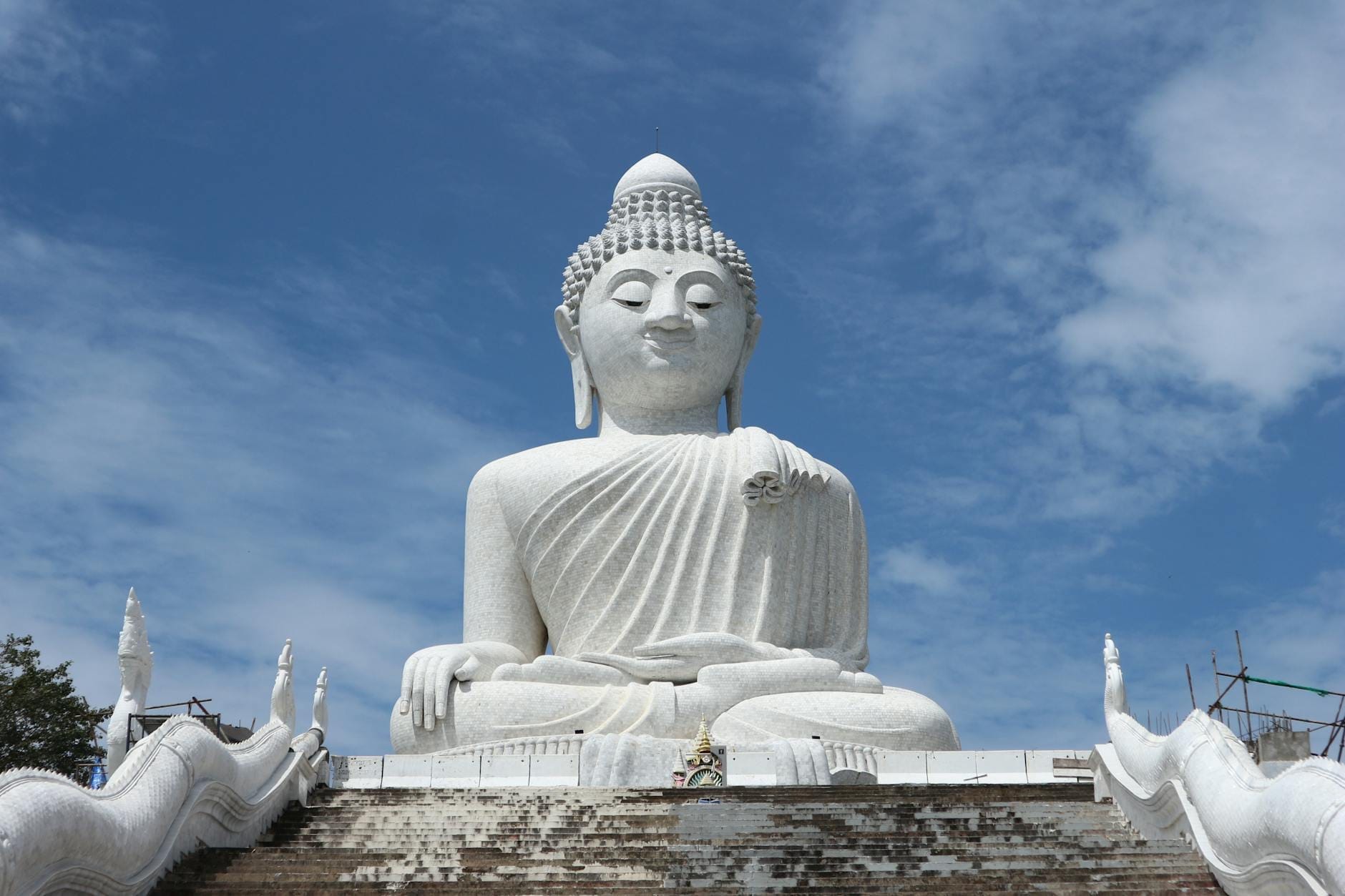
What Is the Big Buddha Phuket, Exactly?
The Big Buddha Phuket, known formally as Phra Phuttha Ming Mongkol Eknakiri (Thai: พระพุทธมิ่งมงคลเอกนาคคีรี), is a 45-meter-tall seated Maravija Buddha image clad in white Burmese marble, seated on a 25-meter-wide base at roughly 400 meters above sea level on Nakkerd Hill. Construction began in 2002, intended as a tribute to King Bhumibol Adulyadej. The site received its official royal name in 2007 and was designated as Phuket's Buddhist Treasure in 2008. A 9-meter brass statue stands on the adjacent grounds.
The statue is visible from large parts of southern Phuket on clear days, appearing above the treeline as you drive between Kata, Karon, and Chalong. Up close, the marble cladding has an almost luminous quality in direct sunlight, and the scale only becomes apparent when you are standing beneath the base and craning your neck upward. It is a functioning religious site: monks maintain the grounds, incense burns at the base shrines, and Thai visitors arrive daily to pray and make merit.
ℹ️ Good to know
Reopening note: The Big Buddha site was closed following a landslide and has reopened. Confirm current access and opening hours locally before visiting, as conditions may still be evolving.
The Approach: Getting Up Nakkerd Hill
The road to the summit is a single-lane winding climb off Chaofa West Road, roughly 6 kilometers of steep, winding asphalt that levels into a broad parking area near the top. By motorbike the ascent takes about five minutes from the Chalong Roundabout junction; by car or taxi, slightly longer because of the tight bends. There is no direct public songthaew service to the summit, so your realistic options are a rented motorbike, a hired tuk-tuk, a private taxi, or a Grab ride. Budget for around THB 300 to 500 return by taxi from central Chalong, though prices vary.
The parking area at the top is large enough to feel uncrowded outside peak hours. A row of small stalls sells bottled water, soft drinks, and souvenir items: Buddha images, elephant figurines, and silk scarves. The scarves matter practically because you will need to cover bare shoulders and knees before entering the main terrace.
If you are planning a longer day in the south of Phuket, the Big Buddha pairs naturally with a stop at Wat Chalong, the island's most important Buddhist temple, which sits at the base of the hill about 5 minutes away by road. Combining both in a half-day loop from Kata Beach is straightforward.
Tickets & tours
Hand-picked options from our booking partner. Prices are indicative; availability and final rates are confirmed when you complete your booking.
Phuket Island and Big Buddha Private Tour
From 125 €Instant confirmationFree cancellationPhuket Island tour with Big Buddha and iconic locations
From 114 €Instant confirmationFree cancellationFull-day tour to the highlights of Phuket City and its surroundings
From 71 €Instant confirmationFree cancellationFull-day luxury catamaran tour to Phi Phi Islands & Maithon from Phuket
From 146 €Instant confirmationFree cancellation
On the Terrace: What You Actually See and Feel
Walking up the final staircase from the parking area onto the main terrace, the statue's size hits differently than it did from a distance. The marble is not smooth in the way you might expect: up close it has a slightly granular texture, and the individual tiles are visible if you look carefully at the lower sections of the base. The color shifts from bright white in direct midday sun to a warm cream in the low-angle light of early morning or late afternoon.
The views from the terrace are the practical reward for most visitors. On a clear day you can see Chalong Bay to the southeast, the outlines of Racha Island on the horizon, the rooftops of Kata and Karon to the west, and the central ridge of Phuket's hills running northward. The wind at this elevation is consistent and noticeably cooler than at sea level, which makes the terrace genuinely pleasant to linger on even around midday.
Smaller Buddha images and votive bells surround the base of the main statue. Visitors can purchase a small bell and write their name on it before hanging it as an offering. The sound of dozens of bells moving in the hill wind is one of those incidental details that makes the place feel distinctly different from a conventional tourist attraction.
💡 Local tip
Photography tip: The best light for shooting the statue falls in the early morning (before 9:00) when the sun is low and to the east, casting warm tones across the marble and keeping the sky deep blue rather than washed out. Afternoon shoots work well for the western sea views.
How the Experience Changes by Time of Day
Arrive between 6:30 and 8:00 and you will share the terrace mainly with Thai worshippers and the occasional jogger who has made the hill climb for exercise. The monks' chanting may be audible. The air smells of incense and damp morning air. This is the quietest, most atmospheric window of the day.
By 10:00, tour groups begin arriving in waves, typically from Patong and the hotel areas around Kata and Karon. The parking area fills noticeably, and the stairway up to the terrace becomes a steady two-way flow of visitors. Between 10:30 and 14:00 the site is at its most crowded, the marble reflects a harsh white glare, and temperatures on the exposed terrace can feel oppressive. This is also when souvenir vendors are most active and vocal.
Late afternoon, from about 15:30 onward, the crowd thins again. The light softens considerably and the views toward the Andaman Sea take on a golden quality. The site closes at 18:30, and while full sunset is often after closing time depending on the season, the last hour before closing is a good balance of pleasant light and manageable visitor numbers.
Dress Code and Practical Logistics
The dress code is enforced. Shorts that stop above the knee, short skirts, sleeveless tops, and open-shoulder garments are not permitted on the main terrace. Sarongs and wraps are available to borrow or purchase at the stalls near the parking area. Wearing a light long-sleeved layer or loose linen trousers is the simpler solution if you are coming from the beach.
There are toilet facilities near the parking area. The path from the parking area to the terrace involves stairs but the gradient is moderate; however, no detailed accessibility information for wheelchair users is available, and the staircase design makes unassisted wheelchair access unlikely. The site operates daily from 6:30 to 18:30 (Google Maps indicates 6:00), though confirm locally as hours can shift slightly.
Bring water. The walk from parking to terrace is short but the exposed terrace and the tropical heat combine to make dehydration a real concern for visitors who linger. Vendors sell chilled water at the stalls, but carrying your own is cheaper and more convenient.
⚠️ What to skip
The road up Nakkerd Hill is steep and has tight bends. If you are renting a motorbike and are not a confident rider on inclines, consider going by taxi. Accidents on this stretch do happen, particularly during or after rain when the road surface becomes slippery.
Is It Worth Your Time? An Honest Assessment
The Big Buddha Phuket is one of the more defensible major attractions on the island. Entry costs nothing, the views are genuinely good on a clear day, and the religious context gives it substance beyond being purely a photo opportunity. It is not a contemplative or remote experience; you will share it with large numbers of other tourists, particularly during peak hours.
Visitors looking for an immersive Buddhist experience or deep historical engagement may find Wat Chalong below more rewarding, since it is a lived temple with a longer documented history and more architectural detail at ground level. But as a combined visit with Chalong Bay or the southern beaches, the Big Buddha earns its place.
If you are building a day around the south of the island, consider pairing the Big Buddha with Karon Viewpoint for a second panoramic perspective further along the coast road, or a swim at Kata Noi Beach to end the day. For a fuller picture of what the area offers, the things to do in Phuket guide has useful context on how this fits into a longer itinerary.
Visitors who may want to skip the Big Buddha: those with very limited time who have already seen large Buddha images elsewhere in Southeast Asia, anyone who finds heat and crowds at a rooftop site unrewarding, and travelers who cannot manage stairs or do not have private transport to reach the summit.
Insider Tips
- Arrive before 8:00 on weekday mornings if you want the terrace largely to yourself. Tour groups from the main resort areas rarely arrive before 10:00.
- The brass Queen Sirikit statue on the adjacent platform is often overlooked by visitors focused on the main image. It is worth a closer look and is usually less crowded.
- Pack a light long-sleeved shirt rather than relying on the sarongs at the stalls. The stall wraps are functional but can feel uncomfortable in the heat, and having your own cover-up means you can move freely without stopping to borrow one.
- If you are visiting during the rainy season (May to October), the hilltop can be cloud-covered by mid-morning. Arriving at opening time gives you the best chance of clear views before cloud builds.
- The small food stalls near the parking area sell freshly cut fruit and coconut water at fair prices. It is a better post-visit refreshment option than backtracking to a tourist restaurant.
Who Is Big Buddha Phuket For?
- First-time visitors to Phuket wanting the island's most iconic landmark
- Families with older children who can manage stairs and follow the dress code
- Photography enthusiasts targeting the early-morning marble light or the late-afternoon sea views
- Travelers interested in Thai Buddhist culture and merit-making traditions
- Anyone building a half-day loop through the Chalong and Kata-Karon area
Nearby Attractions
Other things to see while in Kata & Karon:
- Karon Beach
Stretching around 3-4 kilometres along Phuket's southwest coast, Karon Beach offers wide white sand, clear Andaman water, and noticeably fewer crowds than nearby Patong. It's a strong choice for beach walks, swimming in high season, and a quieter pace overall — but red flags and rip tides demand respect in the wet months.
- Karon Temple Market
Held twice weekly on the grounds of Wat Karon, the Karon Temple Market is one of the most approachable local markets in Phuket's Kata-Karon area. Free to enter, cash-friendly, and far less crowded than the big tourist night markets, it rewards visitors who show up hungry and unhurried.
- Karon Viewpoint
Karon Viewpoint, also called Three Bays Viewpoint, sits on a hilltop south of Kata Beach and delivers one of the most complete coastal panoramas in Phuket. Entry is free, the road is straightforward by scooter or car, and the payoff is a sweeping view of Kata Noi, Kata, and Karon bays curving into the Andaman Sea below.
- Kata Noi Beach
Hat Kata Noi sits tucked below a rocky headland on Phuket's southwest coast, separated from the larger Kata Beach by a ridge that most visitors never bother crossing. At roughly 700 to 850 meters long, it is compact, clean, and noticeably quieter than anything in Patong or Karon. The trade-off is limited facilities and a steep approach, but for travelers who prioritize sand quality over convenience, that is exactly the point.