Veles e Vents: Valencia's Striking Waterfront Landmark
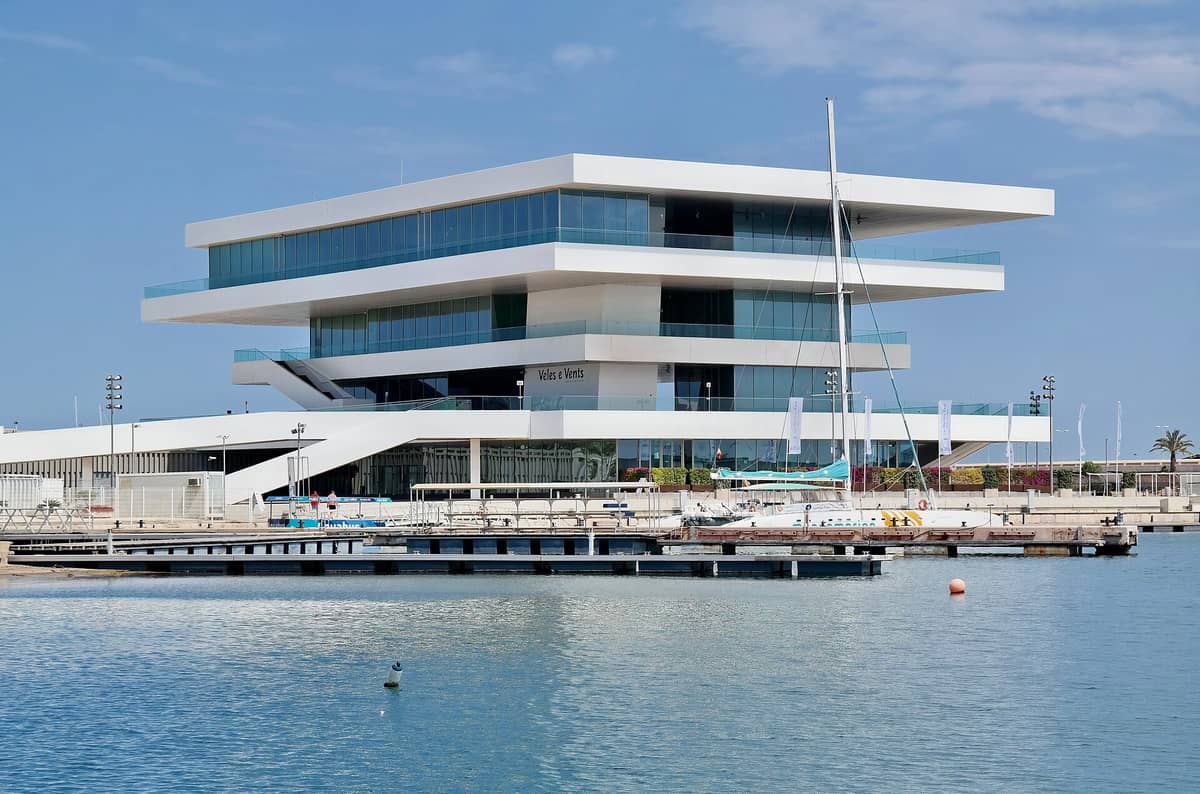
Designed by David Chipperfield and Fermín Vázquez for the 2007 America's Cup, Veles e Vents is a layered glass-and-concrete pavilion rising above Valencia's marina. Entry is free, the views across the Mediterranean are wide open, and the building itself is one of the most architecturally coherent structures built in Valencia this century.
Quick Facts
- Location
- Marina Real Juan Carlos I, Calle Muelle de la Aduana s/n, 46024 València
- Getting There
- Metro Line 8 (Marina Reial Joan Carles I / Neptú stop) and nearby Line 6 stops such as Grau-La Marina; also reachable by bike via the Turia Garden path
- Time Needed
- 30 to 60 minutes for the building and immediate waterfront
- Cost
- Free admission
- Best for
- Architecture lovers, photographers, evening walkers, design enthusiasts
- Official website
- veleseventsvalencia.es
What Is Veles e Vents?
Veles e Vents is a purpose-built pavilion at the edge of Valencia's working marina, completed in 2006 as the centrepiece for the 32nd America's Cup held in Valencia in 2007. The name, taken from a 15th-century poem by the Valencian writer Ausiàs March, translates roughly as 'sails and winds', a nod to both the city's seafaring history and the sailing competition it was built to host. It is also commonly referred to as the America’s Cup Building or Foredeck Building in many sources.
The architects were David Chipperfield, the British Pritzker Prize laureate known for rigorous, understated modernism, and Fermín Vázquez, a Barcelona-based architect whose work shares a similar restraint. Together they produced a building that avoids the showy excess of many regatta pavilions. At roughly 10,000 square metres across multiple levels, it reads from a distance as a series of cantilevered horizontal planes, each one offset from the last, creating deep shade bands that are as functional as they are visually striking.
ℹ️ Good to know
Opening hours are Monday to Sunday, 10:00 to 01:30. Entry is free. Note that these are publicly listed hours for general access; if you are visiting outside those hours for an event or private function, check directly with the venue.
The Architecture Up Close
Standing beneath Veles e Vents, the first thing you notice is the scale of the overhangs. Each floor plate extends significantly beyond the one below, creating deep covered terraces that face the sea. The structural logic is visible and satisfying: concrete frames carry the load while large expanses of glazing keep the interior visually connected to the water. There is no fussiness here, no decorative gesture for its own sake.
The ground level opens directly to the marina basin, where the smell of salt water and engine oil from the working boats mixes with the breeze off the Mediterranean. The pavement around the building is broad and mostly uncluttered, giving you space to step back and read the whole composition. From this angle the stacked terraces create a rhythm that changes as you move around the structure, never quite looking the same twice.
The upper terraces, accessible during opening hours, offer an unobstructed view across the Marina de València and out to the open sea. On clear mornings, the light is almost theatrical: low sun bouncing off the water while the building's white concrete planes glow against a deep blue sky. This is one of the better free viewpoints in the city, without the crowds that gather at more central spots.
Tickets & tours
Hand-picked options from our booking partner. Prices are indicative; availability and final rates are confirmed when you complete your booking.
Valencia Silk Museum tickets and audio guide
From 7 €Instant confirmationFree cancellationSaint Nicholas Church Entrance Tickets and Audioguide
From 11 €Instant confirmationHistoric Valencia walking tour
From 27 €Instant confirmationFree cancellationNatural thermal springs and Girlfriend Waterfall tour from Valencia
From 89 €Instant confirmationFree cancellation
How the Experience Changes Through the Day
Early morning, before 10:00 when the building opens, the marina is at its most atmospheric. Delivery crews move around the dock, and the light is soft and directional. You can walk the perimeter of the building and photograph it without other visitors in frame. The café terraces nearby are just setting up, and the area feels genuinely local rather than tourist-facing.
Midday in summer turns the concrete apron in front of the building into a heat reflector. The covered terraces inside become genuinely useful shade, and the breeze off the water makes them pleasant even in July. If you are visiting in summer, arriving at opening time (10:00) or later in the afternoon is noticeably more comfortable than the midday stretch.
The area around Veles e Vents changes character significantly through the day, but the building stays open to the public into the late evening on most days, so you can also plan a late-afternoon or night visit. The broader marina promenade stays lively into the evening, and the exterior of the building is worth seeing at dusk when the upper levels catch the last light.
⚠️ What to skip
The publicly listed opening hours are 10:00 to 01:30 daily. If you arrive expecting a specific event or terrace area to be open, you may find parts of the building reserved for private functions. The venue hosts conferences and corporate events regularly.
The America's Cup Context and What It Left Behind
The 2007 America's Cup was a turning point for Valencia's waterfront. The city invested heavily in infrastructure, transforming a largely industrial port edge into a public marina with restaurants, promenades, and new architecture. Veles e Vents was the centrepiece of that transformation. The competition itself was historic: Alinghi defended the cup against Emirates Team New Zealand, and Valencia became the first European city outside Cowes to host the event in its modern form.
What makes Veles e Vents more interesting than a typical event legacy building is that it has retained genuine use. It operates as an events and conference venue, which means it stays maintained and inhabited rather than becoming a monument to a moment that passed. The quality of the original construction is evident in how well it has aged: the concrete is clean, the glazing systems still work, and the terraces have not been cluttered with additions.
For context on how this waterfront development fits into the wider story of Valencia's modernisation, the Ciudad de les Arts i les Ciències complex tells a parallel story from the same era, with Santiago Calatrava's work representing a very different architectural philosophy. Visiting both in a single day gives you a useful comparison of how Valencia approached large-scale public architecture in the 2000s.
Getting There and Getting Around the Marina
Metro Lines 6 and 8 serve the marina area directly. From the city centre, the journey takes around 15 minutes. Alternatively, cycling is a genuinely pleasant option: the Turia Garden cycling route runs close to the seafront and connects the centre to the marina area without requiring you to ride in traffic. Valenbisi, Valencia's public bike scheme, has stations nearby.
The walk from the Malvarrosa beach strip to Veles e Vents along the marina promenade takes roughly 20 minutes and passes the main marina basin with its mix of sailing yachts, superyachts, and working vessels. It is a more interesting approach than arriving directly by metro if you have the time.
The immediate neighbourhood is Poblats Marítims, the collective name for Valencia's historic fishing and working-class maritime districts. It includes El Cabanyal, Canyamelar, and Cap de França. The contrast between the polished marina architecture and the narrow tiled streets a few blocks inland is one of the more interesting tensions in this part of the city.
Photography Notes and Practical Considerations
For photography, the building rewards a wide lens. The horizontal emphasis of the architecture is best captured from a low angle, either from the waterfront pavement or from the opposite side of the marina basin if you can access it. Morning light from the east hits the seaward face of the building directly, which is useful for architecture shots. Afternoon light wraps around the western elevation and creates more dramatic shadow play between the projecting floor plates.
There are no specific photography restrictions on the exterior. Interior photography during public access hours is generally tolerated, but the building does host private events, so common sense applies. Drone photography over the marina requires permits under Spanish aviation regulations and is not something you can do casually.
Regarding accessibility: the published sources do not include explicit wheelchair access details for Veles e Vents. The ground-level surroundings are flat and paved, but given the multi-level nature of the building, visitors with mobility requirements should contact the venue directly before visiting to confirm what is accessible.
Is It Worth Your Time?
Honestly, Veles e Vents is not a destination for everyone. If contemporary architecture does not interest you, and you are not drawn to marinas or waterfront walking, it will feel like a detour. There is no permanent exhibition inside, no museum narrative, no collection to see. What you get is a very well-designed building in a pleasant setting, free of charge, with good views.
For anyone interested in 21st-century architecture, it is one of the more satisfying buildings in Valencia, easier to appreciate in full than Calatrava's more theatrical structures. Combining it with a walk along the marina, a visit to the Playa de la Malvarrosa, and lunch in El Cabanyal makes for a coherent half-day that covers architecture, beach, and neighbourhood character without feeling rushed.
If you are building a broader itinerary around Valencia's architectural landmarks, the Valencia architecture guide covers the full range from Gothic to contemporary, which helps place Veles e Vents in useful context.
Insider Tips
- Arrive at 10:00 when the building opens. The marina is quiet, the light is good for photography, and you will have the terraces almost entirely to yourself.
- The building stays open for public access well into the evening. Do not assume it closes for the day at lunchtime; instead, check the latest hours if you are planning a specific interior visit, as private events can restrict access to some areas.
- The best view of the full building is from the far side of the marina basin, not from directly in front. Walk around the harbour edge for a broader perspective that shows all the cantilevered levels at once.
- Combine this visit with a walk into El Cabanyal, about 10 minutes north on foot. The contrast between the polished marina and the hand-painted azulejo tiles on the old fishermen's houses is striking and gives you a much fuller picture of this part of Valencia.
- In summer, the covered terraces are significantly cooler than the open waterfront. If you are visiting between June and September, use the building itself as a place to pause and cool down, not just to photograph.
Who Is Veles e Vents For?
- Architecture and design enthusiasts who want to see a coherent example of 21st-century modernism without paying an entrance fee
- Photographers looking for strong geometric subjects with water and sky as natural backdrops
- Walkers combining the marina promenade with a beach visit or a neighbourhood walk through El Cabanyal
- Travellers with a serious interest in the America's Cup legacy and Valencia's waterfront transformation
- Visitors who want a genuine viewpoint over the Mediterranean that does not involve climbing stairs or buying a ticket
Nearby Attractions
Other things to see while in Poblats Marítims & The Waterfront:
- Marina de València
La Marina de València is a sprawling public waterfront district built around Valencia's historic harbor, transformed into a leisure and cultural hub after hosting the 2007 and 2010 America's Cup. Covering roughly one million square metres of combined land and water — docks, promenades, and open plazas — it is free to enter and rewards visitors at almost any time of day.
- Playa de la Malvarrosa
Playa de la Malvarrosa is Valencia's signature city beach, stretching roughly 1,800 metres of fine golden sand along the Mediterranean coast. Free, accessible, and well-served by public transit, it draws everyone from early-morning swimmers to late-night terrace crowds. This guide covers what to expect, when to go, and what the tourist brochures leave out.
- Playa de las Arenas
Known officially as Playa del Cabanyal and popularly as Las Arenas, this broad sandy beach sits minutes from Valencia's city centre along Avenida Neptuno. Wide, gently sloping sands, a promenade lined with seafood restaurants, and easy tram access make it the default choice for a beach day without leaving the city.