Marina de València: Valencia's Reinvented Port District
La Marina de València is a sprawling public waterfront district built around Valencia's historic harbor, transformed into a leisure and cultural hub after hosting the 2007 and 2010 America's Cup. Covering roughly one million square metres of combined land and water — docks, promenades, and open plazas — it is free to enter and rewards visitors at almost any time of day.
Quick Facts
- Location
- Carrer del Moll de la Duana, s/n, 46024 València — Poblats Marítims district
- Getting There
- Bus lines and metro stops along Avenida del Puerto and the seafront connect the city centre to the port area; the marina sits at the seaward end of the avenue.
- Time Needed
- 1 to 3 hours depending on pace; longer if dining or attending an event
- Cost
- Free to enter as a public space; food, drink, and activities priced separately
- Best for
- Waterfront walks, architecture, sundowners, sailing culture, and weekend events
- Official website
- www.lamarinadevalencia.com
What Is La Marina de València?
La Marina de València is Valencia's historic harbor, radically reimagined after serving as the venue for the 32nd and 33rd America's Cup regattas in 2007 and 2010. During that period, the area was branded as Port America's Cup and later La Marina Real Juan Carlos I. Today it operates under its current name as a large, free-access public district combining active marina operations, restaurants, cultural programming, and open waterfront space. The scale is genuinely impressive: regional tourism sources describe the site at around one million square metres, making it one of the largest regenerated port spaces in Spain.
This is not a theme park or a single monument. It is a working port edge that has been partially opened to the public, and understanding that distinction helps set expectations correctly. Parts of the dock area remain industrial or nautical in function, while other sections have been developed into promenades, terraces, and event spaces. The result is a place that feels genuinely alive rather than artificially curated.
ℹ️ Good to know
La Marina de València is located by the seafront near the end of Avenida del Puerto. If arriving by car, turn left at the Clock Building (Edificio del Reloj) to access the marina zone. There is no admission charge for the public areas.
The America's Cup Legacy: Why This Place Looks the Way It Does
Before 2007, this stretch of Valencia's port was largely inaccessible to the public, a working freight and commercial dock with little reason for visitors to venture past the city's beaches. The city's successful bid to host the America's Cup changed that decisively. Infrastructure was built at speed: new pavilions, syndicate team bases, a landmark viaduct, and public walkways were installed to accommodate tens of thousands of spectators and the international sailing circus. Several of the distinctive white structures visible along the waterfront today date from that construction effort.
The most architecturally significant remnant is the Veles e Vents building, designed by David Chipperfield and Fermín Vázquez. Completed in 2006, it is a stacked series of cantilevered terraces facing the sea, and it remains one of the more quietly remarkable pieces of contemporary architecture in Valencia. The name translates roughly as 'sails and winds' in Valencian, a reference to a 15th-century poem by Ausiàs March. The building now operates as a restaurant and event venue rather than a race operations centre, but its form still reads clearly as something designed for watching boats from a distance.
For context on how this fits into Valencia's broader architectural landscape, the Valencia architecture guide covers everything from the Gothic silk exchange to Santiago Calatrava's futuristic science complex.
Tickets & tours
Hand-picked options from our booking partner. Prices are indicative; availability and final rates are confirmed when you complete your booking.
Valencia Silk Museum tickets and audio guide
From 7 €Instant confirmationFree cancellationHistoric Valencia walking tour
From 27 €Instant confirmationFree cancellationNatural thermal springs and Girlfriend Waterfall tour from Valencia
From 89 €Instant confirmationFree cancellationMontanejos guided hike with natural pools full-day tour from Valencia
From 45 €Instant confirmationFree cancellation
What You Actually See When You Walk Through
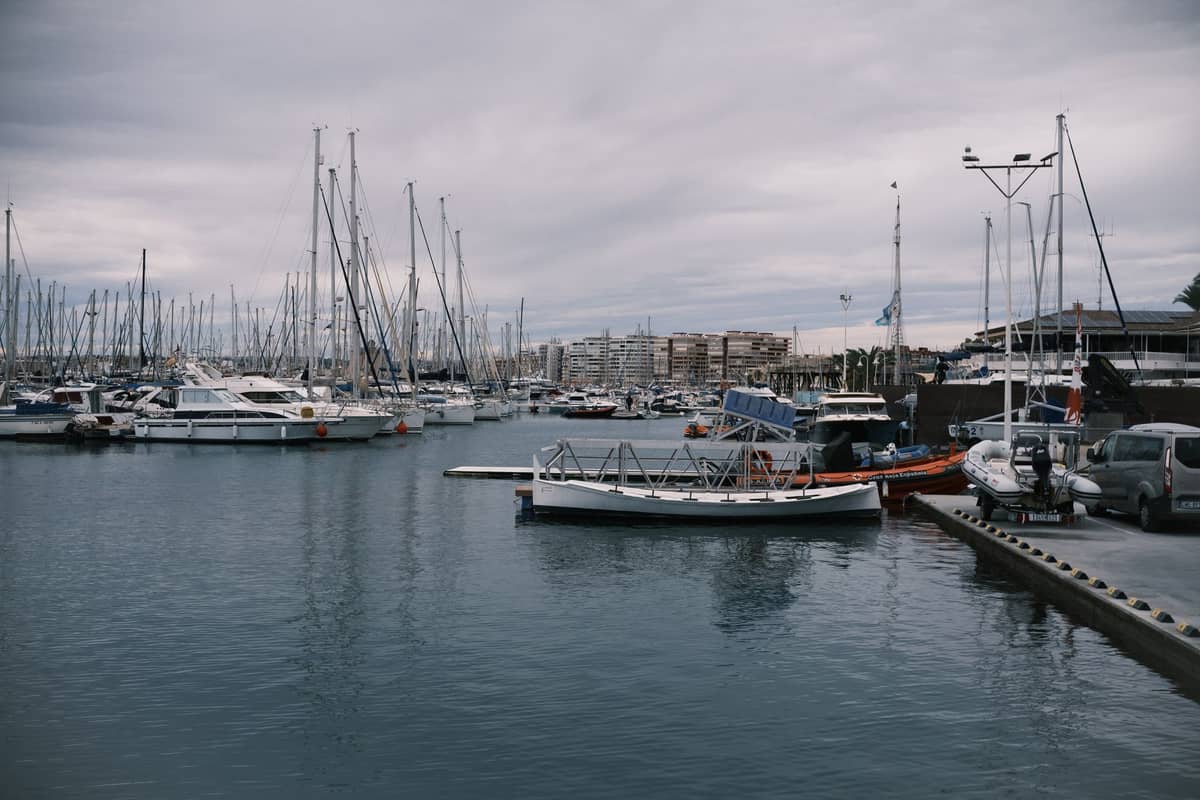
Arriving via Avenida del Puerto, the first thing you notice is the scale of the port infrastructure: cranes, container-handling equipment, and bulk storage facilities to the north. This is not the picturesque part. Continue past the Clock Building and the character shifts. The dockside becomes pedestrian-friendly, with wide paved walkways running alongside berths that hold everything from small sailing yachts to large motor cruisers. The smell of salt water and diesel is real and constant; on windy days, halyards clank against aluminum masts in a way that confirms you are somewhere working boats actually live.
The central zone around the former America's Cup base is where most visitors gravitate. The Veles e Vents building anchors the far end. Restaurants and bars occupy a series of low pavilions along the inner dock edge, with terrace seating that faces the water. On weekday mornings the area is calm, occupied mainly by people walking dogs along the breakwater or marina staff moving equipment. The terraces fill gradually from around noon, and by early evening the atmosphere shifts considerably.
The breakwater promenade, extending out toward the open sea, is worth the short walk. From the end of the breakwater on a clear day, the full arc of Valencia's coastline becomes visible: the beaches of Malvarrosa and Las Arenas to the north, and the longer undeveloped stretch toward Pinedo to the south. The light in the late afternoon, especially in spring and autumn, is particularly good here because you are looking westward back at the city skyline with the sun behind you.
How the Marina Changes Through the Day
Early morning visits, roughly 7:00 to 9:00, belong to local runners, cyclists, and fishermen. The cafes are not yet open, the terrace chairs are stacked, and the light on the water is flat and silver. This is the best time to photograph the Veles e Vents building without people in the frame and to appreciate the geometry of the moored boats against the dock structures.
Midday sees a mixed crowd: families, tourists walking from the nearby beaches, and workers from the port area grabbing lunch at the dock-facing restaurants. The sun reflects hard off the white dock surfaces and the water, so sunglasses and sun protection are genuinely necessary from late spring through early autumn. The heat between 13:00 and 16:00 in summer can be intense, and the lack of shade in the more open sections of the promenade becomes noticeable quickly.
⚠️ What to skip
In July and August, the exposed dock areas get very hot between noon and 4pm. Bring water, wear sun protection, and consider visiting in the early morning or after 6pm when the sea breeze picks up and temperatures drop noticeably.
Evenings, especially Thursday through Sunday, are when the marina shows its most social face. The restaurants fill by 21:00 in the Spanish dining rhythm, and the outdoor terraces stay occupied until late. During summer months, outdoor concerts, markets, and cultural events are regularly programmed in the open plazas. Checking the official marina website before visiting is worthwhile if you are hoping to catch something specific.
The Surrounding Neighborhood: Poblats Marítims
La Marina de València sits within the broader Poblats Marítims district, the collective name for Valencia's coastal neighborhoods including El Cabanyal, El Canyamelar, and La Malva-rosa. This context matters for visitors who want to understand what surrounds the marina.
The beaches of Playa de la Malvarrosa and Playa de las Arenas are accessible on foot heading north along the seafront from the marina, a walk of roughly 15 to 20 minutes. The neighborhood of El Cabanyal, with its distinctive modernist tiled facades and increasingly active restaurant scene, is a short walk inland.
Visitors spending a half-day in this part of Valencia might logically combine the marina with the beach and a meal in El Cabanyal. The best paella in Valencia is often debated, but the seafront restaurants in this district are among the most cited locations, with rice dishes cooked in full view of the Mediterranean.
Practical Information for Visitors
La Marina de València is a public space and entry to the promenades and dock walkways is free. Restaurants and bars operate on their own schedules, generally opening for lunch from around 13:00 and for evening service from around 20:00, with some terrace bars opening earlier in summer. The marina office itself operates on administrative hours (Monday to Tuesday 8:00 to 15:00 and 16:00 to 18:00, Wednesday to Friday 8:00 to 15:00) but this is not relevant for general visitors.
Getting there without a car is straightforward. Several EMT bus lines and metro stops connect the city centre to Avenida del Puerto and the marina area, and the journey from the historic centre takes around 15 to 20 minutes. Cycling is another practical option: the cycle path network that runs through the Turia Garden connects to the seafront, and bike rentals are available across the city. The dock walkways are wide and flat, making them accessible for pushchairs and wheelchairs, though the transition from road to dock edge in some sections involves kerb steps.
💡 Local tip
Photography tip: the Veles e Vents building photographs best from the water side, looking back toward the structure with the dock in the foreground. The late afternoon light from the west creates strong shadows across the cantilevered terraces. A wide-angle lens handles the full facade; longer focal lengths work better for isolating details of the rigging and boat reflections.
Parking is available in the port area but can be limited on summer weekends when events draw large crowds. The marina is reasonably well connected to Valencia's metro and bus networks, but the bus or bicycle remains a practical option for those arriving without a car. Ride-hailing services operating in Valencia can also drop at the marina entrance.
Honest Assessment: Is It Worth Your Time?
La Marina de València is not the most visually polished waterfront in Spain. It lacks the concentrated charm of smaller fishing harbors and does not offer the density of attractions found at the Ciudad de las Artes y las Ciencias. Parts of the dock area are functional rather than beautiful, and on a quiet weekday without an event scheduled, some sections feel a little empty. Visitors expecting a manicured promenade with continuous interest at every step may find it underwhelming.
What it does offer is a genuine sense of scale, an interesting architectural moment in the Veles e Vents building, good waterfront dining, and a distinctly non-touristy atmosphere by Valencia standards. It is the kind of place where you can sit on a breakwater wall with a beer watching boats come and go without feeling like you are in a managed tourist experience. For travelers who have already covered the historic centre and the science complex, it provides a different register of the city entirely.
Travelers with very limited time, say one or two days in Valencia, might reasonably prioritize the historic centre, the central market, or the beaches over the marina. But for anyone spending three or more days, or with a particular interest in sailing, port architecture, or contemporary urban regeneration, it earns its place on the itinerary.
The marina works particularly well as part of a broader day in the coastal neighborhoods. The guide to El Cabanyal covers the modernist architecture and food scene of the neighborhood immediately to the north, which pairs naturally with a marina visit.
Insider Tips
- The breakwater promenade extending out from the marina toward the open sea is underused by visitors and offers the best unobstructed views of the Valencia coastline. Walk to the very end on a clear day for an orientation point that no map quite replicates.
- Weekday mornings before 9:00 are the quietest time to photograph the Veles e Vents building and the moored yachts without crowds. The light from the east at that hour catches the water surface at a low angle.
- Check the official marina website (lamarinadevalencia.com) before visiting in summer. Outdoor music events, artisan markets, and cultural festivals are frequently programmed in the open plazas from June through September, and they significantly change the atmosphere.
- The restaurants closest to the dock entrance tend to be the most generic. Walk further into the marina complex, toward the Veles e Vents building end, for venues that have a stronger identity and better positioning relative to the water.
- If combining the marina with a beach visit, walk north along the seafront path rather than returning to the road. The pedestrian and cycle route runs directly from the marina to Playa de las Arenas and Playa de la Malvarrosa without crossing traffic.
Who Is Marina de València For?
- Architecture and design enthusiasts who want to see the Chipperfield-designed Veles e Vents building in context
- Travelers spending three or more days in Valencia who have covered the historic centre and want a different side of the city
- Evening visitors looking for waterfront dining and drinks with genuine maritime atmosphere rather than tourist-street settings
- Families with children who want open, flat space near the water without the formality of a ticketed attraction
- Cyclists following the coastal route who want a natural endpoint before heading back through the seafront promenades
Nearby Attractions
Other things to see while in Poblats Marítims & The Waterfront:
- Playa de la Malvarrosa
Playa de la Malvarrosa is Valencia's signature city beach, stretching roughly 1,800 metres of fine golden sand along the Mediterranean coast. Free, accessible, and well-served by public transit, it draws everyone from early-morning swimmers to late-night terrace crowds. This guide covers what to expect, when to go, and what the tourist brochures leave out.
- Playa de las Arenas
Known officially as Playa del Cabanyal and popularly as Las Arenas, this broad sandy beach sits minutes from Valencia's city centre along Avenida Neptuno. Wide, gently sloping sands, a promenade lined with seafood restaurants, and easy tram access make it the default choice for a beach day without leaving the city.
- Veles e Vents
Designed by David Chipperfield and Fermín Vázquez for the 2007 America's Cup, Veles e Vents is a layered glass-and-concrete pavilion rising above Valencia's marina. Entry is free, the views across the Mediterranean are wide open, and the building itself is one of the most architecturally coherent structures built in Valencia this century.